How to Check Who Owns an Online Casino
The casino name shown on the homepage is not always the company responsible for the site.
A brand may sit above a legal operator, license holder, white-label platform, payment company and wider group of sister casinos. That structure is not automatically unsafe. Many established gambling businesses use several companies for different operational roles.
The risk begins when those roles are difficult to identify.
Before depositing, a player should be able to confirm who operates the account, which company holds the license, whether the exact domain is authorised and where a formal complaint would go. Those details matter most when a withdrawal is delayed, verification expands or an account becomes restricted.
This guide explains how to check who owns an online casino without relying on the brand name alone. It also shows how to identify white-label structures, detect shared operators and separate useful evidence from weak ownership clues.
For broader regulatory context, the casino licensing guide explains how different licenses affect player protection, KYC and complaint rights.
Quick Ownership Check Before You Deposit
Start with four questions:
| What to Check | Where to Find It | Why It Matters | Main Warning Sign |
|---|---|---|---|
| Legal operator | Footer and Terms | Shows who runs the player account | No company is named |
| License holder | License details and regulator register | Shows which company is authorised | The domain is missing |
| Operating structure | Terms, legal policies and platform wording | Reveals white-label or group relationships | Responsibility remains unclear |
| Complaint route | Terms and complaints page | Shows where a dispute can be escalated | Support is the only route |
A clear result does not guarantee a perfect casino. However, it gives the player a legal trail to follow if the account, payment or verification process later becomes difficult.
The five-minute version
- Find the legal company in the footer.
- Confirm the same operator in the Terms and Conditions.
- Check the license holder in the regulator’s official register.
- Match the exact casino domain.
- Search the company for sister brands and complaint patterns.
When those five checks do not line up, pause before depositing.
Why Casino Ownership Matters When Money Is at Risk
Ownership can feel like a technical detail while registration and deposits work normally.
That changes when money needs to leave the casino.
A player may need to know:
- which company approved or delayed the withdrawal
- who controls identity and payment verification
- which entity applies the casino terms
- who holds the gambling license
- where a formal complaint should be sent
- whether the same operator runs other brands with similar issues
A polished interface cannot answer those questions. Neither can a large game library or a familiar payment logo.
Clear ownership gives the player a path from the public brand to the company responsible for the account. Weak ownership disclosure creates uncertainty precisely when the casino has more control over the balance than the player does.
That does not prove misconduct. Still, CasinoIndex treats unclear ownership as a meaningful risk signal because it weakens accountability before a dispute even begins.
The Casino Ownership Trust Chain
Casino ownership is easier to understand when the structure is divided into separate layers.
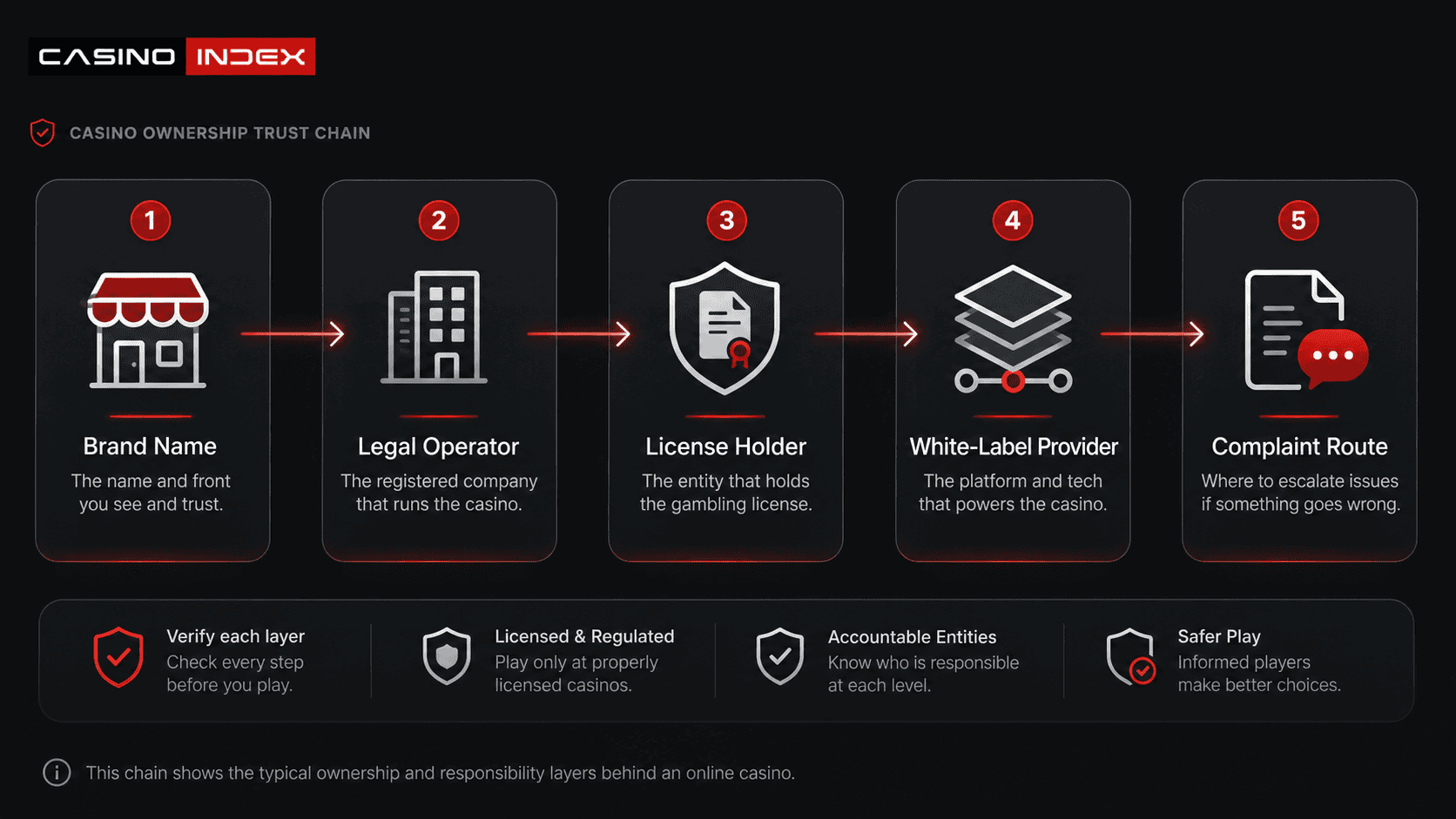
- Public brand: the casino name players see.
- Legal operator: the company that contracts with the player.
- License holder: the entity authorised by the regulator.
- Platform or white-label provider: the company supplying operational systems.
- Complaint route: the operator, regulator or dispute body responsible for escalation.
One company may control several layers. In other cases, different entities handle each role.
The number of companies is not the main issue. The important question is whether the relationship between them is visible and consistent.
What a clean trust chain looks like
- the footer names the legal operator
- the Terms use the same company
- the license register confirms the holder and domain
- any white-label relationship is understandable
- the complaints page identifies a formal escalation route
What a weak trust chain looks like
- the brand is visible but the operator is not
- different legal pages name unrelated companies
- the license belongs to another entity or domain
- support cannot explain who controls the account
- no company accepts clear responsibility for disputes
Step 1 — Check the Website Footer
The footer is the fastest place to begin.
Look for:
- the full legal company name
- registered address
- license number
- regulator or licensing authority
- restricted-country wording
- responsible gambling links
- Terms and Conditions
- complaints or dispute information
Specific legal wording is more useful than broad marketing claims.
Be cautious when the footer only says:
- “licensed and regulated”
- “internationally licensed”
- “powered by a licensed platform”
- “operated under gaming laws”
- “fully certified”
None of those phrases identifies who controls the player account.
Record the details before moving on
Write down the company, license number, regulator and domain. Keeping those details together makes mismatches easier to notice when you open the terms or regulator register.
Step 2 — Read the Opening Section of the Terms
The first legal paragraphs often provide the clearest ownership statement on the site.
Look for language such as:
- “this website is operated by”
- “these terms form an agreement between”
- “the gaming services are provided by”
- “the license holder is”
The terms should help identify who runs the website, who contracts with the player and which law applies.
Compare the company with the footer
A small variation in the company name may reflect an abbreviation or trading name. A completely different entity needs an explanation.
Possible reasons include:
- a white-label arrangement
- a parent and subsidiary relationship
- a separate license holder
- a payment-processing company
- outdated or copied legal text
The first four can be legitimate. The last one is a serious quality warning.
Check which company controls the player agreement
The most useful ownership detail is not always the ultimate parent company. For a player, the key entity is usually the company responsible for the account, balance, terms and dispute process.
Step 3 — Verify the License Holder and Exact Domain
A license badge is only a starting point.
Open the regulator’s official register independently and compare the casino’s claims with the record.
Confirm:
- the legal license holder
- license or certificate number
- current status
- authorised gambling activity
- brand or trading name where available
- the exact casino domain
A real license held by the correct company can still be irrelevant when it does not cover the website being used.
Check the license type
A software supplier, platform provider or B2B approval is not the same as a player-facing casino authorization.
The practical question is:
Which licensed company is legally responsible for the player account and withdrawal?
Use the dedicated walkthrough on how to verify a casino license when the register, company or domain relationship is unclear.
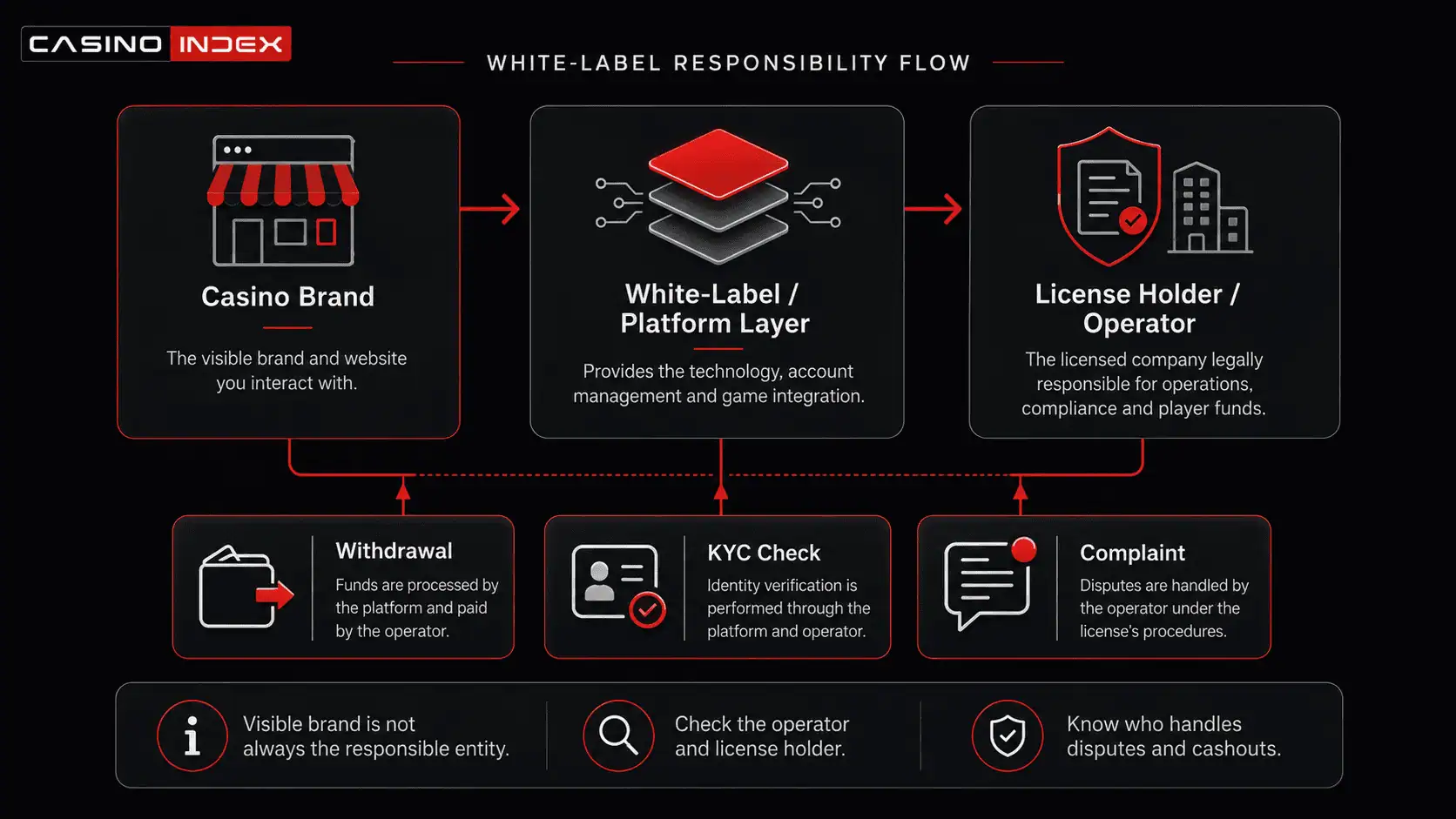
Step 4 — Identify White-Label Ownership
A white-label casino uses infrastructure supplied by another gambling company.
The provider may handle some or all of the following:
- casino platform and back office
- license access or regulatory systems
- payment processing
- KYC and compliance tools
- game integrations
- customer support
- risk and fraud controls
The public brand may still control marketing, design or customer acquisition.
White-label does not automatically mean unsafe
Many legitimate casinos use shared infrastructure. The risk depends on transparency and operational quality.
A cleaner structure explains:
- which company operates the player account
- which company holds the license
- which domain is authorised
- who handles withdrawals and KYC
- where complaints can be escalated
A weaker setup lets responsibility move between the brand, platform and “relevant department” without identifying who has final authority.
The separate guide to what white-label casino ownership means explains how this model can affect withdrawals, support and complaint handling.
Step 5 — Check for Sister Brands and Shared Operators
Once the company or license holder is known, search for other brands connected to it.
This can reveal useful operating history when the casino itself is new.
Search using:
- the full legal company name
- license number
- registered address
- complaints email address
- privacy-policy contact details
- distinctive terms wording
Strong evidence of a shared operator
| Signal | What It Can Show | Reliability |
|---|---|---|
| Same legal operator | The brands contract through the same company | Strong |
| Same license and address | The brands likely sit within the same licensed structure | Strong |
| Same complaint contact | Disputes may be handled by the same team | Moderate to strong |
| Identical legal policies | The sites may share an operator or white-label provider | Moderate |
| Similar design or games | The sites may use the same platform | Weak on its own |
Do not assume common ownership from design alone. Many unrelated brands use the same themes, game providers or platform templates.
CasinoIndex explains how to detect shared casino operators using stronger legal, licensing and policy evidence.
Why sister-brand history matters
A shared operator can provide context about payment behavior, KYC practices and complaint handling.
However, the connection should not be used to claim that every brand behaves identically. Sister casinos may use different management teams, markets, payment providers or terms.
The correct approach is to treat related-brand evidence as context, not automatic proof.
Step 6 — Compare Every Important Legal Page
Do not rely on one ownership statement.
Compare the:
- footer
- Terms and Conditions
- Privacy Policy
- AML and KYC Policy
- bonus terms
- responsible gambling page
- complaints page
Different companies may appear for legitimate reasons. For example, the Privacy Policy may name a data controller, while a payment page identifies a processing partner.
The main operator should still remain clear.
Look for unexplained inconsistencies
- different operators in the footer and terms
- another casino’s name in a legal document
- an old company that no longer holds the license
- broken license or complaints links
- no registered address
- no governing law
- no route for formal disputes
Copied or poorly maintained legal pages do not prove that a casino will refuse payments. They do show weak operational control in an area that directly affects player rights.
Step 7 — Research Company History and Complaint Patterns
Search the operator rather than only the casino brand.
Useful searches combine the company name with:
- casino
- withdrawal
- complaint
- KYC
- blocked account
- license
The goal is not to find one angry comment. It is to see whether several brands or players describe the same unresolved process.
Patterns that deserve attention
- withdrawals repeatedly stall at the same stage
- KYC requests expand after larger wins
- several brands use the same unclear terms clause
- accounts are restricted without explaining the balance
- the same complaints address produces no useful resolution
One complaint does not prove operator-wide misconduct. Repeated, well-documented cases carry more weight.
Use the CasinoIndex framework for reading casino complaint patterns before drawing conclusions from public reports.
Step 8 — Use WHOIS as Supporting Evidence Only
WHOIS records can show the domain registration date, registrar and sometimes ownership details.
Many legitimate businesses use privacy protection. Hidden WHOIS data alone is not evidence of a scam.
It becomes more relevant when combined with other weaknesses, such as:
- no legal company on the casino website
- a very recent domain despite claims of long operating history
- frequent domain changes
- no matching license record
- no public history for the operator
WHOIS should confirm or challenge the casino’s legal story. It should not replace the footer, terms or regulator register.
Owner, Operator and License Holder Are Not the Same
| Role | Typical Responsibility | Why Players Should Care |
|---|---|---|
| Parent or ultimate owner | Controls the wider corporate group | Provides group history and accountability context |
| Legal operator | Runs the player account and applies the terms | Usually the most important company in a dispute |
| License holder | Holds regulatory authorization | Connects the casino to official oversight |
| White-label provider | Supplies platform, compliance or cashier systems | May influence KYC, payments and support |
| Payment processor | Handles deposits or withdrawals | May appear on bank statements without owning the casino |
| Data controller | Controls personal-data processing | May differ from the gambling operator |
Players do not need to map every shareholder.
They do need to identify who is responsible for the account, balance, verification process and formal complaint.
Ownership Red Flags That Should Change the Decision
| Red Flag | Why It Matters |
|---|---|
| No legal operator | The player cannot identify who runs the account |
| License badge without a match | The authorization may not cover the site |
| Different unexplained companies | Responsibility becomes difficult to follow |
| Domain missing from the license | The exact website may not be authorised |
| Copied or outdated legal pages | The operator may not maintain basic compliance information |
| Hidden white-label relationship | The brand may avoid explaining who controls key decisions |
| No complaint route | External escalation may be unavailable |
| Support cannot name the operator | The player may receive even less clarity during a dispute |
One weak detail may have an innocent explanation. Several connected red flags should reduce the amount of trust placed in the casino.
For a large intended deposit or balance, unclear ownership can be enough reason to choose another operator.
Why Ownership Matters Most During Withdrawals and Disputes
Ownership becomes practical when a casino delays a payment, requests additional documents, freezes an account or applies a disputed rule.
The player needs to know:
- which company made the decision
- which terms govern the account
- who reviews an appeal
- whether the regulator covers the domain
- where evidence should be submitted
A clear structure does not guarantee that the player will win the dispute. It creates a defined route for challenging the decision.
When ordinary support stops helping, the guide to how online casino dispute resolution works explains internal complaints, regulators and other escalation routes.
Payment processors do not necessarily own the casino
A bank statement may show a payment company rather than the legal operator. That alone does not prove hidden ownership.
Still, the casino should explain how the payment entity connects to the account and what happens when a refund or withdrawal issue appears.
A Practical 10-Minute Ownership Check
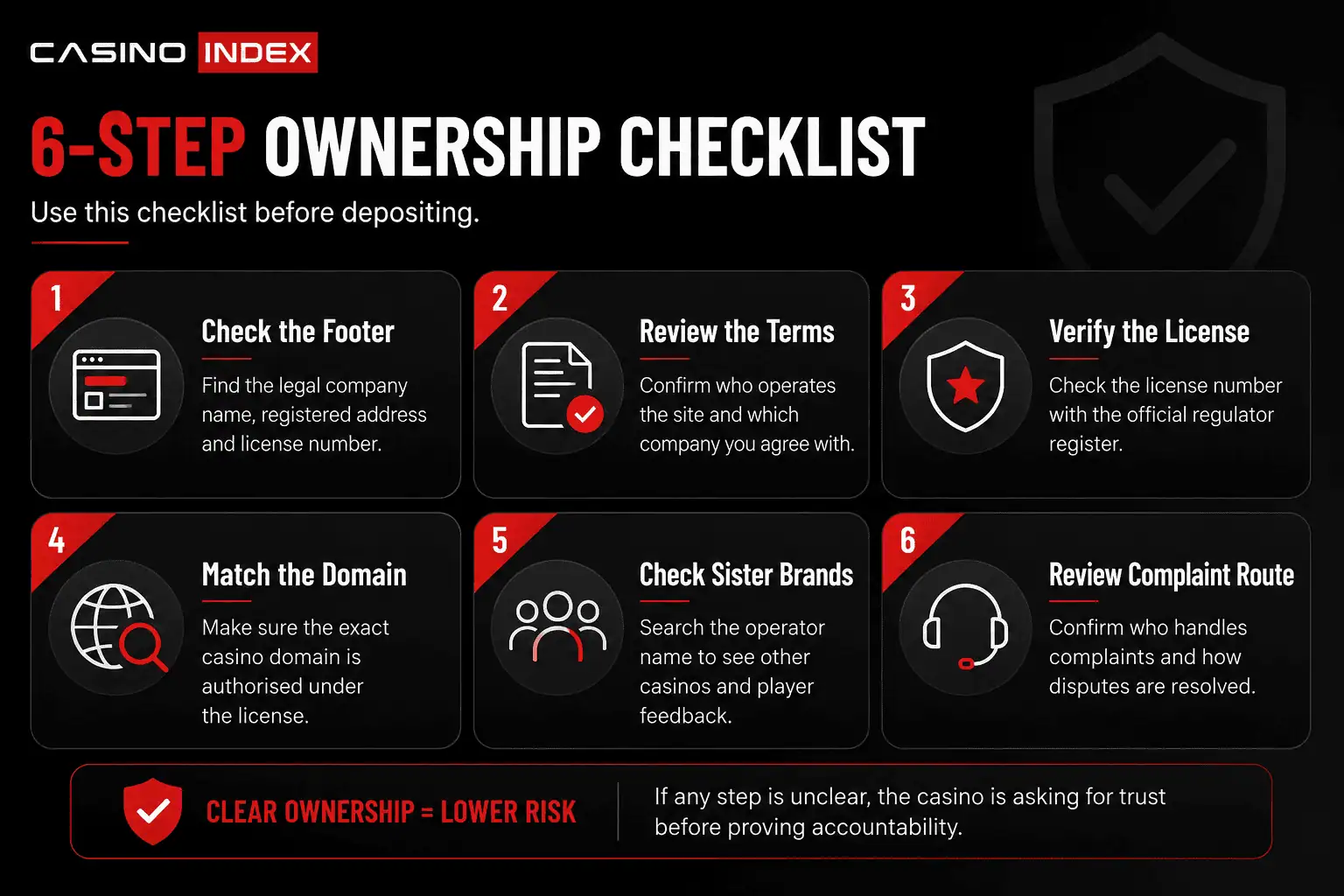
- Record the legal company shown in the footer.
- Confirm the operator in the Terms and Conditions.
- Find the regulator and license number.
- Search the regulator’s official register.
- Match the exact casino domain.
- Check whether the site uses a white-label structure.
- Search the operator and license number for sister brands.
- Compare the Privacy, AML, KYC and complaints pages.
- Review recent operator-level complaint patterns.
- Decide whether the structure is clear enough for the planned deposit.
This check cannot guarantee a smooth experience. It can prevent the player from relying on a brand that has not shown who is accountable.
What to Do When You Cannot Find the Owner
Ask support direct questions:
- What is the full legal name of the casino operator?
- Which company holds the gambling license?
- What is the license number?
- Does the authorization cover this exact domain?
- Which company handles formal complaints?
A serious support team should be able to point to the relevant legal page or regulator record.
Replies such as “we are fully licensed” or “our legal department handles that” do not answer the question.
When the operator remains hidden after a direct request, the casino has not provided enough accountability for a real-money deposit.
The broader safe online casino guide explains how to combine ownership with payment, KYC, security and complaint checks.
How CasinoIndex Uses Ownership in Reviews
CasinoIndex treats ownership as part of the wider trust assessment rather than a simple yes-or-no field.
A useful review should explain:
- the legal operator and license holder
- whether the exact domain can be verified
- any material white-label relationship
- relevant sister-brand history
- who controls withdrawals and account reviews
- where complaints can be escalated
The review should also separate confirmed corporate links from inferences based only on design, platform similarities or copied wording.
This evidence-first standard is part of what makes a casino review reliable.
FAQ: Checking Who Owns an Online Casino
How do I find the company behind an online casino?
Start with the footer and the opening section of the Terms and Conditions. Record the legal operator, license holder, registered address and license number. Then compare those details with the official regulator register.
Is the casino brand always the owner?
No. The public brand may be operated by a separate legal company or through a white-label platform. The company responsible for the player agreement matters more than the brand name.
Does a casino license prove ownership?
Not completely. A license can identify the authorised company, but the player must still confirm that the exact casino domain and relevant gambling activity are covered.
Are white-label casinos automatically risky?
No. The model itself is common. Risk rises when the casino does not explain which company operates the account, controls withdrawals or handles complaints.
How can I tell whether two casinos share an operator?
Compare the legal operator, license number, registered address, complaints contact and legal policies. Similar design or game libraries are weak evidence on their own.
Can a payment company be the casino owner?
It can be related to the operator, but a payment descriptor alone does not establish ownership. Check the casino terms and license record before drawing that conclusion.
Is hidden WHOIS information a warning sign?
Not by itself. Many legitimate businesses use domain privacy. It becomes more relevant when the casino also hides its legal operator, lacks a license match and has no credible operating history.
Should I avoid a casino when the owner is unclear?
Yes, particularly when planning a meaningful deposit. Unclear ownership gives the player fewer ways to challenge payment, verification or account decisions.
Why do sister brands matter?
They can reveal a longer operator history than the current casino brand shows. Repeated issues across connected brands may provide useful risk context, but each casino still needs its own evaluation.
What is the strongest ownership warning sign?
The strongest warning is a broken legal chain: the footer, terms, license record and casino domain point to different entities without a clear explanation.
Final View: Follow the Company Behind the Brand
Checking who owns an online casino is not a corporate research exercise. It is a practical way to find out who controls the account and who must answer when something goes wrong.
The strongest ownership trail connects:
brand → legal operator → license holder → authorised domain → complaint route.
White-label structures and sister brands can add complexity without automatically making a casino unsafe. The deciding factor is whether the structure remains transparent and verifiable.
Before depositing, confirm the company, match the license, verify the domain and review the operator’s wider history.
The brand is the front door. The legal structure shows who is responsible once your money is inside.

Maria Hoffmann has worked in cryptocurrency content and digital publishing since 2017. She is a co-founder of Freecoins24 and CryptoMutant and has covered blockchain projects, crypto platforms and emerging industry trends for several years. She has also been active as a cryptocurrency investor since 2019. At CasinoIndex, Maria combines content research and SEO experience with a focus on casino trust, platform security, withdrawal processes, payment risks and user protection. Her work looks beyond bonuses and product features to examine how gambling platforms handle player funds, verification and account-related risks.