What a White-Label Casino Really Means for Players
How a White-Label Casino Changes the Player’s Risk
A white-label casino is not automatically unsafe. The model becomes a problem when the brand is visible but responsibility is not.
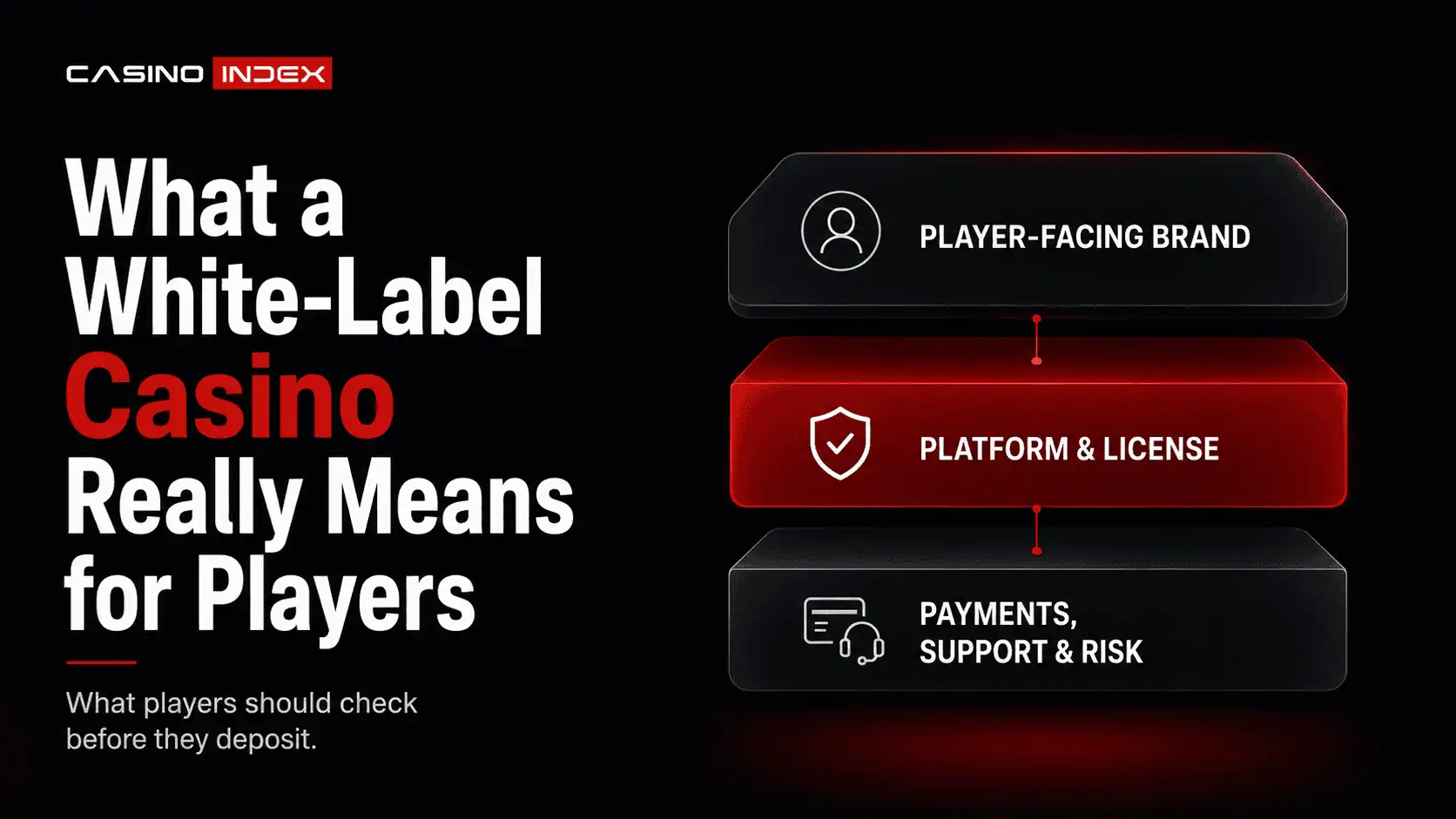
A casino can have its own name, design, promotions, game lobby and support chat while relying on another company for the platform, licensing structure, payment tools, compliance systems or account controls.
That arrangement may work well. Established platform infrastructure can give a smaller brand stable technology, familiar games and structured security processes. However, the player still needs a clear answer to one question:
Who is responsible when a withdrawal, verification review or account dispute begins?
The answer should not require guesswork. Before depositing, the legal operator, license holder, covered domain, complaints process and withdrawal responsibility should all be understandable.
This guide explains what a white-label casino really means, where shared infrastructure can help, when responsibility becomes blurred and how to investigate the structure before trusting the brand with money.
What Is a White-Label Casino?
A white-label casino is a player-facing gambling brand built on technology and operational services supplied by another business.
The visible brand may control its marketing, design, promotions and positioning. Behind it, a platform provider or operator network may supply some or all of the following:
- casino software and account systems
- game-provider integrations
- payment and cashier tools
- KYC and fraud controls
- compliance workflows
- responsible gambling tools
- risk-management rules
- reporting systems
- support infrastructure
- licensing support or legal structure
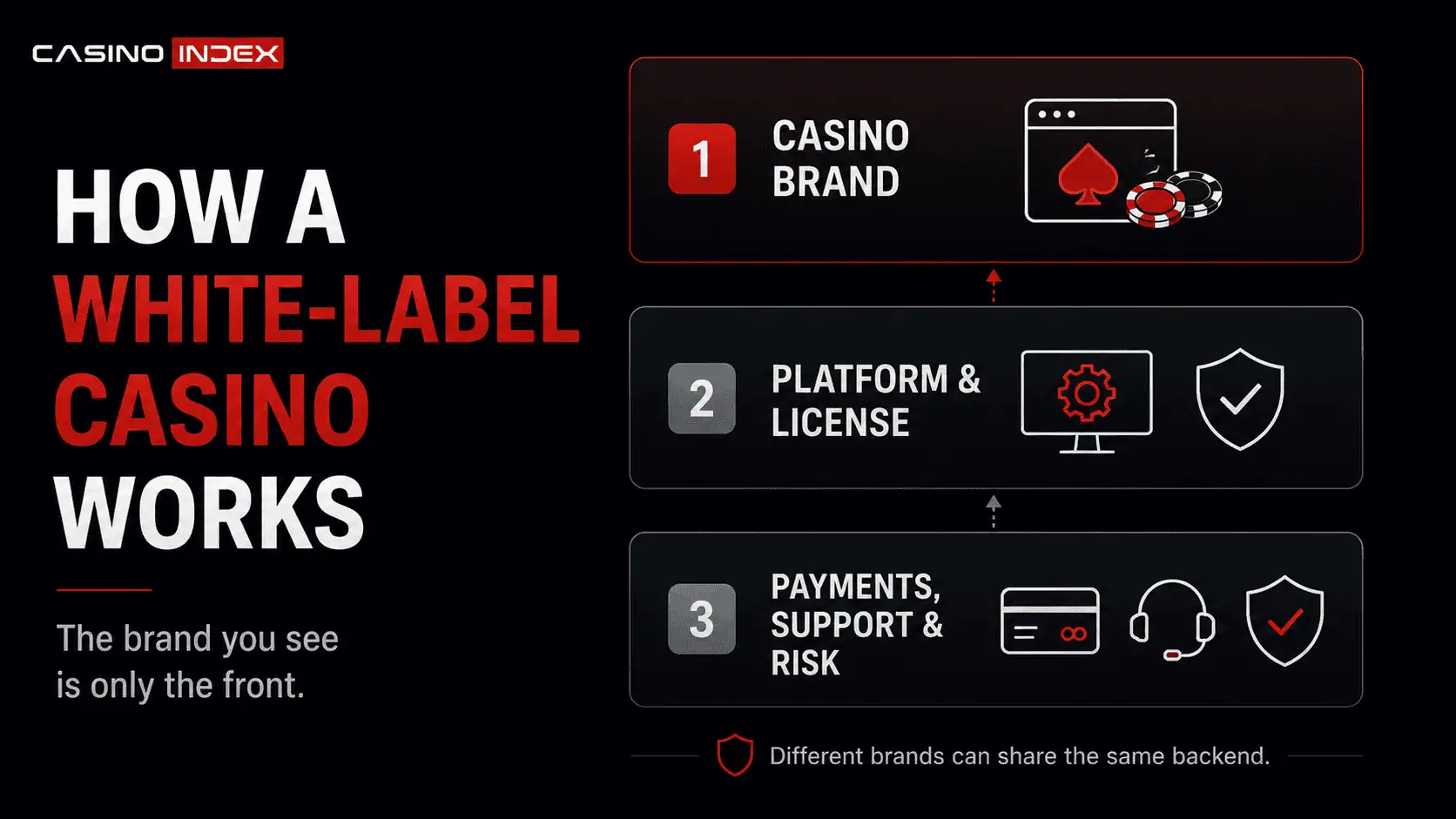
This explains why two casinos can look different but behave in similar ways. They may share the same cashier logic, identity checks, bonus wording, support scripts or account-review system.
Shared systems do not prove shared ownership. Many unrelated casinos use the same game providers and payment processors. The important task is to identify which company controls the player account and which entity carries legal responsibility.
Which Parts of the Casino May Be Shared?
White-label arrangements vary. One brand may outsource only the platform, while another relies on a larger group for almost every operational function.
| Layer | What May Be Shared | What the Player Should Confirm |
|---|---|---|
| Technology | Website platform, account tools and game integrations | Whether the site is stable and account records remain accessible |
| Licensing | Licensed company, regulatory framework or approved domain structure | Which entity holds the license and whether the exact domain is covered |
| Payments | Cashier, payment routing and withdrawal-processing tools | Who approves withdrawals and which payment rules apply |
| Compliance | KYC, payment ownership, fraud and source-of-funds reviews | Which team runs the review and how the player can complete it |
| Support | Shared agents, ticketing systems or outsourced service | Whether support can give case-specific answers and escalate disputes |
| Terms | Bonus, account, country and payment clauses | Whether the rules match the visible brand and current operator |
The more operational layers a brand shares, the more important clear company and responsibility information becomes.
White-Label Does Not Mean Unsafe by Default
Calling every white-label casino unsafe would be inaccurate.
A smaller brand can benefit from an established platform that already has tested payment tools, security controls and game integrations. In some cases, that infrastructure may be stronger than the systems used by a fully independent operator.
Potential advantages include:
- stable platform technology
- established account and cashier systems
- faster integration of recognized game providers
- existing fraud and payment controls
- structured compliance processes
- responsible gambling tools
- central reporting and security functions
None of those advantages removes operator risk. Good infrastructure can support fair account handling, but it cannot guarantee that a particular brand has clear terms, useful support or reliable withdrawals.
The safer distinction is not independent versus white-label. It is:
transparent responsibility versus hidden responsibility.
Start With the Legal Operator, Not the Brand Name
The public casino name is mainly a marketing identity. The legal company is the entity that matters during licensing, payments, data handling and disputes.
Check the following pages:
- website footer
- terms and conditions
- privacy policy
- responsible gambling page
- complaints policy
- license or legal-information page
Record the company names, addresses and license details that appear. A normal structure may involve more than one entity, but the relationship should make sense.
For example, one company may own the brand while a licensed operating entity provides gambling services. A separate payment processor may appear on the bank statement. That is not automatically suspicious.
Concern rises when:
- the footer and terms name different operators without explanation
- the privacy policy names an unrelated business
- the license belongs to a company that is not connected to the brand
- support cannot identify the legal operator
- the complaints process does not state who makes the final decision
CasinoIndex explains how to check who owns an online casino, including company records, terms, license entries and other ownership signals.
Why Licensing Still Matters With White-Label Casinos
A shared platform does not reduce the need for a verifiable license.
The license may belong to the visible brand, an operating company or a platform-related entity. Any of those structures can be legitimate when the relationship is clear and the authorization covers the casino being used.
Before depositing, confirm:
- the regulator
- the licensed legal company
- the license number and current status
- the exact casino domain
- the activity covered by the license
- the complaint or dispute route
A real license is weaker evidence when the domain is missing or the company in the register does not match the casino terms.
The broader why licensing still matters with white-label casinos analysis explains how regulatory quality, domain coverage and enforcement affect practical player protection.
Verify the license independently
Do not rely only on a footer badge. Open the regulator’s official register and search the company, license number and domain.
The CasinoIndex guide to verifying whether an online casino license matches the operator and domain provides a step-by-step check.
Who Actually Controls Withdrawals?
Withdrawals are where a shared-platform structure becomes most important.
The visible casino may manage the player relationship, while a central risk or compliance team reviews the request. Payment tools may come from the platform, and a third-party processor may move the funds after approval.
Possible checks include:
- identity and age verification
- payment ownership
- country eligibility
- bonus and wagering activity
- duplicate or linked accounts
- wallet or transaction risk
- source-of-funds review
- account-security concerns
None of these checks proves unfair treatment. The problem begins when the casino cannot explain who is reviewing the case, what is required or how the player can move the request forward.
What a stronger payout process looks like
A clearer operator explains:
- the current withdrawal stage
- the reason for the review
- the document or action required
- whether the review is handled by the brand or a central team
- the normal next step
- where a complaint can be escalated
When responsibility becomes blurred
Risk rises when the brand says the platform or payment provider is responsible but gives the player no contact or appeal route.
The casino accepted the deposit under its own name. It should remain able to explain the withdrawal process even when another team performs the technical review.
Players can review what casinos check before approving a withdrawal before testing a new platform.
KYC Responsibility and Support Quality
White-label casinos often use shared verification tools. This can make document handling more consistent across related brands, but it can also produce generic communication when the support team does not understand the underlying review.
A reasonable KYC process should keep requests relevant to the identified issue.
For example:
- identity concerns should lead to identity documents
- address checks should focus on recent proof of address
- payment ownership should focus on the method used
- source-of-funds concerns should be explained as a separate review
A weak process repeatedly asks for documents without identifying what remains unresolved.
Support does not need to disclose confidential fraud controls. However, it should tell the player which type of review is taking place and what action is needed.
CasinoIndex explains what a fair casino KYC process looks like and when repeated or unrelated requests become a warning sign.
Sister Brands and Shared-Operator Risk
Several casino brands may share an operator, license holder or platform. That relationship matters because operational problems can appear across more than one site.
One complaint against one casino does not prove that every related brand has the same problem.
A repeated pattern deserves more attention. Examples include:
- similar withdrawal delays across related sites
- the same KYC complaints at the same payout stage
- identical bonus-confiscation disputes
- accounts restricted after similar activity
- the same generic support language
- the same company and license across several brands
- complaints transferred between the same internal teams
The useful question is not whether the websites share a visual template. It is whether the same company or operational system appears behind the decisions that affect money.
Use how to tell if two casino brands share the same operator to compare company names, license records, terms, support details and payment clues.
Read patterns, not isolated accusations
Related-brand research should remain evidence-based. Similar logos or identical game lobbies do not prove common ownership.
A reliable review connects operator information with withdrawals, terms and public complaint outcomes. CasinoIndex explains that standard in what makes a casino review actually reliable.
Bonus, Linked-Account and Country Risks
Shared operator networks can use similar account and promotional rules across several brands.
Important terms may cover:
- duplicate accounts
- multiple accounts across related brands
- shared households or devices
- payment methods used on another account
- bonus eligibility across sister casinos
- maximum-bet and restricted-game rules
- VPN use and location restrictions
- linked-account investigations
Some restrictions are legitimate fraud and promotion controls. The risk comes from broad wording that is difficult to understand before deposit but enforced strictly after a win.
Before claiming a promotion, check whether the terms define “related brands,” “linked accounts,” “casino group” or similar language.
The guide to which casino terms matter before depositing covers the clauses most likely to affect withdrawals and account reviews.
How to Check Whether a Casino Uses a White-Label Structure
A casino may never use the words “white-label.” The structure must often be identified through several smaller signals.
1. Compare the legal pages
Check whether the footer, terms, privacy policy and complaints page name the same company or clearly explain the different entities.
2. Search the license record
Note whether the same licensed company appears behind several domains or brands.
3. Review support and contact details
Shared support emails, postal addresses or complaint contacts can suggest a wider network. They are clues, not proof on their own.
4. Compare account and bonus wording
Unusually similar terms, identical limits and the same account-review language may point to a common operating structure.
5. Look at payment information
A card or bank statement may show the legal merchant or payment descriptor. Do not publish sensitive transaction information, but compare the company name with the casino’s legal pages.
6. Check complaints across brands
Search the legal company, license holder and complaint contact—not only the public casino name.
7. Ask support a direct question
Ask which company operates the casino and whether other brands share the same license or account system.
Support may not provide a full group chart. It should still be able to identify the legal operator and complaint route.
White-Label Casino Risk Checklist
Use this table as an early filter before sending money.
| Check | What to Confirm | Stronger Sign | Warning Sign |
|---|---|---|---|
| Operator | Legal company in the footer and terms | The structure is named clearly | Different companies appear without explanation |
| License | License holder, status and activity | The record matches the operator | The license belongs to an unrelated entity |
| Domain | The exact website address | The domain is listed or validated | Only a similar domain is covered |
| Withdrawals | Approval rules and escalation | The review stage and next step are explained | Support repeats “internal review” without context |
| KYC | Verification triggers and document process | Requests are relevant and specific | Requirements expand without a clear reason |
| Support | Ownership and complaint answers | Agents identify the responsible company or team | Responsibility is passed to an unreachable provider |
| Related brands | Operator network and public patterns | Connections are traceable and issues are resolved | The same unresolved problem repeats across brands |
| Terms | Bonus, country and linked-account rules | Important restrictions are specific | Broad discretion appears around winnings and closures |
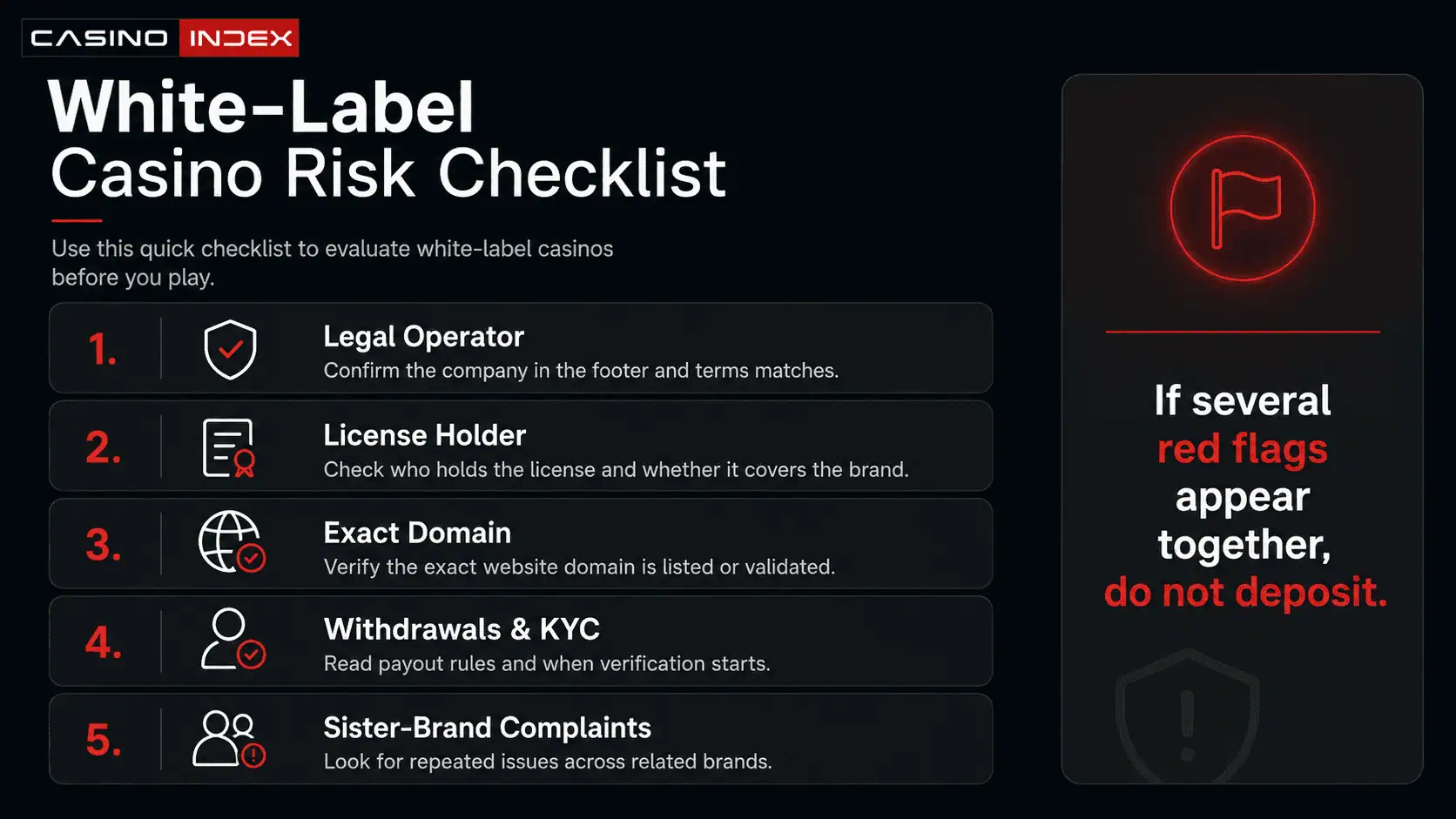
One weak signal may have an innocent explanation. Several connected warning signs are more important than a single unusual detail.
Stronger and Weaker White-Label Signals
| Area | Stronger Trust Signal | Weaker Risk Signal |
|---|---|---|
| Ownership | The legal operator is easy to identify | The company structure is hidden or inconsistent |
| License | The company and domain match an active record | The badge is generic, expired or mismatched |
| Terms | Legal pages tell the same story | Different entities and rules appear across pages |
| Withdrawals | Review reasons and required actions are clear | The payout remains under an undefined review |
| KYC | Requests match the identified issue | New documents appear after each submission |
| Support | Agents give specific answers and escalation routes | Agents blame another company but offer no next step |
| Related brands | Network connections are transparent | Shared ownership is hidden until a dispute starts |
| Complaints | Issues appear isolated and receive visible resolutions | The same payout or account problem repeats |
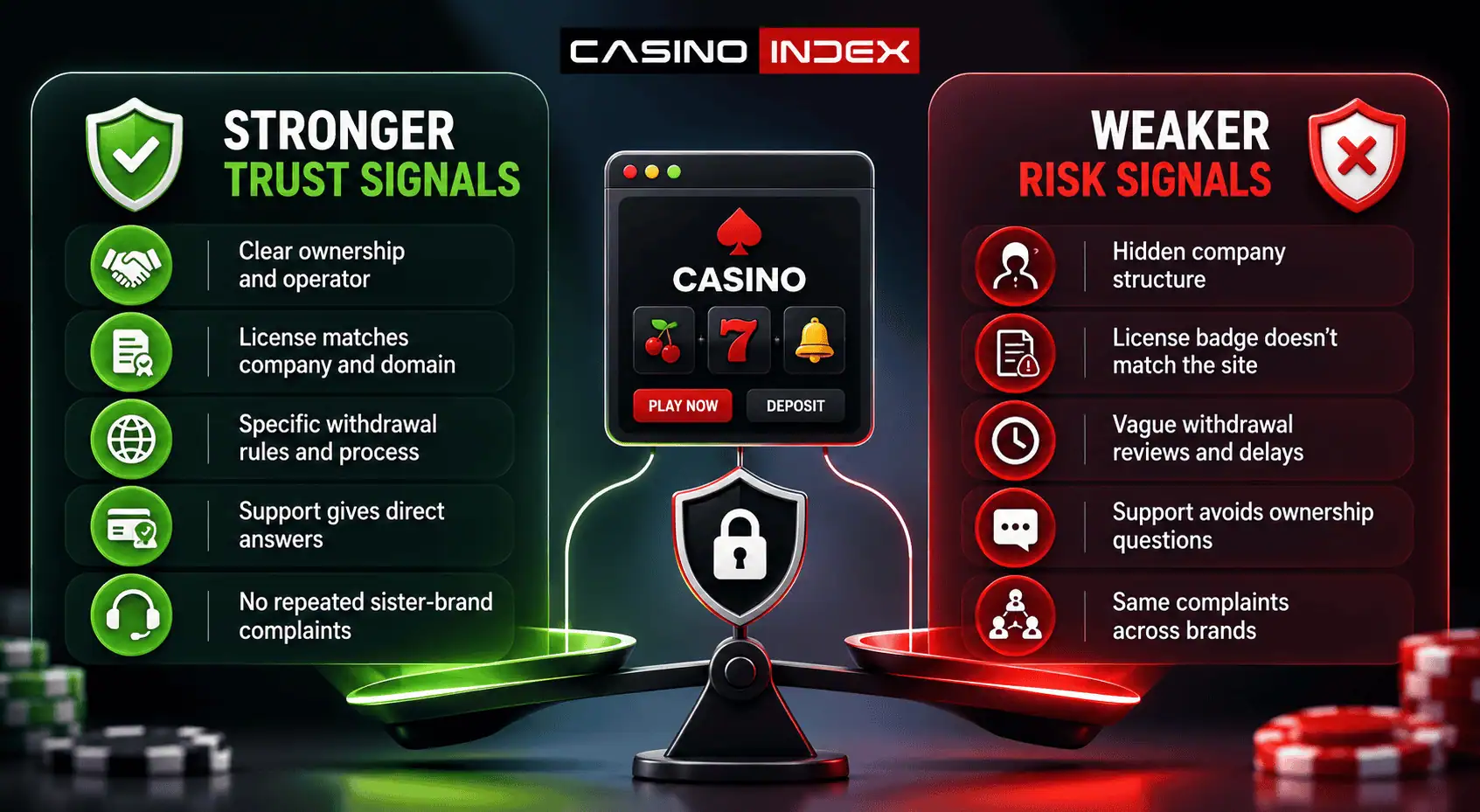
These signals support a risk judgment. They do not prove that every player will receive the same outcome.
How CasinoIndex Evaluates White-Label Casinos
CasinoIndex does not reduce the evaluation to a yes-or-no white-label label.
The analysis focuses on the parts that affect real money:
Operator transparency
Can the player identify the company responsible for the account without searching through contradictory legal pages?
License clarity
Does the authorization match the operator, domain and gambling activity?
Withdrawal responsibility
Can the casino explain who reviews payouts and how a delayed request can be escalated?
KYC timing and relevance
Are verification triggers understandable, and do document requests remain connected to the identified risk?
Related-brand evidence
Do sister casinos show a repeated payment, account-block or bonus-dispute pattern?
Terms consistency
Do the footer, terms, privacy policy, license information and complaints process align?
Support under pressure
Does support provide case-specific information when money is involved, or does responsibility disappear behind generic replies?
A transparent white-label operator can perform well under this framework. A brand that uses shared infrastructure to obscure responsibility should receive a higher risk assessment.
When a White-Label Casino May Be Acceptable
A shared-platform casino may be worth a cautious test when:
- the legal operator is visible
- the license holder and domain can be verified
- the terms name the same operating structure
- withdrawal rules are specific
- KYC requests follow a clear process
- support answers ownership and complaint questions
- related brands do not show a repeated unresolved pattern
- bonus and linked-account rules are understandable
Even then, use a controlled first cycle:
- Make a modest deposit through a payment method you control.
- Avoid a complicated bonus during the first test.
- Use low stakes.
- Request a small withdrawal when practical.
- Observe how the casino handles approval and verification.
- Increase exposure only after the complete process remains clear.
A small payout does not guarantee identical treatment for a larger withdrawal, but it provides more evidence than the homepage.
When to Avoid a White-Label Casino
Do not deposit when the structure creates more questions than answers.
The strongest reasons to walk away include:
- no identifiable legal operator
- no verifiable license record
- the casino domain is not connected to the authorization
- the footer and terms identify different companies without context
- support cannot explain who operates the site
- withdrawal responsibility is passed between unreachable teams
- related brands show the same unresolved payout complaints
- account-blocking or linked-account terms are excessively broad
- large promotions are paired with unclear withdrawal restrictions
- no usable complaint route exists
You do not need definitive proof of misconduct to decline the risk.
If the casino cannot explain who controls the account, documents, balance and complaint process, it has not earned the deposit.
Final View: Shared Technology Is Not the Main Danger
White-label infrastructure can give a casino stable technology and established operational tools. The model itself is not the main warning sign.
The real risk is a structure where the public brand accepts the money but no company accepts responsibility when the player wants it back.
Before depositing, verify:
- who operates the casino
- who holds the license
- whether the exact domain is covered
- who reviews and approves withdrawals
- who handles complaints
- whether related brands show repeated problems
- whether KYC, bonus and account rules are clear
A transparent setup may justify a small test. Hidden or contradictory responsibility is enough reason to leave.
White-label is not the danger. A casino that cannot explain who is responsible is.
FAQ: White-Label Casinos
What does white-label casino mean?
A white-label casino is a player-facing brand that uses technology or operational services supplied by another company. The shared services may include the platform, games, payments, compliance, licensing support or customer-service tools.
Are white-label casinos unsafe?
Not automatically. Risk depends on operator transparency, licensing, withdrawals, KYC, terms, support and complaint history rather than the platform model alone.
Why do casino brands use white-label platforms?
The model allows a brand to launch with existing technology, game integrations, payment tools and compliance systems instead of building every function independently.
Who holds the license at a white-label casino?
The license may belong to the operating company, another group entity or a platform-related license holder. The legal pages and official register should show how the authorization connects to the casino domain.
Who is responsible for withdrawals?
The casino operator remains responsible for explaining the player’s payout process, even when a central compliance team or payment provider performs part of the review.
Can white-label casinos share KYC systems?
Yes. Related brands may use the same verification provider or compliance process. That can improve consistency, but it can also create repeated problems if the underlying system is weak.
What is sister-brand risk?
Sister-brand risk appears when related casinos share an operator or operational system and the same withdrawal, KYC, bonus or account problem repeats across several brands.
How can I check whether two casinos share an operator?
Compare the company names, license records, terms, privacy policies, complaint contacts and approved domains. Similar design or shared game providers are not enough on their own.
Can a white-label casino have a strong license?
Yes. The important point is whether the licensed company, active status and exact domain can be verified and whether the authorization creates meaningful accountability.
How can I identify a white-label casino?
Review the legal operator, license holder, privacy-policy entity, payment descriptor, support details and related domains. Use several matching clues rather than one visual similarity.
Should I avoid every casino with shared infrastructure?
No. Avoid casinos with unclear responsibility. A transparent shared-platform operator can present less risk than an independent brand with weak licensing, terms or withdrawal handling.
What is the biggest white-label warning sign?
The biggest warning sign is inconsistency. When the footer, terms, license, domain and support answers do not identify the same responsible structure, the casino should not receive a deposit.
What should I test first?
Start with a small deposit and a modest withdrawal without a complicated bonus. This tests the cashier, support, approval process and KYC communication before more money is exposed.

Talha Aydin has been active in cryptocurrency since 2017 and is a co-founder of Freecoins24 and CryptoMutant. Over the years, he has worked with crypto projects on community growth, giveaways, user acquisition and digital strategy while gaining hands-on experience across blockchain platforms and crypto markets. At CasinoIndex, Talha focuses on crypto casinos, withdrawals, payment systems, platform trust and the risks players face when moving funds between wallets and gambling platforms.