Online Casino Guide 2026

Online Casino Guide 2026 – The Complete Master Guide to Choosing the Right Casino
Choosing an online casino in 2026 is no longer as simple as picking the biggest bonus or the flashiest homepage. The market has matured, but it has also become far more crowded. Players now face hundreds of options, from fully regulated international brands to crypto-first casinos, no KYC platforms, mobile-first operators, and fast withdrawal sites that promise near-instant payouts.
That variety creates opportunity, but it also creates risk.
A modern casino can look polished, offer thousands of games, support crypto, and still be a poor choice if the operator lacks strong licensing, weakens payment transparency, or enforces terms inconsistently. On the other side, a less aggressive brand with solid regulation, reliable withdrawals, and strong provider partnerships may deliver a much safer long-term experience.
That is why a serious casino evaluation should never begin with promotions alone.
The smarter approach is to look at the foundations first:
- Licensing
- Security
- Payment reliability
- Game providers
- Bonus transparency
- Reputation
- User experience
These are the real factors that separate trustworthy casinos from risky ones.
This master guide brings all of those topics together in one place. Instead of isolating a single factor, it gives players a practical framework for understanding how online casinos work, what matters most, and how to compare platforms properly. It also serves as the central hub connecting the most important trust, payment, and evaluation topics across CasinoIndex.
If you want a broader trust-first overview before comparing specific platforms, start with Our trust-first casino safety breakdown. If you want to jump directly into current rankings, you can also explore Our current casino comparison rankings.
The key principle behind everything in this guide is simple:
A good casino is not defined by marketing. It is defined by operational quality.
What This Online Casino Guide Covers
Most players do not need more casino marketing. They need a framework that helps them make better decisions.
This guide covers the main factors that define casino quality in 2026:
| Topic | Why It Matters |
|---|---|
| Licensing | Determines legal accountability and dispute options |
| Security | Protects player accounts, payments, and personal data |
| Payments | Affects deposits, withdrawal speed, and processing reliability |
| Bonuses | Impacts value, wagering, and real withdrawal potential |
| Game Providers | Helps confirm software quality and game legitimacy |
| RTP and fairness | Explains return percentages and gaming transparency |
| Crypto and no KYC models | Important for players seeking speed or privacy |
| Mobile experience | Critical for players who mostly gamble on phones |
Each of these topics deserves its own deep dive. That is why this master page also connects to the core cornerstone guides already built across CasinoIndex.
For example:
- The bonus structure comparison guide explains how bonus systems actually work.
- The payment methods overview breaks down deposits, withdrawals, and transaction flows.
- The RTP and fairness breakdown explains how return percentages connect to game integrity.
- The platform security systems guide focuses on account protection, fraud control, and technical safety.
- The casino licensing overview explains how regulation impacts long-term trust.
This page connects all of these elements into one central decision-making framework.
What Makes a Good Online Casino in 2026?
A strong casino in 2026 usually performs well across several categories at once. It is rarely just one feature that makes a platform worth using. In practice, the best casinos combine trust, operational reliability, and player usability.
The strongest operators usually show:
- Clear licensing
- Transparent payment rules
- Known game providers
- Consistent withdrawal history
- Professional security standards
- Reasonable bonus enforcement
- Strong mobile usability
The weakest operators usually show the opposite:
- vague legal details
- hidden conditions
- unclear withdrawal handling
- unknown providers
- poor customer support
- aggressive marketing with weak accountability
This is why players should avoid evaluating casinos based on one feature in isolation.
A casino with a huge welcome bonus but poor withdrawal transparency is risky.
A casino with a trusted license, clear terms, and strong providers usually deserves more attention, even if the marketing is less aggressive.
This broader evaluation model is exactly why we treat areas like payout reliability comparisons, crypto gambling platforms, and no-verification casino models as connected topics rather than isolated categories.
The Main Types of Online Casinos
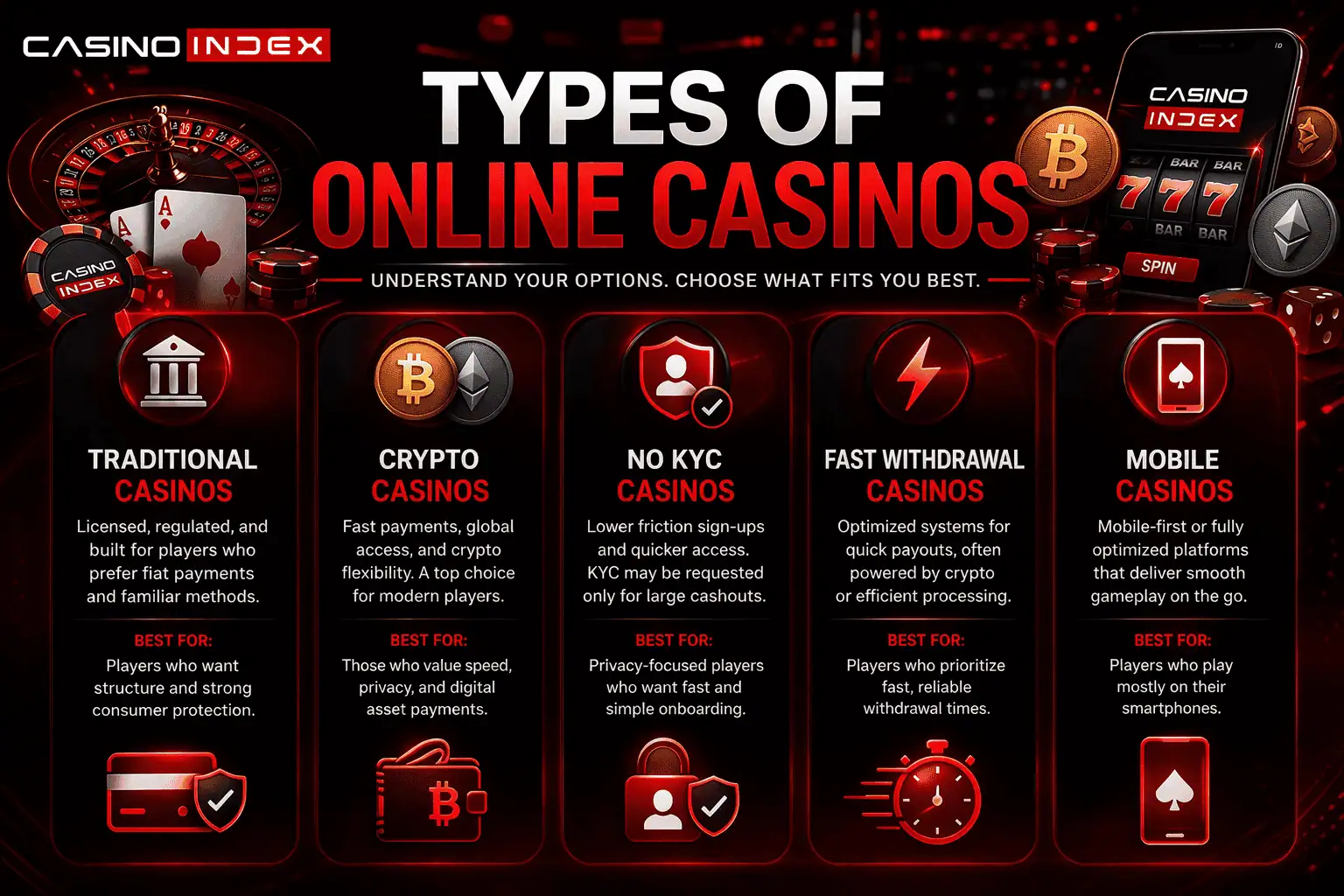
Not all online casinos operate in the same way. Understanding the main casino types helps players choose a platform that fits their priorities instead of following generic recommendations.
Traditional Online Casinos
Traditional casinos usually focus on fiat payments, mainstream regulation, and broad market appeal.
They often support:
- debit and credit cards
- bank transfer
- Skrill
- Neteller
- Apple Pay or local methods
These casinos often appeal to players who value familiarity and strong consumer protection. They are commonly found in more tightly regulated markets and often enforce standard KYC from the start.
Best for:
- players who prefer regulated environments
- players using standard banking methods
- users who value structured consumer safeguards

Crypto Casinos
Crypto casinos are now one of the fastest-growing categories in online gambling. These platforms usually focus on digital asset payments, faster cashouts, and global accessibility.
Typical supported assets include:
- Bitcoin
- Ethereum
- USDT
- Litecoin
- Solana
- other major coins
Crypto casinos can be very strong when they combine good payments with known providers and solid licensing structures. However, they also vary widely in regulatory quality.
Best for:
- players who prioritize speed
- users who prefer crypto rails
- players comfortable managing wallets and blockchain transactions
Our crypto casino comparison guide explores this category in much more detail, while the crypto deposit and withdrawal guide explains the practical side of using digital assets.
No KYC Casinos
No KYC casinos are popular with users who want lower friction during signup and smaller withdrawals. However, this model is often misunderstood.
No KYC does not automatically mean:
- no rules
- no verification forever
- better safety
Instead, it usually means reduced verification for standard usage, often combined with crypto-first payments and lower onboarding friction.
Best for:
- privacy-focused users
- experienced crypto players
- players who understand the trade-offs
For a full breakdown of how this category works, review our no-KYC casino overview and risk analysis.
Fast Withdrawal Casinos
Some casinos focus heavily on payout speed as a competitive advantage. This often includes crypto processing, streamlined internal approvals, or VIP-based cashout prioritization.
However, speed should always be evaluated together with reliability.
A casino promising instant withdrawals means little if:
- payments are inconsistent
- limits are unclear
- support is weak
- KYC rules are selectively enforced
Our withdrawal speed comparison framework focuses on payout consistency as much as speed.
Mobile Casinos
Mobile gambling continues growing every year. Many players now do most of their casino activity through smartphones rather than desktop devices.
A strong mobile casino should offer:
- responsive design
- smooth navigation
- fast loading
- touch-friendly game interfaces
- stable cashier performance
Our mobile casino usability guide covers this category in more depth.
The Core Trust Signals Every Player Should Check
Professional casino reviews do not rely on hype. They rely on recurring trust signals that help identify operational quality.
Below are the most important ones.
1. Licensing
Licensing remains the most important legal trust signal in online gambling.
A valid license usually means the operator must follow rules around:
- player protection
- complaint handling
- fair gaming
- identity verification
- anti-fraud procedures
Not all regulators offer equal protection, which is why our licensing quality comparison framework is essential reading.
Important: licensing alone does not make a casino perfect, but lack of licensing is always a major warning sign.
2. Security
Modern casino security is about much more than an SSL padlock.
A strong casino should also show:
- secure account systems
- 2FA support where possible
- fraud detection
- payment safeguards
- reasonable document handling
This is covered in detail in our casino security systems breakdown.
3. Payments and Withdrawals
Many casino problems only appear after a player requests a withdrawal.
That is why payment evaluation should include:
- deposit methods
- withdrawal speed
- cashout limits
- KYC triggers
- transparency of fees
For a deeper breakdown, see our Casino Payment Methods Guide and Fast Withdrawal Casinos.
4. Game Providers
Known software partners are one of the strongest indirect trust signals.
Trusted providers usually include:
- Pragmatic Play
- Evolution
- NetEnt
- Play’n GO
- Hacksaw Gaming
- BGaming
If a casino works mostly with unknown providers and offers little fairness information, risk increases. This is one reason the Casino Providers Guide matters so much.
5. Bonus Transparency
Bonuses are not just promotions. They are operational rules.
Strong bonus transparency means players can clearly understand:
- wagering requirements
- game contribution
- withdrawal caps
- expiry rules
- max bet restrictions
This is exactly why the bonus mechanics breakdown should be part of every serious casino comparison process.
Comparison of Popular Casino Categories
A simple way to understand casino selection is to compare the most common models side by side.
| Casino Type | Main Strength | Main Risk | Best For |
|---|---|---|---|
| Traditional casino | Strong regulation | Slower onboarding | Players wanting structure |
| Crypto casino | Fast payments | Variable oversight | Crypto users |
| No KYC casino | Lower friction | More self-responsibility | Privacy-focused players |
| Fast withdrawal casino | Speed | Speed may not equal reliability | Cashout-focused players |
| Mobile casino | Convenience | Varies by app or browser quality | Phone-first users |
No single category is “best” for everyone. The right choice depends on what the player values most.
Sample Casino Comparison Table
Below is a simple example of how players can compare individual operators once they understand the main trust categories.
| Casino | Main Strength | Why Players Check It |
|---|---|---|
| TrustDice Casino Review | Crypto rewards | Popular for crypto bonuses and broad coin support |
| BC.Game Casino Review | Large ecosystem | Known for gamified rewards and crypto infrastructure |
| BitStarz Casino Review | Long-term reputation | Often compared for trust and payout reliability |
| Shuffle Casino Review | VIP focus | Crypto-first structure with loyalty appeal |
| MyStake Casino Review | Multi-currency support | Broad payments and active promotions |
| Jackbit Casino Review | Fast UX | Often checked by mobile and crypto users |
| Bitcasino.io Review | Longevity | Established name in crypto gambling |
| Crypto.Games Casino Review | Simplicity | Appeals to players who want a more direct crypto model |
| Duelbits Casino Review | Modern design | Popular among players wanting a newer interface |
| Wild.io Casino Review | Promotional variety | Active campaign structure and crypto support |
This kind of table works best when combined with deeper trust analysis, not on its own. A player should still cross-check security, licensing, withdrawal standards, and provider mix before making a final decision.
Why Bonuses Alone Should Never Decide Your Casino Choice
A major mistake many players still make in 2026 is overvaluing the welcome bonus.
A bonus can look attractive while hiding:
- difficult wagering
- strict game exclusions
- max withdrawal caps
- short expiry periods
- high max bet rules
This is why the correct order is:
Trust first, bonus second
A bonus only matters if:
- the casino is reliable
- the rules are clear
- the payout process works
- the operator actually honors the offer fairly
Players who want to understand this area properly should read the Casino Bonus Guide before comparing bonus-heavy casinos.
How RTP, Fairness, and Providers Fit Into the Bigger Picture
Many casino players focus only on the game count, but game quality matters more than raw numbers.
Three connected trust areas define game-side quality:
- provider quality
- RTP logic
- fairness systems
The RTP mechanics explanation shows how theoretical return percentages work. The provider ecosystem breakdown explains why software partnerships matter. And the provably fair systems guide becomes especially important for crypto users who want transparent verification.
Together, these guides help players evaluate not just whether a casino has games, but whether the game environment deserves trust.
Part 1 Closing Summary
A strong online casino decision in 2026 should never begin with hype.
It should begin with a framework.
That framework includes:
- licensing
- security
- payments
- providers
- bonus transparency
- operational reputation
Everything else comes after that.
This master guide exists to bring all of those pillars into one place and connect the key CasinoIndex cornerstone pages into one central hub.
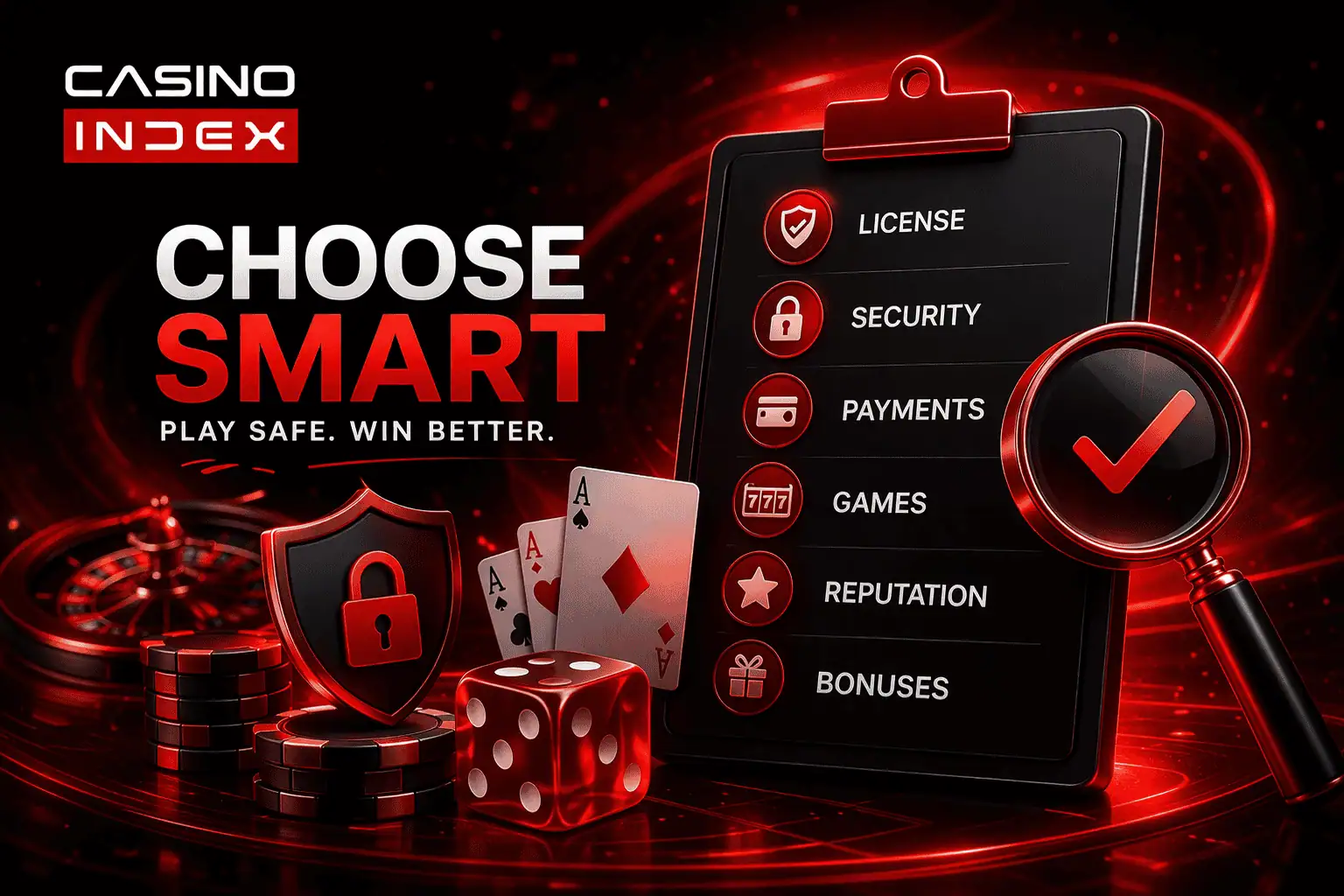
How to Choose the Right Online Casino (Step-by-Step Professional Method)
Most players choose casinos randomly. Professional players use a structured evaluation process. This dramatically reduces the risk of payment problems, unfair bonus enforcement, or security issues.
Instead of asking:
“Which casino has the biggest bonus?”
Experienced players ask:
“Which casino is safest to trust with my money?”
A professional evaluation usually follows this order:
| Step | What To Check | Why It Matters |
|---|---|---|
| Step 1 | Licensing | Legal protection |
| Step 2 | Security | Account safety |
| Step 3 | Payments | Withdrawal reliability |
| Step 4 | Providers | Game legitimacy |
| Step 5 | Reputation | Operational stability |
| Step 6 | Bonuses | Value comparison |
Most beginners reverse this order and start with bonuses. This is the biggest mistake in casino selection.
If you want the full safety methodology first, our player protection framework guide explains the full evaluation model used by experienced players.

Step 1 – Check Licensing First (Always)
Licensing determines whether a casino operates under real regulatory oversight.
Without licensing:
There is usually no realistic dispute resolution.
With licensing:
There is at least a regulatory framework.
Strong licensing signals include:
• Public license number
• Legal company information
• Regulator verification
• Transparent compliance pages
You can learn how to properly verify licensing inside the casino licensing framework breakdown.
Important industry rule:
Licensing does not guarantee safety. But lack of licensing guarantees risk.
Step 2 – Evaluate Security Infrastructure
After licensing, security becomes the next major trust signal.
A modern casino should show evidence of:
• SSL encryption
• Secure login systems
• Anti-fraud protection
• Responsible gambling tools
• Payment monitoring
This is why security should always be reviewed together with licensing.
Our casino security breakdown explains how serious operators protect players technically and operationally.
Weak security often appears alongside:
• unclear licensing
• unknown providers
• poor payment transparency
These risks usually cluster together.
Step 3 – Analyze Payment Systems
Payments are where casino trust becomes visible.
Marketing claims are easy to create.
Payment behavior exposes how a casino actually operates under pressure.
Key payment evaluation factors include:
| Payment Factor | Why It Matters |
|---|---|
| Deposit speed | User convenience |
| Withdrawal time | Operational reliability |
| Fees | Cost transparency |
| Limits | Liquidity structure |
| KYC triggers | Compliance behavior |
Players should never evaluate deposits without evaluating withdrawals.
A casino that makes deposits easy but withdrawals complicated should raise caution.
For deeper understanding review:
payment methods breakdown
payout speed comparison
Step 4 – Check Game Providers
Game providers are one of the strongest indirect trust indicators.
Casinos working with known providers usually meet minimum operational standards.
Trusted providers typically include:
• Pragmatic Play
• Evolution Gaming
• NetEnt
• Play’n GO
• Hacksaw Gaming
• BGaming
Unknown providers increase uncertainty because they remove external verification of fairness and RTP integrity.
If a casino mostly lists unknown studios, players should investigate further.
Our game provider ecosystem analysis explains how provider partnerships connect to trust.
Step 5 – Evaluate Reputation
Reputation reflects long-term operational performance.
Strong reputation indicators include:
• consistent payouts
• clear terms
• strong provider relationships
• stable platform history
Players often compare this using full reviews such as:
TrustDice cashback model analysis
the BC.Game ecosystem review
BitStarz bonus structure breakdown
Shuffle crypto reward model
MyStake multi-currency system
These deeper breakdowns provide far more insight than surface comparisons.
Step 6 – Compare Bonuses Last
Bonuses should always be evaluated last.
Never first.
Why?
Because bonuses only matter if:
• withdrawals work
• rules are clear
• the casino is reliable
Players wanting to properly understand bonus structures should review the bonus mechanics breakdown before comparing offers.
Bonus marketing is not trust.
Operations are trust.
How Experienced Players Compare Casinos (Professional Framework)
Professional players usually evaluate casinos across multiple categories simultaneously.
Example comparison framework:
| Category | Strong Casino | Weak Casino |
|---|---|---|
| Licensing | Verified regulator | Unclear legal status |
| Security | Documented protection | Minimal information |
| Payments | Consistent payouts | Payment complaints |
| Providers | Known studios | Unknown suppliers |
| Terms | Clear rules | Hidden conditions |
This is the same evaluation logic used across the Best Online Casinos 2026 ranking.
Casino Comparison Table – Operational Strength Overview
Below is a simplified structural comparison showing how different casinos may emphasize different strengths:
| Casino | Known For | Typical Player Interest |
|---|---|---|
| TrustDice Casino Review | Crypto bonuses | Players seeking BTC promotions |
| BC.Game Casino Review | Gamified ecosystem | Long-term crypto players |
| BitStarz Casino Review | Reputation | Stability-focused users |
| Shuffle Casino Review | VIP rewards | Loyalty players |
| MyStake Casino Review | Multi crypto | Payment flexibility |
| Jackbit Casino Review | Modern UI | Mobile players |
| Wild.io Casino Review | Promotions | Campaign players |
| Duelbits Casino Review | Modern UX | New crypto players |
| Crypto.Games Casino Review | Simple model | Minimalist players |
| Flush Casino Review | Balanced structure | Mixed payment users |
Different casinos succeed in different categories.
The best casino depends on:
Player priorities.
Understanding Withdrawal Speed vs Withdrawal Reliability
One major misunderstanding in the industry is confusing speed with reliability.
Fast withdrawals do not automatically mean safe withdrawals.
The correct hierarchy is:
Reliability > Speed
Example comparison:
| Withdrawal Type | Speed | Safety Value |
|---|---|---|
| Instant but inconsistent | High | Low |
| 24h but reliable | Medium | High |
| 48h structured | Lower | Strong |
| Delayed with clear process | Low | Medium |
The most important question is simple:
Does the casino consistently pay?
Everything else is secondary.
Players evaluating payout speed and reliability should review:
KYC vs No KYC – The Real Tradeoff
Many players misunderstand KYC.
KYC exists to support:
- Fraud prevention
- AML compliance
- Identity verification
- Payment protection
Reduced or no-KYC models often offer:
- Faster onboarding
- Lower entry barriers
- Crypto-focused access
However, reduced verification usually means:
Higher personal responsibility and less structured protection.
Players comparing these models should review:
Privacy and protection always involve trade-offs.
Common Casino Selection Mistakes Players Still Make
Many players still make predictable mistakes.
Common mistakes include:
Choosing based on bonus alone
Ignoring licensing
Ignoring payment structure
Ignoring providers
Ignoring reputation
These mistakes usually lead to problems later.
A better approach is:
Trust first
Features second
Professional Casino Selection Checklist
Serious players often use a checklist like this:
Before depositing:
Check license
Check payments
Check providers
Check withdrawal rules
Check bonus terms
After depositing:
Test small withdrawal
Verify payment speed
Confirm support response
This dramatically reduces risk exposure.
Understanding Casino RTP and Fairness
RTP (Return to Player) is one of the most misunderstood concepts in gambling.
RTP does NOT mean:
Guaranteed return.
It means:
Long-term statistical return across millions of rounds.
Example:
| RTP | Meaning |
|---|---|
| 96% | Casino edge 4% |
| 97% | Casino edge 3% |
| 99% | Casino edge 1% |
Higher RTP usually means better theoretical value.
Our RTP and volatility analysis explains how RTP connects to fairness and volatility.
How Providers and RTP Work Together
Provider quality usually connects directly with RTP transparency.
Trusted providers usually publish:
• RTP ranges
• volatility data
• mechanics transparency
This is why provider evaluation should always happen together with RTP evaluation.
Players wanting deeper understanding should combine:
game provider ecosystem analysis
RTP mechanics explanation
provably fair verification systems
Together they explain fairness far better than bonus comparisons ever could.
How CasinoIndex Structures Casino Rankings
CasinoIndex rankings are built on trust metrics rather than marketing weight.
Core ranking signals include:
| Ranking Factor | Importance |
|---|---|
| Licensing | Very high |
| Security | Very high |
| Payments | Very high |
| Providers | High |
| UX | Medium |
| Bonuses | Medium |
Bonuses never override trust.
This prevents unsafe casinos from ranking highly simply through aggressive promotions.
Part 2 Key Takeaway
The smartest way to choose an online casino is simple:
Follow a professional evaluation structure.
That structure should always be:
Licensing
Security
Payments
Providers
Reputation
Bonuses
Never the reverse.
Players who follow this structure avoid most industry risks.
Advanced Casino Safety Evaluation (How Experts Identify Risk)
Most casual players only see the surface layer of a casino:
Design
Bonus size
Game count
Experienced evaluators look deeper.
Professional casino analysis focuses on operational signals that are harder to fake. These signals usually reveal whether a casino is built for long-term operation or short-term acquisition.
Serious evaluators typically analyze:
• ownership structure
• licensing consistency
• provider relationships
• withdrawal history
• terms enforcement patterns
• technical stability
• payment liquidity
These signals form the real foundation of trust.
If you want to understand the broader protection methodology, our casino risk evaluation framework explains the full safety model used across CasinoIndex.

The 5 Risk Categories Every Casino Falls Into
Professional analysts usually categorize casinos into five operational risk tiers.
| Risk Tier | Description | Typical Characteristics |
|---|---|---|
| Tier 1 | Highly trusted | Established operators, strong licensing |
| Tier 2 | Reliable | Good operations, smaller brand history |
| Tier 3 | Acceptable | Functional but limited transparency |
| Tier 4 | Elevated risk | Operational weaknesses |
| Tier 5 | High risk | Unknown operators or weak structure |
Most well-known crypto casinos typically fall into Tier 1–3 depending on operational stability.
Examples of casinos frequently analyzed in this context include:
• BC.Game Casino Review
• BitStarz Casino Review
• TrustDice Casino Review
• Shuffle Casino Review
These examples are useful because they have visible operational histories that allow proper comparison.
Red Flags That Signal Elevated Casino Risk
Unsafe casinos usually reveal themselves through patterns, not single issues.
Common warning signs include:
- No visible licensing information
- Anonymous or unclear ownership
- Unclear withdrawal rules
- Unknown or low-quality providers
- Weak or slow support response
- Frequent payment complaints
- Aggressive and unrealistic bonus offers
Risk rarely appears alone.
It usually appears in clusters.
A typical high-risk combination looks like:
- No license
- Extremely large bonus
- Unknown providers
- Unclear payment terms
This combination should always trigger maximum caution.
Players looking for deeper understanding should review:
Payment Failure Patterns Players Should Recognize
Payment behavior is the clearest real-world signal of casino quality.
There are predictable patterns that often appear before major payment issues become visible.
Common early warning signs include:
- Unexplained withdrawal delays
- Repeated or reset verification requests
- Changing withdrawal limits
- Sudden enforcement of restrictive bonus rules
- Unresponsive or evasive support
These signals often appear weeks before larger trust problems surface.
Experienced players act early.
They usually start with a small withdrawal test to verify real payment behavior.
This approach significantly reduces financial exposure and risk.
How Experienced Players Test a Casino Before Trusting It
Smart players rarely deposit large amounts immediately.
Instead, they follow a structured testing approach to evaluate risk before committing.
A typical professional testing process looks like this:
- Step 1 – Small deposit
- Step 2 – Limited gameplay
- Step 3 – Small withdrawal test
- Step 4 – Support interaction check
- Step 5 – Terms and limits verification
If all steps run smoothly, confidence increases significantly.
If issues appear early, risk is already visible.
This approach exposes problems before they become expensive.
For deeper analysis, review:
Understanding Casino Liquidity (A Hidden Trust Factor)
Few players think about liquidity, but it often determines whether a casino can process large withdrawals smoothly.
Strong liquidity usually shows through:
- Consistent withdrawal reports
- Stable withdrawal limits
- Clear payment tiers
- Long operational history
Weaker liquidity often shows through:
- Changing limits
- Delays on larger withdrawals
- Payment prioritization issues
Large ecosystem casinos often maintain stronger liquidity because they operate across multiple revenue streams and user bases.
Players often compare platforms like:
These comparisons help illustrate differences in scale, payment capacity, and operational strength.
Casino Trust Scoring Model (How Serious Reviews Work)
CasinoIndex uses a structured evaluation approach rather than subjective ranking.
Typical scoring categories include:
| Category | Weight |
|---|---|
| Licensing | 20% |
| Security | 20% |
| Payments | 20% |
| Providers | 15% |
| Reputation | 15% |
| UX | 5% |
| Bonuses | 5% |
Important principle:
Trust factors always outweigh marketing factors.
This prevents unsafe casinos from ranking purely based on promotions.
This same methodology is consistently applied across:
Understanding Bonus Risk vs Bonus Value
Not all bonuses are equal.
Some bonuses provide real value.
Others mainly increase wagering exposure.
Example comparison:
| Bonus Type | Risk Level | Player Value |
|---|---|---|
| Low wagering | Low | High |
| Medium wagering | Medium | Medium |
| High wagering | High | Low |
| Cashback | Low | Stable |
| VIP rewards | Medium | Long-term value |
Players looking for a deeper understanding should review the real breakdown of casino bonus mechanics.
Bonus marketing is often the most misleading part of casino promotion.
Why Provider Quality Matters More Than Game Count
Many casinos advertise large numbers like:
- 5000 games
- 8000 games
- 10000 games
However, game count alone has very little meaning.
Provider quality matters far more than quantity.
A typical comparison looks like this:
Casino A may offer 8000 games, but mostly from unknown or low-tier providers.
Casino B may offer 3000 games, but from established and audited providers.
In most cases, Casino B is the safer choice.
Why?
Because strong provider partnerships require:
- Compliance standards
- Fairness verification
- Ongoing monitoring
Unknown providers often lack these controls.
This is why experienced players focus on who builds the games, not how many exist.
For a deeper breakdown, review the complete casino provider ecosystem guide.
How Crypto Changes Casino Risk Models
Crypto casinos introduce a different risk and trust structure compared to traditional platforms.
Key advantages often include:
- Fast withdrawals
- Global access
- Lower friction (no banking delays)
- Blockchain-level transparency
However, these benefits come with important trade-offs:
- Reduced regulatory protection
- Higher personal responsibility
- Less standardized dispute resolution
This means players must evaluate crypto casinos differently.
Instead of relying on regulation alone, focus on payment consistency, platform behavior, and provider quality.
For proper evaluation, review:
Understanding this balance is critical.
Crypto is not automatically safer.
It is simply a different risk model that requires informed decision-making.
Understanding No KYC Tradeoffs Properly
No KYC casinos attract players looking for:
- speed
- privacy
- lower onboarding friction
But those advantages usually come with trade-offs.
Trade-offs often include:
- lower legal protection
- tiered withdrawal limits
- higher personal responsibility
That is why players should understand both sides through the no-KYC casino risk overview and the casino security systems breakdown.
Privacy has value. Risk awareness matters just as much.
How Casino Marketing Can Mislead Players
Marketing language often relies on phrases like:
- instant payouts
- guaranteed winnings
- unlimited bonuses
- risk-free betting
Experienced players do not evaluate casinos through slogans. They look for:
- clear terms
- real limits
- transparent withdrawal rules
- credible provider mix
- visible licensing data
Marketing attracts attention. Operations determine trust.
How to Build a Personal Casino Trust Checklist
Serious players often use a simple checklist before trusting a platform.
Before playing
- check the license
- check the providers
- check withdrawal limits
- check support responsiveness
- check bonus rules
After joining
- test a small withdrawal
- test support quality
- verify actual payout speed
This simple process removes a large part of avoidable risk.
Professional Risk Comparison Table
Below is a simplified trust comparison structure:
| Trust Signal | Strong Casino | Risk Casino |
|---|---|---|
| License | Visible | Hidden |
| Payments | Consistent | Complaints |
| Providers | Known | Unknown |
| Terms | Clear | Vague |
| Reputation | Stable | Limited history |
This framework mirrors evaluation logic used across CasinoIndex cornerstone guides.
Why Long-Term Stability Matters More Than Hype
The most reliable casinos usually show one key pattern:
Operational longevity.
Casinos that have been active for years typically demonstrate:
- Consistent payments
- Stable systems
- Reliable provider partnerships
New casinos are not automatically risky.
However, they require stricter evaluation, especially when it comes to withdrawals, support behavior, and long-term consistency.
Players often compare newer operators against established benchmarks like:
This type of comparison creates real context for trust, payment reliability, and operational stability.
Part 3 Key Takeaway
Casino safety is rarely determined by one factor.
It is determined by patterns.
Safe casinos usually show:
Strong licensing
Strong payments
Strong providers
Strong security
Risky casinos usually show:
Unclear operations
Payment problems
Unknown structure
Understanding these patterns dramatically improves casino selection decisions.
How CasinoIndex Ranks Online Casinos (Our Evaluation Methodology)
To keep rankings useful and trustworthy, CasinoIndex follows a structured evaluation process instead of relying on marketing claims or bonus size alone.
Our goal is simple:
Rank casinos by operational quality, not promotional pressure.
Our review process focuses on measurable factors.
| Evaluation Area | What We Analyze |
|---|---|
| Licensing | Regulatory framework and compliance visibility |
| Security | Account protection and payment safeguards |
| Payments | Withdrawal consistency and speed |
| Providers | Software partnerships and game quality |
| Reputation | Operational stability and player feedback |
| User Experience | Navigation and platform stability |
| Bonuses | Transparency and real player value |
Important rule: Bonuses never outweigh trust signals.
This prevents aggressive marketing platforms from outranking safer casinos.
The same evaluation logic is used across our current casino comparison rankings, crypto casino comparison overview, and trust-first casino safety breakdown.
Why Trust Signals Matter More Than Promotions
Casino marketing constantly evolves. Trust fundamentals rarely change.
Players should always prioritize:
- security over bonuses
- payments over promotions
- providers over raw game count
- licensing over design
The safest casino decision framework always begins with operational strength.
For deeper understanding of how those trust signals connect, use the core CasinoIndex framework:
- casino security systems breakdown
- licensing quality comparison framework
- payment methods overview
- RTP and fairness analysis
- bonus mechanics breakdown
Together these pages form the operational foundation of safe casino selection.
The Most Important Questions Players Should Ask Before Choosing a Casino
Before choosing a casino, players should be able to answer these questions clearly:
- Is the casino licensed?
- Are payments consistent?
- Are the providers reputable?
- Are the withdrawal rules clear?
- Is support responsive?
If any of these answers remain unclear, further research is necessary.
This decision process is explained throughout our trust-first casino safety breakdown.
Final Casino Comparison Framework
A simple professional comparison method looks like this:
| Factor | Strong Choice | Weak Choice |
|---|---|---|
| License | Verified | Missing |
| Security | Documented | Minimal |
| Payments | Reliable | Complaints |
| Providers | Established | Unknown |
| Terms | Transparent | Confusing |
Players using this framework usually avoid most industry problems.
Frequently Asked Questions About Online Casinos (2026)
What is the safest type of online casino?
There is no single casino type that is automatically the safest. The safest platforms usually combine strong licensing, reliable withdrawals, known providers, and transparent terms.
In practice, operational quality matters more than category labels. Players should start with a trust-first casino safety breakdown before choosing any platform.
Are crypto casinos safe?
Crypto casinos can be safe, but safety still depends on the same core factors as any other casino: payment reliability, provider quality, clear terms, and credible oversight.
The main difference is that crypto platforms often operate with different consumer protection standards than traditional regulated casinos. For a deeper breakdown, see our crypto casino comparison overview.
Are no KYC casinos legal?
No KYC casinos are not automatically illegal. Legality depends on the jurisdiction, licensing model, and the compliance rules that apply to the operator.
What matters most is understanding the trade-off: lower friction does not mean lower risk. Players should review the no-KYC casino risk overview before assuming this model is safer or more flexible.
How do I know if a casino will pay withdrawals?
The strongest indicators are:
- clear payment rules
- consistent reputation
- strong provider partnerships
- visible operational history
Many experienced players also test this with a small withdrawal first. For a deeper breakdown, see our payment methods overview.
What is RTP in online casinos?
RTP means Return to Player. It describes the long-term theoretical return percentage of a game across a very large number of rounds.
For example, a 96% RTP means the theoretical house edge is 4% over time. For a full breakdown, read our RTP and volatility analysis.
Why do casinos require KYC?
KYC helps casinos prevent fraud, meet AML requirements, and protect the payment process.
Some casinos request verification during signup. Others delay it until the first withdrawal. Players comparing those models should review the casino security systems breakdown and the no-KYC casino risk overview.
Do bigger bonuses mean better casinos?
No. Bonus size does not equal trust.
A smaller offer with clear rules often provides more real value than a larger bonus with strict wagering, short expiry windows, or heavy withdrawal caps. For the full breakdown, see our bonus mechanics breakdown.
What are the biggest casino risks?
The most common risks include:
- unlicensed operators
- payment delays
- unknown providers
- unclear terms
These problems often appear together rather than in isolation. That is why players should always verify trust signals before looking at bonuses or design.
How many games should a good casino have?
Game count matters less than provider quality.
A casino with 3,000 games from strong studios is often safer than a casino with 8,000 titles from unknown suppliers. What matters is the credibility of the software ecosystem. See our game provider ecosystem analysis.
Are fast withdrawal casinos always better?
Not always.
Reliability matters more than speed. A casino that pays consistently within 24 hours is usually stronger than a casino that advertises instant cashouts but handles them inconsistently. See our payout reliability comparison.
Can I trust casino reviews?
You can trust reviews more when they explain licensing, payments, providers, and operational behavior in detail.
Reviews that focus only on bonuses are usually less useful. CasinoIndex focuses on operational analysis rather than promotional comparisons.
What is the biggest mistake players make?
The biggest mistake is choosing a casino based only on the bonus.
Bonuses should be compared last, not first. Trust always comes before promotions.
Should I test a casino before depositing large amounts?
Yes.
Testing a small deposit and a small withdrawal is one of the safest ways to evaluate a casino before increasing exposure.
How important is customer support?
Customer support is an important trust signal because it often reflects overall operational maturity.
Slow, evasive, or unclear responses can point to broader issues in payments, verification, or complaint handling.
Are mobile casinos different from desktop casinos?
Most modern casinos use responsive design, but mobile quality still varies a lot in practice.
Navigation, cashier usability, loading speed, and game stability often perform differently on phones than on desktop. For more detail, see our mobile casino usability guide.
What makes a casino trustworthy long term?
Long-term stability usually depends on:
Consistent payments
Strong licensing
Provider partnerships
Operational maturity
Final Expert Summary – How to Choose the Right Casino in 2026
Choosing the right casino is not about finding the biggest promotion. It is about identifying the most reliable operator.
The best decision framework remains simple:
- check licensing
- check security
- check payments
- check providers
- check reputation
- check bonuses
In that order.
Players who follow this structure usually avoid most industry risks.
CasinoIndex exists to simplify that process by connecting the most important research areas into one hub.
Players who want to continue their research should explore:
- current casino comparison rankings
- trust-first casino safety breakdown
- bonus mechanics breakdown
- casino security systems breakdown
- licensing quality comparison framework
- crypto casino comparison overview
These cornerstone pages form the core research structure for serious players.
Final Key Takeaway
The best casino choice is rarely the loudest one.
It is usually the most consistent one.
Trust signals always outweigh marketing signals.
Players who understand this gain a major long-term advantage.