Why RTP Alone Does Not Make a Casino Good
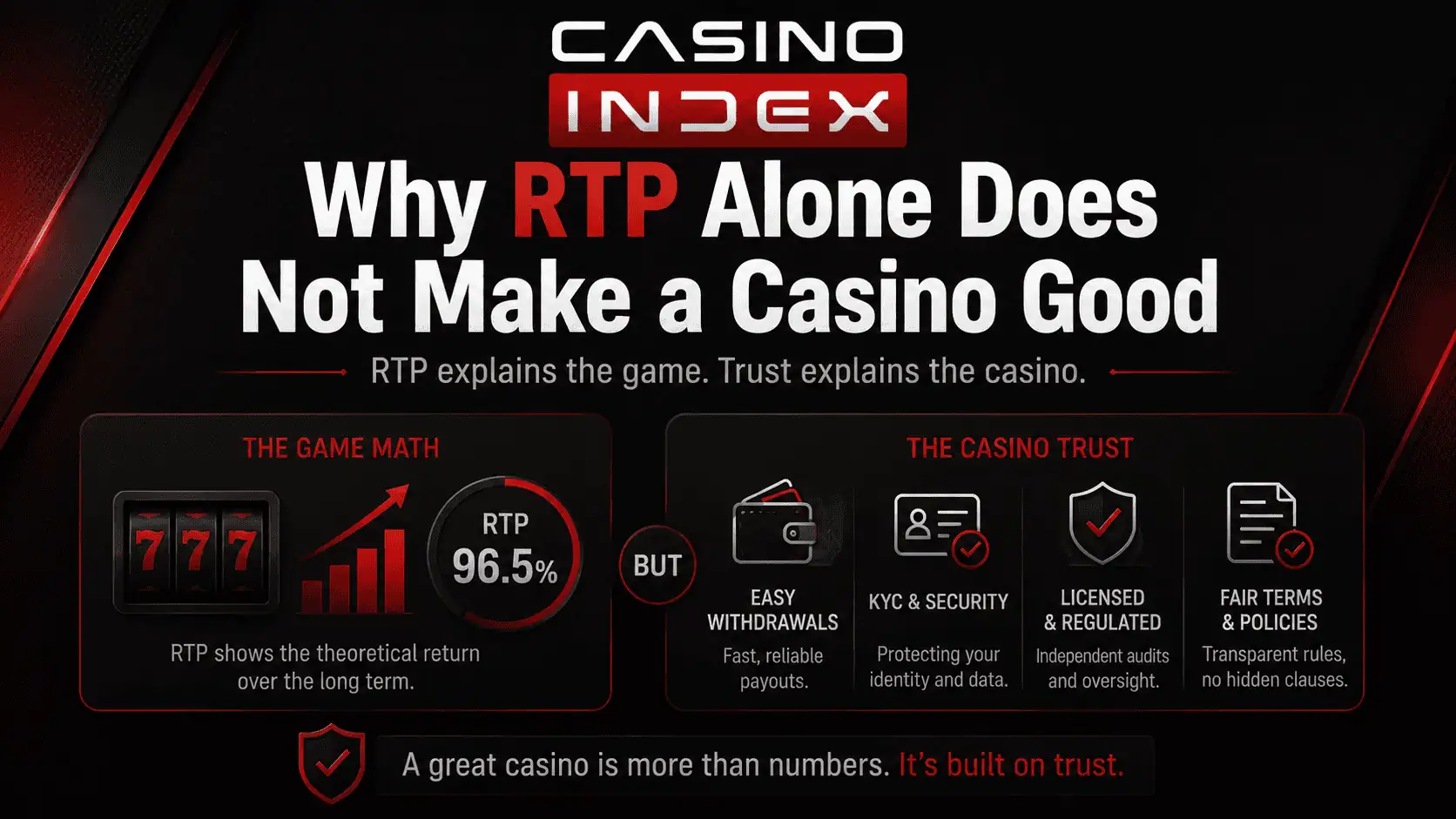
A high RTP can make a casino game look fair.
It does not make the casino trustworthy.
That difference matters because RTP is often treated like a quality score for the whole platform. Players see 96% slots, low-house-edge table games, or provably fair titles and assume the casino itself must be safe. But RTP only explains how a game is designed to perform over a large number of plays. It says almost nothing about the operator behind it.
A casino can offer strong game math and still delay withdrawals, apply vague KYC checks, hide weak bonus terms, or give poor support after a player wins.
That is why RTP should be respected, but never overvalued.
It helps players judge the game. It does not answer the bigger real-money question:
What happens when the player wins and tries to withdraw?
That is where casino quality starts. And that is where RTP alone stops being enough.
RTP explains the game, not the casino
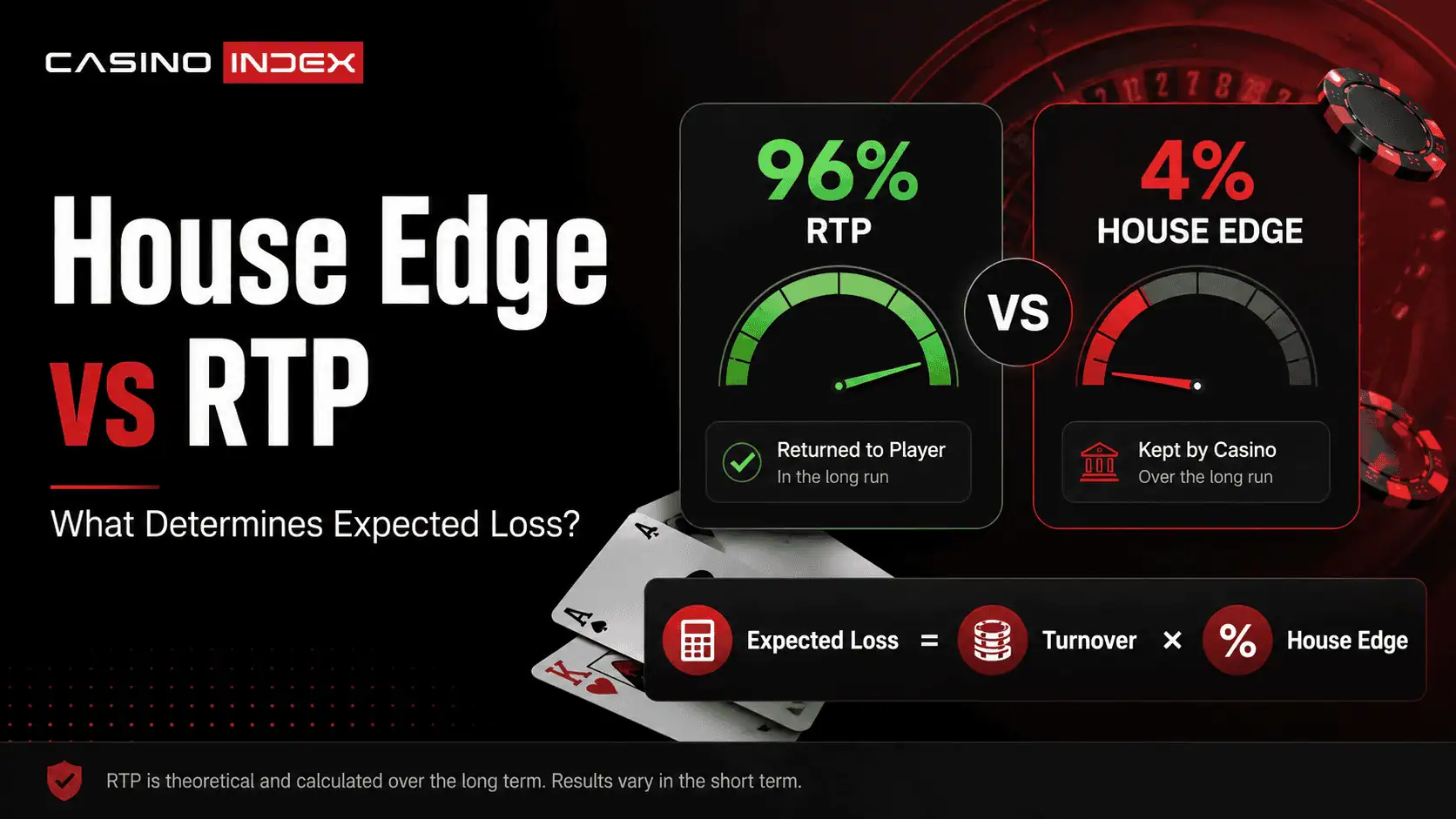
RTP stands for return to player. It shows the theoretical percentage of wagered money a game is designed to return over time.
A slot with 96% RTP does not mean you should expect $96 back from every $100 you personally wager. It means the game is built to return around 96% across a large volume of play. Short sessions can land far above or far below that number.
That makes RTP useful for game selection.
It helps players compare slots, understand house edge, avoid poor-value titles, and think more clearly about long-term cost. A player choosing between two similar games should usually prefer the one with stronger RTP, assuming volatility and rules are also suitable.
But RTP has a narrow job.
It measures game math.
It does not measure casino behavior.
That is why CasinoIndex treats why RTP is only one signal as a starting point, not a final trust verdict.
The casino controls the experience around the game
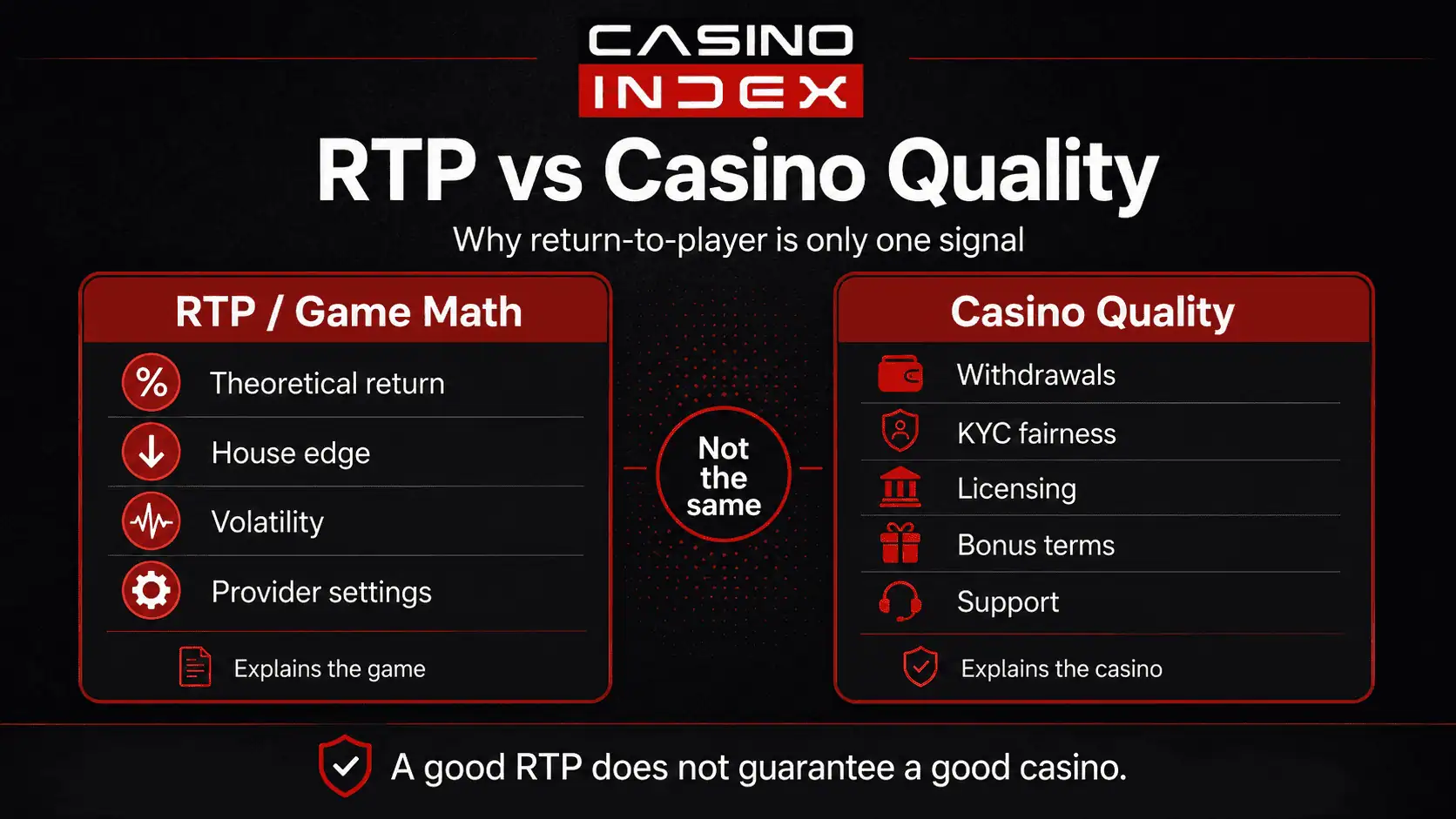
A game provider creates the math model. The casino controls the environment around it.
That environment matters.
Two casinos can offer the same high-RTP game and still create completely different outcomes for players. One may show game information clearly, process withdrawals quickly, explain limits upfront, and handle account checks professionally.
Another may offer the same game while using vague terms, slow payments, unclear KYC triggers, aggressive bonus restrictions, or weak support.
The RTP number is the same.
The player experience is not.
This is why “good RTP” should never be confused with “good casino.” A fair game inside a weak platform can still lead to a poor real-money outcome.
The game may be mathematically sound.
The casino may still be difficult to trust.
Payout trust matters more than theoretical RTP
RTP affects the cost of play.
Withdrawals decide whether winnings become usable money.
That is the difference.
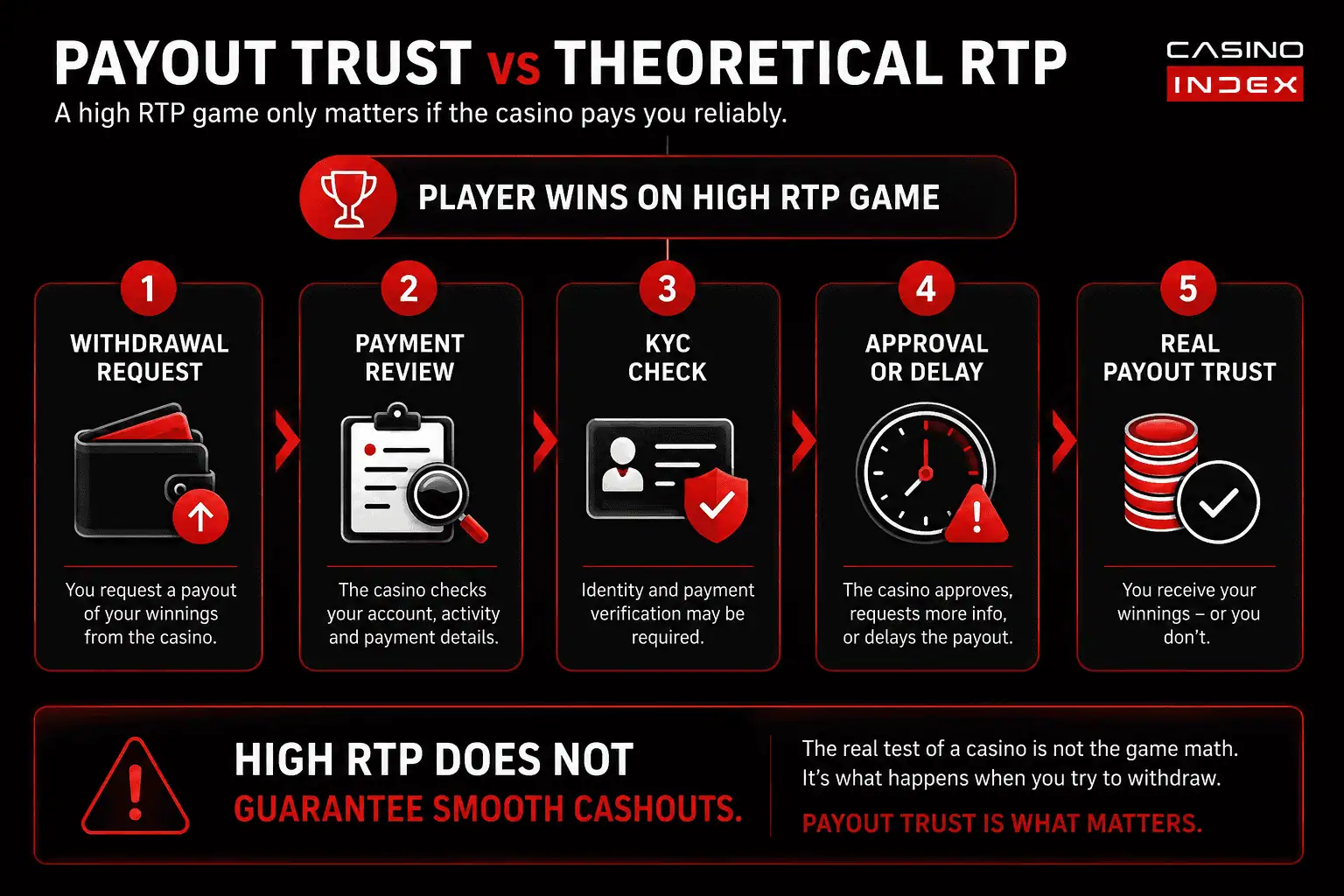
A player can choose a slightly lower-RTP game and still have a fair experience if the casino pays reliably, explains rules clearly, and handles verification properly. But a player who wins on a high-RTP game may still have a bad experience if withdrawals are delayed, documents are requested without clear reason, or support gives vague answers.
That is why payout trust vs theoretical RTP is one of the most important distinctions in casino evaluation.
RTP does not answer these questions:
- How quickly does the casino process withdrawals?
- Are payout limits clear before deposit?
- Does the casino delay large wins?
- Are KYC checks explained before withdrawal?
- Are payment matching rules fair?
- Does support give direct answers?
- Are disputes handled consistently?
These questions matter more when money is leaving the casino.
A 97% RTP game is not enough if the withdrawal process becomes unpredictable after a win.
High RTP does not protect players from bad terms
Bonus terms can destroy the value of a good game.
This is one of the most common mistakes players make. They choose a high-RTP slot, claim a bonus, meet some wagering progress, and only later discover that the promotion had harsh rules.
The problem may not be the game.
It may be the terms around the game.
Bonus rules can include:
- high wagering requirements
- restricted games
- max bet limits
- max cashout caps
- mixed-balance confusion
- country restrictions
- bonus abuse clauses
- withdrawal delays during review
RTP does not explain any of this.
A 96.5% RTP slot becomes less useful if the bonus attached to it limits cashout, blocks certain games, or gives the casino broad room to void winnings after a technical mistake.
This is why players should not judge casino value by RTP alone. They also need to understand how casino terms can change the real value of a deposit.
The real question is not only:
“What does the game return?”
It is also:
Can the player withdraw winnings under rules that are clear, fair, and visible before play?
RTP does not show whether verification is fair
Verification is one of the biggest trust tests in online casinos.
A casino may allow easy signup and quick deposits, then request documents only after a player wins. Sometimes that is legitimate. Casinos need controls for fraud, payment ownership, jurisdiction risk, and source-of-funds concerns.
The issue is timing and transparency.
Fair verification should be predictable. Players should understand when KYC may happen, what documents may be needed, and why checks are being requested.
Weak verification feels different. It appears suddenly, moves slowly, and gives the player little clarity. In the worst cases, it looks like a payout barrier rather than a normal security process.
RTP cannot protect a player from that.
A high-RTP slot does not make late-stage KYC fair. It does not make document requests reasonable. It does not show whether the casino handles account reviews properly.
This is why CasinoIndex gives serious weight to how fair casino verification should work before payout pressure starts.
A good casino does not need to avoid verification completely.
It needs to apply it clearly and proportionately.
RTP does not prove the casino is licensed well
Licensing is another area where RTP has no reach.
A casino can offer reputable providers and good RTP games while still being weak on ownership clarity, licensing transparency, complaint handling, or player protection.
A strong license does not guarantee a perfect casino. A weaker license does not automatically prove a casino is unsafe. But licensing still matters because it affects oversight, dispute routes, compliance expectations, and how much accountability players may have if something goes wrong.
Players usually do not care about licensing when deposits are instant and games run smoothly.
Players rarely need licensing details while everything works. They need accountability when a withdrawal is delayed, support becomes vague, bonus terms are applied aggressively, or the casino rejects documents without a clear explanation.
RTP cannot solve those problems.
RTP cannot solve those problems.
That is why what makes a casino license actually trustworthy matters more than a lobby full of strong game percentages.
RTP does not remove short-term risk
RTP is long-term math.
Players live in short sessions.
That gap creates confusion.
A game with 97% RTP can still empty a bankroll quickly if it is highly volatile. A game with lower RTP may produce more frequent small hits but less upside. Two games with similar RTP can feel completely different because their volatility, bonus structure, hit frequency, and max win potential are different.
RTP is not a session forecast.
It does not tell you:
- how often the game pays
- how severe downswings can be
- whether the bonus feature is rare
- whether the game suits your bankroll
- whether the listed RTP version is the version offered
- whether the game is suitable for bonus wagering
This matters because many players chase RTP without understanding variance.
A high-RTP game can still be a bad fit for a small bankroll.
A strong RTP can improve long-term expectation, but it does not remove gambling risk.
Some casinos use RTP as trust decoration
Good casinos display RTP clearly.
Weak casinos sometimes use RTP as decoration.
They highlight fair game math while staying vague about the parts that matter more during real-money play. They may promote high-RTP slots, provably fair games, or provider names, but say little about withdrawal approval, payment limits, KYC timing, bonus restrictions, or dispute handling.
That creates a trust illusion.
The player sees a technical fairness signal and assumes the whole platform is safer than it really is.
This is where RTP becomes dangerous.
Not because RTP itself is bad. It is useful information.
The danger comes when RTP is used to distract from weaker parts of the casino.
CasinoIndex covers this problem in more detail in its guide to how RTP claims can mislead players when the full casino experience is ignored.
A serious casino should not hide behind game math.
It should be strong when the player deposits, plays, verifies, withdraws, and asks for help.
What matters beyond return-to-player
RTP should sit inside a wider trust framework.
It should not replace one.
When CasinoIndex evaluates a casino, RTP belongs under product quality and game transparency. It helps answer whether the casino offers fair games, respected providers, clear information, and reasonable game value.
But the bigger trust picture includes more important signals.
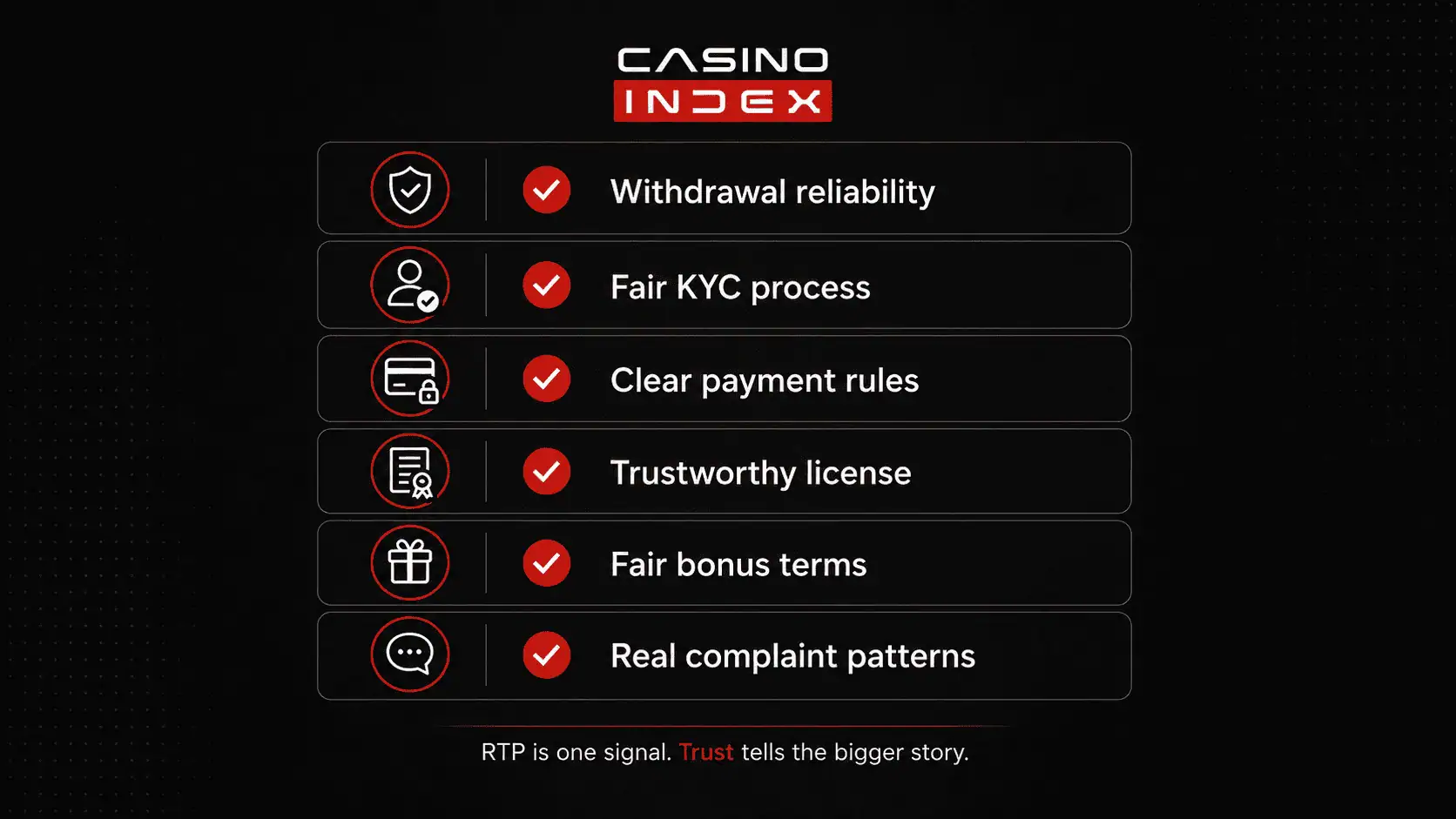
The strongest signals are:
Withdrawal reliability: Does the casino pay legitimate winnings without unnecessary friction?
Verification fairness: Are KYC checks clear, proportionate, and explained before the withdrawal stage?
Licensing and ownership: Can players understand who runs the casino and what oversight exists?
Payment transparency: Are limits, fees, payment matching rules, and processing times clear before deposit?
Bonus fairness: Are promotions useful, or do they create avoidable withdrawal traps?
Complaint patterns: Are negative reports isolated, or do repeated issues point to a real pattern?
Long-term usability: Does the casino stay predictable after multiple deposits, larger wins, and account reviews?
That is what matters beyond return-to-player.
RTP helps you judge the game.
These signals help you judge the operator.
The right way to use RTP
RTP still matters.
Ignoring it would be a mistake.
Players should check RTP when choosing slots, comparing providers, reviewing bonus wagering value, or avoiding games with poor long-term return. They should also watch for different RTP versions of the same game. Some providers offer multiple versions, and not every casino uses the highest one.
RTP is especially useful when:
- comparing similar slots
- checking game value before play
- understanding house edge
- choosing between provider versions
- reviewing bonus wagering games
- avoiding unusually low-return titles
- planning long-term bankroll use
But RTP should answer only one question:
Is this game mathematically reasonable?
It should not answer:
Is this casino trustworthy?
That second question needs a deeper review.
How CasinoIndex treats RTP in reviews
CasinoIndex does not ignore RTP.
It simply does not overvalue it.
A casino gets credit when it offers reputable providers, clear game information, fair RTP visibility, and a strong game selection. A casino loses trust when it hides game details, uses poor-value versions without clarity, or presents RTP in a misleading way.
But RTP cannot rescue a weak casino review.
If a casino has repeated withdrawal complaints, vague verification rules, unclear ownership, harsh bonus terms, or poor support behavior, high-RTP games do not fix the deeper problem.
CasinoIndex reviews follow the full player journey:
- Can the player understand the rules before deposit?
- Are games fair and clearly presented?
- Are payment methods and limits easy to understand?
- Are withdrawals predictable?
- Is verification handled fairly?
- Are bonus terms reasonable?
- Are complaints isolated or pattern-based?
- Does the casino behave well after the player wins?
That is how to judge casino quality properly without reducing a review to one percentage.
When RTP matters less than players think
RTP matters less when the casino itself is weak.
It also matters less when the player uses short sessions, highly volatile games, unclear bonuses, or a payment method that creates withdrawal friction.
A high RTP does not help much if:
- the casino delays withdrawals
- the bonus has a low max cashout
- the account triggers unclear verification
- payment matching rules are hidden
- the license is weak or unclear
- support gives vague answers
- the game version is not transparent
- the player’s bankroll does not match the game volatility
This is why experienced players do not only ask:
“What is the RTP?”
They ask:
What happens if I win?
That question reveals more about casino quality than most homepage claims.
A better way to judge casino quality
A strong casino should pass a simple real-money test.
Before deposit, the player should be able to understand the rules.
During play, the games should be fair and clearly presented.
At withdrawal, the process should be predictable.
During verification, the casino should explain what is needed and why.
If there is a dispute, support should respond with clear information instead of generic delays.
RTP only covers one part of that journey.
A good casino needs more than fair game math. It needs payment reliability, honest terms, reasonable verification, clear licensing, responsible bonuses, and a track record that gives players confidence.
That is the core difference.
RTP helps you choose games.
Trust helps you choose casinos.
Final verdict
RTP is useful, but it is not a casino rating.
It tells you how a game is designed to return money over time. It does not tell you whether the casino pays fairly, handles KYC properly, writes clear bonus terms, resolves complaints, or protects players when real money is involved.
A high-RTP game inside a weak casino can still create a bad experience.
A slightly average game library inside a reliable casino may be better for real players if withdrawals are stable, terms are clear, and support acts professionally.
That is why RTP should be treated as one signal inside a wider trust system.
RTP helps judge the game. Withdrawals, terms, licensing, verification, and complaint behavior help judge the casino.
When real money is involved, the second group matters more.
FAQ
Does high RTP mean a casino is trustworthy?
No. High RTP only means a game is designed to return a certain percentage of wagers over a large sample size. It does not prove that the casino pays withdrawals quickly, handles KYC fairly, writes clear terms, or resolves disputes properly.
Why is RTP only one signal?
RTP is only one signal because it measures game math, not casino behavior. A casino also needs reliable withdrawals, fair verification, transparent payment rules, clear licensing, reasonable bonus terms, and credible complaint handling.
Can a casino have good RTP but bad payouts?
Yes. A casino can offer strong RTP games and still create problems when players withdraw. That is why payout trust often matters more than theoretical return. The game can be fair while the platform around it is weak.
What matters more than return-to-player?
Withdrawal reliability, KYC fairness, payment transparency, licensing clarity, bonus terms, support quality, complaint patterns, and long-term account stability all matter more when judging the casino itself.
Should I always choose the highest RTP game?
Not always. RTP is useful, but volatility, bankroll size, game rules, bonus restrictions, and session length also matter. A high-RTP game can still be a poor fit if it is too volatile for your bankroll.
Can RTP be misleading?
RTP can be misleading when players treat it as a short-term prediction or a casino trust score. It is a long-term game metric. It does not guarantee personal session results and does not prove that the casino is reliable.
How does CasinoIndex use RTP in reviews?
CasinoIndex uses RTP as part of game and product quality. It gives credit for clear game information, fair provider selection, and transparent RTP display. But RTP does not override withdrawal problems, vague terms, weak licensing, or poor complaint patterns.
What is the best way to judge casino quality?
Judge the full player journey. Look at the license, ownership, terms, payment rules, withdrawal process, KYC timing, complaint history, support quality, bonus fairness, and game transparency. RTP belongs in that review, but it should never control the whole verdict.

Talha Aydin has been active in cryptocurrency since 2017 and is a co-founder of Freecoins24 and CryptoMutant. Over the years, he has worked with crypto projects on community growth, giveaways, user acquisition and digital strategy while gaining hands-on experience across blockchain platforms and crypto markets. At CasinoIndex, Talha focuses on crypto casinos, withdrawals, payment systems, platform trust and the risks players face when moving funds between wallets and gambling platforms.