Home • News • Crypto casinos • Can Casinos Reverse Winnings? What Actually Happens
Can Casinos Reverse Winnings? What Actually Happens

Yes, casinos can reverse winnings.
That is the uncomfortable truth.
A win on the screen does not always become a paid withdrawal. Between those two moments, the casino can still review the account, the bonus use, the payment trail, the game session, and the withdrawal request. If it finds a rule breach, it may cancel bonus-linked winnings, void part of the balance, reverse a pending cashout, or lock the account while it investigates.
That does not mean every reversal is fair.
Some reversals come from real fraud, real technical faults, or clear bonus abuse. Others happen because the rules were broad, hidden, or only enforced once the player won enough money to matter. That is why this topic matters so much. The real issue is not only can a casino reverse winnings. The real issue is when, why, and how clearly the site warned the player before the problem started.
Before the deeper breakdown, these three reviews are the best supporting reads for this topic:
| Review | Why it matters | Open review |
|---|---|---|
| BC.Game | Strong example of bonus, KYC, and payout checks colliding after a win | Read the BC.Game review |
| 1xBit | Useful for studying harsher rule language and higher payout-risk environments | Read the 1xBit review |
| Vavada | Good example of restricted-game, bonus-fund, and withdrawal-stage disputes | Read the Vavada review |
The short answer
Casinos usually reverse winnings in four main situations.
First, they say the win came from a bonus breach.
Second, they say the player used restricted games or broke a max-bet rule.
Third, they say the account failed verification, used the wrong payment source, or came from a restricted country.
Fourth, they say the win came from a technical error, pricing mistake, or suspicious pattern.
Most players do not notice the danger at the moment they win.
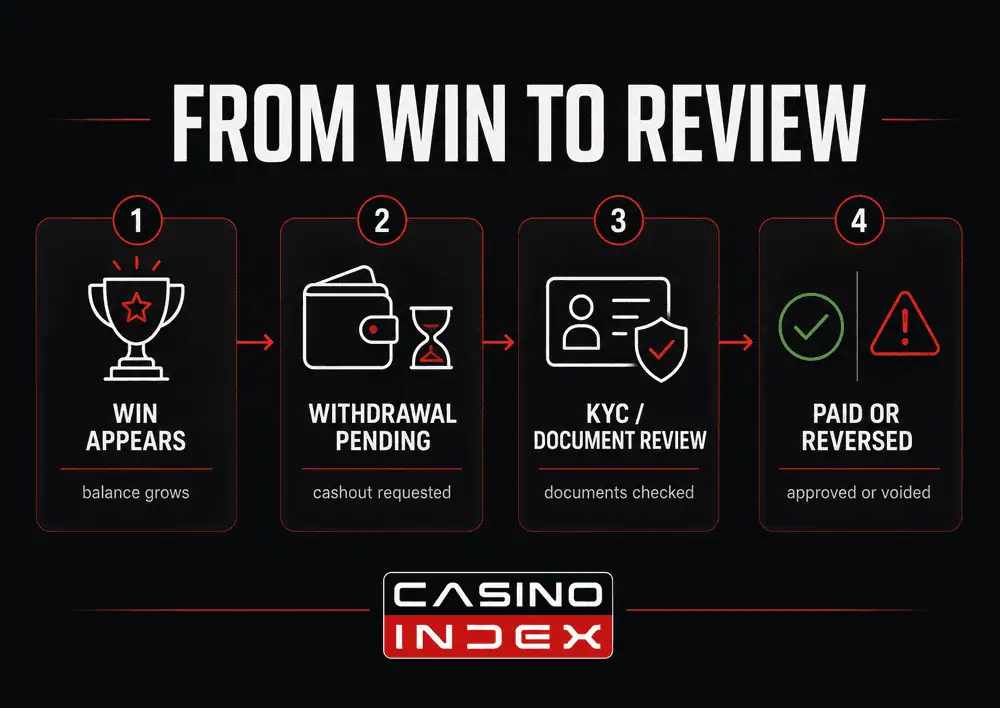
The danger often appears later. The withdrawal goes pending. Support asks for documents. The casino checks the bonus history. It reviews the wallet, card, or bank method. Then it decides whether the money qualifies as payable cash or as money it can still void.
That is why experienced players care less about the celebration moment and more about the review stage. This is also where guides on how casino verification really works, what happens before a casino approves a withdrawal, and what a safe casino KYC process should look like become more useful than another generic casino list.
Real experience: how a reversed win usually starts
A reversed win rarely starts with a dramatic message.
Most of the time, it starts with a normal withdrawal request.
The player submits the cashout. At first, everything looks fine. Then the status changes to pending, under review, or processing. A support agent asks for ID. Later, the casino asks for a selfie, proof of address, or proof of payment ownership. Sometimes it asks for source of funds too. In softer cases, the player sends the documents, waits, and gets paid. In harsher cases, the casino uses that review stage to question the entire balance.
The second common path starts with a bonus.
A player deposits, claims a promotion, wins, and assumes the money is already safe. Then the casino checks whether the session actually complied with the promotion. It looks at game eligibility, contribution rates, maximum bet size, bet patterns, and timing. If the player used an excluded game or went above the allowed stake, the operator may cancel the bonus-linked winnings even if the wagering bar looked complete.
Another path starts with the account itself.
The casino may say the problem is not the game session but the player profile. It may claim duplicate accounts, a third-party deposit method, suspicious wallet use, VPN or location conflict, or a jurisdiction issue. At that point, the argument stops being about one win. It becomes an account-risk dispute.
That is where players usually feel the shift most sharply.
At first, the site feels smooth. Deposits work. Games open fast. Promotions look simple. Support sounds friendly. Once a meaningful withdrawal appears, the tone changes. Suddenly, the operator becomes less interested in keeping the experience easy and more interested in controlling risk. That is why trust-first players focus so hard on why some casinos delay withdrawals and what happens when casinos block accounts before they ever claim a bonus.
When casinos can void winnings
Bonus abuse
This is one of the biggest categories.
If the operator believes the player abused a promotion, it may cancel the related winnings. That can include duplicate accounts, coordinated play, hedge-style betting, low-risk bonus extraction, or any wagering pattern the casino classifies as abuse.
This is where many players lose the argument.
They often think they only need to finish the wagering requirement. The casino often sees a much larger rule set. It may check how the player bet, when the player bet, which games were used, and whether the pattern looked like ordinary gambling or systematic bonus extraction.
Some sites describe this clearly. Others do not.
When the wording is broad, the player only learns how strong the rule is after a large withdrawal appears. That is one reason how casino wagering really works matters more than the headline bonus number.
Restricted games
Restricted games cause a huge number of disputes.
A player might think, “I wagered enough, so the bonus is cleared.” The operator may respond, “You wagered on the wrong category, so the winnings do not count.”
That difference changes everything.
Many casinos allow bonus wagering only on slots or only on a limited set of eligible games. If the player moves into blackjack, roulette, live casino, sportsbook, provably fair titles, or another excluded area too early, the casino may cancel the bonus-linked part of the balance.
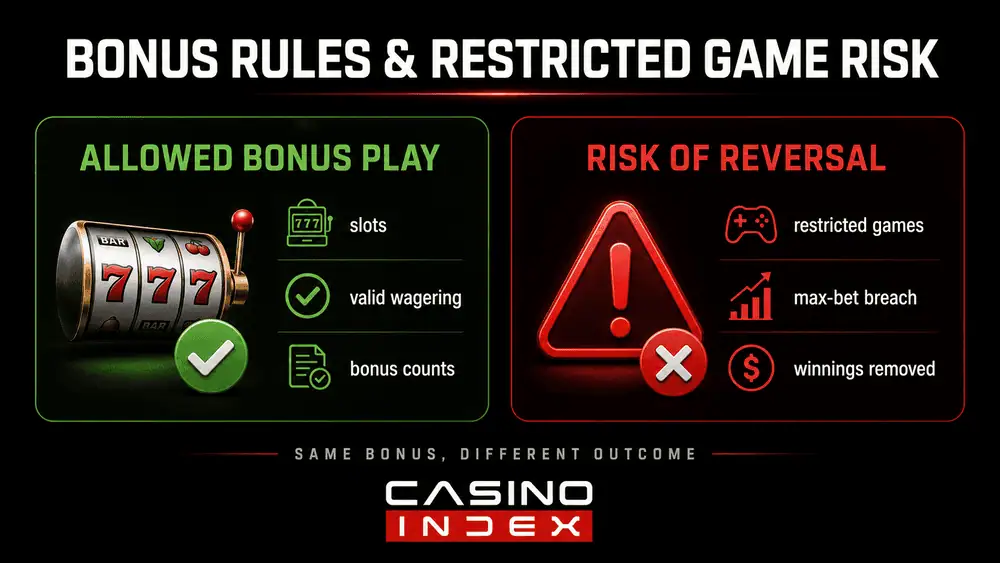
This is one of the clearest answers to what causes winnings to be removed.
The session looked successful from the player side. The casino then checked the game type and decided the session never qualified under the promotion in the first place.
Max-bet breaches
A max-bet rule is one of the simplest ways to lose winnings.
The player may do everything else correctly. They deposit, opt into the promotion, wager enough, and hit a good run. Then the casino sees one or more bets above the allowed limit while the bonus was active. That can be enough to void the bonus-linked winnings.
Players miss this constantly.
The reason is simple. Max-bet rules often look small when compared with big wagering numbers. Yet they can decide the whole dispute. One session at the wrong stake level can destroy the value of hours of otherwise valid play.
This is also why are casino bonuses worth it is really a risk guide, not just a promo guide.
Technical errors and malfunctions
Casinos can also void wins if they say the result came from an error.
That may involve a slot malfunction, a broken jackpot trigger, a display problem, a stale sportsbook line, or an incorrect price. Operators rely on “malfunction voids all pays and plays” type language because it gives them a direct escape route when a game result looks invalid from their side.
Players hate this category for obvious reasons.
The win looked real. The balance appeared. The session felt normal. Then the operator says the result should never have counted.
Sometimes that claim is legitimate. Sometimes it is hard to verify from the player side. Either way, once the casino classifies the round as an invalid event, it will usually treat the payout as reversible.
KYC, payment ownership, and country restrictions
This is often the most painful category.
The player sees a completed win. The casino sees unfinished compliance.
That gap creates many of the ugliest disputes in gambling. A site may allow registration, deposits, and gameplay with little friction. Only later, at withdrawal stage, it starts asking for ID, address proof, payment ownership, or source-of-funds proof. If the player cannot satisfy the request, the operator may hold, reverse, or void the withdrawal.
Country restrictions create similar problems.
Some players only discover the real importance of location rules after they win. The casino may say the account should never have played from that jurisdiction. Once that happens, the discussion is no longer about the bonus or the session. It becomes a broader eligibility dispute.
Why balances sometimes get reversed
Players often assume every balance is the same kind of money.
It is not.
A casino may treat funds inside one wallet as several different categories at once. One part may be deposited cash, while another may still be locked as bonus value. Some of the balance may come from bonus-derived winnings. A pending withdrawal can sit inside that same total. In tougher cases, part of the amount is already under manual review.
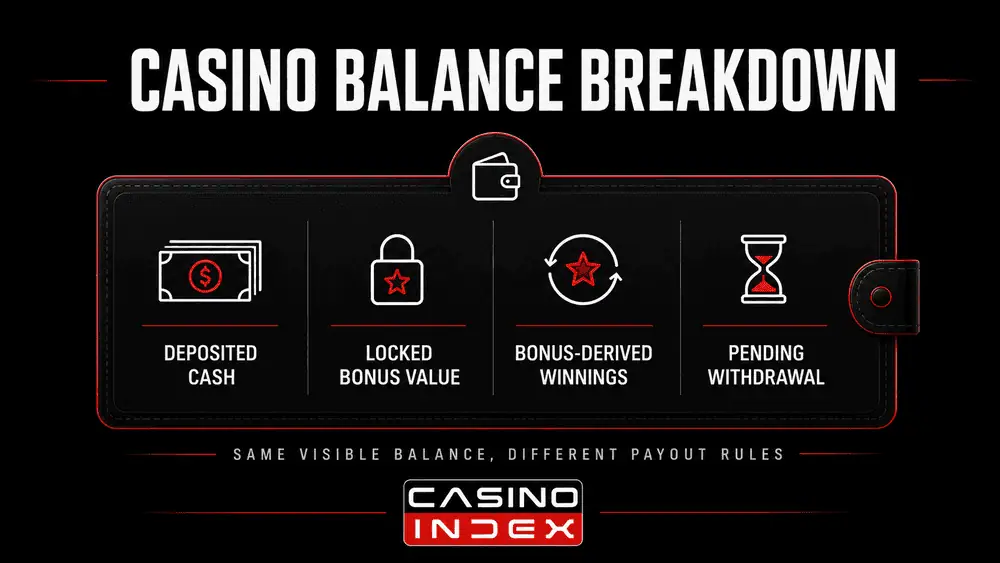
That is one of the clearest reasons why balances sometimes get reversed instead of paid immediately.
The number on the screen may look like one clean amount. The operator may see several layers with different rules attached to them. If a site decides the bonus conditions were breached, it may only remove the bonus-linked portion. If the site starts a KYC or fraud check, it may push a pending withdrawal back into the account while the review continues. In tougher cases, it may freeze everything.
That is why players describe the same event in different ways.
One says, “They stole my winnings.”
>Another says, “They canceled my withdrawal.”
>Another says, “They removed the bonus.”
>Another says, “They locked the account after I won.”
Those may all refer to different stages of the same dispute.
What causes winnings to be removed most often
The most common causes are not dramatic.
They are usually simple rule triggers.
Bonus misuse sits near the top.
Restricted games are another major cause.
Max-bet breaches are constant traps.
Failed KYC appears again and again.
Third-party payment use also triggers many problems.
Duplicate-account suspicion is common.
Restricted-country play matters more than players think.
Technical error claims can wipe out an apparent win.
Pricing mistakes do the same in sportsbook environments.
Some removals are fair rule enforcement.
Some are aggressive but still covered by the terms.
The worst cases sit in the middle. The rule exists, but the operator wrote it vaguely, explained it badly, or only enforced it hard after the player won enough to matter. That is why disputed win situations explained properly never come down to emotion alone. The key questions are always the same: which rule, which game, which payment method, which account pattern, and which exact moment the casino decided to act?
Disputed win situations explained
BC.Game
BC.Game is a good example of layered disputes.
The issue often is not just one thing. A dispute may involve bonus logic, document checks, withdrawal review, and anti-abuse language at the same time. Public complaint patterns around BC.Game make it useful for this article because they often show how a payout issue grows after the cashout request appears.
That makes BC.Game relevant here for two reasons.
First, it shows how a casino can combine bonus review with KYC review. Second, it shows how a balance reversal does not always begin as an outright confiscation. Sometimes the dispute starts as a suspended withdrawal, then turns into a wider account review.
1xBit
1xBit is useful for a different reason.
It is one of the better examples of a high-risk rule environment. The lesson here is not only about one bonus or one game. The bigger lesson is that players should treat harsh rulebooks as part of the product itself.
That matters because many users do not do that.
They look at the games, the cashier, or the promo page. They do not study the rule language until something goes wrong. With brands like 1xBit, that is often too late. If the terms leave wide room to refuse winnings, void bets, or fall back on technical-error wording, the site becomes riskier even before the player starts the first session.
Vavada
Vavada is a strong example of restricted-game and bonus-scope risk.
That makes it especially useful for explaining how a player can think the session went well while the operator sees a clear bonus breach. Vavada also helps illustrate how blocked-account and canceled-payment disputes fit into the same broader pattern.
The key point is simple.
A reversed win does not always come from obvious cheating or fake play. Sometimes it comes from a rule mismatch. The player thinks the account is in a normal payout stage. The casino thinks the money never qualified for release in the first place.
How to protect yourself before you play
Start with the rules that affect payouts.
Look at which games count for wagering.
Make sure you understand any max-bet limit.
See whether the casino waits until withdrawal stage to ask for KYC.
Review whether it may demand proof of payment ownership.
Watch for broad clauses that let the site void winnings for abuse, fraud suspicion, or technical errors.
Vague wording is a warning sign, not a small detail.
Good recordkeeping matters too.
Keep a copy of the bonus page.
Download or screenshot the terms version tied to the offer.
Store your bet history and withdrawal request.
Hold on to support messages and chat transcripts.
Make sure you can prove that the wallet, bank method, or card belongs to you.
Those details can decide the dispute later.
For readers who want the most practical support pages before they deposit, the strongest next reads are how casino verification really works, why payment matching rules delay cashouts, and how to spot a scam casino before it turns into a payout fight.
Final verdict
Yes, casinos can reverse winnings.
The bigger question is whether they do it for a fair reason and in a fair way.
A legitimate operator may still void a win after real fraud, real bonus abuse, real restricted-game breaches, real verification failure, or a real technical error. A weaker operator may point to the same types of clauses but use them late, vaguely, or aggressively once the payout becomes painful.
That is why trust-first players think differently.
They do not only ask, “Can casinos reverse winnings?”
They also ask, “Did the site explain the rule before deposit?”
They ask, “Did the operator warn me clearly?”
They ask, “Did the site act consistently?”
They ask, “Does the complaint pattern show the same problem again and again?”
That is the difference between gambling casually and evaluating a casino like a serious player.
FAQ
Can a casino take back winnings after I win?
Yes. Casinos can void or withhold winnings under bonus rules, fraud checks, KYC failures, payment disputes, restricted-country rules, or technical-error clauses. Whether the move is fair depends on the rule, the disclosure, and the evidence.
When casinos can void winnings most often?
Most often after bonus abuse claims, restricted-game use, max-bet breaches, duplicate-account suspicion, failed verification, or a claimed game or pricing error.
Why balances sometimes get reversed instead of paid out?
Because the visible amount may still include bonus-derived funds, a pending-withdrawal amount, or money under review. A reversed withdrawal often means the casino has started a deeper check.
What causes winnings to be removed even after wagering is complete?
Wagering completion alone is not enough. The operator may still check game eligibility, max-bet limits, KYC status, payment ownership, country restrictions, and anti-abuse rules.
What should I do if a casino disputes my win?
Ask for the exact clause, the exact transaction, and the exact reason the operator removed the money. Keep the promo page, payment proof, bet history, and withdrawal request. Then compare the casino’s conduct with what a fair operator should have explained before you deposited.
Table of Contents

Talha Aydin has been active in cryptocurrency since 2017 and is a co-founder of Freecoins24 and CryptoMutant. Over the years, he has worked with crypto projects on community growth, giveaways, user acquisition and digital strategy while gaining hands-on experience across blockchain platforms and crypto markets. At CasinoIndex, Talha focuses on crypto casinos, withdrawals, payment systems, platform trust and the risks players face when moving funds between wallets and gambling platforms.