

Casino Scams Guide

Casino Scams Guide 2026: How to Identify Fake Casinos and Avoid Losing Your Money
Most players do not lose money because of bad luck.
They lose money because they trust the wrong operator.
That is the real problem.
Casino scams are not always obvious. The most dangerous ones often look polished at first. They offer big bonuses, clean design, and fast replies before deposit. The pattern changes when a player tries to withdraw.
That is where weak or dishonest operators usually expose themselves.
This guide is about clarity, not fear.
If you understand how scam casinos actually work, you stop relying on luck and start making better decisions.
You will learn:
- how scam casinos operate
- which red flags matter most
- how to check whether a casino is worth trusting
- what to do when something goes wrong
If you want a reference point for how stronger operators are evaluated, compare these warning signs against the trusted casino rankings used across CasinoIndex.
What a Casino Scam Actually Is
Not All Scams Look Like Scams
When people hear “scam casino”, they imagine broken websites or obvious fraud.
That’s not how it works.
Most scam casinos look normal.
They:
- have a professional design
- offer popular games
- advertise large bonuses
- accept deposits instantly
The difference is not in how they start.
The difference is in how they behave when you try to withdraw.
The Real Definition
A casino scam is any platform that prevents fair access to your funds.
This can happen in multiple ways:
- refusing withdrawals
- delaying payments indefinitely
- hiding unfair terms
- manipulating bonus conditions
- ignoring support requests
Some scams are direct. Others are more subtle.
The subtle ones are more dangerous.
Understanding how stronger operators are evaluated inside the casino safety breakdown makes these differences easier to recognize.
Why Casino Scams Still Exist in 2026
Players Focus on the Wrong Signals
Most players choose casinos based on:
- bonus size
- design
- marketing
Very few check:
- payout reliability
- licensing details
- real user feedback
That creates an opening for weak operators. Experienced players usually focus on deeper trust signals instead, especially platform security, payout consistency, and account handling. Those checkpoints are covered more clearly in the casino security breakdown used for trust analysis.
Lack of Understanding
Many problems are not direct scams.
They happen because players do not understand:
- verification requirements
- bonus terms
- withdrawal limits
Scammers benefit from that confusion. Clear knowledge removes most of their advantage.
The Most Common Casino Scam Types
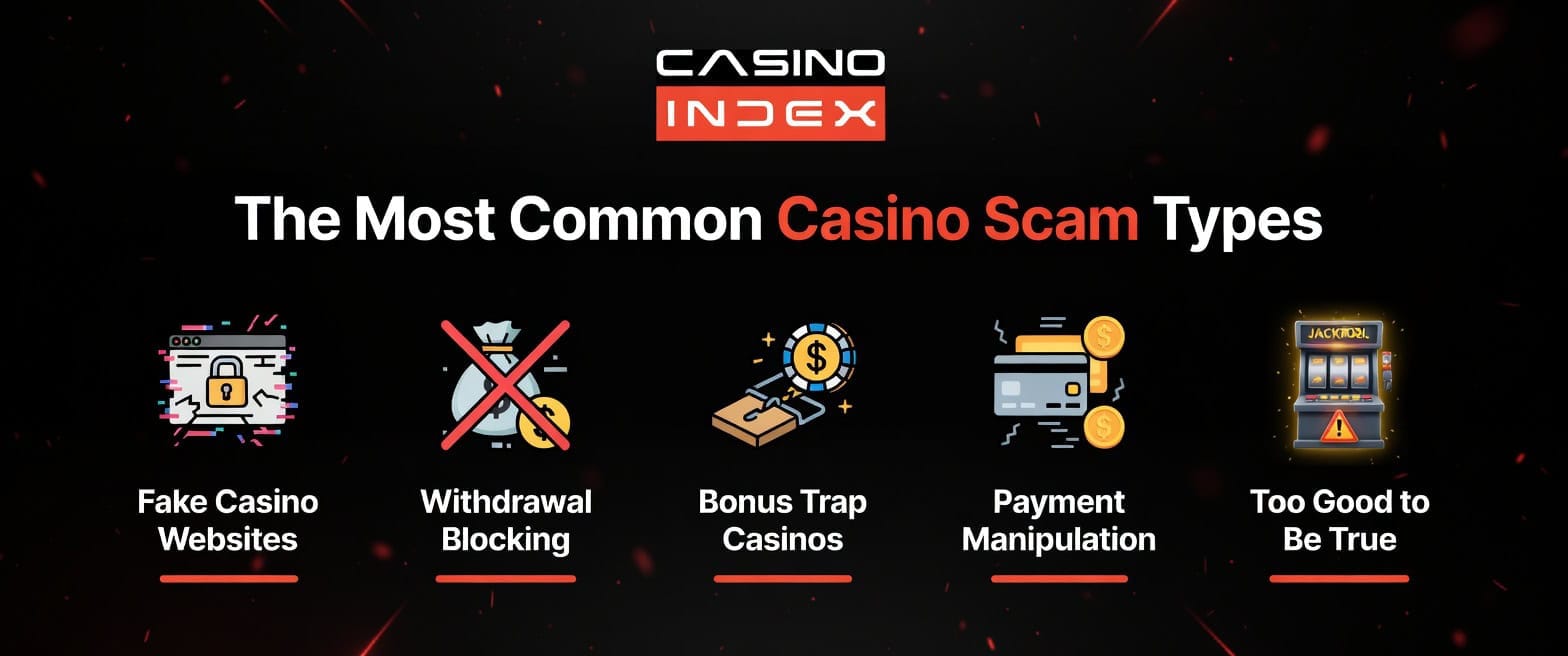
Fake Casino Websites
These are the most direct type of scam.
They copy:
- branding
- layout
- game libraries
To look real.
Once deposits are made, withdrawals never happen.
These sites often disappear after a short period.
Comparing these setups against top crypto casino platforms makes unrealistic operators easier to spot.
Withdrawal Blocking Casinos
These platforms operate normally until you win.
Then they:
- delay withdrawals
- request repeated documents
- create unclear explanations
- stop responding
This is one of the most common scam patterns.
Comparing this behavior against fast payout casinos makes soft-blocking patterns much easier to detect.
Bonus Trap Casinos
Some casinos use bonuses as a trap.
They advertise large offers but hide:
- unrealistic wagering requirements
- strict max bet rules
- vague abuse clauses
When you try to withdraw, they use these rules to block payouts.
A proper bonus terms breakdown makes these payout traps much easier to spot before deposit.
Payment Manipulation
Some platforms accept deposits easily but restrict withdrawals through:
- limited payment options
- forced payment method changes
- withdrawal caps not clearly stated
This creates friction and delays.
A clear payment methods overview helps reveal these withdrawal bottlenecks early.
“Too Good to Be True” Platforms
If a casino offers:
- extremely high bonuses
- guaranteed wins
- unrealistic rewards
It usually signals risk.
Legitimate casinos operate on margins.
They cannot offer unlimited value.
Early Warning Signs Most Players Ignore
Unclear Terms and Conditions
One of the biggest red flags is vague language.
Watch for:
- unclear bonus rules
- missing withdrawal details
- generic legal text
Reliable casinos explain rules clearly.
You can review those clauses more critically through the casino terms and conditions guide.
Poor or Delayed Support
A reliable operator answers specific pre-deposit questions about withdrawal limits, KYC triggers, processing times, and restricted payment methods. Vague answers before registration often predict bigger issues after a win.
Warning signs include:
- slow responses
- copy-paste replies
- avoiding direct answers
Support quality usually reflects internal processes.
Payment Inconsistencies
If deposit methods and withdrawal methods do not align, it creates risk.
Example:
- many deposit options
- very limited withdrawal options
This imbalance often leads to delays.
No Real Reputation
If you cannot find:
- real reviews
- consistent feedback
- platform mentions
That is a warning sign.
Reliable casinos leave a visible footprint.
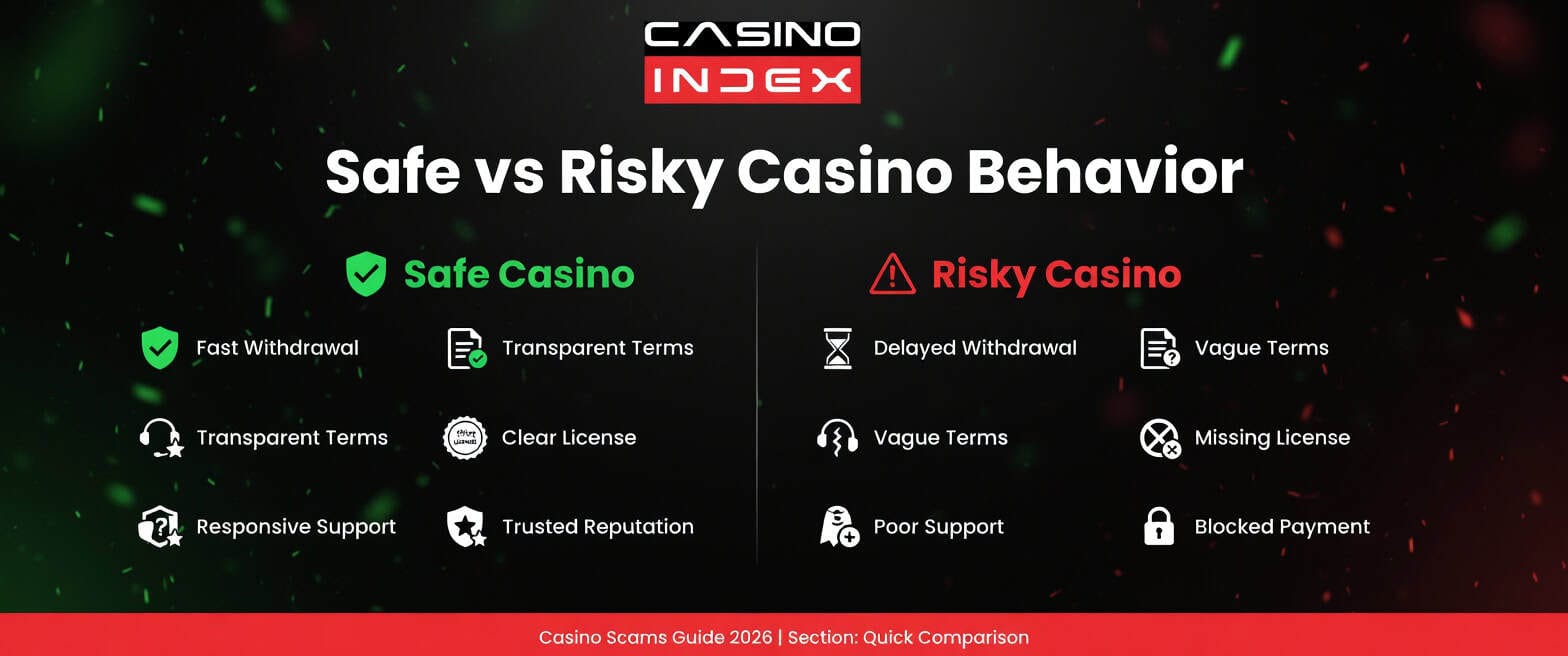
Quick Comparison: Safe vs Risky Casino Behavior
| Signal | Safer Casino | Risky Casino |
|---|---|---|
| Withdrawal process | Clear and consistent | Delayed or unclear |
| Bonus terms | Transparent | Complex and vague |
| Support | Responsive and helpful | Slow or evasive |
| Licensing | Clearly stated | Missing or unclear |
| Reputation | Established presence | Limited or inconsistent |
This comparison helps simplify evaluation.
Why Withdrawal Behavior Is the Most Important Signal
Everything comes down to one question:
Can you actually get your money out?
A casino can look polished on the surface. If withdrawals fail, none of the other features matter.
That is why payout behavior remains the strongest trust signal. To understand what normal processing looks like versus a real warning sign, review the casino withdrawal guide.
How to Verify If a Casino Is Legit (Before You Deposit)
Start With a Simple Rule
Never judge a casino by how it looks.
Judge it by how it behaves.
Design, bonuses, and marketing are easy to copy. Payment behavior, support quality, and terms consistency are much harder to fake.
If you follow a structured check before depositing, you eliminate most risks.
Step 1 — Check Licensing (But Don’t Stop There)
Licensing is the first filter, not the final decision.
A casino should clearly display:
- licensing authority
- license number
- regulatory information
Reliable casinos make this easy to find.
If licensing is missing or unclear, that is already a strong warning sign.
For the compliance side of this check, review the casino licensing overview.
Why Licensing Alone Is Not Enough
Many players make this mistake.
They see a license and assume the casino is safe.
Reality:
Licensing quality varies.
Some licenses enforce strict rules. Others provide minimal oversight.
This means:
License present ≠ guaranteed safety
It only means the casino passed a basic requirement.
You still need to check everything else.
Step 2 — Evaluate Withdrawal Behavior
This is the most important step.
Before depositing, ask:
- how long do withdrawals take?
- are limits clearly stated?
- do users report delays?
Reliable casinos are consistent.
Unreliable ones create friction.
The difference becomes clearer when you compare real-world payout patterns against the withdrawal speed comparison.
Step 3 — Read Terms Like a Professional
Most players ignore terms.
That’s where problems start.
Focus on:
- withdrawal limits
- bonus conditions
- verification rules
- restricted activities
You don’t need to read everything.
But you need to understand the sections that affect your money.
Red Flags Inside Terms
Watch for:
- vague wording
- “at our discretion” clauses
- unclear wagering explanations
- undefined withdrawal conditions
These give casinos room to block payouts.
Step 4 — Check Payment Structure
A reliable casino has balanced payment options.
That means:
Deposit methods ≈ Withdrawal methods
If a casino offers many ways to deposit but very few ways to withdraw, that is a warning sign.
Payment reliability becomes easier to judge when you compare systems through the casino payment structure guide.
Step 5 — Test the Casino Before Going Big
Experienced players never start with large deposits.
They test first.
Safe Testing Method
- deposit a small amount
- play lightly
- request a small withdrawal
This reveals:
- processing speed
- verification requirements
- support quality
If a casino performs well in small tests, it is usually more reliable at larger scale.
Step 6 — Evaluate Support Quality
Support is often overlooked.
But it reveals everything.
Reliable support:
- answers directly
- explains clearly
- responds consistently
Weak support:
- avoids questions
- sends generic replies
- delays responses
If support cannot answer basic questions before you deposit, it will not improve later.
Step 7 — Compare With Known Platforms
Never evaluate a casino in isolation.
Compare it with established platforms.
For example:
- the BitStarz payout model is useful when judging withdrawal consistency
- TrustDice gives a clear example of a bonus-heavy structure
- the BC.Game ecosystem shows how a feature-rich casino is positioned
Comparing platforms gives context.
Context reveals quality.
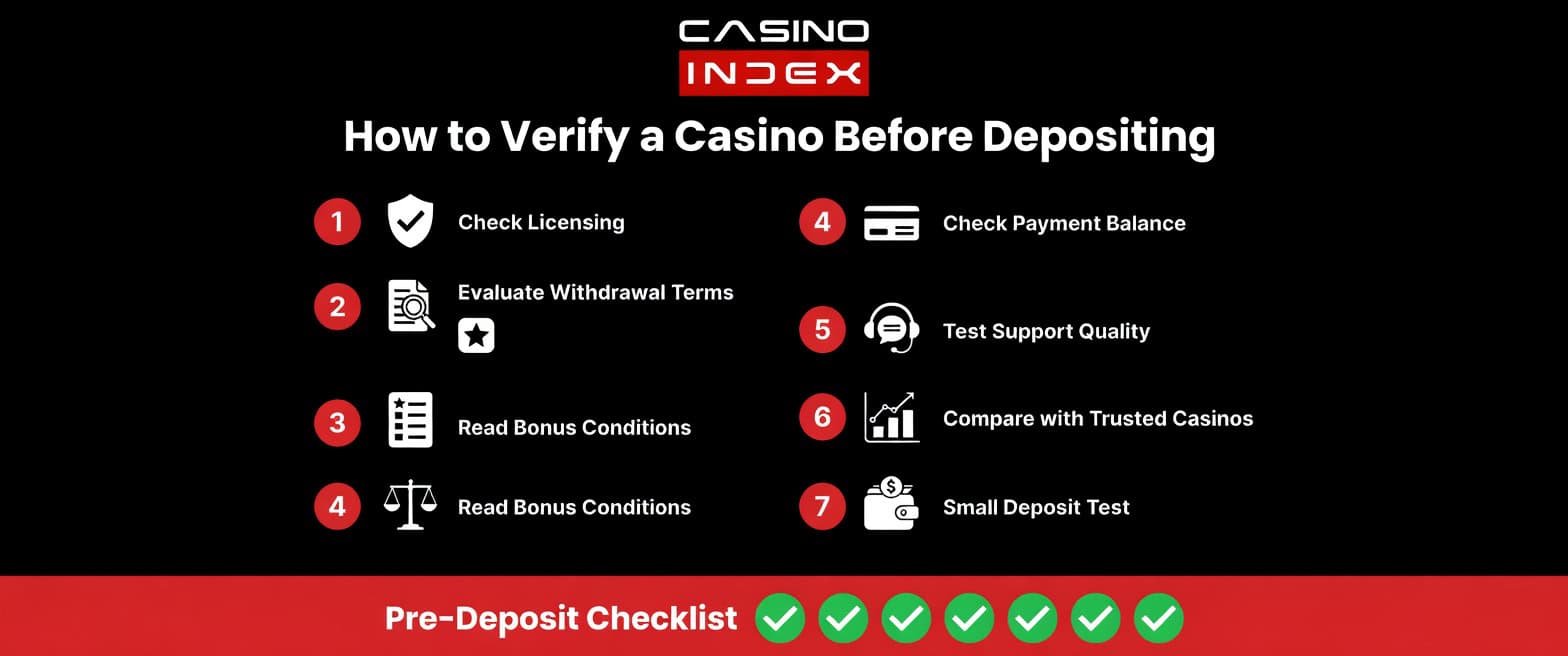
The “Pre-Deposit Checklist” Used by Experienced Players
Before depositing, experienced players run a quick mental checklist.
✔ License visible and clear
✔ Withdrawal terms understandable
✔ Payment methods balanced
✔ Support responsive
✔ No major red flags
If one or more of these fail, they move on.
How to Test a Casino Without Risking Large Money
Small Deposit Strategy
Start with the minimum deposit.
This reduces risk.
Early Withdrawal Test
Do not wait until a big win.
Test withdrawal early.
This shows:
- how fast funds move
- how support responds
- whether verification is required
Observe Behavior, Not Promises
Ignore:
- marketing claims
- bonus size
- homepage messaging
Focus on:
- actual payout behavior
- real responses
- real processing time
That is what matters.
The Biggest Mistakes Players Make When Verifying Casinos
Trusting Bonuses Too Much
Large bonuses attract attention.
But they often hide:
- strict rules
- high wagering
- payout restrictions
Always evaluate usability, not size.
You can break those offers down more clearly through the casino bonus mechanics guide.
Skipping the Test Phase
Players deposit large amounts immediately.
This increases risk.
Testing first removes uncertainty.
Ignoring Withdrawal Terms
Many players only check deposit options.
Withdrawals are more important.
Always check:
- limits
- processing times
- payment methods
Believing “No KYC” Means No Verification
Some platforms advertise minimal verification.
But large withdrawals often trigger checks.
A clearer casino verification guide helps explain why low-friction onboarding does not always mean zero checks.
Quick Comparison: Verified vs Unverified Approach
| Approach | Outcome |
|---|---|
| Test first | Controlled risk |
| Deposit large early | High risk |
| Check terms | Fewer surprises |
| Ignore terms | Possible withdrawal issues |
| Compare platforms | Better decisions |
| Trust marketing | Higher chance of mistakes |
These benchmarks become clearer when you compare them against broader best online casinos 2026 comparison, not isolated marketing pages.
Why Experienced Players Rarely Get Scammed
It’s not luck.
It’s process.
They:
- verify before depositing
- test before committing
- compare before choosing
- withdraw early
This removes most risk.
What to Do If You Get Scammed (Step-by-Step Recovery)
First Rule — Stay Controlled
The worst move after a problem is panic.
Do not:
- spam support
- threaten immediately
- open multiple tickets
- redeposit to “fix” the issue
These actions often make things worse.
Start structured.
Step 1 — Identify the Exact Problem
Be precise.
Common situations:
- withdrawal stuck in pending
- withdrawal rejected
- account restricted
- bonus conflict
- verification delay
Each requires a different response.
If you are unsure, compare the situation against the casino withdrawal guide to see whether the delay looks standard or abnormal.
Step 2 — Gather Evidence (Do This Early)
Before contacting support, collect proof.
You need:
- transaction IDs
- deposit confirmations
- withdrawal request details
- account screenshots
- chat history
Save everything.
Do not rely on memory.
Clear documentation increases your chances significantly.
Step 3 — Contact Support the Right Way
Most players fail here.
Bad approach:
- emotional messages
- vague complaints
- aggressive tone
Professional approach:
- clear explanation
- exact problem
- supporting evidence
- calm tone
Example structure:
- what happened
- when it happened
- what you expect
Support responds better to clarity.
Step 4 — Give Realistic Time
Not every delay is a scam.
Allow:
- 24–72 hours for normal processing
- additional time for verification
If the casino communicates clearly, it’s usually not a scam.
If communication stops, risk increases.
Step 5 — Escalate if Necessary
If support does not resolve the issue:
Next steps:
- request escalation internally
- reference previous ticket
- ask for specific timeline
Stay structured.
Do not open multiple tickets.
Step 6 — Evaluate If It’s Actually a Scam
At this point, ask:
- is the casino responding?
- are reasons consistent?
- are requests reasonable?
If yes → likely delay, not scam
If no → higher risk situation
Compare that behavior with benchmarks like the BitStarz payout model or TrustDice to understand how stronger operators usually handle pressure situations.
When a Casino Becomes High Risk
Clear Scam Indicators
At some point, patterns become obvious.
Warning signs:
- no response for extended time
- constantly changing explanations
- new rules appearing after a win
- refusal without clear reason
- impossible verification requests
If multiple signs appear together, risk is high.
Withdrawal Blocking Patterns
Some casinos do not refuse directly.
Instead, they:
- delay repeatedly
- ask for documents again and again
- avoid giving final answers
This creates “soft blocking”.
It’s one of the most common scam strategies.
How to Limit Damage
Stop Depositing Immediately
This sounds obvious, but many players continue depositing to “solve” issues.
Never do this.
It increases losses.
Do Not Chase Losses
Trying to recover funds through more play rarely works.
It leads to:
- emotional decisions
- larger losses
Stick to controlled actions.
Secure Your Account
If something feels wrong:
- change password
- enable 2FA
- review account activity
This prevents further issues.
Can You Recover Lost Funds?
Reality Check
In crypto environments:
Recovery is difficult.
Transactions are:
Irreversible
Final
This is why prevention matters more than recovery.
When Recovery Is Possible
You may have options if:
- casino is licensed
- support still responds
- issue is procedural
In these cases:
- provide documents
- follow instructions
- remain consistent
When Recovery Is Unlikely
If:
- casino disappears
- no support exists
- no license is visible
Funds are likely lost.
This is why initial verification is critical.
How to Avoid Getting Scammed Again
Use a Structured Approach
Every time you try a new casino:
- verify first
- test with small deposit
- withdraw early
- observe behavior
This removes most risk.
Stick to Proven Platforms
Avoid random casinos.
Use platforms with:
- established reputation
- verified reviews
- consistent payout history
This reduces exposure significantly.
Understand Systems Before Using Them
Most problems come from:
- misunderstanding rules
- ignoring terms
- skipping verification
Learning how stronger operators are assessed through the platform trust analysis helps prevent these mistakes.
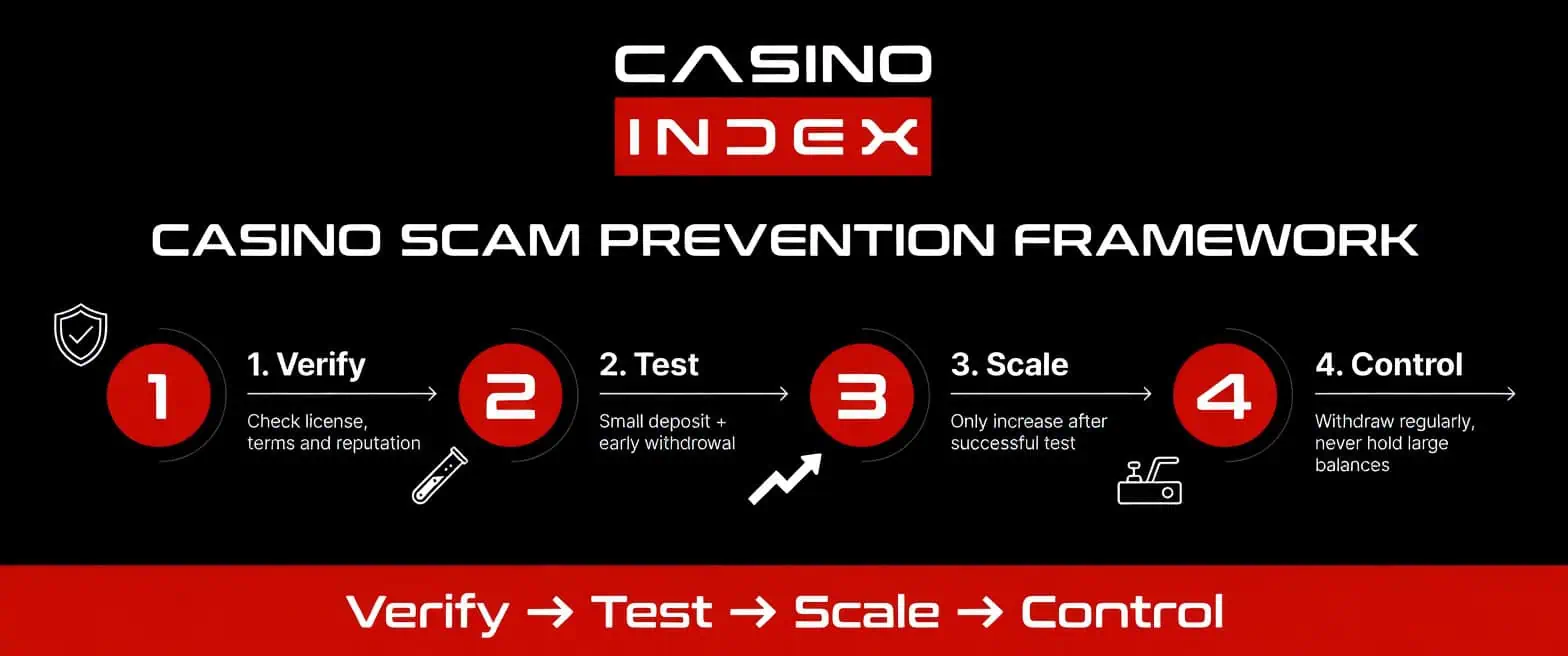
Casino Scam Prevention Framework
Simple Model Used by Experienced Players
Step 1 — Verify
Check license, payments, terms.
Step 2 — Test
Deposit small
Withdraw early
Step 3 — Scale
Only increase deposits after successful test.
Step 4 — Control
Withdraw regularly
Avoid large balances
This framework works across all casino types.
Final Comparison: Safe Behavior vs Risky Behavior
| Behavior | Result |
|---|---|
| Testing first | Low risk |
| Depositing large early | High risk |
| Checking terms | Fewer surprises |
| Ignoring terms | Higher chance of issues |
| Withdrawing early | Better control |
| Holding large balance | Increased exposure |
Casino Scams FAQ
What is the most common type of casino scam?
The most common scam is not a fake website.
It is a casino that allows deposits but delays or blocks withdrawals later.
These platforms operate normally at the beginning. Problems only appear when players try to cash out. That is why withdrawal behavior is the strongest trust signal.
How can I tell if a withdrawal delay is normal or a scam?
Not every delay is a scam.
Normal delays usually involve:
- verification checks
- bonus validation
- payment processing time
Suspicious delays involve:
- no clear explanation
- repeated requests for documents
- changing reasons
- no response from support
If a casino communicates clearly and consistently, it is usually not a scam.
Why do casinos ask for verification after I win?
Verification is part of compliance rules.
Casinos need to confirm:
- identity
- age
- payment ownership
The reason it often happens after a win is simple:
That is when money leaves the platform.
Prepared players usually complete checks early. The casino verification guide explains why that reduces payout friction later.
Can casinos legally refuse to pay winnings?
Yes, but only under specific conditions.
Valid reasons include:
- violating bonus terms
- using restricted strategies
- incomplete verification
- using third-party payment methods
Unfair refusal usually involves vague or changing explanations.
That is why reading terms before playing matters.
Are crypto casinos more likely to scam players?
Not necessarily.
Crypto casinos are different, not automatically more dangerous.
However, risks increase when:
- platforms are unregulated
- players do not verify information
- transactions are sent incorrectly
Crypto removes banking protection, which means responsibility shifts to the player.
What is a “bonus trap” and how does it work?
A bonus trap is designed to block withdrawals.
It usually involves:
- high wagering requirements
- strict max bet rules
- hidden restrictions
- unclear conditions
Players accept the bonus without understanding the terms.
Later, the casino uses those rules to deny payouts.
A proper bonus structure comparison helps expose these traps before they become payout disputes.
How important are reviews when choosing a casino?
Very important, but only if they are reliable.
Real reviews help you understand:
- payout consistency
- support quality
- real user experience
Comparing benchmarks like the BitStarz payout model or the BC.Game ecosystem gives context that marketing pages cannot provide.
What should I do if support is not responding?
First, stay structured.
- wait reasonable time
- follow up with the same ticket
- avoid opening multiple requests
If there is still no response:
- this becomes a warning signal
- reassess the platform
Reliable casinos do not ignore players consistently.
Is it safe to deposit large amounts immediately?
No.
Experienced players never start with large deposits.
They:
- test with small amounts
- check withdrawal behavior
- evaluate support
Only after successful testing do they increase deposits.
Can a casino change its terms after I win?
Legitimate casinos should not change terms retroactively.
However, some weak operators attempt this.
Warning signs include:
- new rules applied after a win
- unclear clauses suddenly enforced
- support referencing terms that were not visible before
This is why screenshots and documentation matter.
What are the biggest red flags before registering?
Common warning signs include:
- unclear licensing
- unrealistic bonuses
- limited withdrawal options
- poor support communication
- no real reputation
If multiple red flags appear, it is better to avoid the platform.
Why do some casinos ask for the same documents multiple times?
This can happen for two reasons.
Normal reason:
- incomplete or unclear documents
Suspicious reason:
- delaying withdrawals intentionally
If requests repeat without clear explanation, risk increases.
How can I protect myself from scam casinos?
Use a simple process:
- verify casino reputation
- check payment methods
- read key terms
- test with small deposit
- withdraw early
This process removes most risk.
Are there completely safe casinos?
No platform is 100% risk-free.
However, some casinos are significantly safer than others.
Safer platforms usually have:
- consistent payouts
- clear terms
- responsive support
- strong reputation
That is the difference.
Do fast withdrawals mean a casino is safe?
Not always.
Fast withdrawals are a positive sign, but not the only factor.
A casino can process payments quickly and still have issues with:
- terms
- support
- account handling
That is why overall evaluation matters.
Can I trust influencer promotions?
Be careful.
Influencers often promote casinos based on:
- sponsorships
- affiliate deals
This does not always reflect real quality.
Independent research is more reliable.
What is the safest way to test a new casino?
Use this method:
- deposit minimum amount
- play lightly
- request withdrawal early
Observe:
- processing speed
- communication
- requirements
This gives real insight.
Why do players ignore scam warning signs?
Because of:
- bonus attraction
- urgency
- overconfidence
- lack of knowledge
Scams rely on emotional decisions.
Structured thinking prevents mistakes.
Can a casino block my account without reason?
They can block accounts, but they should provide a reason.
Legitimate reasons include:
- suspicious activity
- rule violations
- compliance checks
Unclear or inconsistent blocking is a red flag.
What is the most important rule to avoid scams?
Simple:
Never trust a casino before testing withdrawals.
Everything else is secondary.
How do experienced players avoid scams consistently?
They follow a clear system:
verify
test
compare
withdraw
Instead of relying on luck, experienced players trust process.
That approach is what helps them avoid most casino scams.
Final Conclusion
Casino scams do not happen randomly.
They follow patterns.
Players who understand these patterns avoid most risks.
The key is simple:
- verify before depositing
- test before trusting
- withdraw before scaling
Crypto or fiat does not change this rule.
The safest players are not the luckiest.
They are the most prepared.