Online Casino Terms and Conditions: What to Read Before You Deposit
Article OverviewOnline casino terms and conditions determine who can play, how bonuses must be wagered, when KYC may be requested, which withdrawal limits apply and how funds can be paid out. Before depositing, check country restrictions, maximum bet and cashout rules, payment matching, verification triggers, fees and the complaints process.
Online casino terms and conditions matter most when a player tries to withdraw, not when the deposit button works. They define who may play, how bonuses are cleared, when verification can be requested, which payment method may receive a cashout, and what can happen if the operator believes a rule was broken.
Most players discover those details in the wrong order. They register, accept an offer, deposit, play and request a withdrawal. Only then do they find the max-bet limit, identity check, country restriction or payout cap that controlled the account from the beginning.
This guide reverses that process. It shows where casino rules are usually published, which clauses deserve attention first, how to run a focused five-minute check and which wording should make you pause before sending money.
Strict terms are not automatically unfair. Age checks, one-account rules, payment verification and fraud controls can have legitimate purposes. The real question is whether important conditions are visible, specific, proportionate and applied consistently.
This is practical player-safety guidance, not legal advice. Gambling rules and consumer rights vary by jurisdiction.
Online casino terms and conditions: the 60-second answer
If you only have one minute, check the rules that control eligibility, bonus value and access to your balance.
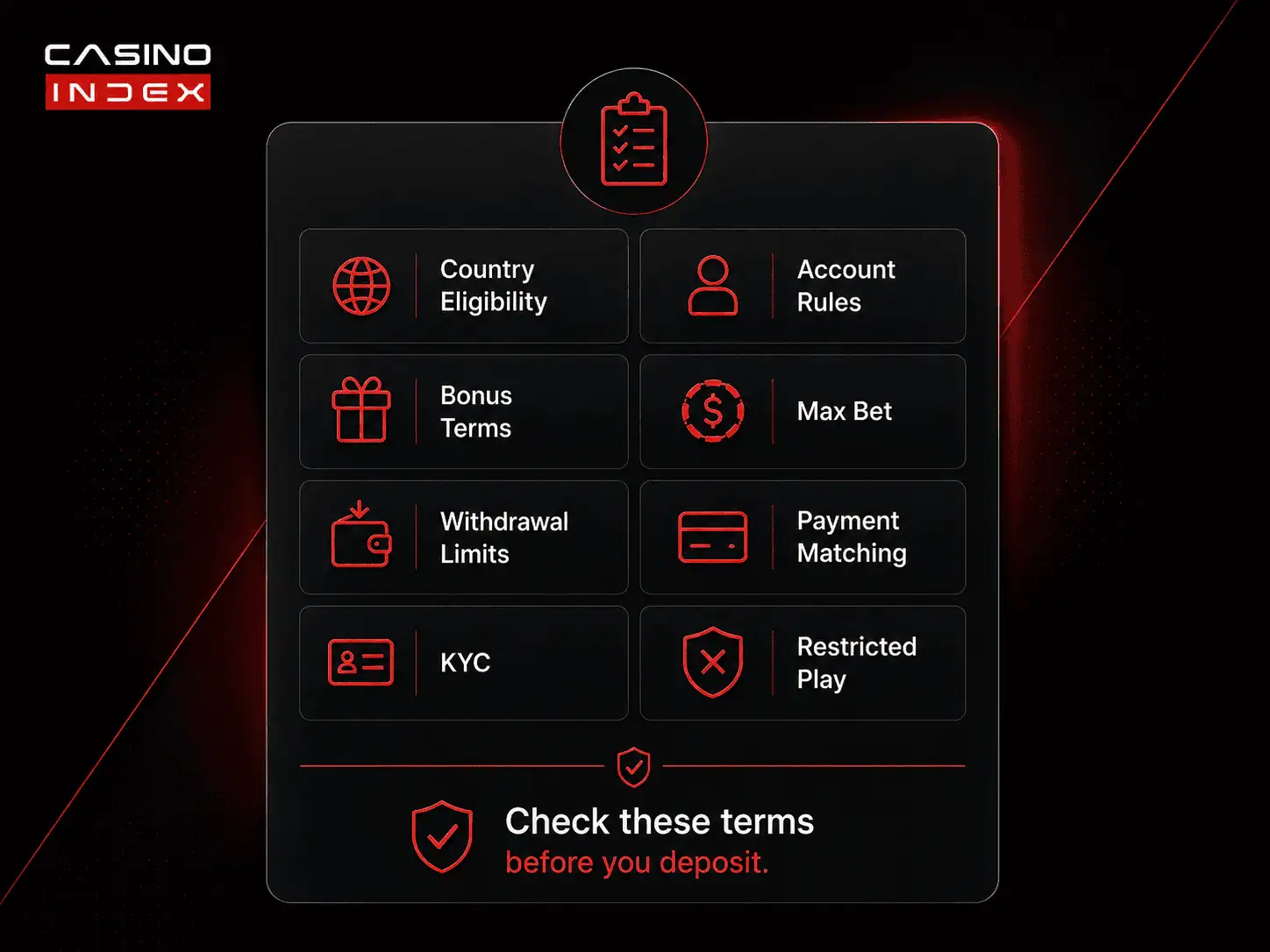
| Check first | Question to answer | Reason it matters |
|---|---|---|
| Country and age | Are your location, age and residency clearly accepted? | Registration access does not always prove real-money eligibility. |
| Account rules | Are shared devices, households, IP addresses or VPNs restricted? | An innocent overlap can resemble duplicate-account activity. |
| Bonus rules | What must be wagered, by when, at which maximum stake? | A headline bonus can become poor value once the restrictions are applied. |
| Withdrawals | What are the minimum, maximum and processing limits? | A large balance may take weeks or months to withdraw. |
| Payment matching | Can the deposit method receive withdrawals? | Some methods work only for deposits or require a different payout route. |
| KYC and source of funds | Which documents may be requested, and at what stage? | “No KYC at signup” does not necessarily mean “no verification at withdrawal.” |
| Restricted play | Which games, strategies or betting patterns are prohibited? | Vague abuse clauses can create disputes over winnings. |
If the casino does not explain these points clearly, do not assume support will interpret them in your favour later.
Where to find online casino terms and conditions — and which version matters
A casino rarely keeps every important condition on one page. The general terms may define the account relationship, while separate documents control bonuses, payments, verification and individual promotions.
Before depositing, open all relevant documents:
- General terms: eligibility, account ownership, prohibited conduct, suspension and complaints.
- Bonus terms: wagering, max bet, eligible games, expiry, max cashout and balance order.
- Payment or cashier rules: limits, fees, processing times and payment matching.
- Verification policy: KYC, proof of address, payment ownership and source-of-funds checks.
- Promotion-specific rules: conditions that apply only to one welcome offer, reload, cashback or free-spin package.
- Complaints policy: the formal escalation route, response timeframe and any named dispute-resolution body.
These pages are usually linked from the footer, registration form, cashier, promotion page or help centre. Missing, broken or difficult-to-find terms are a warning sign. So are different pages that contradict one another.
Record the URL and “last updated” date. Save a PDF or screenshot of the conditions that applied when you registered or accepted a promotion. Terms can change, and a dated copy gives you something concrete to compare if a dispute develops.
If the general rules and a promotion page appear inconsistent, ask support which clause controls the offer and request the answer in writing. Do not rely on an undocumented live-chat promise that conflicts with published terms.
The five-minute pre-deposit terms check
A quick review of online casino terms and conditions does not require reading every legal paragraph before a small deposit. It does require finding the clauses that can change the value or accessibility of your balance.
- Open the key documents. Load the general terms, bonus rules, payment page and verification policy in separate tabs.
- Search the pages. Use your browser’s search function for: withdraw, wagering, max bet, max cashout, verification, KYC, restricted, country, household, VPN, bonus abuse, source of funds, fee and dormant.
- Write down the numbers. Note the wagering multiplier, expiry, stake limit, cashout cap, payout limits, fees and review times.
- Check for broad discretion. Look for phrases such as “at our sole discretion,” “irregular play” and “management decision is final.” Then check whether examples or a review process limit that discretion.
- Make a deposit decision. If a rule affecting money is missing, contradictory or too broad to understand, pause and ask for clarification before paying.
1. Confirm country, age and VPN eligibility
The first question is not whether the website loads. It is whether the operator clearly accepts players in your circumstances.
Check restricted countries, permitted locations, minimum age, residency requirements and the casino’s position on VPN or proxy use. Some operators distinguish between residence, physical location and the country connected to a payment method. Others place responsibility on the player to determine whether gambling is legal locally.
A casino may allow registration or even a deposit before it identifies a location conflict. That does not prove the operator intends to withhold money, but it makes an assumption expensive. If your country is restricted, unclear or absent from the eligible list, get a written answer before depositing.
Never use a VPN to bypass a stated country restriction. It can create location inconsistencies during verification and give the operator a direct terms-based reason to review the account.
2. Review account, household and device rules
Most casinos permit one account per person. Many also restrict multiple accounts connected to the same household, device, IP address, payment method or network.
That can affect legitimate users. Two family members may share Wi-Fi. A couple may use the same laptop. A player may create a second account after forgetting the first login. Those situations can resemble multi-accounting even when no one intended to exploit an offer.
Search for:
- one account per person or household;
- shared IP address or shared device restrictions;
- third-party deposits and payment ownership;
- VPN, proxy and geolocation requirements;
- duplicate-account penalties;
- rules covering self-excluded or previously closed accounts.
The lowest-friction setup is simple: one real identity, one account, one payment profile and no shared login. If another household member already uses the casino, ask support whether a second verified account is allowed before creating it.
3. Calculate the real cost of casino bonus terms
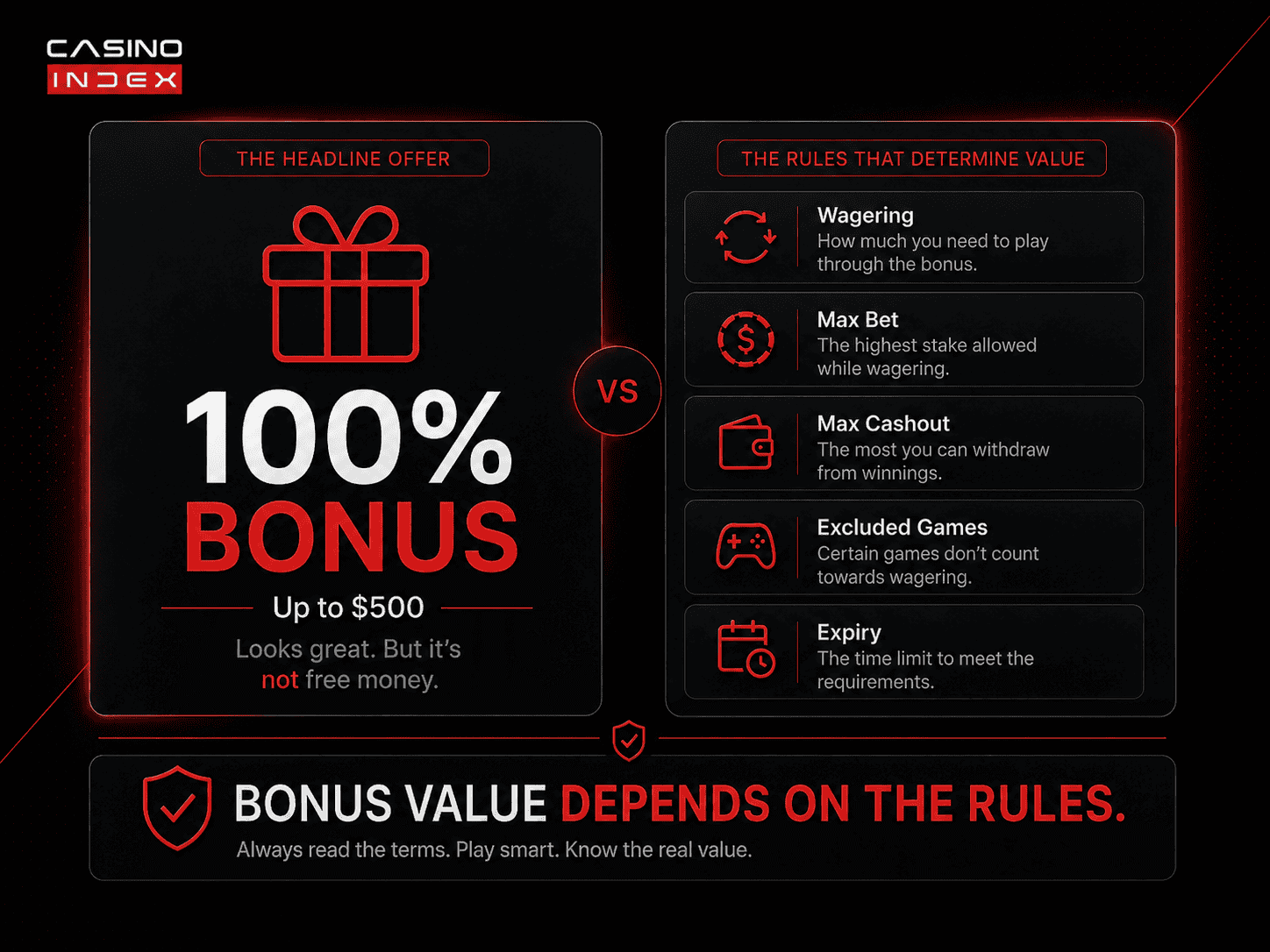
Casino bonus terms are where the promotional headline becomes a financial commitment. A 100% match does not tell you how much must be wagered, how long you have, which games count or how much can eventually be withdrawn.
Check what the wagering multiplier applies to
The same “35x wagering” label can describe two very different obligations.
Suppose you deposit $100 and receive a $100 bonus:
- 35x bonus only: $100 × 35 = $3,500 in required wagering.
- 35x deposit plus bonus: ($100 + $100) × 35 = $7,000 in required wagering.
The multiplier is identical, but the second offer requires twice the betting volume. This is why the wagering base matters as much as the advertised number.
Find the maximum bet
Casinos often cap the amount that may be staked per spin, hand or round while a bonus is active. The rule can apply even when the interface displays a combined cash-and-bonus balance.
Check whether the limit covers slots, live games, table games, bonus buys, autoplay and gamble features. Some operators treat the full price of a bonus buy as the stake; others prohibit the feature during wagering.
Exceeding the limit once can trigger a bonus review. Do not assume that an accidental breach will be ignored simply because the interface accepted the bet.
Check game contribution and excluded games
Slots may contribute 100% toward wagering while blackjack, roulette or video poker contributes much less—or nothing. High-RTP games and low-risk betting patterns can also be restricted.
Look for a contribution table and a separate excluded-game list. If neither is easy to find, you cannot calculate how long the requirement will realistically take.
Check expiry and balance order
Record when the bonus activates and when it expires. Also check whether bets use cash first, bonus funds first or a proportional combination. Balance order affects how much real money remains if you opt out or request an early withdrawal.
Look for maximum cashout
A max-cashout clause caps the amount that may be withdrawn from a promotion even when the displayed balance is higher. It is common with free spins and no-deposit offers, but it can also appear on deposit bonuses, cashback and country-specific promotions.
A high wagering requirement paired with a low cashout ceiling is usually weak value. The player carries the betting requirement while the upside remains limited.
For a deeper breakdown, read the CasinoIndex casino bonus guide.
4. Read casino withdrawal rules before trusting speed claims
“Instant” usually describes the payment stage after approval. It does not necessarily include the pending period, internal review or KYC process that comes first.
Before depositing, record:
- minimum withdrawal amount;
- maximum per transaction;
- daily, weekly and monthly limits;
- pending or reversible withdrawal period;
- internal approval timeframe;
- fees and blockchain network costs;
- manual-review clauses;
- jackpot, VIP or large-win exceptions;
- rules for dormant or inactive balances.
A $5,000 monthly limit turns a $20,000 balance into a four-month payout schedule before any additional review or payment delay is considered. The casino can still be solvent and legitimate, but the limit materially changes the player’s exposure.
Use the broader casino withdrawal guide for the complete payout process and the separate explanation of withdrawal limits for large-balance risk.
5. Check payment matching before choosing how to deposit
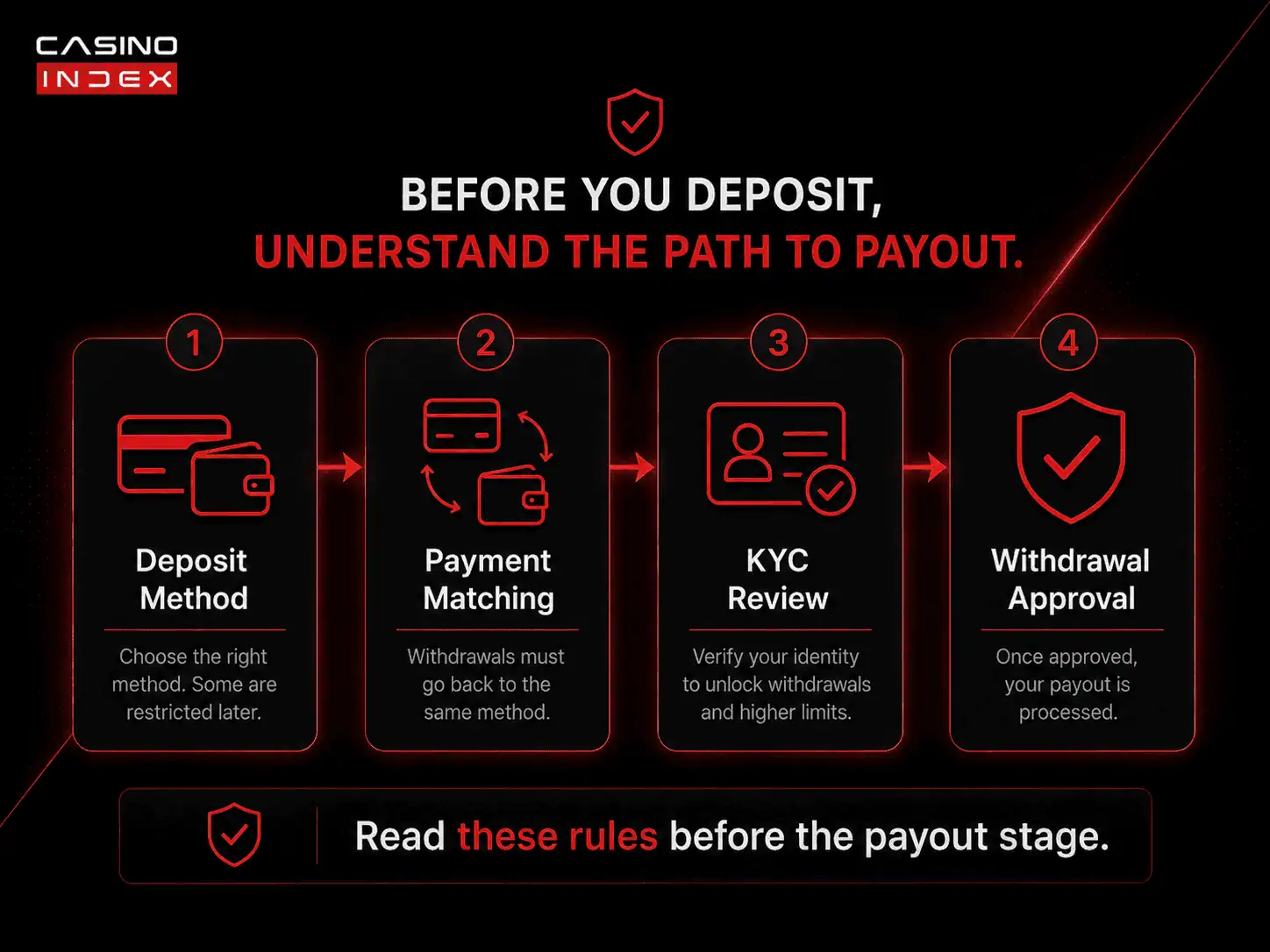
Many operators follow closed-loop payment logic: funds should return through the method used for the deposit where possible. This can support fraud prevention and payment traceability, but it creates friction when the original method cannot receive withdrawals.
Prepaid options, third-party crypto purchase services and some local banking methods may work on the way in but not on the way out. A card may allow only the original deposit amount to be returned before winnings move through another route.
Ask three questions before depositing:
- Can this method receive withdrawals?
- Must the deposit amount be returned to it first?
- What verified alternative is used for the remaining balance?
Never deposit from another person’s card, bank account or crypto-exchange account unless the operator explicitly permits it. Payment ownership mismatches are a common reason for enhanced verification.
See the full explanation of casino payment matching rules.
6. Understand KYC before the first withdrawal
Quick registration is not the same as permanent verification-free play. A casino may request documents when a player withdraws, reaches a risk threshold, changes payment methods, wins a larger amount or triggers an account review.
Read which documents may be required, when the process can begin and how rejected or expired documents are handled. The policy should distinguish routine identity verification from enhanced checks such as proof of payment ownership or source of funds.
A normal review asks for relevant evidence and provides a workable submission path. Risk increases when requests keep changing, no timeframe is offered, or documents unrelated to the stated concern are repeatedly demanded without explanation.
Verification documents are sensitive. Submit them only through the operator’s confirmed secure process after checking the casino’s identity, licence and privacy information. Do not send documents to an unverified contact simply because a message claims to be support.
CasinoIndex explains the expected process in its guide to a safer casino KYC process.
7. Identify vague bonus-abuse and restricted-play clauses
Some discretion is unavoidable. Operators need tools to investigate fraud, collusion, duplicate accounts, payment abuse and deliberate exploitation of promotions. Problems begin when the terms give the casino broad power without defining the prohibited behaviour or explaining how a decision can be reviewed.
Read phrases such as:
- “at our sole discretion”;
- “irregular play” or “abnormal betting pattern”;
- “bonus abuse”;
- “suspicious activity”;
- “breach of the spirit of the promotion”;
- “management decision is final”;
- “we reserve the right to void winnings.”
The wording itself is not proof of misconduct. The useful test is whether the surrounding rules give examples, thresholds, evidence standards or a complaint route. “One account per person” is specific. “Any play we dislike may be treated as abuse” is not.
Also check whether different documents use different definitions. A bonus page may permit a game that the general terms classify as restricted. A cashier page may advertise one limit while the general rules reserve the right to apply another. Contradictions should be resolved in writing before play.
8. Do not overlook fees, inactivity and account closure
These clauses receive less attention than bonuses, but they can affect a balance over time.
- Deposit and withdrawal fees: check both casino charges and third-party processor or network costs.
- Currency conversion: find out which exchange rate applies when the account and payment method use different currencies.
- Dormant-account fees: note when inactivity begins and whether the casino deducts recurring charges.
- Account closure: check how a remaining verified balance is returned after a voluntary or operator-led closure.
- Tax responsibility: rules differ by country. Operator terms may place reporting responsibility on the player, but they do not replace local tax law.
An inactivity clause should state the timeframe, fee and communication process. A broad right to reduce or remove a balance without clear notice deserves closer scrutiny.
Five realistic ways casino terms create disputes
These examples are simplified, but each shows how a small clause can control a much larger balance.
| Situation | Rule that matters | Possible outcome | Safer action |
|---|---|---|---|
| A player raises the stake after an early bonus win. | Maximum bet during wagering | Bonus winnings are reviewed or voided. | Set a stake below the published limit and avoid bonus buys unless clearly allowed. |
| A $100 deposit and $100 bonus carry 35x wagering. | Bonus-only versus deposit-plus-bonus calculation | The real requirement is $3,500 or $7,000. | Calculate the wagering base before opting in. |
| A deposit method cannot receive winnings. | Payment matching and fallback withdrawal route | The cashout pauses for additional payment verification. | Confirm the withdrawal route before depositing. |
| Two adults play from the same home network. | One-account-per-household or shared-IP rule | Both accounts may be linked and reviewed. | Ask support for written approval before the second account is created. |
| A large win exceeds the monthly withdrawal limit. | Payout cap and large-win review | Funds remain exposed on the platform for longer. | Choose limits that match your likely balance and test withdrawals early. |
Strict terms versus potentially unfair terms
A rule can be inconvenient without being deceptive. Compare how the condition is written and applied.
| Area | Clear but strict | Higher-risk wording or practice |
|---|---|---|
| KYC | Lists possible documents, triggers and a submission process. | Repeated new requests with no explanation or workable endpoint. |
| Withdrawals | Shows exact limits, fees and expected review time. | Limits may change at any time without usable detail. |
| Bonus max bet | Displays the amount next to the offer and in the bonus rules. | The limit is buried or defined differently across pages. |
| Restricted play | Names prohibited games, strategies and account behaviour. | Allows winnings to be voided for undefined “irregular play.” |
| Country access | Provides a current restricted-country list. | Accepts deposits while leaving basic eligibility impossible to determine. |
| Complaints | Provides a written process and escalation route. | States that management decisions are final with no review path. |
For Great Britain-licensed operators, the UK Gambling Commission states that customers must be treated fairly and that this extends to terms, conditions and practices. Requirements vary elsewhere, so always check the regulator named on the casino’s own licence page. See the Commission’s official guidance on fair and transparent terms and practices.
How to protect yourself before and after depositing
- Verify the operator and licence. A logo in the footer is not enough; check the named legal entity and licence number.
- Save the applicable terms. Keep dated screenshots or a PDF of the general rules and any claimed promotion.
- Use your own payment method. Keep the account name, payment owner and identity consistent.
- Skip unclear bonuses. A bonus is optional value, not a requirement for playing.
- Start with a controlled amount. Do not use a small successful withdrawal as proof that every future cashout will be instant.
- Verify through a secure channel. Complete legitimate checks when appropriate, but protect sensitive documents.
- Withdraw regularly. Avoid leaving a larger balance on a platform longer than necessary.
- Keep written records. Save transaction IDs, chat transcripts, emails and the exact clause discussed with support.
Reading terms reduces avoidable mistakes, but it cannot guarantee fair treatment. Licensing quality, ownership, complaint history and actual withdrawal behaviour still matter. CasinoIndex combines those signals in its casino rating methodology.
What to do if a casino applies a term against you
Do not continue depositing or wagering in an attempt to solve an account dispute. Preserve the balance and create a written record.
- Ask the casino to identify the exact clause, document version and account activity behind its decision.
- Save the current terms, promotion page, transaction history, emails and chat transcripts.
- Submit a formal complaint through the operator’s published procedure rather than relying only on live chat.
- Keep the complaint factual: dates, amounts, transaction IDs, requested documents and the remedy you want.
- If the operator is regulated, check whether the named regulator or an approved dispute-resolution provider can review the case.
The correct route depends on the licence and jurisdiction. For example, the UK Gambling Commission tells players to complain to the business first and then follow the applicable escalation process; its official gambling-business complaint guide lists terms, payments, bonuses, ID verification and account closure among common complaint types.
A licence does not guarantee that every complaint will be decided for the player. It does show whether a formal escalation route exists and whether the operator has obligations beyond its own support desk.
How CasinoIndex reviews online casino terms and conditions
CasinoIndex does not rate terms by length. A long document can be transparent, and a short one can leave the operator too much discretion.
We look at six practical questions:
- Visibility: can players find important rules before registration or deposit?
- Clarity: are limits, triggers and prohibited actions stated specifically?
- Consistency: do the general terms, cashier, promotion pages and support explanations agree?
- Proportionality: does the consequence reasonably match the alleged breach?
- Timing: are KYC, bonus and withdrawal conditions disclosed before they become a problem?
- Outcome: do complaint and payout patterns suggest the rules are applied consistently in practice?
This reflects the wider CasinoIndex priority order: trust and withdrawal behaviour carry more weight than headline bonus size.
Frequently asked questions about casino terms and conditions
How long should a pre-deposit terms check take?
A focused first review can take about five to ten minutes. Concentrate on country eligibility, account restrictions, bonuses, withdrawals, payments and verification. Spend longer when the deposit, bonus or intended stakes are larger.
Can a casino change its terms after I register?
Operators can update their terms, but how a change affects an existing account or promotion depends on the wording, jurisdiction and applicable consumer law. Save the version that applied when you accepted an offer and check for change-notification clauses.
Can a casino remove winnings for breaking a rule by accident?
A casino may investigate or apply a stated consequence even when a breach was accidental. Whether that outcome is fair or enforceable depends on the clarity, prominence, proportionality and legal context of the rule. Ask for the exact clause and use the formal complaint process if you disagree.
Does “no KYC” mean documents can never be requested?
No. It may mean verification is not required at signup or below certain thresholds. Anti-fraud, payment ownership, source-of-funds or regulatory checks can still be triggered later if the terms allow them.
Are crypto casino terms different?
The payment mechanics differ, but the main risks remain familiar: restricted countries, bonus rules, wallet ownership, network selection, KYC, withdrawal limits and account reviews. Faster blockchain settlement does not remove internal approval.
Should I always reject a casino bonus?
No. A bonus can provide reasonable value when wagering, expiry, max bet, game contribution and cashout rules fit your play. Skip it when the conditions are unclear or require behaviour you are unlikely to follow.
What is the most important withdrawal clause?
There is no single clause for every player. The combined effect of approval time, KYC, payment matching, payout limits and fees determines how quickly and predictably money can leave the account.
What should I do when terms contradict each other?
Do not guess. Save both versions, ask support which rule controls the account or promotion and request a written answer. If the conflict affects a meaningful amount of money and remains unresolved, avoid the offer or casino.
Final verdict: clear rules are part of casino trust
The best online casino terms and conditions are rarely exciting. They clearly explain who can play, how bonuses work, when verification happens, which payment route applies, what can delay a withdrawal and how disputes are reviewed.
Weak terms reverse that pattern. Depositing feels simple, while the rules that control winnings are scattered, contradictory or broad enough to mean almost anything.
Read the clauses that control your balance before the casino controls the payout. If you cannot understand the risk before depositing, the operator has not earned the deposit yet.

Maria Hoffmann has worked in cryptocurrency content and digital publishing since 2017. She is a co-founder of Freecoins24 and CryptoMutant and has covered blockchain projects, crypto platforms and emerging industry trends for several years. She has also been active as a cryptocurrency investor since 2019. At CasinoIndex, Maria combines content research and SEO experience with a focus on casino trust, platform security, withdrawal processes, payment risks and user protection. Her work looks beyond bonuses and product features to examine how gambling platforms handle player funds, verification and account-related risks.