How to Escalate a Casino Complaint After Support Fails
Casino support has failed when it stops helping you understand the problem.
Not when one live chat agent is slow. Not when a document review takes a reasonable amount of time. The real issue starts when support repeats scripts, avoids clear answers, changes the reason for delay, ignores evidence, or refuses to explain what is blocking your withdrawal, account, bonus, or verification.
That is the point where players often react emotionally.
The reaction is often understandable, but it rarely helps. More chats get opened, public accusations appear too early, and angry emails replace the evidence needed to build a stronger case.
That usually makes the dispute harder to solve.
Escalation works best when the complaint becomes structured, factual, and easy to review. The goal is not to sound louder than support. The goal is to show what happened, prove the timeline, and ask for a specific outcome.
This guide explains how to escalate a casino complaint after support fails, what evidence to collect, how to word the complaint, when public complaints help, how regulator or ADR escalation may work, and what mistakes can weaken a real case.
Quick answer: what should you do when casino support fails?
When casino support fails, stop arguing in live chat and move the issue into a formal complaint process. Save all support replies, collect screenshots, transaction IDs, KYC proof, bonus terms, account status records, and a clear timeline. Then send one structured complaint to the casino and ask for a written final response. If the casino ignores it, gives no clear answer, or issues an unfair decision, use the correct external route.
| Step | What to do | What to collect | Why it matters |
|---|---|---|---|
| 1 | Stop repeating live chat | Chat transcripts | Prevents a messy record |
| 2 | Build the evidence file | Screenshots, IDs, emails, terms | Turns frustration into proof |
| 3 | Write a formal complaint | Timeline and requested outcome | Gives the casino one clear case |
| 4 | Ask for a final position | Final response or latest reply | Helps external reviewers understand the dispute |
| 5 | Escalate externally | Complaint platform, ADR, or regulator route | Adds review, pressure, or formal oversight |
A strong escalation is calm, specific, documented, and consistent.
A weak escalation is emotional, incomplete, contradictory, or based only on assumptions.
How CasinoIndex evaluates complaint escalation
CasinoIndex does not judge failed support by one bad reply.
Support agents can be slow. They may not see payment-team notes. They may need compliance to review a document. A short delay does not automatically prove unfair treatment.
CasinoIndex looks at complaint escalation through a stricter lens.
First, the issue type matters. A delayed withdrawal, failed KYC check, bonus dispute, account closure, and payment mismatch each need different evidence.
Second, the casino’s communication matters. A serious operator should explain what process is active, what evidence is missing, what rule applies, and what timeframe the player can expect.
Third, the player’s conduct matters. A player who saves records, uses accurate details, follows KYC, and keeps one clear timeline has a stronger case than a player who changes the story across platforms.
Fourth, repeated patterns matter. One unresolved complaint may be unclear. Many similar complaints about delayed withdrawals, vague KYC loops, ignored support, or confiscated winnings create a stronger risk signal.
Fifth, the escalation route matters. A casino with a visible complaint policy, ADR path, and clear operator details gives players a better route than a casino that hides behind live chat.
That is why escalation is not only a player-help topic. It is also a trust signal.
CasinoIndex covers the broader dispute path in its guide to how online casino dispute resolution works after support breaks down.
Step 1: stop using live chat as the main channel
Live chat is useful at the start.
It is not ideal once the complaint becomes serious.
Many live chat agents handle basic account questions. They may not approve withdrawals, overrule KYC, reverse bonus decisions, or explain risk reviews. Repeating the same complaint to different agents often creates a long but weak record.
Once support starts repeating generic replies, change the channel.
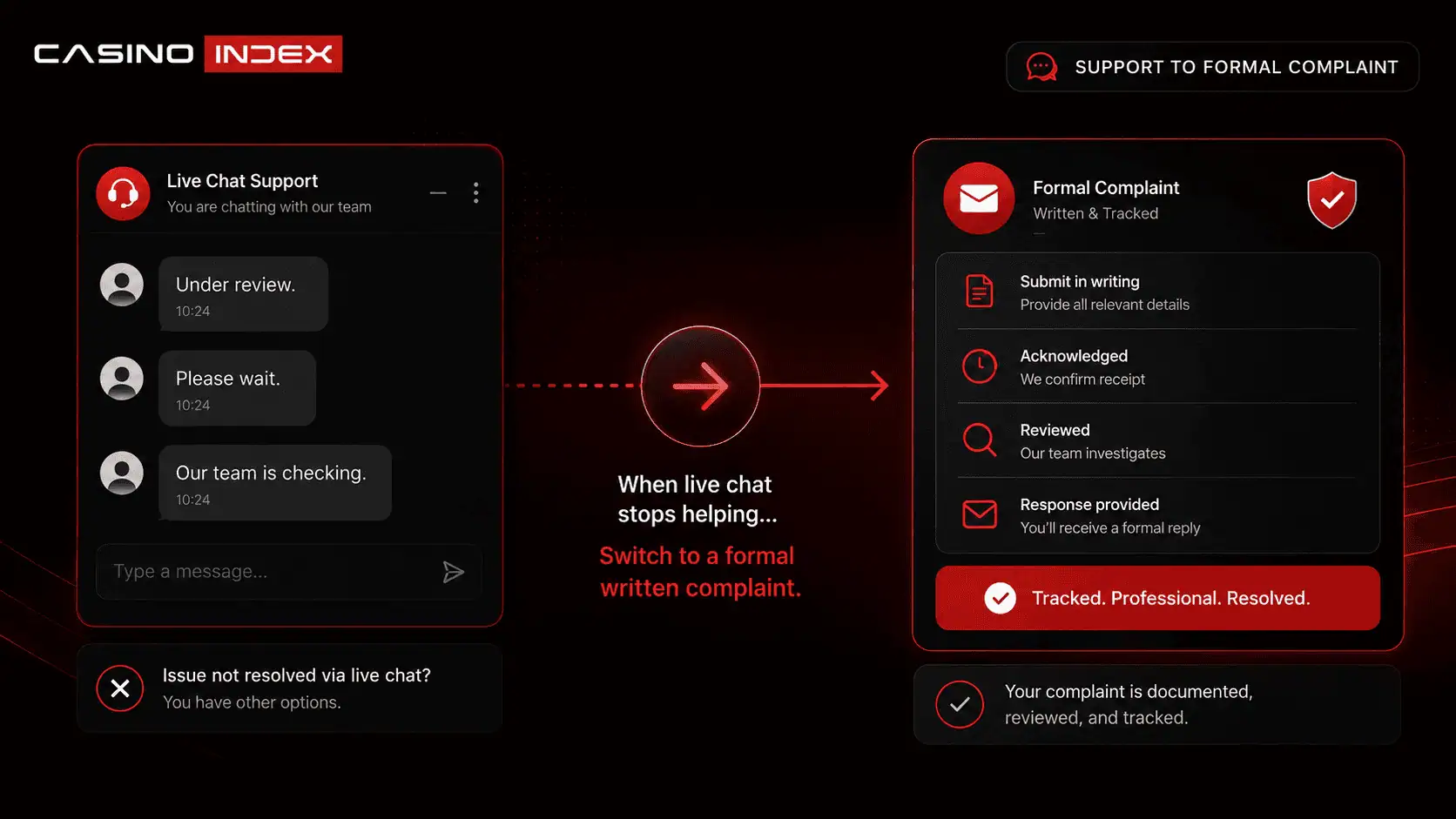
Ask one clear question:
“Please confirm the formal complaint process and the correct email or form for submitting a written complaint.”
Then save the transcript.
Use the formal route the casino provides. That may be a complaint email, a form listed in the terms, or a dedicated complaints department named on the site.
The goal is to move from casual support to a traceable complaint.
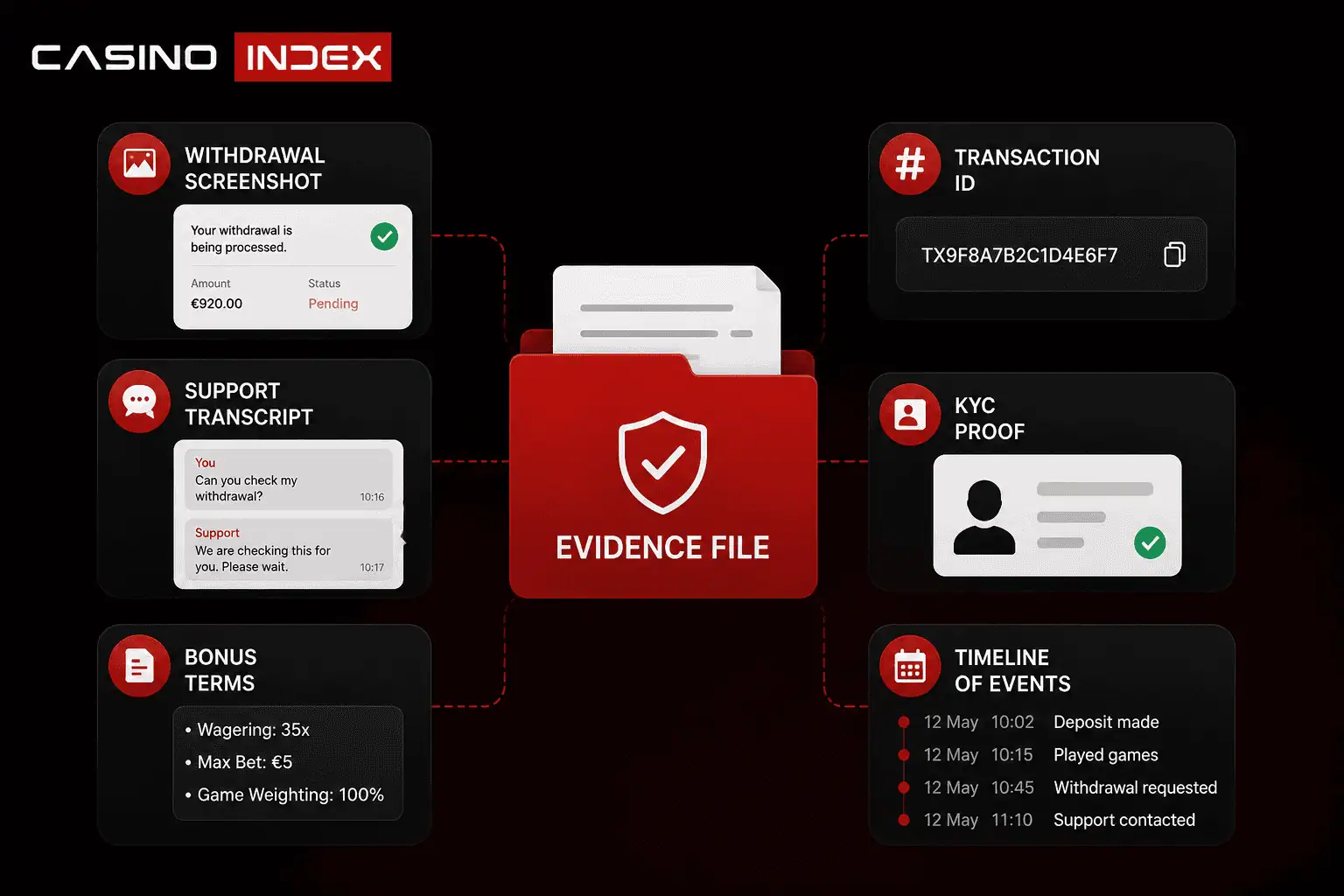
Step 2: build the evidence file before escalating
Many players escalate too early.
They post a complaint before saving withdrawal screenshots, transaction IDs, support replies, KYC records, or bonus terms. That gives the casino room to challenge the case.
Build the file first.
| Evidence | What it proves | Best used for |
|---|---|---|
| Withdrawal screenshot | Amount, date, and pending status | Unpaid withdrawal complaints |
| Transaction ID | Deposit or payout movement | Crypto and payment disputes |
| Support transcript | What the casino said | Delays, contradictions, refusal |
| KYC upload proof | When documents were sent | Verification disputes |
| Bonus terms screenshot | Rules active at the time | Bonus disputes |
| Account status screenshot | Blocked, verified, pending, or restricted status | Account cases |
| Timeline | Order of events | Every complaint type |
Do not rely on memory.
A complaint that says “they delayed me for weeks” is weak.
A complaint that says “the withdrawal was requested on 4 March, KYC was confirmed on 6 March, and support asked for the same document again on 12 March” is stronger.
Dates, amounts, and exact wording matter.
Step 3: create one clean timeline
A timeline makes the case easier to review.
Use short entries. Do not add emotion. Focus on what happened.
Example:
- 3 April: deposited €200 by Visa
- 3 April: claimed welcome bonus
- 5 April: completed wagering
- 5 April: requested €920 withdrawal
- 6 April: submitted ID and address proof
- 8 April: support confirmed documents were received
- 12 April: withdrawal still pending
- 13 April: support said the case was under review
- 18 April: no final answer received
Keep this version consistent everywhere.
Do not give one timeline to the casino, another to a complaint platform, and another in a public post. Inconsistency weakens credibility.
Step 4: write a formal complaint, not a longer argument
A formal complaint should be short, structured, and easy to answer.
It should include:
- casino name and exact domain
- account email or username
- disputed amount
- issue type
- withdrawal or incident date
- payment method
- bonus name, if relevant
- KYC status
- short timeline
- evidence list
- exact requested outcome
The complaint should not attack support staff. It should not make unsupported accusations. It should not include every emotional detail.
Keep the tone firm but professional.
A good complaint says:
“I am asking for a written explanation of the delay and the specific rule or process that prevents payment.”
A weak complaint says:
“You are scammers and I will post everywhere.”
The first version gives reviewers something to work with. The second version may be understandable, but it does not strengthen the case.
Step 5: ask for a written final position
Before escalating externally, ask whether the casino has made a final decision.
The wording may differ. Some casinos call it a final response, final decision, complaint outcome, or deadlock letter. Others simply confirm that their decision will not change.
Ask:
“Please confirm whether this is the casino’s final position. If not, please confirm the expected timeframe for a final complaint response.”
This question matters because external reviewers often want to see that the player gave the casino a fair chance to resolve the issue.
The player does not need to wait forever.
But the escalation becomes stronger when the evidence shows:
- the casino was contacted
- a formal complaint was submitted
- the casino had reasonable time to respond
- the response was missing, unclear, or unfair
- the player asked for the final position
That creates a cleaner path than jumping straight to public accusation.
Step 6: choose the right escalation route
Not every complaint belongs in the same place.
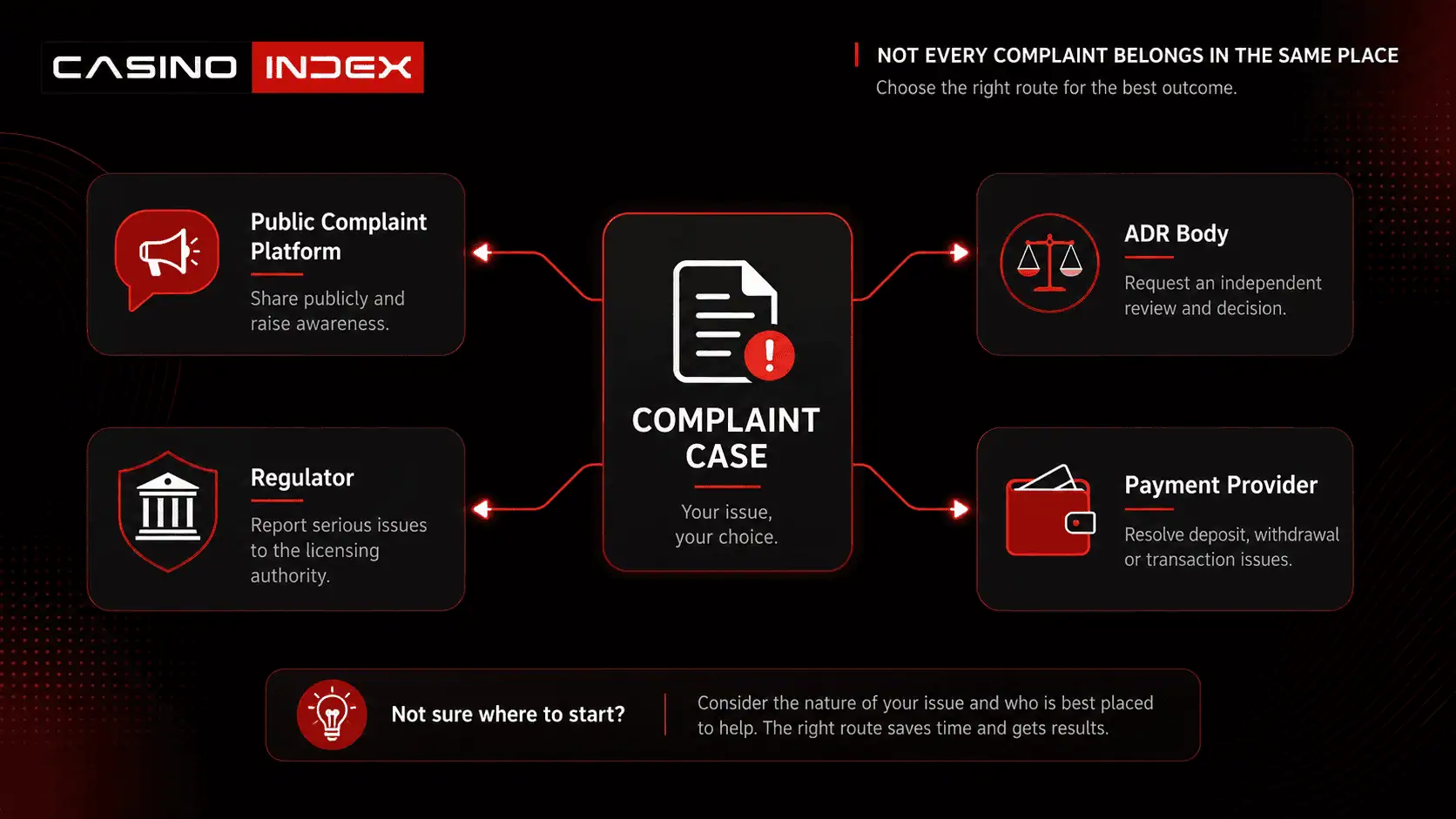
The right route depends on the license, complaint type, evidence quality, and the casino’s own terms.
| Route | Best used when | What to prepare | Main limitation |
|---|---|---|---|
| Public complaint platform | Support stops responding or gives vague replies | Timeline, screenshots, support logs | May not force payment |
| ADR body | The casino’s license provides ADR access | Final casino response, full evidence file | Scope depends on jurisdiction |
| Regulator | License issue, unsafe conduct, or no fair complaint route | Operator name, license number, case summary | May not decide every payout dispute |
| Payment provider | Failed transaction or payment ownership issue | Transaction ID, receipts, account proof | Not for normal gambling losses |
| Legal advice | Large amount or serious rights issue | Full case file and terms | Cost and jurisdiction matter |
This table is important because players often escalate to the wrong place.
A bonus-term dispute may need an ADR route. A fake license concern may belong with a regulator. A crypto transaction mismatch may need payment records. A public complaint may help when the casino is ignoring support but still cares about reputation.
Check the casino’s terms for:
- complaint policy
- license number
- regulator name
- ADR or dispute body
- support email
- legal operator
- complaint timeframe
A casino that offers no meaningful escalation route creates an extra trust concern.
CasinoIndex explains how to separate real warning signs from isolated frustration in its guide to reading casino complaints without overreacting to one case.
Step 7: use public complaints carefully
Public complaints can help when support fails.
A strong public complaint can organise the case, ask the casino for a response, publish the outcome, and create reputation pressure. This is useful when the casino is active on the platform and the player has evidence.
Public complaints work best when they are specific.
Include:
- casino name
- disputed amount
- issue type
- short timeline
- support replies
- evidence summary
- current casino response
- requested outcome
Keep private documents private.
Do not publish ID cards, bank statements, full wallet addresses, card details, home addresses, or sensitive KYC files in an open thread. Use private upload tools if the platform provides them.
Also keep the wording accurate. Exaggerating the amount, hiding bonus use, or calling the casino a scam without strong evidence may weaken the case.
Step 8: escalate to a regulator or ADR only when the route fits
Regulator or ADR escalation can help, but players should understand the limits.
Regulators usually focus on operator conduct, licensing rules, and complaint procedures. ADR bodies are more likely to review individual disputes. With offshore or lightly regulated casinos, players may have fewer practical options. The exact path depends on the license and jurisdiction.
Regulator escalation makes more sense when the casino:
- ignores its own complaint process
- misrepresents its license
- gives no fair route to challenge a decision
- repeatedly fails to explain payout delays
- shows unsafe or misleading conduct
- refuses to identify the operator or license route
Before sending a regulator or ADR complaint, prepare:
- casino name
- website domain
- legal operator, if known
- license number
- account username
- disputed amount
- issue type
- timeline
- formal complaint copy
- casino’s latest or final response
- evidence file
- requested outcome
Keep the message factual.
A regulator does not need dramatic wording. It needs a clear case.
What not to do when escalating
Bad escalation can damage a real complaint.
Avoid these mistakes:
- opening many duplicate tickets
- changing the story across platforms
- exaggerating the disputed amount
- hiding bonus use
- refusing reasonable KYC
- posting private documents publicly
- threatening staff
- using fake or edited screenshots
- deleting account records
- ignoring casino replies
- filing public complaints before collecting evidence
- calling the casino a scam without strong proof
The strongest pressure is calm, documented pressure.
Not soft. Not aggressive. Clear.
When your complaint may be weak
Support may be poor, but the player’s case may still be weak.
That can happen when the player broke a clear bonus rule, used someone else’s payment method, created multiple accounts, entered incorrect details, played from a restricted country, used a VPN against the terms, or refused reasonable verification.
The case is also weaker when there is no evidence.
Before escalating, ask:
- Can I prove the amount?
- Can I prove the date?
- Can I show the casino’s replies?
- Can I show the terms that apply?
- Did I use my own payment method?
- Did I follow KYC instructions?
- Did I break a bonus rule?
- Did I give the casino a fair chance to respond?
A weak case does not mean the casino is right.
It means the player needs to be realistic about the chance of success.
When the casino’s case looks weak
The casino’s position looks weaker when it refuses to explain itself.
Warning signs include:
- no written reason for delay
- repeated copy-paste replies
- changing document requests
- ignored KYC submissions
- no clear term cited
- bonus rules applied after the fact
- account closure without balance explanation
- no formal complaint route
- no ADR or regulator information
- repeated similar public complaints
These signals do not always prove wrongdoing.
But they do justify escalation.
CasinoIndex covers wider warning signs in its Casino Scams Guide, especially where support failure appears together with delayed withdrawals, blocked accounts, unclear terms, and ignored complaints.
How CasinoIndex uses escalation behavior in casino evaluation
Escalation behavior shows how a casino acts under pressure.
CasinoIndex does not evaluate casinos only by bonuses, game variety, deposit speed, or homepage claims. Real trust appears when something goes wrong and the operator has to explain its decision.
CasinoIndex looks at:
- withdrawal communication
- complaint process clarity
- KYC handling
- bonus-rule transparency
- support quality under pressure
- public complaint patterns
- regulator or ADR route visibility
- response quality in unresolved cases
- whether similar issues repeat over time
A casino with large bonuses can still rank poorly if support collapses during withdrawals or disputes.
A casino with fewer promotions may deserve more trust if it explains decisions clearly, resolves valid complaints, and keeps payment rules transparent.
That is part of how CasinoIndex evaluates real player risk, as explained in how CasinoIndex ranks casinos beyond bonus size and surface-level claims.
Formal escalation template
Use this structure when support has failed.
Subject: Formal escalation: unresolved complaint regarding [withdrawal / KYC / bonus / account issue]
Hello,
I am escalating an unresolved complaint regarding my account at [casino name].
Account details
Account email / username: [details]
Casino website: [domain]
Issue type: [withdrawal / KYC / bonus / account closure / payment issue]
Disputed amount: [amount]
Date the issue started: [date]
Short timeline
- [date]: [event]
- [date]: [event]
- [date]: [event]
Evidence attached
- Withdrawal or account screenshot
- Support transcript
- Transaction ID
- KYC submission proof
- Relevant terms screenshot
- Account status screenshot
Current issue
I contacted support on [dates]. The issue remains unresolved because [short reason].
Requested outcome
Please review the attached evidence and provide [payment of withdrawal / explanation of rejected documents / review of bonus decision / account balance clarification / written final decision].
Please also confirm whether this is the casino’s final position or whether further internal review is still pending.
Regards,
[Name]
This template works because it gives the reviewer the facts in the right order.
It does not force them to search through a long emotional message to understand the problem.
Bottom line: escalation works best when the case is clean
When casino support fails, anger is understandable.
But anger is not a strategy.
A strong escalation shows the disputed amount, the timeline, the casino’s replies, the evidence, the rule involved, and the exact outcome requested. It gives the casino one clear chance to respond. Then, if the answer is missing, vague, or unfair, it moves the case to the correct external route.
The player who can prove the case has more leverage than the player who only repeats the accusation.
Save records. Build the timeline. Write one formal complaint. Ask for the final position. Use public complaints carefully. Escalate to ADR or a regulator only when the route fits. Keep private documents private.
Support failure is a warning sign.
A clean complaint file is what turns that warning sign into a case.
FAQ
When should I escalate a casino complaint?
Escalate when support stops giving useful answers, the casino misses its stated timeframe, refuses to explain a decision, ignores evidence, or gives a final response you believe is unfair.
What evidence do I need before escalating?
Collect screenshots, support transcripts, transaction IDs, withdrawal records, KYC proof, bonus terms, account status screenshots, and a clear timeline.
Should I keep using live chat?
Use live chat for the first contact. Move to email or the formal complaint process once the issue becomes serious because written records are easier to escalate.
Can I post a public complaint?
Yes, but keep it factual. Include dates, amounts, evidence, support replies, and the outcome you want. Do not post private documents publicly.
Should I contact the regulator immediately?
Usually no. First use the casino’s complaint process unless the issue involves fake licensing, serious misconduct, no complaint route, or unsafe conduct.
Can a regulator force the casino to pay?
It depends on the license and jurisdiction. Some disputes go through ADR. Some regulators supervise conduct but may not decide every individual payout dispute directly.
What makes my complaint weaker?
No evidence, unclear timeline, mismatched payment details, edited documents, multiple accounts, VPN use against terms, broken bonus rules, or changing the story across platforms.
What if the casino ignores my formal complaint?
Save proof of submission, wait a reasonable timeframe, then escalate through the complaint platform, ADR body, or regulator route listed in the casino’s terms.

Maria Hoffmann has worked in cryptocurrency content and digital publishing since 2017. She is a co-founder of Freecoins24 and CryptoMutant and has covered blockchain projects, crypto platforms and emerging industry trends for several years. She has also been active as a cryptocurrency investor since 2019. At CasinoIndex, Maria combines content research and SEO experience with a focus on casino trust, platform security, withdrawal processes, payment risks and user protection. Her work looks beyond bonuses and product features to examine how gambling platforms handle player funds, verification and account-related risks.