Best Casinos for Small Deposits and Low-Risk Testing

How to Test a Casino With a Small Deposit Before Scaling Up
Small deposits are most useful when they serve one clear purpose: testing a casino before trusting it with more money.
That does not make gambling safe. It only limits the amount exposed while the player checks payment flow, low-stake games, bonus rules, withdrawal terms, verification pressure and support quality.
Many low-deposit casino rankings focus on the smallest possible number. A $1, $5 or $10 deposit may sound attractive, but the number alone says very little about the quality of the casino.
A platform with a low minimum deposit can still have:
- an impractical minimum withdrawal
- unclear bonus conditions
- poor payment matching rules
- weak support after a cashout request
- verification checks that appear only after a win
- limited low-stake game options
- withdrawal limits that make a small balance difficult to remove
The better question is:
Can this casino be tested properly with a small amount before the player commits more?
CasinoIndex does not treat small-deposit casinos as risk-free gambling sites or cheap bonus opportunities. Instead, this ranking focuses on whether a limited first payment can reveal something useful about the cashier, games, support, KYC process and withdrawal handling.
Best Small-Deposit Casinos: Quick Comparison
These casinos suit different types of small-balance testing. The ranking does not guarantee that every player will receive the same result. Country rules, payment method, bonus use, account history and withdrawal size can all change the experience.
| Casino | Best Fit | What the First Test Should Check | Main Caution |
|---|---|---|---|
| BitStarz | Crypto-friendly casino and slot players | Game access, cashier clarity, low-stake play and an early crypto cashout | Promotional terms can make a first withdrawal more complicated |
| Jackbit | Players who want to examine crypto promotions | Bonus visibility, game restrictions, payment routes and support answers | Wagering, maximum-bet and maximum-cashout rules need careful review |
| MyStake | Casual casino and sportsbook users | Whether both product areas remain clear within one account and cashier | A broader platform also creates more overlapping terms and limits |
| Wild.io | Players familiar with crypto-first casinos | Wallet flow, game minimums, bonus separation and withdrawal handling | Less suitable for beginners who are unfamiliar with crypto payments |
| Flush | Players who prefer a simpler test environment | Basic navigation, cashier access, support quality and one small payout | Public operating evidence is thinner than for larger brands |
| Gambear | Cautious users testing a less prominent crypto brand | Payment rules, account clarity, low-stake practicality and withdrawal communication | A limited public proof base makes a test-first approach especially important |
| Bitz | Players wanting a straightforward crypto casino test | Deposit flow, simple gameplay, payment consistency and cashout rules | Smaller brands require more caution when independent evidence is limited |
How to interpret the comparison
A good small-deposit casino is not automatically the operator with the lowest entry amount.
A casino with a $5 minimum can be less useful than one requiring $10 when the lower-entry option has vague withdrawal rules, restrictive bonuses or a minimum cashout that the test balance is unlikely to reach.
Therefore, the table should be read as a comparison of test suitability, not as a promise of safety or instant payments.
How CasinoIndex Evaluates Small-Deposit Casinos
This ranking follows the same trust-first order used across CasinoIndex:
Trust → Withdrawals → Reputation → Product → Bonus.
Minimum deposit size matters, but only after the more important questions have been addressed.
Payment clarity
The cashier should show the minimum deposit, minimum withdrawal, available methods, fees and expected payment route before the player sends money.
A low entry amount has limited value when the withdrawal requirements remain hidden until later.
Practical low-stake play
A small balance needs games with realistic minimum bets.
If the available tables, slots or crash games require stakes that consume the balance within a few rounds, the player cannot examine the casino properly. The test becomes a short gambling session rather than an evaluation.
Withdrawal access
The player should be able to understand whether a small cashout is possible and which rules apply.
A casino may accept a $5 deposit but set a withdrawal minimum much higher than the remaining balance. That does not necessarily make the rule unfair, but it weakens the usefulness of the casino for low-risk testing.
KYC and account clarity
A test-friendly casino does not need to promise that KYC will never happen.
It should explain when identity, payment or account checks may appear and how the player can complete them. Vague verification language makes even a small deposit harder to evaluate.
Bonus separation
The player should be able to test the real-money casino without being forced into a promotional balance.
Automatic bonuses, unclear opt-out systems or mixed real-money and bonus balances make the first test less useful.
Support under basic pressure
Support does not need to guarantee a future withdrawal time. However, it should answer practical questions about limits, payment matching, verification and bonus terms without pushing the player to deposit first.
What a Small Deposit Should Mean
A small deposit is a controlled first payment used to examine the casino.
For one player, that may be $5. For another, it may be $10, $20 or a small crypto amount. The exact number matters less than the reason behind it.
A useful small-deposit test should reveal:
- how quickly the payment is credited
- whether the cashier explains the transaction clearly
- whether low-stake games are easy to find
- whether bonus rules are visible before acceptance
- whether support answers a simple payment question
- whether withdrawal limits are practical
- whether a modest cashout can be requested
- whether verification begins in a clear and proportionate way
The last two points carry the most weight.
Most casinos are designed to accept deposits efficiently. Withdrawals provide more useful evidence about how the operator handles real player funds.
If a casino takes money quickly but makes a small cashout confusing, it is not genuinely beginner-friendly. It is simply easy to enter.
Before starting, players can use the broader guide on how to judge whether an online casino is safe enough to test.
Small Deposits Reduce Exposure, Not Gambling Risk
A small first deposit limits the initial amount exposed to the casino.
It does not remove the risk of losing money.
A $10 balance can disappear quickly through high-volatility slots, crash games, live tables with larger minimum bets or bonus play that the player does not fully understand.
Low-risk testing means controlling the evaluation. It does not mean the casino itself becomes low risk.
A sensible first test has clear boundaries:
- one fixed deposit
- no reload during the test
- low-stake games only
- no bonus unless every important term is clear
- no attempt to recover losses
- one small withdrawal request where possible
- a decision after the test rather than during the session
The cleanest mindset is:
This is a test budget. Once it is gone, the test ends.
That rule matters more than whether the casino advertises a $1, $5 or $10 minimum deposit.
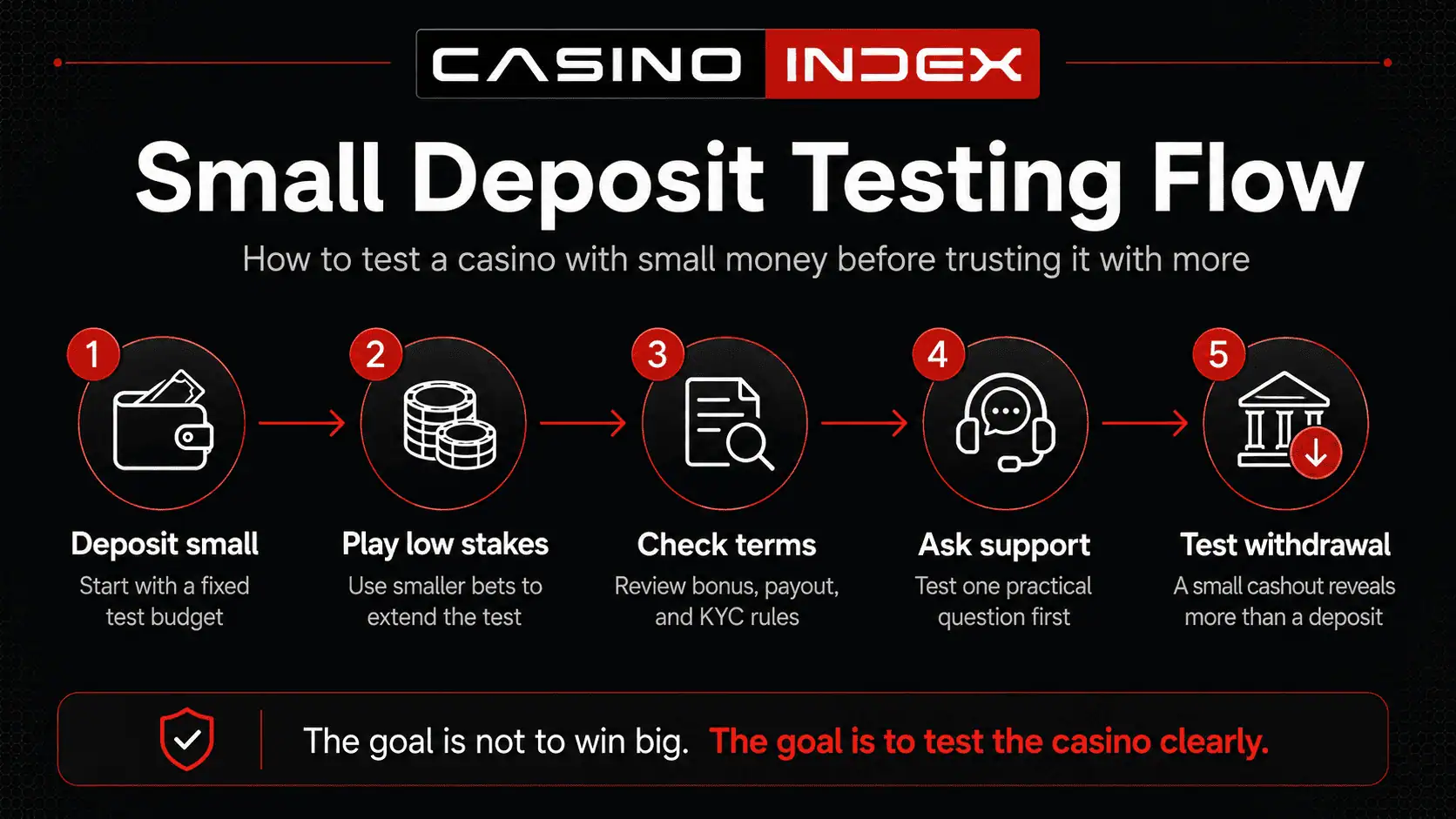
Test Deposit → Test Withdrawal → Scale Carefully
The most useful update to a small-deposit strategy is to treat it as a three-stage process.
The player should not increase the balance simply because registration and the first deposit worked. Each stage needs to provide useful evidence before the next one begins.
| Stage | What to Do | What It Tests | Reason to Stop |
|---|---|---|---|
| 1. Test Deposit | Send one modest amount through a payment method you own | Cashier clarity, crediting time, fees and payment instructions | The deposit is delayed, credited incorrectly or support cannot explain the issue |
| 2. Test Withdrawal | Play at low stakes and request a modest cashout when the balance allows it | Minimums, approval checks, payment matching, KYC and support quality | Reasons keep changing, requirements are unclear or the cashout cannot be tested practically |
| 3. Scale Carefully | Increase exposure only after the complete first cycle works | Whether the casino has earned limited additional trust | The successful test creates pressure to deposit far more than planned |
Stage 1 — Make one controlled deposit
Before paying, check the minimum withdrawal as well as the minimum deposit.
Use a payment method in your own name. Crypto users should confirm the asset, network and wallet address. Card and e-wallet users should make sure the payment account matches the casino account.
After sending the payment, confirm:
- whether the correct amount was credited
- whether any fee was disclosed beforehand
- whether the casino recorded the payment method correctly
- whether the transaction appears in the account history
A deposit problem that support cannot explain is already enough reason to stop.
Stage 2 — Test the withdrawal path
Use low stakes and keep the session simple. The goal is not to manufacture a large win. It is to retain enough balance to examine the cashier.
When possible, request a modest cashout through the expected payment route.
This stage helps reveal:
- whether the stated minimum withdrawal is accurate
- whether additional turnover applies to the deposit
- whether payment ownership becomes an issue
- whether KYC appears
- whether the request receives a clear status
- whether support can explain a review
- whether the casino meets its published processing expectations
CasinoIndex explains why small withdrawals should be tested first and why casino approval time must be separated from bank, wallet or blockchain processing.
Stage 3 — Increase exposure only with a reason
A successful test withdrawal provides useful evidence, but it does not prove that every larger payment will follow the same process.
Higher-value withdrawals may trigger stronger account, KYC, payment or source-of-funds checks. Bonus use can also change the rules.
Therefore, scaling should remain gradual. The player should not move from a $10 test to a large casino balance simply because one small payout worked.
A better approach is to:
- keep the next deposit within the original bankroll plan
- avoid holding unnecessary funds inside the casino
- withdraw periodically rather than building a large balance
- recheck terms if the payment method or bonus changes
- stop if account handling becomes less clear at higher values
Testing reduces uncertainty. It does not create a guarantee.
What Makes a Casino Good for Small-Deposit Testing?
Clear minimums on both sides of the cashier
The minimum deposit should never be examined on its own.
A useful cashier also shows:
- the minimum withdrawal
- daily, weekly or monthly limits
- payment fees
- available return methods
- internal processing stages
- payment matching requirements
A low deposit minimum combined with a high or poorly explained cashout threshold may be unsuitable for a small test.
Games that work with a limited balance
Low-stake access matters because the balance needs to last long enough to test the product.
Players should check the practical minimum bet rather than assuming every slot or table supports tiny stakes. Live dealer games and some crash formats may consume a small balance much faster than ordinary low-stake slots.
Visible bonus conditions
Wagering, maximum-bet rules, restricted games, expiry and maximum cashout conditions should be available before the offer is activated.
A casino is easier to test when the player can decline the bonus and use a clean real-money balance.
Usable support
Support should answer a simple question without sending the player through several unrelated departments.
Useful test questions include:
- Can I withdraw through the method used for my deposit?
- What is the minimum withdrawal?
- When can verification be requested?
- Does a deposit turnover requirement apply?
- Can I decline or remove the welcome bonus?
Reasonable verification communication
A casino can request documents even after a small payment. Deposit size is only one risk factor.
Location, payment ownership, account duplication, wallet activity or a first withdrawal can also trigger checks.
Players should understand when verification can still appear after small deposits rather than assuming that low-value play guarantees a document-free account.
Beginner-Friendly Deposit Options
The best payment method depends on the player’s country, the casino’s rules, fees and personal experience.
Crypto
Crypto can work well for small tests because transfers are often flexible and several networks support low fees.
However, crypto is not automatically simple. Players still need to understand:
- wallet addresses
- network selection
- transaction fees
- minimum withdrawal amounts
- wallet consistency
- possible wallet or ownership checks
A fast blockchain does not remove the casino’s internal approval stage.
E-wallets
E-wallets can keep casino payments separate from everyday bank spending.
They may also provide a cleaner deposit and withdrawal route when the casino account and wallet names match. Still, availability, fees and bonus exclusions vary by country and operator.
Cards
Cards are familiar, but they can create additional ownership and return-payment checks.
The player should never use a card belonging to another person. Even with permission, a third-party payment can create a serious withdrawal problem.
Bank transfers
Bank transfers are often less practical for a small test because they can take longer and involve more manual information than the amount justifies.
They may still suit players who want a direct bank route and are comfortable with the processing time.
Choosing the route
The strongest option is usually the method the player can use consistently for both entry and cashout.
The wider guide to how casino payment methods affect deposits and withdrawals explains crypto, e-wallet, card and bank-transfer differences in more detail.
Whatever the method, keep the route clean:
- use your own payment account
- keep transaction records
- avoid switching methods without a reason
- check the withdrawal route before depositing
- do not test a casino with money belonging to someone else
Should Small-Deposit Players Claim a Bonus?
Usually not during the first test.
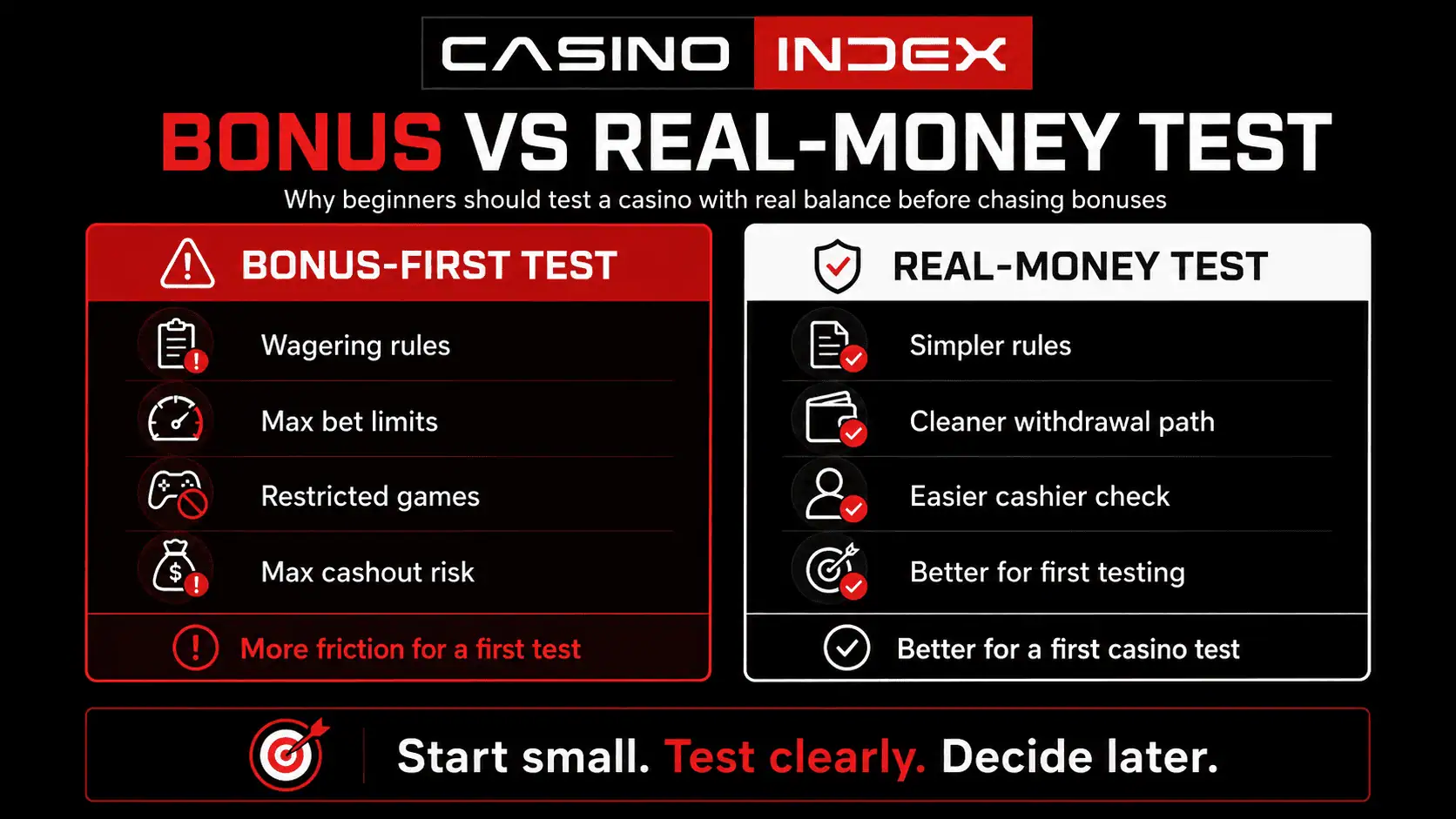
A bonus can make a small deposit appear more valuable, but it also changes what the player is testing.
Instead of examining the basic casino flow, the session now includes:
- wagering requirements
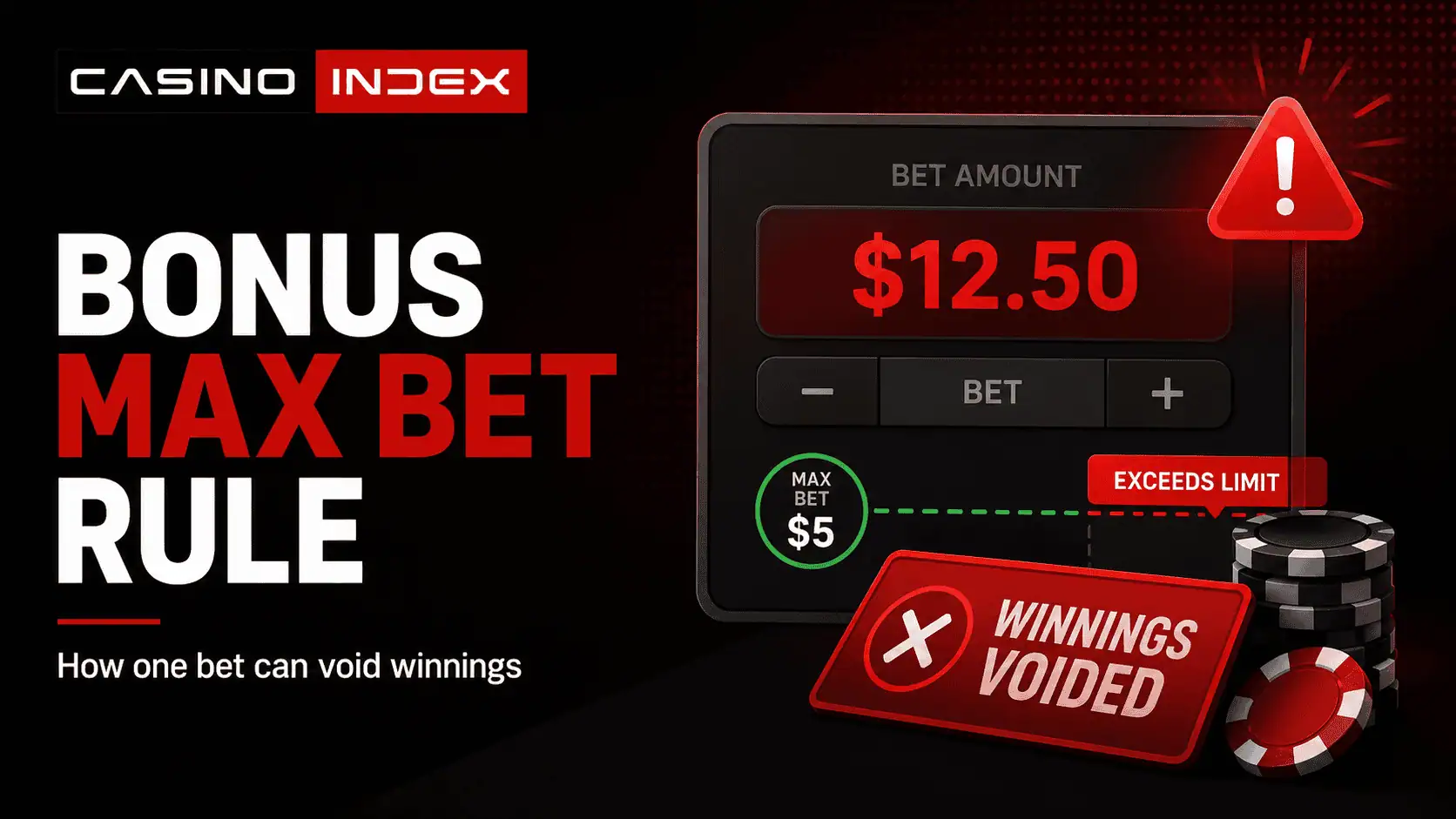
- maximum-bet rules
- restricted games
- expiry deadlines
- minimum withdrawal rules
- maximum cashout limits
- bonus-to-cash conversion rules
- possible bonus-abuse reviews
That is too much added friction for a clean first evaluation.
A player may deposit $10, claim a promotion and win, only to discover that the balance cannot be withdrawn until a large wagering target has been completed. Even after wagering, a cashout cap or restricted-game rule may still apply.
That does not mean every bonus is unfair. It means bonus testing should come after the ordinary payment and account flow has already been examined.
A cleaner first test is:
Deposit a small amount. Use the real balance. Play low stakes. Request a modest withdrawal.
After that first cycle, the player can decide whether a promotion is worth analysing.
The CasinoIndex bonus guide explains how wagering, restricted games, maximum bets and cashout limits change the real value of an offer.
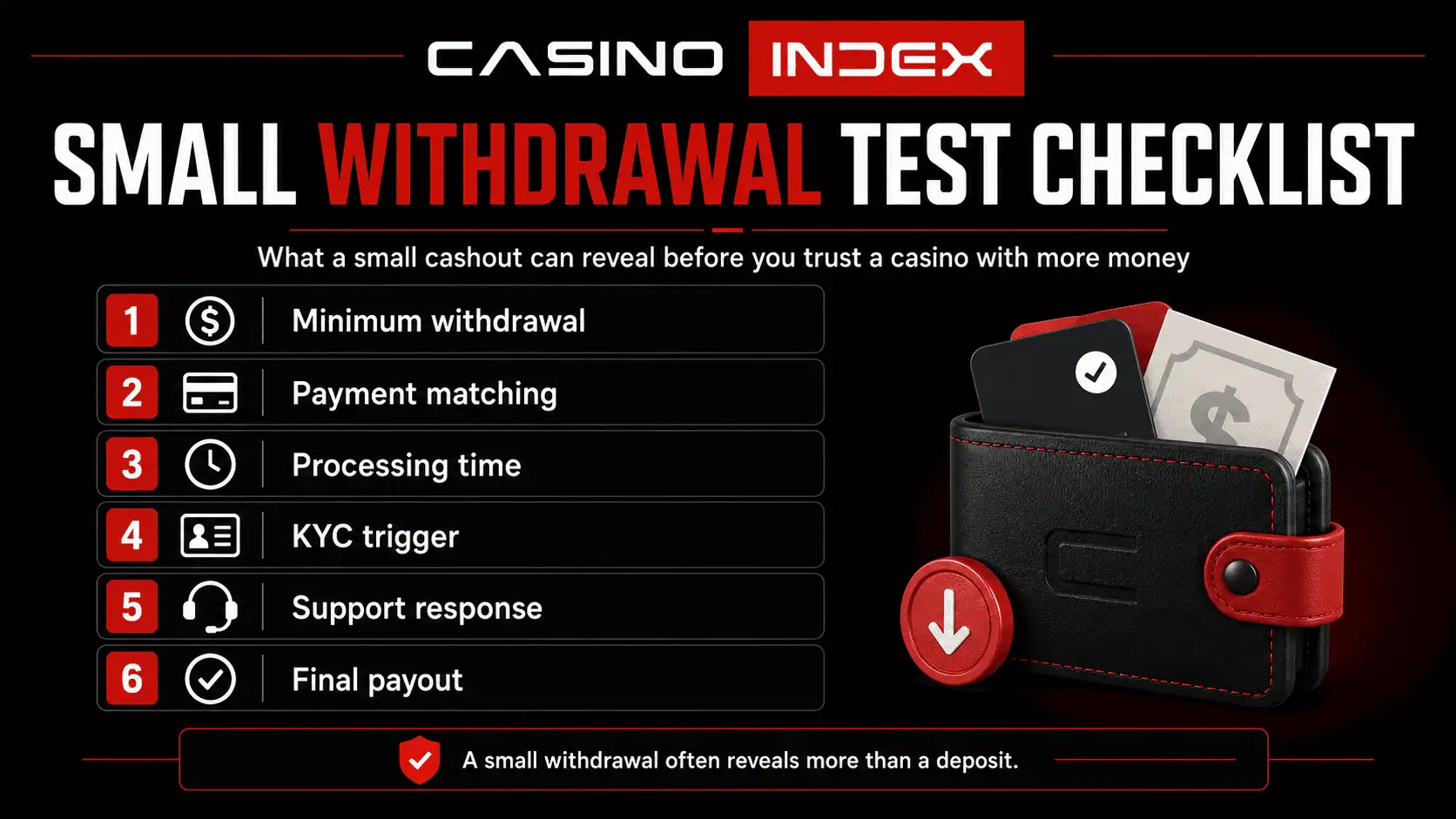
What a Small Withdrawal Test Actually Reveals
A cashout test provides more useful evidence than the original deposit.
The deposit confirms that the casino can receive money. The withdrawal shows how it behaves when funds are moving back to the player.
A modest request can reveal:
- whether the cashier is easy to use
- whether the minimum withdrawal is practical
- whether the published processing stages are accurate
- whether payment matching creates friction
- whether KYC begins
- whether documents can be uploaded easily
- whether support gives a specific answer
- whether the operator delays without explanation
A delay is not automatically a red flag.
Initial identity checks, payment verification, deposit turnover or a normal finance review may all be legitimate. The more important question is whether the casino explains the issue and gives the player a realistic next step.
A stronger process sounds like this:
Your withdrawal is waiting for proof that the deposit method belongs to you. Please upload the requested document through the account page.
A weaker process relies on phrases such as “security review” or “relevant department” without explaining what the player must do or when another update is expected.
What one successful cashout does not prove
A small completed withdrawal is a positive signal, but it has limits.
It does not confirm that:
- a much larger payout will receive identical treatment
- bonus winnings will follow the same rules
- a different payment method will work equally well
- KYC will never appear later
- future account activity cannot trigger review
The first cashout should support a cautious decision, not create unlimited confidence.
Where Small-Deposit Players Usually Go Wrong
Treating a small payment as risk-free
The amount may be limited, but the account still enters the casino’s full rule system.
Problems can occur when a player:
- uses another person’s payment method
- opens a duplicate account
- claims a bonus without reading the rules
- plays restricted games with promotional funds
- uses a VPN against the terms
- requests less than the minimum withdrawal
- switches payment methods without checking the consequences
- ignores verification wording
Reloading after the test fails
A player deposits $10, loses it quickly and adds another $20 because the first amount “did not show enough.”
At that point, the process is no longer a controlled test. It has become a normal gambling session.
A real test has one budget and one stopping point.
Playing games that do not fit the test balance
A small balance cannot provide much information when the selected game uses most of it within minutes.
High-volatility games may be entertaining, but they are poor tools for evaluating the cashier, support and withdrawal process on a limited budget.
Testing too many variables at once
A first session becomes difficult to interpret when the player changes wallet, claims a bonus, uses several game types and contacts support about multiple issues.
Keep the first cycle simple. One deposit, one payment route, ordinary low-stake play and one cashout request produce clearer evidence.
Leaving the winnings inside the casino
A successful session can create false confidence.
Instead of testing the withdrawal, some players continue playing because the balance has grown. The most useful moment to examine the cashier is often before the balance becomes emotionally difficult to cash out.
Best Small-Deposit Casino Picks Explained
1. BitStarz — Best for Broad Crypto-Friendly Testing
BitStarz suits players who want to examine a crypto-friendly casino with a broad game environment.
The main advantage is flexibility. A player can review the cashier, find lower-stake games and assess how the site handles a straightforward crypto payment without beginning with a large bankroll.
The cleaner test uses real money rather than a promotional balance. BitStarz has a strong bonus focus, so players who claim an offer immediately may end up testing wagering and game restrictions instead of the ordinary withdrawal flow.
Best fit: crypto casino users who want broad game access and are willing to test the cashier before increasing their balance.
2. Jackbit — Best for Testing Promotions Carefully
Jackbit is relevant to players who want crypto access and a visible promotional system.
However, that strength creates the main caution. Wagering, maximum-bet rules, restricted games and maximum cashout terms can matter more than the headline offer.
A useful first test should begin without a bonus unless the player has already read and accepted each material condition.
Best fit: promotion-aware players who can separate bonus value from basic casino trust.
3. MyStake — Best for Casino and Sportsbook Testing
MyStake can suit casual players who want to examine casino games and sports betting through one account.
The combined product reduces the need to maintain separate balances across several operators. On the other hand, it also introduces more rules. Casino offers, sportsbook promotions, payment limits and account checks may overlap.
A first test should focus on one product area and one payment route. Moving repeatedly between sportsbook and casino sections can make the balance and promotional conditions harder to follow.
Best fit: users who value one-account convenience and want to test both product quality and withdrawal clarity gradually.
4. Wild.io — Best for Modern Crypto-First Testing
Wild.io is more suitable for users who already understand crypto casino payments.
The first evaluation should cover wallet handling, low-stake game access, bonus separation, withdrawal terms and support quality. Players unfamiliar with network selection or wallet addresses may find a conventional payment method easier to test.
The strongest approach remains a clean real-money deposit followed by a modest withdrawal attempt.
Best fit: experienced crypto users who want a modern platform and plan to keep their first exposure limited.
5. Flush — Best for a Simpler Test Environment
Flush may appeal to players who prefer a lighter casino structure without several competing product layers.
Simplicity can make it easier to locate the cashier, review account settings and contact support. However, a smaller public proof base means the player should avoid treating clean design as evidence of long-term reliability.
The Flush review for small-deposit testing provides the deeper brand-level context needed before using real money.
Best fit: cautious players who value simpler navigation and are prepared to complete an early cashout test.
6. Gambear — Best for Cautious Low-Exposure Testing
Gambear belongs in this comparison because a small deposit is especially useful when the brand has less public history than the market’s largest operators.
The purpose is not to assume that a lesser-known casino is unsafe. Instead, limited public evidence increases uncertainty, so the player should gather direct information through the cashier, support and withdrawal process.
Read the Gambear review for low-risk testing before deciding whether the available payment and account rules fit the intended test.
Best fit: users willing to treat the first deposit as an evaluation rather than a reason to keep playing.
7. Bitz — Best for a Straightforward Crypto Casino Test
Bitz can suit players who want a more direct crypto casino environment without beginning on a large multi-product platform.
That narrower feel may help the player focus on the basics: deposit, low-stake play, support, account clarity and withdrawal terms.
Nevertheless, less visible brands require careful research because independent reports and long-term operating signals may be more limited.
Best fit: players who want a simple crypto test and understand that smaller brand visibility requires stronger personal limits.
How to Choose a Casino for a Small First Deposit
Start with the withdrawal page
Do not begin with the bonus banner.
Check the minimum withdrawal, available methods, limits, fees and approval wording. A casino that makes deposits easy but hides the exit rules is not suitable for a controlled test.
Compare the game minimums with the test budget
The balance must be large enough to support a reasonable number of low-stake rounds.
When the minimum bets are too high, either choose another game or another casino. Increasing the deposit just to fit the product defeats the purpose of the test.
Check whether the bonus can be declined
A player should not need to contact several departments to remove an unwanted promotion.
The real-money balance, promotional balance and cancellation consequences should remain clear.
Read the verification wording
Look for information about identity, address, payment ownership and possible withdrawal-stage checks.
Vague claims such as “no verification” should not replace the actual terms.
Review the rules that affect money
Before depositing, read which casino terms matter before a small first payment, including withdrawal limits, restricted locations, bonus rules and grounds for account review.
Ask whether the full cycle is practical
The final question is not simply whether the deposit is affordable.
Ask whether the amount is large enough to:
- be accepted by the cashier
- support low-stake play
- reach the minimum withdrawal where possible
- test support and account tools
- produce a useful decision without encouraging a reload
What Low-Risk Testing Should Never Mean
Low-risk testing does not mean safe gambling.
It means controlled exposure to the casino while the player gathers information.
The bankroll should consist only of money the player can afford to lose. The session needs a stopping point, and a failed test should not lead to another payment.
The phrase “only $10” can also become misleading. Several small deposits can create a large total loss because each individual payment feels unimportant.
A better rule is:
Set the full test budget before registering, not after the first balance disappears.
Players who find themselves reloading, chasing losses or extending the test should stop and use the responsible gambling guide to reset limits before continuing any casino activity.
Final Ranking and CasinoIndex View
The best casinos for small deposits are not simply the cheapest casinos to enter.
They are platforms that allow players to examine the real-money experience with limited initial exposure.
A useful small-deposit casino should provide:
- a clear cashier
- practical low-stake games
- visible bonus rules
- understandable verification wording
- a realistic small-withdrawal route
- support that answers payment questions
BitStarz is the strongest broad crypto-friendly testing option in this group.
Jackbit makes more sense for players who want to examine promotions but understand the extra bonus risk.
MyStake suits users who want casino and sportsbook access through one account.
Wild.io fits more experienced crypto-first players.
Flush offers a simpler test environment, although the thinner public evidence base requires caution.
Gambear is best approached through a strict test-first process because direct experience matters more when brand-level evidence is limited.
Bitz remains a straightforward alternative for smaller crypto casino tests.
The safest practical process remains unchanged:
Deposit small → play at low stakes → request a small withdrawal → review what happened → scale only when the full process earns more trust.
FAQ: Casinos for Small Deposits
What is the best casino for small deposits?
The best option is a casino that allows the player to test the full account journey with limited exposure. That includes payment clarity, practical low-stake games, understandable terms, usable support and a realistic withdrawal route.
BitStarz, Jackbit, MyStake, Wild.io, Flush, Gambear and Bitz suit different testing needs, but none should be trusted only because it accepts a small deposit.
Are small-deposit casinos safer?
Not automatically.
A small payment reduces the initial amount exposed. The casino can still apply withdrawal limits, KYC, payment matching, bonus rules and account reviews.
The approach becomes safer only when the player keeps the test controlled and stops after the planned budget is used.
How much should a beginner deposit?
A beginner should use only an amount that can be lost without creating pressure to reload or recover it.
The correct amount is not necessarily the casino’s minimum. It is the fixed test budget chosen before the session begins.
Is a $1 deposit casino better than a $10 deposit casino?
No.
A $1 minimum may look attractive but can be impractical when the minimum withdrawal is much higher, low-stake games are limited or the bonus rules reduce cashout value.
A $10 casino with clearer terms and a usable withdrawal route may provide a better test.
Should I claim a bonus with a small deposit?
Usually not during the first test.
A bonus adds wagering, restricted games, maximum-bet rules, expiry and possible cashout limits. A clean real-money deposit shows how the basic casino and withdrawal process work without promotional friction.
What should I test with a small casino deposit?
Check the cashier, payment method, low-stake games, account settings, support response, withdrawal rules, bonus visibility and KYC wording.
When the balance allows it, the small cashout request is the most useful part of the test.
Can I withdraw after making a small deposit?
Usually, but the result depends on the casino’s minimum withdrawal, deposit-turnover rules, payment method and verification requirements.
Check those conditions before sending the deposit rather than assuming the remaining balance can always be withdrawn immediately.
Can KYC happen after a $5 or $10 deposit?
Yes.
The casino may request verification because of a first withdrawal, payment ownership, location, account security or another risk trigger. A low payment value does not guarantee a document-free process.
Are crypto casinos good for small deposits?
They can be useful because some networks support fast, low-cost payments.
Even so, players need to check wallet addresses, network fees, minimum withdrawals, wallet consistency and casino-side approval rules.
What is the biggest mistake small-deposit players make?
The biggest mistake is turning one test into repeated deposits.
Once the player reloads because the first balance disappeared too quickly, the process is no longer a controlled evaluation.
Does a successful small withdrawal prove that the casino is safe?
No.
It proves that one payment route worked under one set of conditions. Larger withdrawals, bonuses, different payment methods or later account activity may still trigger additional checks.
When should I increase my casino deposit?
Increase exposure only after the complete deposit-to-withdrawal cycle works clearly and the next payment remains within the original bankroll plan.
A successful test should support a cautious decision. It should not create pressure to keep a large balance inside the casino.
What makes a casino beginner-friendly?
A beginner-friendly casino explains deposit and withdrawal rules, offers practical low-stake games, keeps bonuses optional, provides visible support and communicates verification requirements honestly.
Most importantly, it allows the player to test the platform without pushing larger deposits.

Maria Hoffmann has worked in cryptocurrency content and digital publishing since 2017. She is a co-founder of Freecoins24 and CryptoMutant and has covered blockchain projects, crypto platforms and emerging industry trends for several years. She has also been active as a cryptocurrency investor since 2019. At CasinoIndex, Maria combines content research and SEO experience with a focus on casino trust, platform security, withdrawal processes, payment risks and user protection. Her work looks beyond bonuses and product features to examine how gambling platforms handle player funds, verification and account-related risks.