Casino Withdrawal Fees Explained: Crypto, E-Wallet and FX Costs
Article OverviewCasino withdrawal fees can include crypto network costs, e-wallet charges, bank fees and FX spreads. This guide compares BTC, USDT, Skrill and bank withdrawals using transparent $100 examples and explains how to calculate the final amount received.
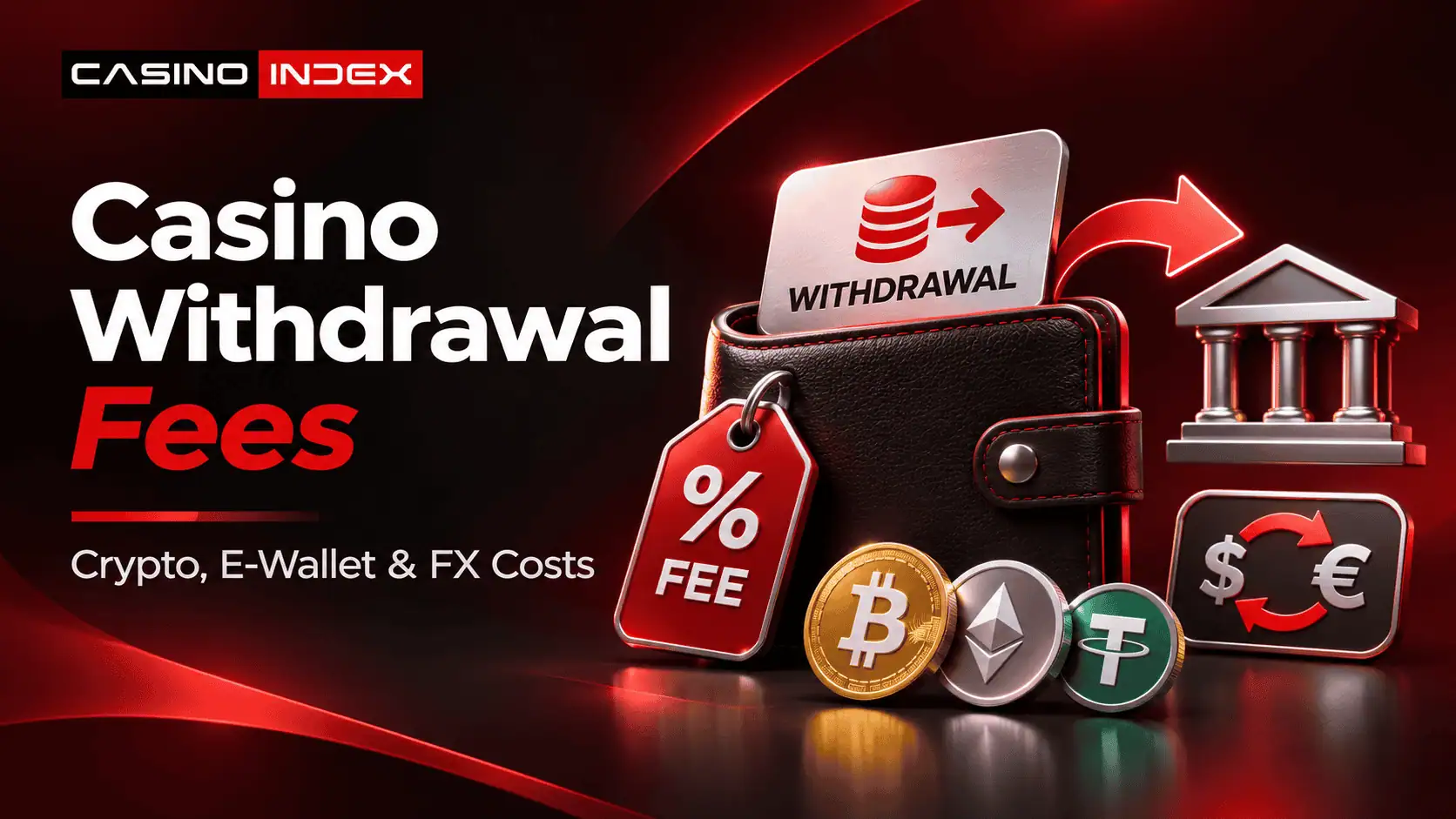
Casino withdrawal fees are not always one charge from the casino. An operator processing fee, a crypto network or payment-provider charge, a bank fee, or a currency-conversion margin can reduce the amount you finally receive. A minimum withdrawal is different: it may stop a payout from being requested without deducting money from your balance. Multiple required transfers can also multiply fixed charges.
The useful question is “How much arrives in the account and currency where I need it?” This guide follows a payout through BTC, USDT, e-wallets and banks, identifying who charges each cost.
Quick answer: what reduces a casino payout?
Check five numbers before confirming: the casino’s deduction, the network or provider deduction, any receiving-bank charge, the conversion rate, and the amount quoted to arrive. Then check the minimum and maximum withdrawal rules separately. A zero casino fee does not mean zero total cost.
The six costs that can reduce a casino withdrawal
Several charges may affect one payout. However, not every charge applies to every method, and some costs appear only after the casino has released the money. The table separates a deduction from a limit, because confusing them leads to inaccurate comparisons.
| Cost type | Charged by | When it appears | How to check | Changes? |
|---|---|---|---|---|
| Casino processing fee | Casino / processor | Before or during payout | Cashier quote and terms | By method or policy |
| Blockchain network fee | Sending transaction | When the sender transfers funds | Network explorer; casino quote | With network demand |
| E-wallet cash-out fee | E-wallet provider | When funds leave the wallet | Provider fee schedule | By country and route |
| Bank transfer fee | Sending / receiving banks | During bank settlement | Bank tariff and receipt | By transfer route |
| Currency conversion loss | Provider setting the rate | When the provider exchanges funds | Rate against a matched reference | With rates and margins |
| Minimum / repeated payouts | Operator or provider | When a minimum or cap applies | Thresholds and per-transfer costs | Minimum is not a fee |
For the broader stages of a cash-out, see how casino withdrawals work. This page is narrower: it measures the money remaining after the payment route is complete.
Casino fees versus network and provider fees
A casino can charge its own fixed or percentage fee. It may instead pass through a third-party charge, absorb that charge, or quote a single amount that contains more than one component. Those approaches do not produce the same net payout.
Suppose you request $100 and the on-chain transfer costs the sender $2. When the casino absorbs it, your destination might receive the full $100 equivalent. A $2 deduction from the requested amount could instead leave $98. Adding a separate $1 processing charge could raise the customer-facing cost. The chain fee alone cannot tell you which policy the casino follows.
Ask whether the amount on the cashier screen is the requested amount, the amount removed from your casino balance, or the estimated amount delivered. Save the quote. For crypto, compare it with the actual transaction details afterward. For a bank or e-wallet, keep both the casino receipt and the provider’s separate statement.
Calling a transfer “network-only” is meaningful only when the casino discloses how it calculates the charge. Even a flat amount the casino calls a network fee may differ from the real-time on-chain cost. A useful policy states the applicable asset, network, minimum, deduction method and confirmation-stage amount.
What does “0% withdrawal fee” mean? It may cover only the casino’s own charge. A network, e-wallet provider, bank or currency conversion can still reduce the final amount. Always compare the full route before calling a withdrawal fee-free.
Bitcoin and USDT network fees: what really changes?
Bitcoin: satoshis per virtual byte, not a percentage of winnings
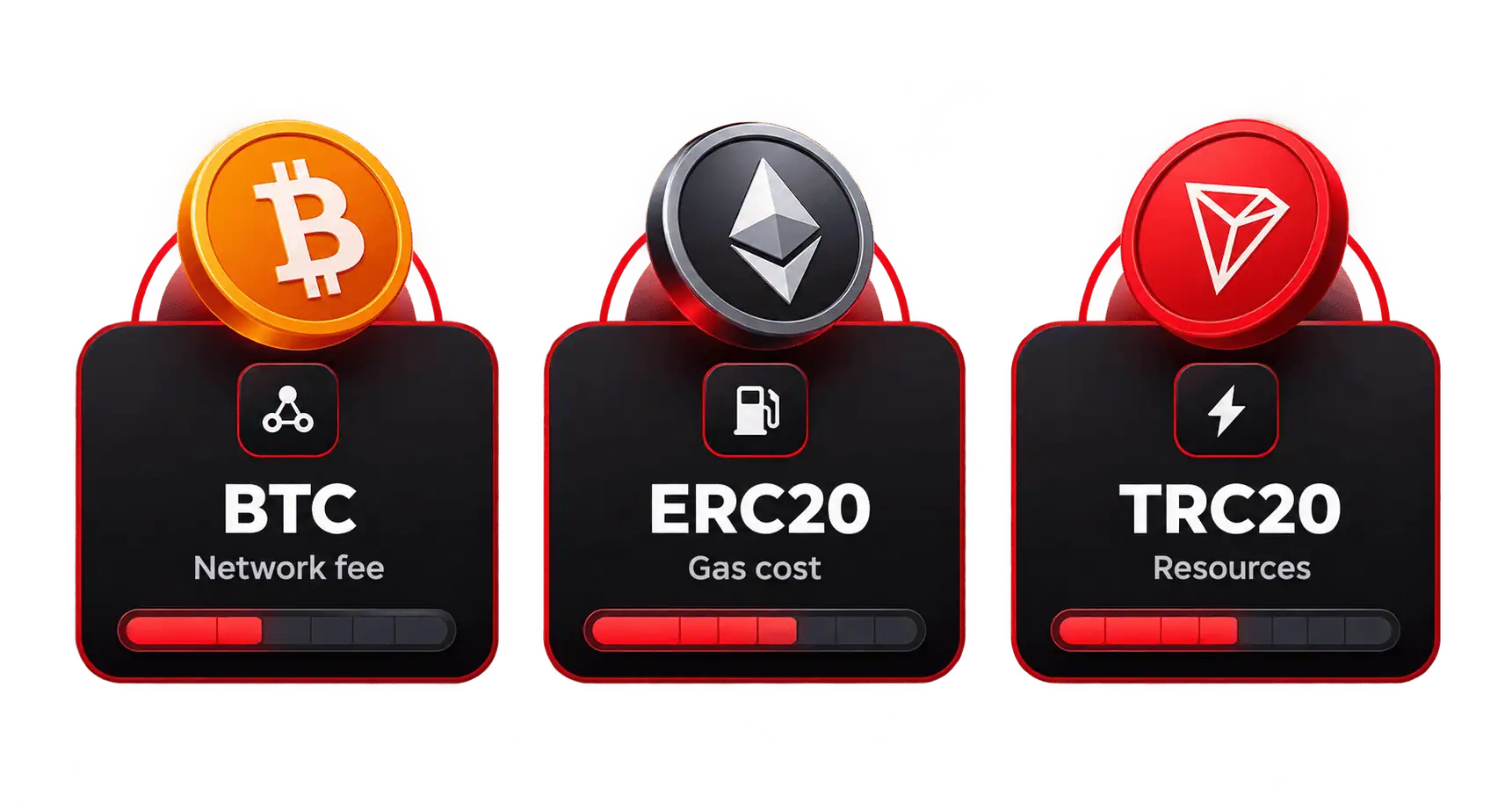
BTC transfer costs depend on transaction size and the fee rate the sender chooses, commonly expressed in satoshis per virtual byte (sat/vB). They are not automatically a percentage of the value withdrawn. For example, a hypothetical 140-vbyte transaction at 2 sat/vB costs 280 satoshis. Its US-dollar value changes with BTC’s price. In the casino cashier, you may instead see a flat dollar deduction or payout estimate; that figure can differ from the actual on-chain transaction cost.
For a live network snapshot, use the public mempool.space fee estimator. The rate shown there is not the same as a casino’s quoted withdrawal deduction. Both figures can change, and batching can prevent a one-to-one comparison of the chain transaction fee with one customer payout.
USDT-ERC20: an Ethereum token transfer uses gas
USDT on Ethereum mainnet is a token transfer. Ethereum charges gas for execution, and the cost depends on gas used and the prevailing base and priority fees. The party sending the token typically pays in ETH, even though the withdrawal asset is USDT. Ethereum’s gas documentation explains why complex token transfers use more gas than a basic ETH transfer.
Therefore, do not advertise one dollar figure as the permanent “USDT-ERC20 withdrawal fee.” The casino might pay the gas but deduct a separate USDT amount from your balance. Equally, it might absorb the transaction cost. Check the exact cashier quote and the Ethereum transaction hash rather than assuming the receiving wallet paid the network fee.
USDT-TRC20: Energy, Bandwidth and the casino’s own quote
On TRON, a USDT token transfer uses resources called Energy and Bandwidth. Resource availability, delegated or staked resources and TRX burned for a shortfall can affect what the sending account pays. The official TRON developer documentation explains the mechanism.
Some comparisons present TRC20 as cheaper than ERC20, but it is not automatically the cheapest casino cash-out. Casino schedules can include fixed deductions unrelated to the exact sender-side resource bill. Compare the final USDT received for both networks, not only a blockchain fee estimator.
Wrong-network risk is not a normal fee
USDT-ERC20 and USDT-TRC20 are not interchangeable deposit routes. The destination must support the exact asset and network selected in the casino cashier. Sending to an unsupported network can make funds inaccessible; recovery is not guaranteed. Coinbase’s network-matching guidance illustrates this risk. Verify the network and address before confirming; never select a cheaper network solely because its displayed fee is lower.
E-wallet charges: receiving money is only the first step
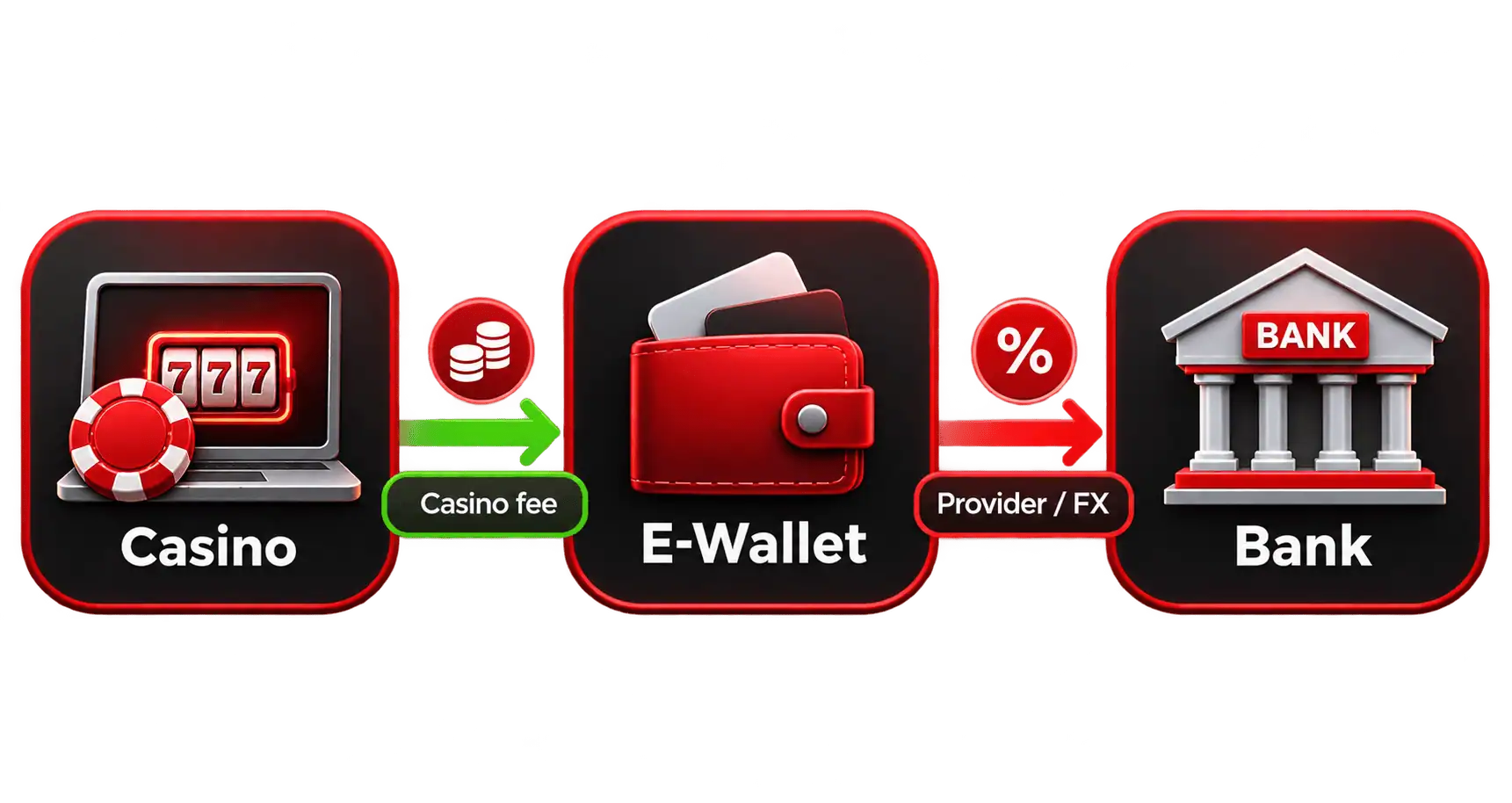
Skrill and Neteller illustrate why a casino’s “free e-wallet payout” can still cost money. The casino-to-wallet transfer and the wallet-to-bank withdrawal are different transactions. Receiving funds in the wallet may incur no receipt fee, while withdrawing them to a bank or card can create a separate provider charge. A conversion can add another cost if currencies differ.
The providers’ public schedules also depend on the customer’s country, payment route, currency and account tier. Do not transfer one region’s advertised fee to a worldwide casino comparison.
- Skrill: The fee schedule checked for this guide listed bank withdrawals at 2.80% (minimum €3.50) and applicable currency conversion at 4.49%.
- Neteller: The viewed schedule showed a $10 bank-transfer charge and a 4.49% currency-conversion fee where applicable.
Fee-page examples checked 3 November 2026. These are examples visible in the official Skrill fee schedule and Neteller fee schedule, not costs taken from test casino withdrawals. The providers personalize pricing, and pages can display different terms by country. Check your logged-in account before relying on an amount.
For example, if a casino sends $100 to an e-wallet with no operator deduction, you may have $100 inside that wallet. That is not necessarily $100 in your bank account. If you plan to move it onward, price that second transfer before depositing at the casino.
Bank withdrawals, cards and the hidden FX spread
A bank transfer can involve a casino charge, an intermediary bank fee, a receiving-bank fee and currency conversion. Domestic transfers may avoid some of these steps; international wires can introduce more. Card payouts depend on issuer and region. Keep card-funding charges separate from withdrawal charges.
An FX spread is not the same as a separately itemized fee. When a provider uses a rate worse than a reference mid-market rate, part of your payout’s value is lost in conversion even if the transaction page says “fee: $0.” Some providers also add an explicit percentage charge. To estimate the total conversion loss, compare the final amount you would receive under the quoted rate with the amount at a time-matched reference rate, and subtract any separately disclosed conversion fee only if the provider has not already included it. Otherwise, you risk double-counting it.
As a simple illustration, suppose the mid-market rate would deliver €90 for a particular $100 payout, but the provider quotes €87.30 with no separate fee. The €2.70 difference is an effective 3% loss relative to the €90 reference. It is not proof of an exactly 3% contractual “FX fee,” and the exchange rate can move between quotes. Wise’s explanation of the mid-market rate is a useful independent reference for understanding the comparison.
Minimum withdrawals and repeated-payment costs
A minimum withdrawal tells you the smallest payout the casino or provider will accept. It is not money deducted from your balance. If the BTC minimum is, hypothetically, $20 equivalent, the cashier may reject a $12 withdrawal request for that route. A minimum blocks a request below the threshold; it does not deduct money from your balance. Read the actual operator terms to see which alternatives exist. Do not deposit extra money just because a site demands a further payment to “unlock” winnings without a clear, legitimate basis.
Fixed charges also have a larger percentage impact on small amounts. A $3 fee consumes 6% of $50 but only 0.3% of $1,000. If payout limits force four separate $25 transfers, four $2 fixed fees would total $8 rather than a single $2 fee. This is a cost illustration, not a suggestion to split withdrawals to bypass checks or limits.
Check the casino’s actual withdrawal minimums and maximum limits. Limits, daily caps and verification rules affect whether the modeled route is even available.
Worked $100 casino withdrawal comparison
The following table compares five routes from the same hypothetical $100 requested withdrawal. We use 3 November 2026 for editorial version control. Actual results depend on the casino, region, supported network, receiving account and final quote.
Illustrative amounts only (3 November 2026): All figures are calculation examples, not live casino fees, live network quotes or tested withdrawals.
| Withdrawal route | Casino fee | External / FX | Minimum | Net received |
|---|---|---|---|---|
| BTC | $0.00 | External fee: $1.50 FX loss: $0.00* | $20 | $98.50* |
| USDT-ERC20 | $0.00 | External fee: $4.00 FX loss: $0.00* | $25 | $96.00* |
| USDT-TRC20 | $0.00 | External fee: $2.00 FX loss: $0.00* | $10 | $98.00* |
| Skrill to bank | $0.00 | External fee: $3.50 FX loss: $1.50 | $20 | $95.00 |
| Bank transfer | $2.00 | External fee: $4.00 FX loss: $2.00 | $50 | $92.00 |
*For this example, BTC has a $100 reference value at one assumed moment; the calculation ignores price changes. The model assumes $1 per USDT for arithmetic, not as a guarantee. For the crypto rows, “external fee” means a hypothetical amount passed through to the customer by the sender; it is not a fee automatically deducted from the receiver on-chain. All five assumed minimums are below the $100 request. The Skrill and bank rows represent complete routes to the stated destination, not merely credit to an intermediate wallet. These figures do not come from a real casino, bank or provider transaction.
How to calculate the net amount received
Net payout formula
For the simplified same-currency scenarios above:
Net received = requested amount − casino deduction − passed-through external costs − conversion loss
In real multi-currency transactions, apply charges at the stage where they occur and compare the actual final converted amount. Do not subtract a network fee twice if it is already included in the casino’s quoted deduction.
For a concrete second-stage example, imagine a $100 request: the casino deducts $1, then passes through $2 in transfer costs. If the subsequent provider conversion loses 2% of the remaining $97, the conversion costs $1.94 and the final equivalent is $95.06. That sequence is more precise than adding a percentage to the original $100 without checking where the conversion occurs.
For a deeper look at choosing supported coins and networks, see USDT casinos evaluated for payment clarity. Those casino evaluations are separate from this hypothetical fee model.
How to compare the real withdrawal cost before depositing
- Choose the final destination. Decide whether you need BTC in self-custody, USDT on a specific network, money inside Skrill or Neteller, or local currency in your bank.
- Check route eligibility. Confirm the casino offers that payout in your country, whether deposit/withdrawal methods must match, and which KYC or payment-ownership checks may apply.
- Record the casino’s policy. Find its fee, per-method minimum, payout cap and whether the casino absorbs or passes through network/provider costs.
- Price the external leg. For a crypto payout, inspect the chain and the casino’s final network-specific quote. Check e-wallet withdrawal-to-bank fees separately. With bank wires, examine receiving and intermediary charges.
- Check currency and rate. Compare the payout’s converted amount with a contemporaneous reference rate, noting any fee already included in the quote.
- Use the actual confirmed net figure. Save the confirmation screen and the published terms that apply on that date. Do not treat a marketing headline as a binding quote.
A payment method can be quick but expensive, or slow with low charges. If you’re comparing the overall trade-off rather than fees alone, read comparing casino payment methods by speed and cost. For timelines after approval, see realistic casino withdrawal times.
When an undisclosed withdrawal fee becomes a complaint issue
A difference between the requested and received amount does not automatically prove casino misconduct. First determine who made the deduction. If the blockchain transaction shows the expected delivered amount but your bank or exchange credits less after conversion, the evidence points to a later stage. If the casino deducts an unexplained amount before sending, ask it to identify the exact term, rate, provider and calculation.
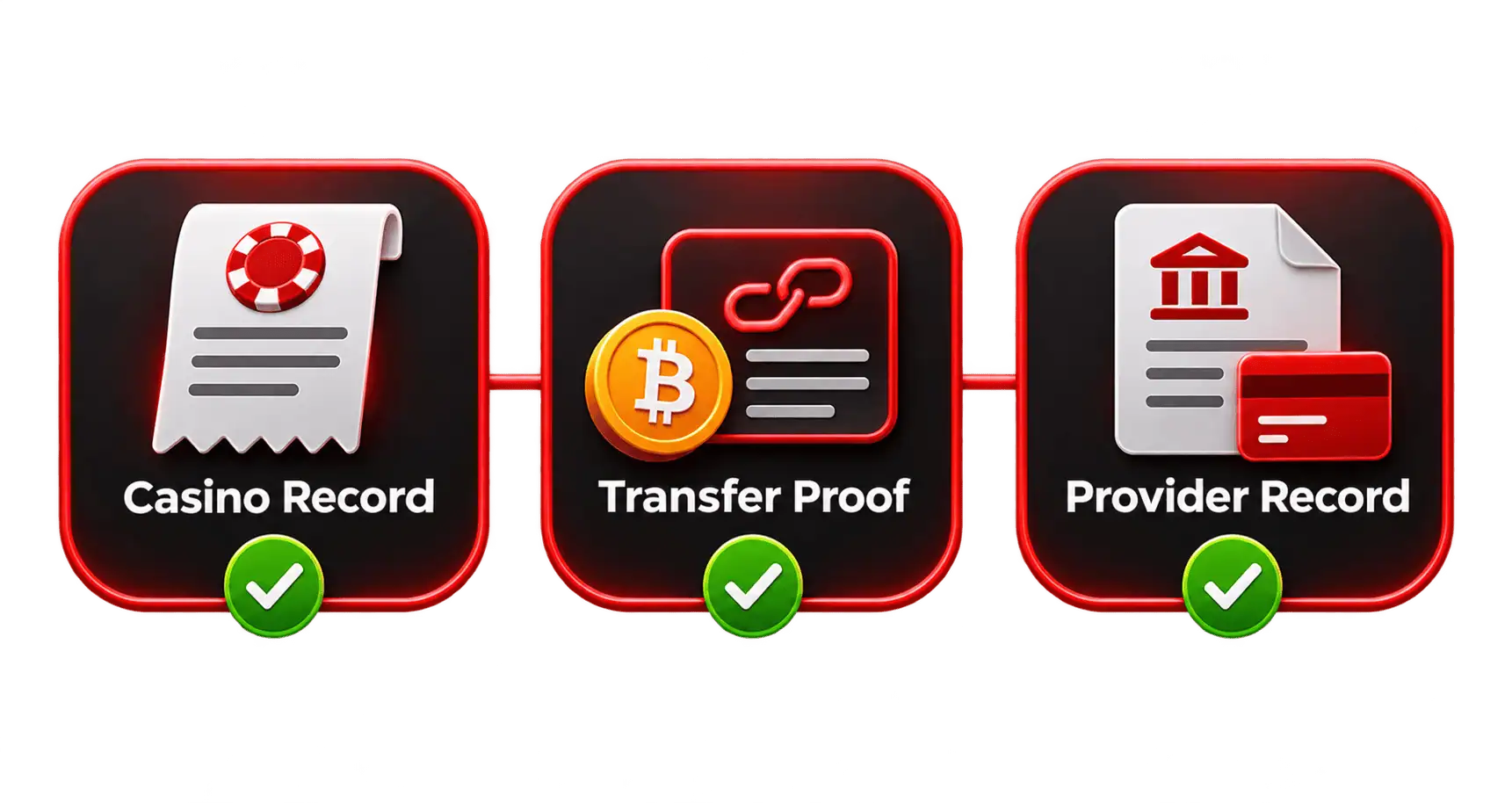
Keep the date, requested amount, asset and network, quoted destination amount, casino balance change, transaction hash or transfer reference, provider statement, currency pair and screenshots of applicable terms. These records make a precise complaint possible. Ask the operator to reconcile each figure in writing instead of merely saying the withdrawal was “processed.”
Regulatory remedies depend on the operator’s actual licence and the customer’s jurisdiction. For example, the UK Gambling Commission’s guidance says certain withdrawal processing fees must be based on a reasonable estimate of directly incurred costs and on fair, transparent contract terms. This is not a universal rule for every offshore casino. Where an applicable licensed operator does not resolve a complaint, follow its formal complaint and available dispute-resolution process.
Finally, do not pay a new deposit or a supposed “tax” directly to an unknown wallet merely because a support message says you must pay to release winnings. Request a written explanation and verify it against the operator’s official channels. Unexpected demands for new payments deserve particular caution.
Common questions about casino withdrawal fees
Do online casinos charge withdrawal fees?
Some do, some absorb external costs, and some pass through processor or blockchain charges. Check the actual casino’s terms and confirmation screen. A zero operator fee does not rule out bank, wallet or FX costs later.
Why was my casino withdrawal smaller than the amount requested?
Compare the casino’s debit, the amount sent, the provider’s receipt and the final bank credit. A processing fee, passed-through transfer cost or currency-conversion rate may explain the difference. The documentation should show where it happened.
Are USDT-TRC20 withdrawals always cheaper than USDT-ERC20?
No. Network resources differ, and a casino can set a fixed withdrawal deduction that does not mirror the real-time chain fee. Check both network quotes at the casino and confirm that your receiving wallet supports the selected route.
Does a receiving crypto wallet pay the network fee?
Ordinarily, the sending transaction pays the blockchain fee. However, a casino may deduct a corresponding amount from the player’s requested withdrawal. That is a casino payout calculation, not an automatic charge taken from the receiver by the chain.
Are Skrill and Neteller casino payouts free?
Receiving funds into the wallet and cashing them out to a bank are separate actions. The first may be free while the second carries a withdrawal charge or FX cost. Review the provider’s fee page for your own country and account.
Is a casino minimum withdrawal a fee?
No. A minimum is an eligibility threshold. The cashier may reject a smaller payout request, but it does not deduct the minimum from your balance. A flat fee can separately make an allowed small withdrawal disproportionately expensive.
Editorial research note (3 November 2026): This is a published-source comparison and educational calculation, not a real-money casino withdrawal test. Provider terms and blockchain conditions change. The $100 amounts are explicitly hypothetical; verify live fees, limits, network support and payment eligibility in your own cashier and payment account before making a decision. The official provider fee pages showed the quoted examples on the date above.

Talha Aydin has been active in cryptocurrency since 2017 and is a co-founder of Freecoins24 and CryptoMutant. Over the years, he has worked with crypto projects on community growth, giveaways, user acquisition and digital strategy while gaining hands-on experience across blockchain platforms and crypto markets. At CasinoIndex, Talha focuses on crypto casinos, withdrawals, payment systems, platform trust and the risks players face when moving funds between wallets and gambling platforms.