How Rakeback Works at Crypto Casinos
Article OverviewCrypto casino rakeback can be calculated from theoretical house edge, wagering volume, losses or VIP activity. The real value depends on the calculation base, eligible games, realistic VIP rate, caps, claim rules and whether the reward is paid as withdrawable cash.

Two crypto casinos can both advertise “10% rakeback” and return completely different amounts of money.
The percentage is not the first thing you should compare.
The first question is:
10% of what?
Some crypto casinos calculate rakeback from the theoretical house edge generated by eligible bets. Others use wagering volume, net losses, VIP points or a platform-specific reward formula. Third-party rebate programs can use another denominator entirely.
That means the same headline percentage can have very different real value.
For a common house-edge-based model:
Rakeback = eligible turnover × house edge × rakeback rate
For example, $10,000 wagered on a game with a 4% theoretical house edge generates $400 of theoretical casino edge.
At a 10% rakeback rate:
$10,000 × 4% × 10% = $40
You receive $40 under that model, not 10% of the $10,000 wagered.
“10% rakeback” does not automatically mean “10% of bets returned.”
How Crypto Casino Rakeback Works: Quick Comparison
| Reward Type | Typical Calculation Base | Main Question |
|---|---|---|
| House-edge rakeback | Turnover × theoretical house edge | What percentage of the edge is returned? |
| Turnover-based reward | Eligible wagering volume | What percentage of wagers qualifies? |
| Net-loss cashback | Qualifying net loss | How does the casino define net loss? |
| Lossback | Usually qualifying loss over a period | What losses and games are included? |
| VIP reward | Can combine edge, volume, tier and activity | What rate do you realistically qualify for? |
| Third-party rebate | Share of affiliate or partner revenue | What is the advertised percentage actually a share of? |
The terminology is not standardized across every casino.
One operator may call a loss-based rebate cashback. Another may use rakeback for a recurring activity reward. A VIP program can combine several different calculations under one rewards dashboard.
CasinoIndex therefore evaluates the calculation behind the label.
Six questions to ask before comparing rates
- What is the percentage applied to?
- What rate can my account actually receive?
- Which games or products qualify?
- Is there a cap, minimum or claim deadline?
- Is the reward cash or bonus balance?
- Does claiming it affect withdrawal?
What Is Casino Rakeback?
Casino rakeback is a recurring reward connected to eligible gambling activity.
Unlike a traditional match bonus, it is usually generated after wagering takes place rather than being added upfront to the player’s balance.
One common crypto casino structure returns a percentage of the theoretical house edge generated by each wager.
Suppose you place $100 of eligible bets on a game with a 4% house edge.
The theoretical edge generated is:
$100 × 4% = $4
At 10% edge-based rakeback:
$4 × 10% = $0.40
If the formula is based on theoretical edge, that calculation does not depend on whether this particular $100 sequence finished in profit or loss.
The qualifying wagering volume and the game’s mathematical edge determine the reward.
Theoretical-Loss-Based Rakeback Explained
Theoretical loss is not the same as the amount a player actually lost.
It describes the long-run mathematical expectation associated with the wagering:
Theoretical loss = eligible turnover × house edge
If rakeback returns a percentage of that theoretical loss:
Rakeback = theoretical loss × rakeback rate
Imagine $5,000 of qualifying wagering on a game with a 2% house edge.
Theoretical loss:
$5,000 × 2% = $100
At 10% rakeback:
$100 × 10% = $10
The player might actually finish up $300, down $600 or almost unchanged. The theoretical-loss calculation remains based on the game’s long-run mathematical edge rather than the session result.
The underlying relationship is explained in more detail in how theoretical loss is linked to house edge.
Why the Same Rakeback Rate Can Pay Different Amounts
In a house-edge-based system, the game itself affects the reward.
Assume $10,000 of eligible turnover and 10% rakeback.
| Illustrative House Edge | Theoretical Loss | 10% Rakeback | Expected Cost After Rakeback |
|---|---|---|---|
| 1% | $100 | $10 | $90 |
| 2% | $200 | $20 | $180 |
| 4% | $400 | $40 | $360 |
| 6% | $600 | $60 | $540 |
The 6%-edge example generates six times as much rakeback as the 1%-edge example.
It also generates six times as much theoretical loss before the reward.
More rakeback dollars do not automatically mean better value.
The reward is larger because the underlying expected cost is larger.
Do Not Choose a Higher House Edge Just to Earn More Rakeback
This is one of the most important practical rules.
A reward interface can make a higher rakeback number look positive. But if the extra reward exists only because the game is mathematically more expensive, the player has not found an advantage.
Consider the examples above.
The 1% game produces $10 in expected rakeback and $90 in expected cost after the reward.
The 4% game produces $40 in rakeback but still leaves $360 in expected cost.
The extra $30 of rebate came with an additional $270 of theoretical cost.
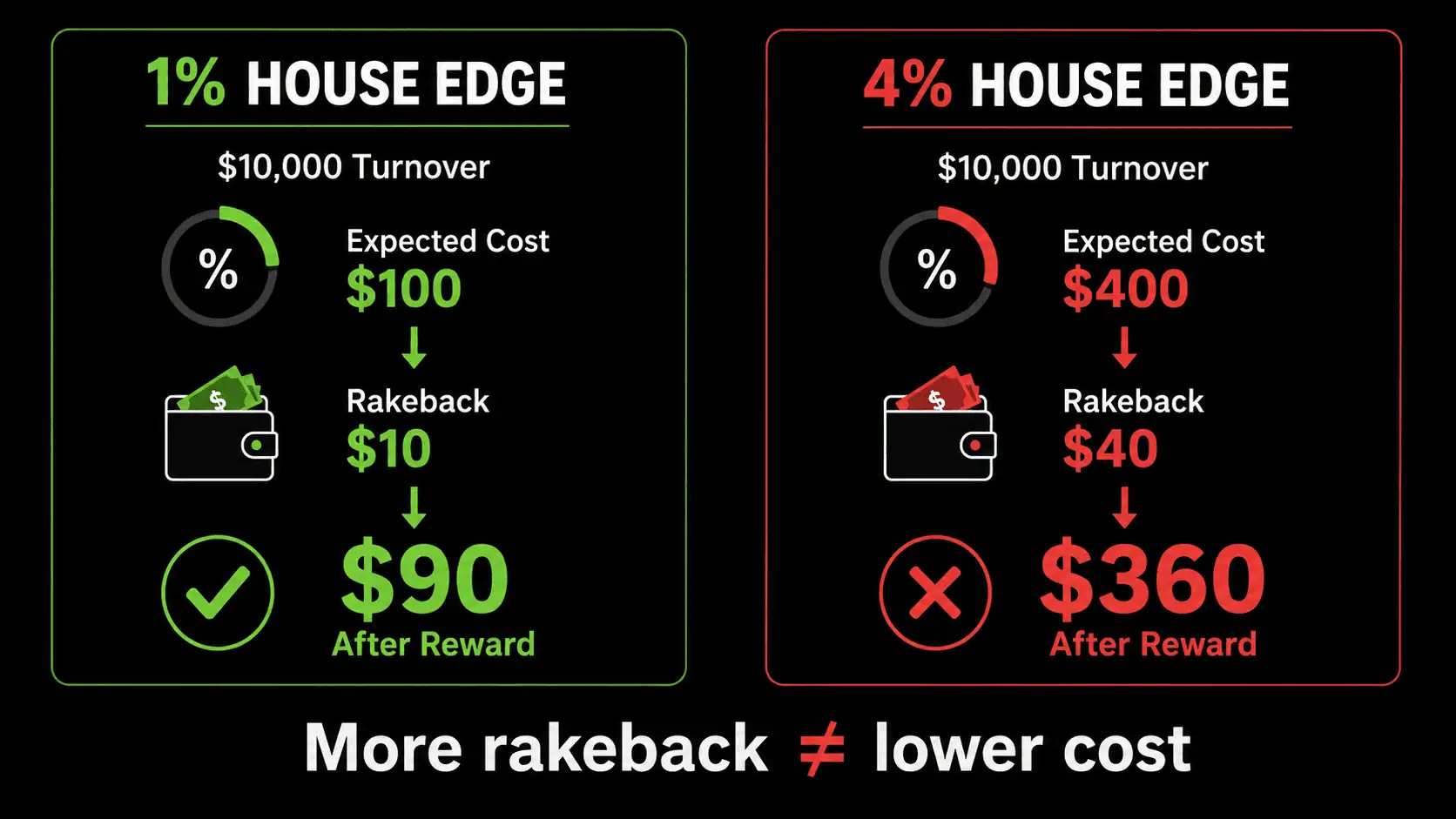
Rakeback is better understood as a discount on gambling activity that would already happen, not something to maximize by choosing worse games.
How Rakeback Changes the Effective Expected Cost
If a reward returns a fixed percentage of the theoretical house edge, its effect can be estimated as:
Effective expected cost rate = house edge × (1 − rakeback rate)
For a 4% game with 10% edge-based rakeback:
4% × 0.90 = 3.6%
This assumes that:
- all relevant bets qualify;
- the advertised rate actually applies to the account;
- the full house edge is included in the calculation;
- there is no reward cap;
- the reward is fully usable;
- no additional wagering is required.
The game’s RTP has not changed.
The separate reward simply reduces the player’s expected cost after the rebate is included.
Turnover-Based Rakeback Is a Different Formula
Some reward programs apply a percentage directly to eligible wagering volume rather than to theoretical house edge.
The formula is then:
Reward = eligible turnover × turnover reward rate
For example:
$10,000 × 0.1% = $10
The game’s house edge does not enter that simple calculation.
A 0.1% turnover rebate therefore cannot be compared directly with 10% of theoretical house edge without converting both offers into actual money.
Rakeback vs Cashback
The clearest distinction is the calculation base.
Rakeback commonly rewards eligible wagering or theoretical casino edge.
Cashback commonly returns part of a qualifying loss.
| Rakeback | Net-Loss Cashback | |
|---|---|---|
| Can pay during a winning period? | Often yes | Usually no |
| Common base | Wagering / theoretical edge | Qualifying net loss |
| Volume matters directly? | Usually | Not in the same way |
| Common settlement | Instant or recurring | Daily, weekly or monthly |
| Key comparison | Calculation denominator | Definition of net loss |
These are useful definitions, not industry-wide legal standards.
Always inspect the terms because casinos can use the same marketing word for different calculations.
What Is Casino Lossback?
Lossback generally returns a percentage of qualifying losses after a defined settlement period.
Suppose:
- weekly qualifying loss: $800;
- lossback rate: 10%.
The headline calculation would be:
$800 × 10% = $80
But the result is only useful if you know how the casino reached the $800 figure.
“Net loss” may be calculated using:
- wagers minus wins;
- deposits and withdrawals;
- casino-only results;
- eligible-game losses;
- loss after previous bonuses are deducted;
- another operator-defined calculation.
The percentage should never be separated from the definition of the loss base.
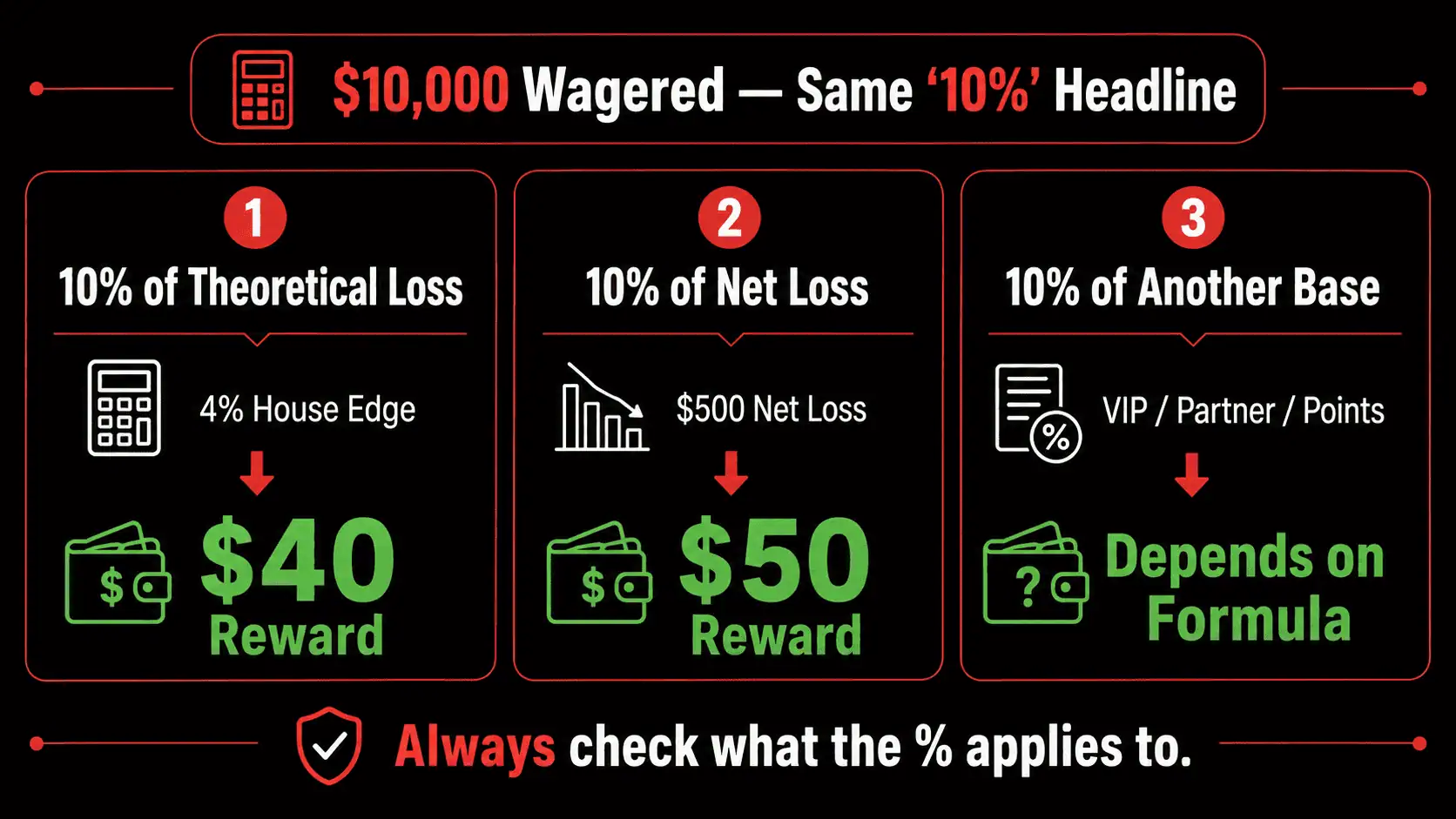
Three Identical Percentages, Three Different Rewards
Suppose a player wagers $10,000 during a week and finishes the qualifying period $500 down.
Offer A: 10% of theoretical loss
Assume an average 4% house edge.
$10,000 × 4% = $400 theoretical loss
$400 × 10% = $40 reward
Offer B: 10% of net loss
The qualifying net loss is $500.
$500 × 10% = $50 reward
Offer C: 10% headline rate on another reward base
If the 10% applies to an internal VIP value, affiliate commission, points total or another defined denominator, neither $40 nor $50 can be assumed.
The terms need to reveal the base before the reward can be calculated.
Same percentage. Different denominator. Different payout.
VIP Gating: Your Real Rakeback Rate May Be 0%
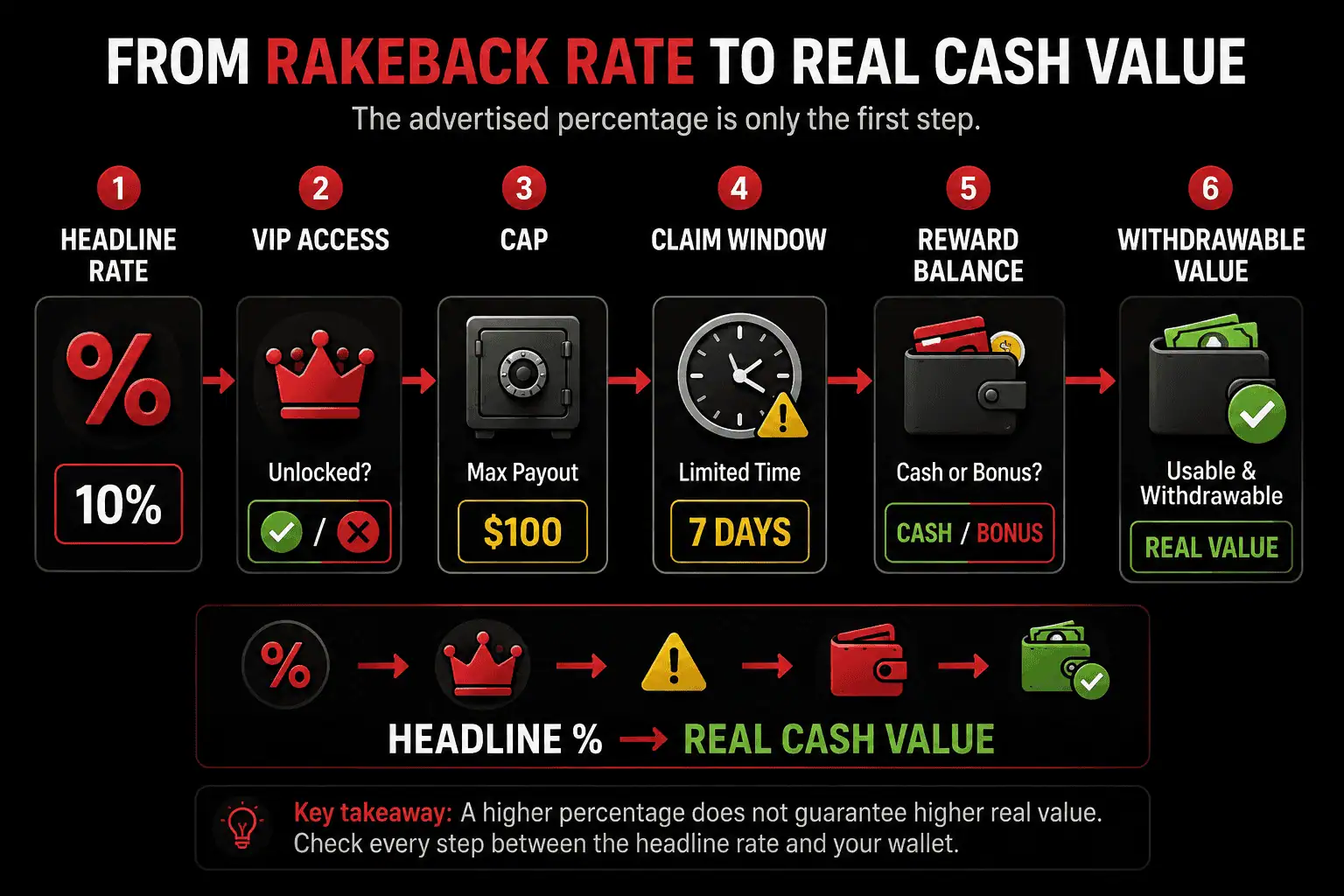
One of the easiest ways to overvalue a crypto casino reward is to compare the maximum VIP rate instead of the rate actually available to your account.
Some programs do not unlock rakeback until the player reaches an entry tier or wagering threshold.
That creates a simple but important reality:
Until the required level is reached, the practical rakeback rate may be zero.
Other programs offer a base rate immediately and increase it at higher tiers.
Before valuing a VIP reward, check:
- when rakeback first unlocks;
- whether progress is lifetime or resets;
- the rate at your realistic tier;
- what volume is needed for the next tier;
- whether the higher rate applies retroactively;
- whether every game contributes equally to VIP progression.
Comparisons of VIP programs with higher reward rates should therefore focus on realistic access rather than the largest possible percentage.
Instant, Daily, Weekly and Monthly Rewards Should Not Be Added Blindly
Modern crypto VIP systems can split rewards across several layers.
A dashboard may show:
- instant rakeback;
- daily rewards;
- weekly rewards;
- monthly rewards;
- level-up rewards;
- reloads;
- special VIP bonuses.
Seeing 5% instant and 5% weekly does not automatically prove the account receives 10% of the same value.
Do not add reward percentages unless both use the same calculation base and both apply to the same eligible wagering.
Also check whether one layer is based on theoretical edge while another uses recent losses, VIP history or a platform-specific formula.
Casino, Poker and Sportsbook Rakeback Can Use Different Bases
A reward formula that applies to casino games should not automatically be carried over to poker or sports betting.
Casino
Crypto casino games may use theoretical house edge, eligible wagering or another platform-defined value.
Poker
Poker rakeback traditionally refers to a percentage of the actual rake collected from pots, tournament fees or other poker charges.
That is different from estimating theoretical house edge on a casino game.
Sportsbook
Sports rewards can use a separate assumed margin, theoretical value or settlement formula.
Voided bets, cashouts, pushes or selected markets may also be excluded.
Some casinos offer rakeback on casino wagering but none at all on sportsbook activity.
Always check the product-specific rules rather than assuming one percentage covers the entire account.
Native Casino Rakeback vs Third-Party Affiliate Rakeback
There is another category that can make headline percentages especially confusing.
Native rakeback is paid through the casino’s own rewards or VIP system.
Third-party rebate programs can instead share part of the affiliate or partner revenue generated when a player is referred to a casino.
That means a third party advertising “50% rakeback” might mean:
50% of the commission it receives
rather than:
50% of your bets
or:
50% of the casino’s house edge
Affiliate agreements can also contain deductions, revenue adjustments, negative carryover or other conditions.
For that reason, third-party rates should not be placed in the same comparison column as native casino rakeback unless the denominator has been normalized.
Capped Rakeback Can Collapse the Effective Rate
A cap can make an attractive headline rate much weaker at higher activity levels.
Imagine:
10% weekly cashback — maximum $100
If qualifying loss is $500:
10% = $50
The full rate applies.
If qualifying loss is $2,500:
10% would normally equal $250, but the casino pays only the $100 maximum.
The effective rate becomes:
$100 ÷ $2,500 = 4%
The headline still says 10%.
The player actually receives 4% of the qualifying loss.
Claim Windows Can Turn Earned Rewards Into $0
Some rewards are credited automatically.
Others remain in a claimable balance and reset after a deadline.
Check:
- automatic vs manual claiming;
- daily, weekly or monthly reset times;
- minimum claim amount;
- whether unclaimed rewards roll over;
- whether a withdrawal cancels pending rewards;
- whether inactive accounts lose accrued value.
If a reward expires before it is claimed, its practical value is zero regardless of how attractive the percentage looked.
Cash Rakeback vs Bonus-Balance Rakeback
The next question is where the reward goes.
A rakeback credit can potentially arrive as:
- withdrawable cash;
- normal real-money balance;
- bonus funds;
- locked promotional credit;
- funds with additional wagering attached.
A 5% reward paid as clean cash can be more useful than a 10% reward that creates another wagering cycle.
This is why the final destination of the credit matters as much as the rate.
CasinoIndex explains the balance mechanics further in how locked bonus funds differ from rakeback.
Can Rakeback Have Wagering Requirements?
Yes.
Rakeback is often marketed as simpler than a traditional deposit bonus, but the term itself does not guarantee wager-free cash.
If the reward enters a bonus balance, the player may still need to meet:
- wagering requirements;
- eligible-game rules;
- maximum-bet limits;
- expiry conditions;
- cashout restrictions.
A recurring reward should therefore not be confused with a standard bonus simply because the interface calls it cashback or rakeback.
The difference between the two structures becomes clearer when you understand why rakeback differs from a wagered bonus.
Rakeback Review Table: How to Judge an Offer
| What to Review | Stronger Structure | Warning Sign |
|---|---|---|
| Calculation base | Formula clearly published | Only an “up to” percentage |
| Realistic rate | Entry rate visible | Only maximum VIP rate advertised |
| Eligibility | Games and products listed | Unclear exclusions |
| Cap | No cap or clear generous limit | Low cap hidden in terms |
| Claiming | Automatic or clear claim window | Short expiry / reset |
| Reward form | Usable cash or real balance | Locked bonus funds |
| Extra wagering | None | Another rollover cycle |
| Withdrawal impact | Does not alter cashout status | Claiming activates restrictions |
This type of review is more useful than ranking rewards by percentage alone.
Rakeback per $1,000 Wagered
For house-edge-based rewards, translating the percentage into dollars per $1,000 wagered makes comparison much easier.
| House Edge | Rakeback Rate | Return per $1,000 Wagered |
|---|---|---|
| 1% | 5% | $0.50 |
| 1% | 10% | $1.00 |
| 2% | 10% | $2.00 |
| 4% | 5% | $2.00 |
| 4% | 10% | $4.00 |
| 5% | 10% | $5.00 |
That makes the marketing number easier to interpret.
A 10% edge-based rakeback rate on a 1% house-edge game returns approximately $1 for every $1,000 of qualifying turnover.
The same advertised rate on a 4% game returns about $4 per $1,000 — while the underlying expected cost is also much higher.
Is Casino Rakeback Worth It?
Rakeback can improve the value of gambling activity a player was already going to make.
A stronger offer usually has:
- a clear calculation formula;
- a realistic entry rate;
- broad eligibility;
- no restrictive payout cap;
- reasonable or automatic claiming;
- cash rather than locked bonus credit;
- no additional wagering;
- no unexpected effect on withdrawals.
It becomes less useful when the player has to increase wagering, reach an unrealistic VIP tier or use higher-edge games to make the reward meaningful.
Rakeback is worth evaluating as a discount on normal play, not as a reason to create more play.
Rakeback Does Not Make a Casino Trustworthy
A transparent reward formula is a positive product feature.
It does not prove that the operator handles player funds well.
A casino can offer excellent rakeback and still have weak:
- withdrawal handling;
- KYC practices;
- ownership transparency;
- account rules;
- complaint resolution;
- payment reliability.
CasinoIndex therefore keeps trust and withdrawal behavior above rewards when evaluating operators.
Players should be comparing casinos beyond headline rewards rather than allowing a large rebate percentage to outweigh payout risk.
Responsible Gambling: Rakeback Should Follow Your Play
Rakeback creates a strong volume incentive because more qualifying wagering usually produces more reward.
That can create the feeling that another session, higher stake or higher VIP tier is needed to avoid missing value.
The safer relationship is the reverse:
Your normal play may generate rakeback. Rakeback should not generate your play.
Do not increase stakes, extend sessions or choose higher-house-edge games simply to unlock a larger reward.
A rebate earned by creating substantially more expected loss is not free value.
Final Takeaway
The biggest mistake when comparing crypto casino rakeback is starting with the headline percentage.
Start with the denominator.
Ask:
What is the percentage applied to?
What rate can I actually receive?
Which games qualify?
Is the reward capped?
When must it be claimed?
Does it arrive as cash?
Does it change withdrawal conditions?
For a house-edge-based model:
Eligible turnover × house edge × rakeback rate = expected rakeback
But that formula is only one part of the value calculation.
A smaller rate with broad eligibility, no cap, automatic cash credit and clean withdrawals can be worth more than a much larger percentage hidden behind VIP requirements, claim windows or locked bonus funds.
Players ready to compare actual casino reward structures can review crypto casinos with cashback and rakeback.
Frequently Asked Questions
What is rakeback at a crypto casino?
Rakeback is a recurring reward linked to eligible gambling activity. Some major crypto casino systems calculate it as a percentage of theoretical house edge, while others use wagering volume or another formula.
How is casino rakeback calculated?
One common formula is eligible turnover × game house edge × rakeback rate. Other casinos use turnover, VIP points, loss-based calculations or mixed reward models, so the exact denominator should always be checked.
Does 10% rakeback mean I get 10% of my bets back?
No. If the 10% rate applies to theoretical house edge, only a percentage of that edge is returned. For example, $1,000 wagered on a 4%-edge game creates $40 of theoretical edge, and 10% of that equals $4.
What is the difference between rakeback and cashback?
Rakeback commonly rewards wagering activity or theoretical house edge, while cashback commonly returns a share of qualifying losses over a defined period. Casino terminology varies, so the formula matters more than the label.
What is casino lossback?
Lossback generally returns a percentage of qualifying net losses after a defined period. Its value depends on how the casino defines the loss, which games qualify, caps and whether the reward is cash or bonus credit.
Does a higher house edge give more rakeback?
In an edge-based system, yes. The same turnover generates more rakeback on a higher-edge game, but it also generates more theoretical loss. Choosing a worse game simply to increase rakeback generally increases expected cost.
Does rakeback improve RTP?
No. The game’s underlying RTP does not change. A separate cash rebate can reduce the player’s effective expected cost after rewards are included.
Can rakeback require VIP status?
Yes. Some programs unlock rakeback only after an entry tier or wagering threshold is reached, while others increase the rate as the player moves through VIP levels.
Can casino, poker and sportsbook rakeback be calculated differently?
Yes. Casino games may use theoretical house edge, poker can use actual rake collected, and sportsbook rewards may use a separate assumed margin or eligibility formula.
What is third-party rakeback?
Some external programs share part of the affiliate commission they receive for referred players. A headline rate in such a program can represent a share of affiliate revenue rather than a percentage of wagers or casino house edge.
Can rakeback have wagering requirements?
Yes. Some programs pay usable cash, while others credit promotional funds that can carry wagering, game restrictions or other bonus conditions.
Is casino rakeback worth it?
It can improve the value of activity a player would already choose. It should not be used as a reason to wager more, chase VIP tiers or select higher-house-edge games simply to earn a larger rebate.

Nina Kanu has worked in cryptocurrency content and blockchain research since 2016. She is also known within parts of the crypto community through CryptoMutant, where her work has covered emerging projects, market trends and developments across the blockchain ecosystem. At CasinoIndex, Nina focuses on crypto casino reviews, platform comparisons, player experience, game ecosystems and bonus fairness. Her research examines how casino products perform beyond their marketing, including usability, payment options, promotional terms and the overall experience players receive after signing up.