House Edge vs RTP: What Actually Determines Expected Loss?
Article OverviewHouse edge and RTP show the long-term mathematics of casino games, but expected loss depends on turnover. Stake size, game speed and session length can increase exposure even when RTP stays the same. This guide explains how to calculate expected loss and compare house edges across casino games.
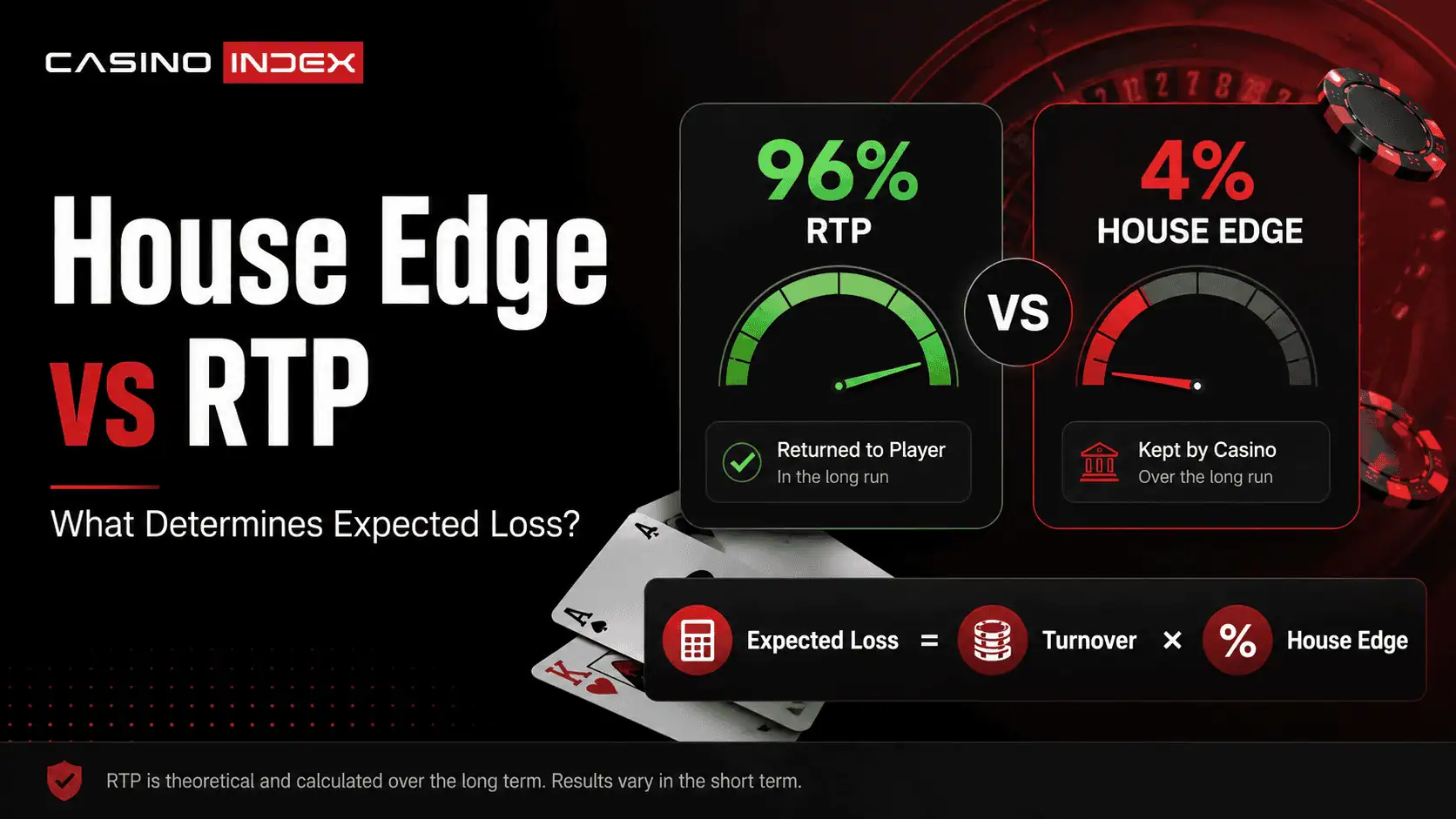
A 96% RTP game and a 4% house edge usually describe the same long-term mathematics from opposite sides.
But neither figure tells you exactly what a real gambling session may cost.
For that, a more useful number is expected loss. It combines the casino’s mathematical advantage with the total amount of money actually wagered.
Expected loss = total amount wagered × house edge
If a player makes 100 bets of $1 on a game with a 4% house edge, total turnover is $100 and theoretical expected loss is $4.
If the same player makes 600 bets, turnover becomes $600 and expected loss rises to $24.
The RTP did not change. The stake did not change. The amount of exposure did.
That distinction is what makes house edge more useful when it is connected to turnover, game speed and session length rather than treated as an isolated percentage.
House Edge vs RTP: The Quick Answer
| Measure | What It Describes | Example |
|---|---|---|
| RTP | Long-run percentage theoretically returned to players | 96% |
| House edge | Casino’s mathematical advantage | 4% |
| Turnover | Total money wagered, including recycled winnings | $1,000 |
| Expected loss | Turnover multiplied by house edge | $40 |
For a conventional game where RTP and house edge use the same wagering basis:
House Edge = 100% − RTP
and:
RTP = 100% − House Edge
A game with 97% RTP therefore corresponds to a 3% theoretical house edge. A 94% RTP game corresponds to 6%.
Players who want the broader explanation of theoretical return, game versions and how the percentage is calculated can first read how casino RTP works.
What Is House Edge?
House edge is the casino’s expected mathematical advantage over repeated wagering.
If a game has a 2.7% house edge, the long-run mathematical expectation is roughly $2.70 lost per $100 wagered, assuming the published percentage applies to the wager being made.
It does not mean that every $100 session loses exactly $2.70.
It also does not mean:
- the casino removes that percentage from every individual bet;
- a player cannot finish a session in profit;
- results should closely follow the percentage over a few dozen rounds;
- a low-house-edge game cannot produce a large short-term loss.
House edge describes expectation, not the order in which wins and losses arrive.
A player can win substantially during a short session on a negative-expectation game. Another player can lose an entire session bankroll quickly. Neither result changes the underlying mathematics.
What Is the Difference Between RTP and House Edge?
RTP looks at the game from the player side. House edge looks at the same long-run relationship from the casino side.
Consider a slot with a theoretical RTP of 96%.
- Theoretical RTP: 96%
- House edge: 4%
- Expected loss per $100 wagered: $4
- Expected loss per $1,000 wagered: $40
- Expected loss per $10,000 wagered: $400
This is where apparently small percentage differences become meaningful.
Across $10,000 of turnover:
- 96% RTP / 4% edge = $400 theoretical expected loss
- 94% RTP / 6% edge = $600 theoretical expected loss
The difference is $200 in expected loss.
That does not predict the player’s final balance. It shows how the mathematical cost changes as total wagering grows.
RTP and house edge are not always perfect mirror images
The simple 100% relationship works when both figures use the same wagering denominator.
That is straightforward for many slots and fixed wagers. Some table games are more complicated because a hand may begin with one stake and later involve doubles, splits, raises or additional wagers.
In those cases, published figures may use the original wager or another defined basis rather than every dollar eventually committed to the hand.
For accurate comparisons, the rules and calculation basis matter as much as the headline percentage.
Expected Casino Loss Depends on Turnover, Not Just Your Deposit
A common mistake is to apply RTP or house edge directly to the original deposit.
A $100 deposit does not necessarily create only $100 of wagering.
A player can wager part of the balance, win, reuse those winnings and continue. The same starting money may pass through the game many times.
This creates turnover.
The UK Gambling Commission defines turnover as the total of all stakes made on a game, including winnings that are reinvested during play.
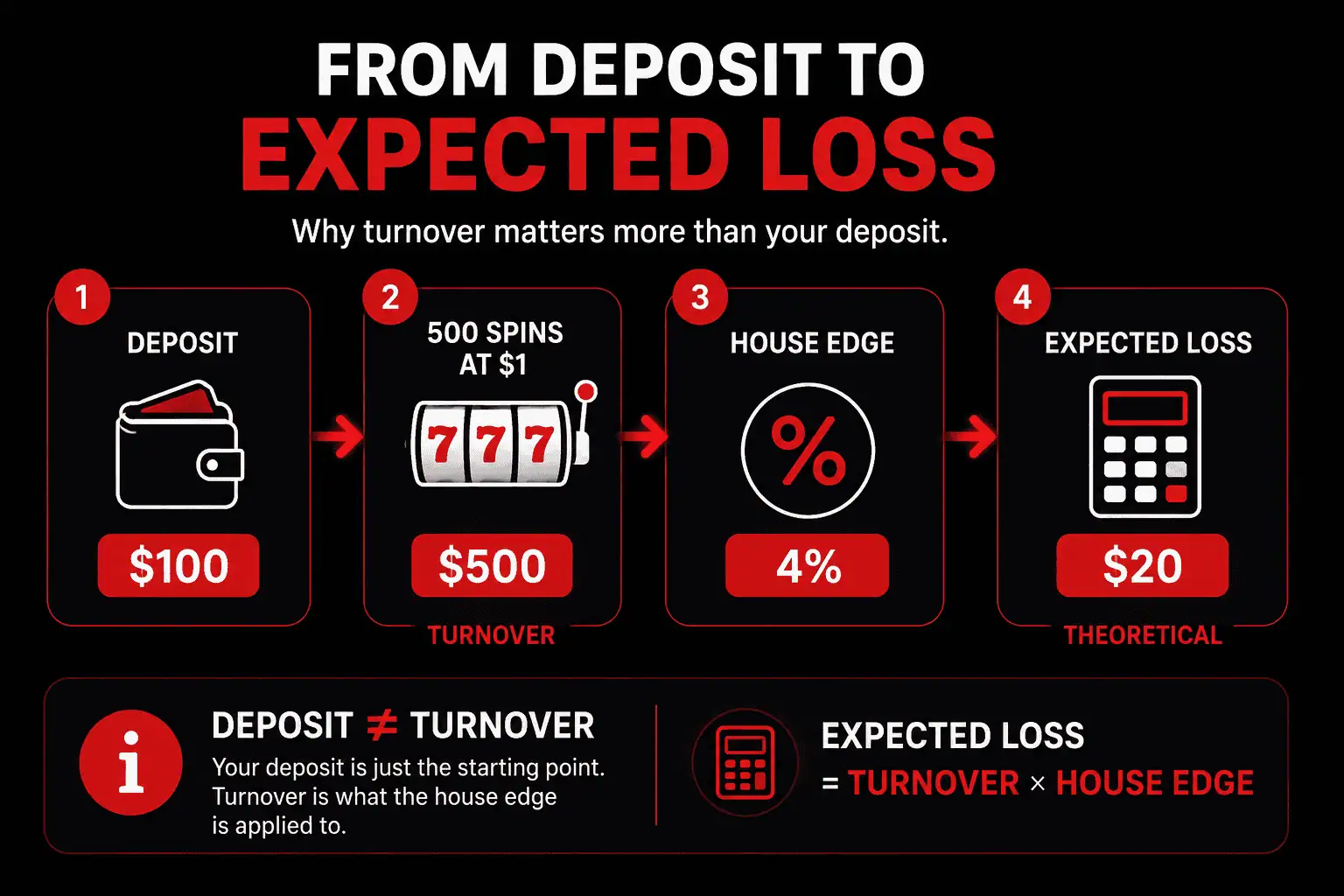
Suppose a player deposits $100 but completes 500 spins at $1 each.
Total turnover is:
500 × $1 = $500
At a 4% theoretical house edge:
$500 × 0.04 = $20 expected loss
The player is not expected to finish with exactly $80. A short session can finish far above or below the mathematical expectation.
The useful point is that the 4% edge was applied to $500 of wagering activity, not simply to the original $100 deposit.
How Stake Size Changes Expected Loss
If the number of rounds and house edge remain the same, increasing the stake increases expected loss in direct proportion.
Consider 500 rounds on a game with a 4% edge:
| Stake per Round | Total Wagered | Theoretical Expected Loss |
|---|---|---|
| $0.50 | $250 | $10 |
| $1 | $500 | $20 |
| $2 | $1,000 | $40 |
| $5 | $2,500 | $100 |
| $10 | $5,000 | $200 |
The game has not become mathematically worse at $10 per round. The player’s financial exposure has increased because more money is passing through the same negative expectation.
Why Game Speed Matters
Game speed can have a surprisingly large effect because faster games create more turnover in the same amount of time.
This is particularly relevant to slots, crash games, dice, mines, plinko-style games, rapid digital table games and formats with autoplay or very short round cycles.
Consider two players on the same 4% house-edge game.
Player A
- $1 per round
- 100 rounds per hour
- $100 hourly turnover
- $4 theoretical expected loss per hour
Player B
- $1 per round
- 600 rounds per hour
- $600 hourly turnover
- $24 theoretical expected loss per hour
The higher expected loss comes entirely from the greater wagering volume created by faster play.
The difference comes from wagering volume.
The Four Variables Behind Expected Loss
For a simple fixed-stake game, a practical estimate is:
Expected loss = stake × number of rounds × house edge
If you want to estimate the effect of time:
Expected hourly loss = stake × rounds per hour × house edge
That leaves four main variables:
1. House edge
The mathematical disadvantage attached to the wager. Lower is generally better when comparing otherwise equivalent games.
2. Stake size
Larger wagers create more financial exposure on every round.
3. Number of rounds
Longer sessions usually create more total wagering.
4. Game speed
Fast games can generate hundreds of bets before the player notices how much money has actually been cycled through the game.
House Edge by Casino Game
There is no single meaningful house-edge number for an entire category unless the exact game, rules and wager are known.
Players comparing categories can first understand how different casino game types work.
| Game / Bet | Approx. House Edge | Expected Loss per $1,000 |
|---|---|---|
| Baccarat Banker, standard 5% commission | 1.06% | $10.60 |
| Baccarat Player | 1.24% | $12.40 |
| European roulette, single zero | 2.70% | $27.00 |
| 96% RTP slot | 4.00% | $40.00 |
| Baccarat Tie paying 9:1, eight decks | Approx. 4.84% | Approx. $48.44 |
| American roulette, standard bets | 5.26% | $52.60 |
| 94% RTP slot | 6.00% | $60.00 |
| Baccarat Tie paying 8:1, eight decks | 14.36% | $143.60 |
These figures illustrate why the exact version or wager matters.
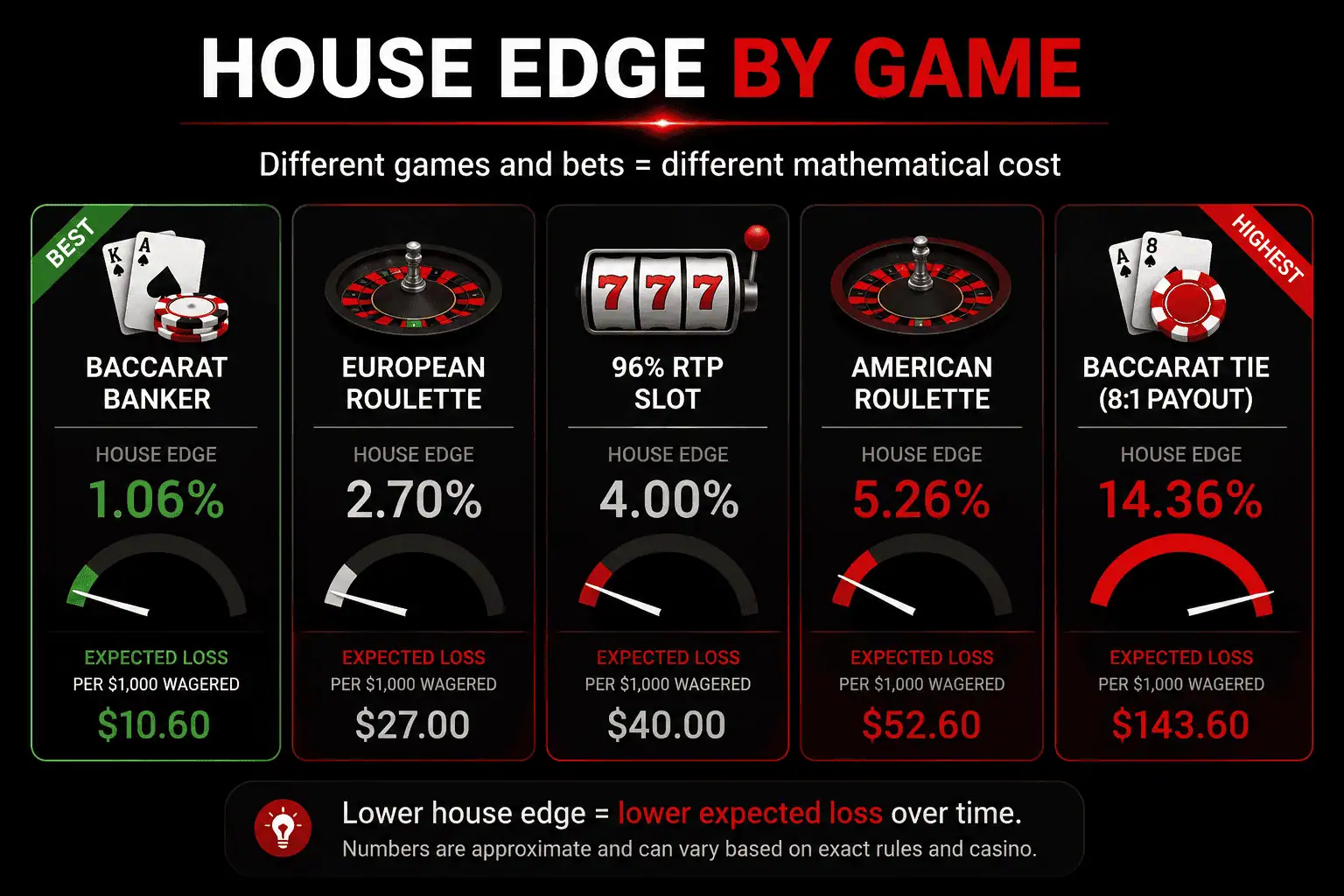
The difference between European and American roulette comes from the wheel structure. The difference between Baccarat Banker and Tie comes largely from the payout relative to the probability of the result.
Blackjack is harder to place in one table because there is no universal blackjack house edge.
Why Blackjack Strategy and Table Rules Both Matter
Blackjack is different from a fixed-RTP slot because player decisions can affect expected value.
But strategy is only half of the equation.
A quoted blackjack house edge normally assumes correct basic strategy for a specific set of rules. Those rules can include:
- number of decks;
- whether the dealer hits or stands on soft 17;
- whether doubling after a split is allowed;
- whether surrender is available;
- re-splitting rules;
- whether blackjack pays 3:2, 6:5 or another amount.
Two blackjack tables can therefore have different mathematical edges even when the player makes identical decisions.
Poor decisions can then increase the disadvantage further.
This is why statements such as “blackjack has a 0.5% house edge” need context. That figure may be reasonable for a particular favorable rule set played with correct basic strategy, but it is not a universal property of blackjack.
Side Bets Can Change the Mathematical Cost Quickly
Side bets often carry a much larger house edge than the main game.
Baccarat provides a clear example.
In a common eight-deck version, the standard Banker bet has a house edge of about 1.06%.
A Tie bet paying 8:1 carries a much higher edge of about 14.36%.
If the same Tie bet pays 9:1, the edge falls substantially to roughly 4.84%.
The payout rule therefore matters.
Assume a player wagers $20 for 60 rounds, creating $1,200 of turnover.
On the Banker bet:
$1,200 × 1.06% = $12.72 expected loss
On an 8:1 Tie bet:
$1,200 × 14.36% = $172.32 expected loss
On a 9:1 Tie bet:
$1,200 × 4.844% ≈ $58.13 expected loss
Nothing about the stake or session length changed. Only the wager and payout rules changed.
This is why house-edge tables should identify the actual bet and rule set rather than assigning one number to an entire game.
Does RTP Mean You Will Win?
No.
A higher RTP indicates a better theoretical long-run return under the game’s designed mathematics. It does not promise what will happen during one player’s session.
A 97% RTP game can produce a rapid loss. A much lower-RTP game can produce a large win on the first round.
The UK Gambling Commission describes RTP as an average that becomes meaningful across a large number of games. Actual results can sit well above or below theoretical RTP over smaller samples because of normal game volatility.
That creates two separate questions:
What is the game’s long-run mathematical expectation?
and:
How much can my bankroll move during this particular session?
RTP answers the first question much better than the second.
House Edge and Volatility Are Different
House edge measures long-run expected cost.
Volatility describes how unevenly returns may arrive.
Two games can both have a 4% theoretical edge and still behave very differently.
One might produce frequent smaller prizes. Another may produce longer losing sequences interrupted by rare larger payouts.
Their expected loss over enough wagering can be similar while the short-term experience is very different.
This matters because players do not experience RTP as an average. They experience individual wins, losses and balance swings.
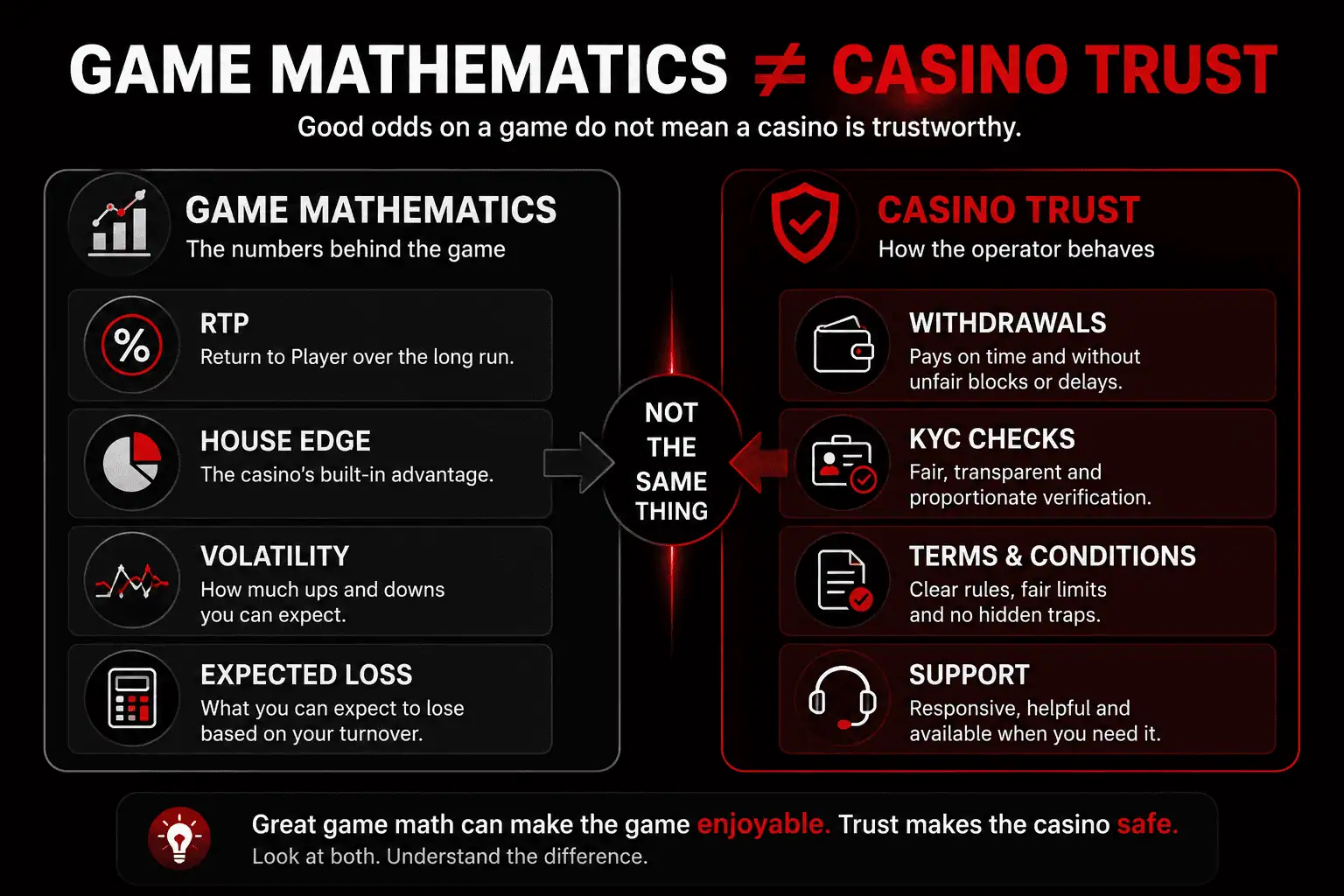
A Lower House Edge Does Not Make a Casino Trustworthy
Game mathematics and casino trust are separate issues.
A casino can offer legitimate games with competitive RTP and still have weaknesses elsewhere, including:
- withdrawal processing;
- KYC timing;
- payment verification;
- bonus conditions;
- account restrictions;
- customer support;
- ownership transparency;
- complaint handling.
The game provider or mathematical model can determine the mechanics of the game. The casino still controls much of what happens to the player’s account and funds around that game.
That is why CasinoIndex separates mathematical value from operator trust. A low house edge can make one game mathematically preferable to another, but it is not evidence that withdrawals will be smooth or that account rules are fair.
This distinction is covered in more detail in why RTP alone does not prove casino quality.
Can a Low House Edge Make Gambling Profitable?
Not by itself.
If the casino retains a positive mathematical edge, repeated conventional wagering remains negative expectation for the player.
Reducing the edge reduces expected cost. It does not automatically reverse it.
- 6% edge on $10,000 turnover = $600 expected loss
- 3% edge on $10,000 turnover = $300 expected loss
- 1% edge on $10,000 turnover = $100 expected loss
The 1% option is mathematically better than the 6% option.
It is still a negative expected value.
Terms such as “high RTP,” “low house edge” and “player-friendly odds” should therefore be read as relative comparisons, not promises of profit.
How to Compare Casino Games More Intelligently
Check the exact game and bet
Do not compare only broad categories. European roulette and American roulette are not mathematically identical. Baccarat Banker and Tie are not comparable wagers. Blackjack depends heavily on table rules.
Check the active RTP or house edge
Use the percentage for the actual version being offered rather than a generic number from another casino or provider configuration.
Estimate realistic turnover
Ask how much you expect to stake per round, how quickly rounds occur and how long you realistically expect to play.
Calculate expected loss
Use:
Total wagering × house edge
Consider volatility
Expected loss does not show how severe short-term swings may become.
Evaluate the casino separately
Strong game mathematics do not replace reliable withdrawals, clear terms and reasonable account controls.
Players who want to compare options based on the mathematical side can review casino games with more player-friendly odds.
How House Edge Should Affect Bankroll Decisions
Understanding house edge should not be used as justification for larger bets simply because a game appears mathematically efficient.
Its practical value is showing how repeated wagering creates exposure.
Before a session, players can decide on:
- a maximum amount they are willing to lose;
- stake size per round;
- a maximum session duration;
- whether autoplay or rapid-play features will be used;
- a stopping point that does not depend on winning losses back.
These decisions do not remove the house edge. They limit how much wagering is exposed to it.
CasinoIndex covers the broader practical side in its guide to managing a bankroll around the house edge.
House Edge Is Best Understood as the Cost of Turnover
The most useful way to think about house edge is not as a prediction of your next result.
Think of it as a mathematical cost attached to wagering volume.
A one-percentage-point difference may look insignificant on a single wager. Across repeated betting, it becomes more meaningful.
- $100 turnover × 1% = $1 expected loss
- $10,000 turnover × 1% = $100 expected loss
- $100,000 turnover × 1% = $1,000 expected loss
Deposit size tells you how much money entered the account.
Turnover tells you how much wagering the mathematical edge was applied to.
That is the distinction that matters when comparing expected casino loss.
Responsible Gambling: Expected Loss Is Not a Safe-Loss Target
Expected loss is a mathematical average, not a budget recommendation or a maximum-loss forecast.
A player can lose substantially more than the theoretical expectation during a short session, particularly in volatile games.
For that reason, bankroll and time limits should be based on an amount a player can afford to lose rather than on an expected-loss calculation.
Chasing losses also increases turnover, which exposes more wagering to the same negative expectation.
If gambling stops feeling controlled or begins affecting essential spending, work or personal life, the right decision is to stop rather than trying to recover losses through additional play.
Final Takeaway
RTP and house edge usually describe the same long-run casino mathematics from opposite directions.
But the percentage alone does not determine the expected cost of a session.
The practical relationship is:
Expected loss = house edge × total amount wagered
Total wagering is then influenced by stake size, number of rounds, game speed and session length.
A lower house edge reduces theoretical expected loss. Slower play and smaller stakes reduce the amount of turnover exposed to it.
None of those factors guarantee a winning session, and a mathematically strong game does not prove that the casino offering it is trustworthy.
House edge is therefore most useful as a comparison and risk-understanding tool: it helps show what repeated wagering costs mathematically before short-term luck enters the picture.
Frequently Asked Questions
What is the difference between RTP and house edge?
RTP represents the theoretical percentage returned to players over the long run. House edge represents the casino’s mathematical advantage. When both use the same wagering basis, the two percentages add up to 100%.
What is the house edge on a 96% RTP game?
A 96% RTP corresponds to a 4% theoretical house edge when both figures use the same wagering basis.
Does 96% RTP mean I get $96 back from every $100?
No. RTP is a long-run statistical measure. It does not predict the return from one $100 deposit or one individual session.
How do you calculate expected casino loss?
A basic formula is expected loss = total amount wagered × house edge. For example, $1,000 of turnover at a 4% house edge produces a theoretical expected loss of $40.
Does betting more change the house edge?
Usually not. Increasing the stake generally increases the amount of money exposed to the same house-edge percentage rather than changing the percentage itself.
Why does game speed matter?
Faster games can create more turnover in the same period. More turnover means more money is repeatedly exposed to the game’s mathematical edge.
Which casino games have the lowest house edge?
It depends on the exact rules and bets. Baccarat Banker is relatively low under standard commission rules, European roulette is lower than standard American roulette, and some blackjack rule sets can have a very low edge when correct basic strategy is used. Side bets can be substantially more expensive.
Is house edge the same as casino hold?
No. House edge is the theoretical mathematical advantage attached to wagering. Hold is an operational measure of how much the casino actually retains relative to money bought in, deposited or otherwise measured over a period. Repeated wagering can cause hold and house edge to differ significantly.
Can a low-house-edge game still lose my entire bankroll?
Yes. House edge describes long-run expectation. Short-term variance can produce losses far larger than the expected-loss figure for a particular session.
Does a high RTP mean the casino is safe?
No. RTP describes game mathematics. Casino trust also depends on areas such as withdrawals, verification, payment rules, licensing, account controls, terms and complaint handling.

Nina Kanu has worked in cryptocurrency content and blockchain research since 2016. She is also known within parts of the crypto community through CryptoMutant, where her work has covered emerging projects, market trends and developments across the blockchain ecosystem. At CasinoIndex, Nina focuses on crypto casino reviews, platform comparisons, player experience, game ecosystems and bonus fairness. Her research examines how casino products perform beyond their marketing, including usability, payment options, promotional terms and the overall experience players receive after signing up.