How to Verify a Provably Fair Casino Game Yourself
Article OverviewProvably fair verification requires two checks: the revealed server seed must match the pre-play hash, and the casino’s documented algorithm must reproduce the exact game result. This guide explains how to verify seeds, nonce, cursor and game outcomes yourself.
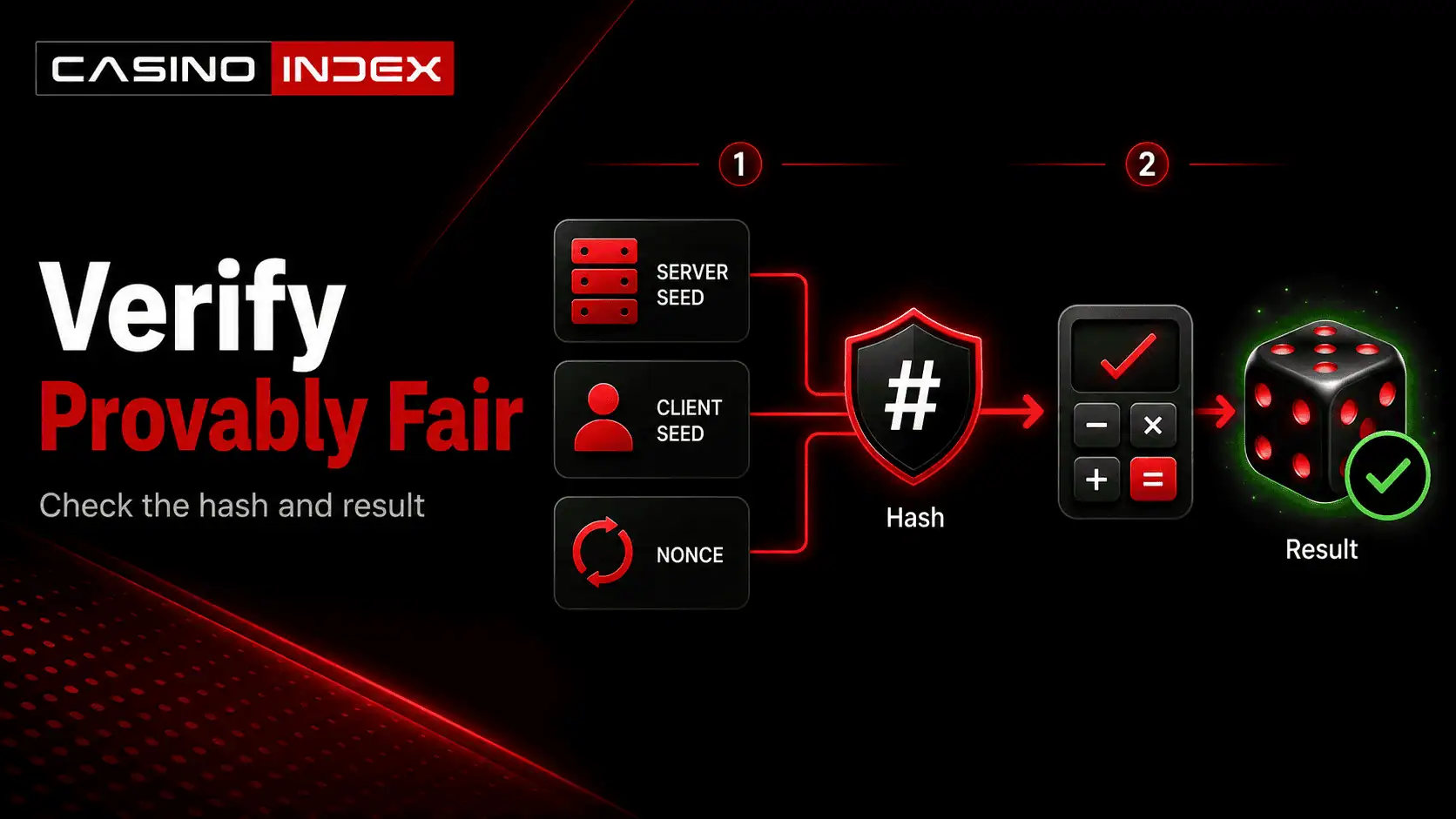
To verify a provably fair game, you need two matches.
First, the revealed server seed must reproduce the cryptographic commitment shown before the bet. Second, the casino’s documented calculation must reproduce the exact game result from the correct seed data and round inputs.
A matching server-seed hash alone does not fully verify the bet.
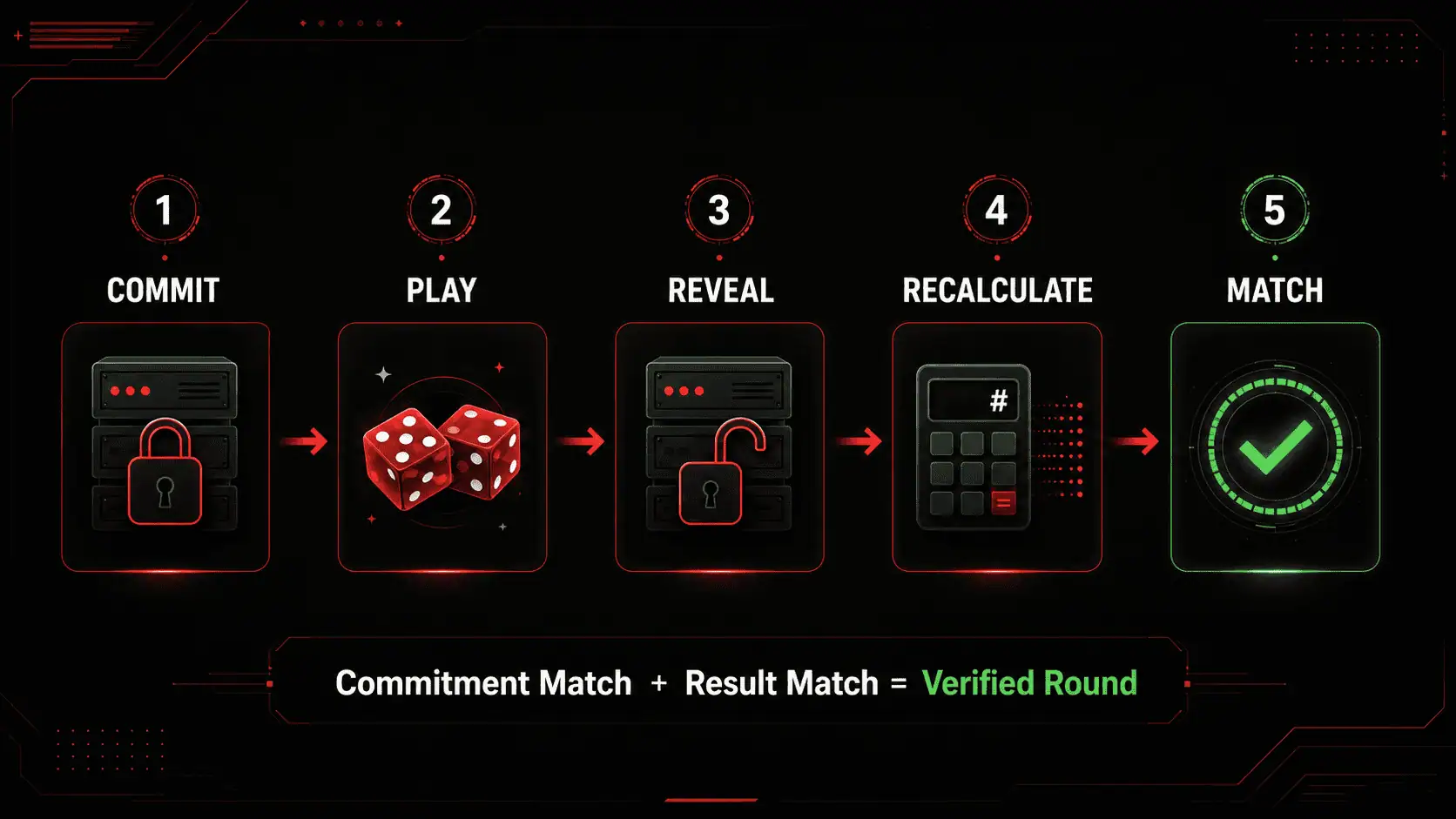
The practical process is:
Commit → Play → Reveal → Recalculate → Compare
There is also an important limit before you begin. A verifiable game result does not prove that the casino itself is trustworthy. It says something about the generation of that result, not about withdrawals, KYC, licensing, bonuses or account restrictions.
CasinoIndex explains that wider distinction in what provably fair does and does not prove.
How to Verify Provably Fair: The 7-Step Process
| Step | What You Need | What You Check |
|---|---|---|
| 1 | Server seed hash | Save the commitment shown before play |
| 2 | Client seed | Record the exact player-side input |
| 3 | Nonce | Identify the exact bet or round |
| 4 | Game result | Save the outcome shown by the casino |
| 5 | Revealed server seed | Reveal or rotate the completed seed pair |
| 6 | Hash function | Check that the revealed seed matches the earlier commitment |
| 7 | Game algorithm | Recalculate the outcome and compare it with the bet history |
How to read the result
- Hash matches only: commitment verified, result verification still incomplete.
- Hash + recalculated result match: the round passes the verification process.
- Hash does not match: recheck the seed pair; a genuine mismatch is a serious failure.
- Result does not match: first check the nonce, seeds, game formula, cursor and game settings.
The important point is that provably fair verification has two layers, not one.
Players who want the wider technical background can read about the wider provably fair casino system.
What You Need to Save Before Verifying a Bet
Do not start with an online hash checker and work backwards.
Start with the actual bet.
For one completed round, collect:
- server seed hash shown before the raw server seed was revealed;
- revealed server seed after the relevant seed pair is retired;
- client seed used for that bet;
- nonce for the exact round;
- bet or round ID;
- displayed result;
- game and game mode;
- any additional input required by the implementation, such as a cursor or game-specific setting.
Server seed, client seed and nonce are common components, but they are not a universal formula.
Different casinos and games can use different input orders, hash functions, counters and methods for converting cryptographic output into the number, card, mine position or multiplier that appears on screen.
Step 1: Save the Hashed Server Seed Before Play
The casino generates a secret server seed.
It normally does not reveal that raw value while it is still active because doing so could expose information used to calculate future results.
Instead, a provably fair system gives the player a cryptographic commitment to it, commonly a SHA-256 hash.
For example:
7d0a...93f2
You do not need to understand that string visually.
You need to save it.
Later, when the original server seed is revealed, hashing that seed should recreate the exact commitment shown before the relevant bets were made.
This is what prevents the operator from simply revealing a different server seed after seeing the result it wants.
Step 2: Record the Client Seed
The client seed supplies another input to the result-generation process.
Many casinos generate one automatically, while some let players replace it with their own value.
The verification requirement is simple:
Use the exact client seed associated with the bet you are checking.
If the client seed changes, the generated cryptographic output changes as well.
For that reason, historical bet information should make it possible to associate a completed wager with the seed pair that was active at the time.
Step 3: Find the Correct Casino Nonce
A nonce is commonly a round counter.
It allows the same server-seed and client-seed pair to produce different results across successive bets.
A simplified sequence could be:
- first bet → nonce 0;
- second bet → nonce 1;
- third bet → nonce 2;
- fourth bet → nonce 3.
But do not assume every operator starts at zero or handles the counter identically.
Use the nonce recorded for the actual bet.
If the bet used nonce 87 and you calculate the result with nonce 86, you should expect a different output even when every other value is correct.
Step 4: Save the Result You Actually Received
Verification means comparing an original result with an independently reconstructed one.
So save what happened.
For Dice, that may be a result such as:
64.05
For Mines, it may be the mine locations. For Plinko, it could be the final bucket or sequence of left/right events. A card game may require the generated card order.
Keep the bet ID as well. A screenshot is useful, but a round identifier provides a stronger connection to the casino’s stored history.
Step 5: Rotate or Reveal the Server Seed
Many seed-based systems do not expose the currently active raw server seed.
Instead, the player rotates to a new seed pair. The old server seed can then be revealed because it is no longer being used for future results.
Before rotating, it is useful to save:
- the active server seed hash;
- the client seed;
- the bet IDs you want to check;
- their nonces and displayed results.
After rotation, locate the previous raw server seed in the fairness interface or bet history.
Do not mix data from the old pair with the newly generated seed pair.
Step 6: Verify the Server Seed Commitment
This is the first actual cryptographic test.
Take the revealed raw server seed and process it through the commitment hash function specified by that casino.
For a SHA-256 commitment, the logic is:
SHA-256(revealed server seed) = server seed hash shown before play
The two outputs should match exactly.
If they do not, check first whether you accidentally used:
- the hashed seed instead of the raw seed;
- a seed from another rotation;
- the current server seed instead of the historical one;
- an incomplete or incorrectly copied value.
If the correct historical raw seed still does not reproduce the earlier commitment, the commitment check has failed.
Why a Provably Fair Hash Checker Is Only Half the Verification
This is where many simplified guides stop too early.
A SHA-256 checker can demonstrate:
revealed server seed → earlier commitment
That tells you the casino revealed the seed corresponding to its original hash.
It does not yet demonstrate:
those inputs → the exact Dice roll, Mines board, card sequence or other result you received
For that, you need the game’s result-generation logic.
Think of the process as:
Layer 1 — Commitment verification
Did the casino reveal the server seed it committed to?
Layer 2 — Result verification
Does the documented algorithm turn the recorded inputs into the actual result?
A completed audit requires both.
Step 7: Recalculate the Actual Game Result
Now use the technical implementation for the specific casino and game.
Some modern implementations use HMAC-SHA256 with inputs including:
- server seed;
- client seed;
- nonce;
- cursor or another counter where additional random data is required.
But this is not a universal casino formula.
Do not paste Stake’s HMAC formula into another casino’s verifier and assume it is valid.
A different implementation may change:
- the cryptographic function;
- which value acts as the HMAC key;
- input order;
- separators between values;
- nonce formatting;
- cursor logic;
- which generated bytes are used;
- how those bytes become numbers;
- how those numbers are mapped to the final game result.
The final point is especially important.
A hash does not naturally contain a Dice result such as 64.05.
The casino’s game code takes generated bytes, converts them into usable random values and then maps those values into the visible event.
That game-specific mapping must also reproduce correctly.
What Is a Cursor in Provably Fair Games?
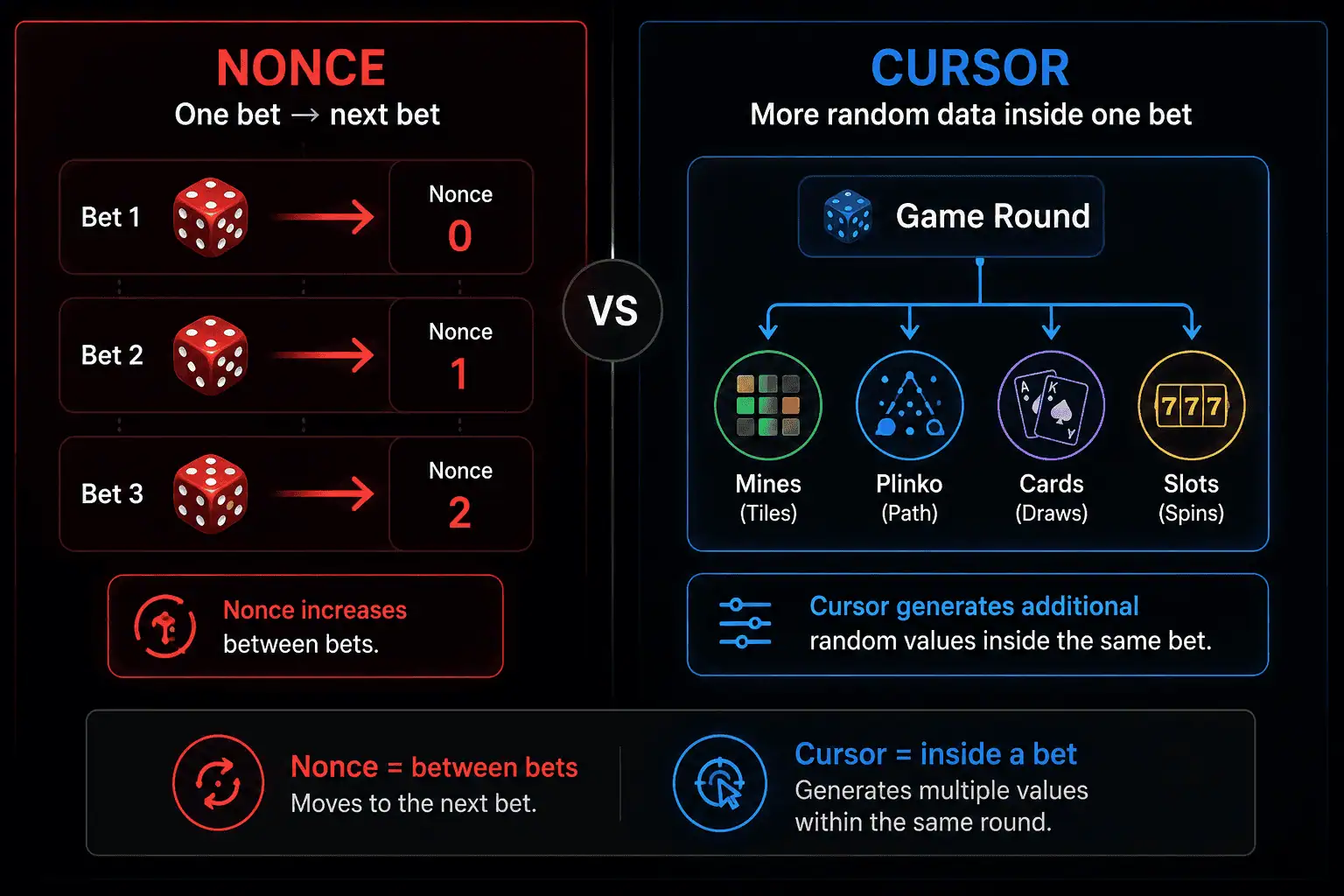
A nonce separates one bet from the next. A cursor can help generate additional random data inside the same game event.
This matters when one round requires more than a single random value.
For example:
- Dice may need one value;
- Mines needs several unique positions;
- Plinko needs multiple directional events;
- a card game can require a sequence of cards.
Some implementations therefore generate random bytes in blocks and use a cursor or similar counter when more output is required.
If the documented game uses a cursor but the verifier you choose ignores it, the reconstructed result may be wrong even when the underlying casino result is valid.
This is why a generic “server seed + client seed + nonce” calculator is not enough for every game.
Dice, Mines and Plinko vs Crash Verification
Another common mistake is assuming that every provably fair game on one site uses exactly the same verification model.
Dice, Mines and Plinko
Seed-based originals commonly generate cryptographic random data from a server seed, client seed, nonce and, where necessary, an additional cursor or counter.
The generated data is then mapped differently for each game.
Dice might turn a random value into one number. Mines needs unique tile positions. Plinko needs a sequence of directional decisions.
Crash can work differently
Crash is a good example of why universal verifiers are risky.
Some implementations use a hash chain, a precommitted sequence of game seeds and an external value such as a future blockchain block hash rather than the same per-player seed workflow used by Dice.
The verification method can therefore be fundamentally different even when both games carry the label “provably fair.”
There is no single generic verifier that should be assumed valid for every casino game.
How to Verify a Provably Fair Dice Roll
Dice is a useful first test because the displayed result is usually one number.
A compact workflow is:
- Record the Dice bet ID, server-seed hash, client seed, nonce and displayed roll.
- Reveal the old server seed after the relevant seed pair is retired.
- Confirm that its hash matches the pre-bet commitment.
- Use that casino’s documented Dice calculation with the correct inputs.
- Compare the reconstructed roll with the result stored in the bet history.
If both the commitment and the reconstructed Dice result match, that round has passed the two relevant checks.
Players comparing platforms specifically for this game can review provably fair dice casinos.
Built-In Verifier vs Independent Verification
A built-in verifier is useful.
It already knows the platform’s own input format and game algorithm, making it the easiest place to detect a basic mismatch.
But there is a difference between:
the casino’s own tool saying the result matches
and:
an independent implementation reproducing the published calculation.
The strongest provably fair systems publish enough information for an external script, open verifier or technically capable player to reach the same result.
You do not personally need to write code for that transparency to matter.
The important question is whether independent reproduction is possible.
Never enter a wallet seed phrase into a game verifier
A server seed or client seed used for a provably fair casino game is not your cryptocurrency wallet recovery seed phrase.
Never enter a wallet seed phrase, private key, exchange password or 2FA code into a provably fair checker.
Those credentials are unrelated to game verification.
What Does a Successful Provably Fair Verification Prove?
If both layers match, you have evidence that the completed result followed the published verification process for the recorded inputs.
That is meaningful game-level evidence.
It does not tell you whether the game’s long-term payout setting is attractive. CasinoIndex explains why RTP and result verification are different.
It also does not remove the mathematical advantage built into the game. A correctly generated round can still be negative expectation for the player, which is why it matters to understand why a fair result can still carry a house edge.
And successful verification does not prove:
- withdrawals will be reliable;
- KYC will be proportionate;
- bonus terms are fair;
- the operator is solvent;
- licensing is strong;
- support will resolve disputes properly.
Provably fair is evidence about the game result, not a trust certificate for the operator.
What If the Verification Does Not Match?
A mismatch deserves investigation, but it is not automatically proof that the casino manipulated the game.
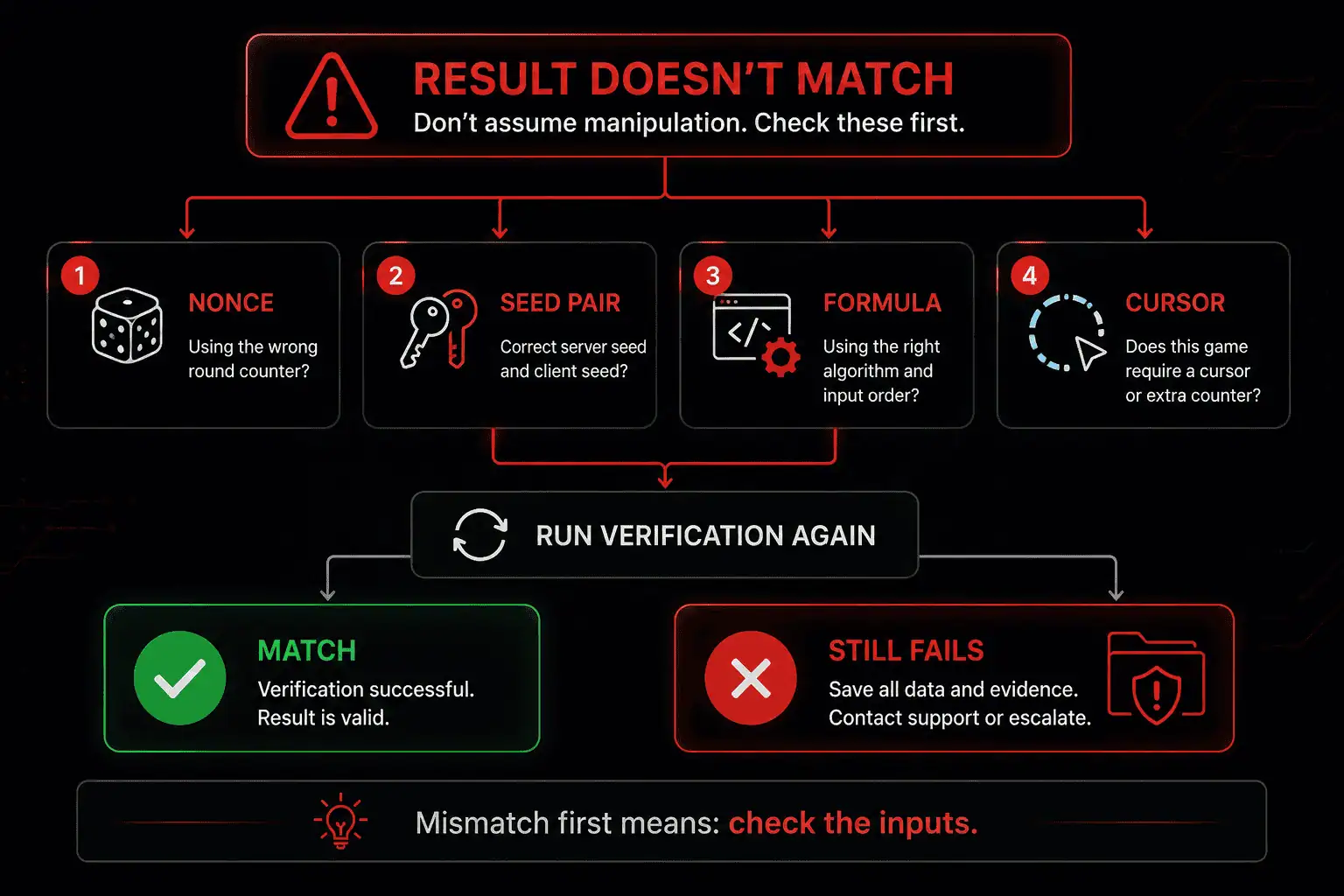
Provably fair calculations are easy to break by using one wrong input.
Check these first:
- Wrong nonce: an adjacent bet was selected.
- Wrong seed pair: one value belongs to another rotation.
- Hash used as raw seed: the verifier expects the revealed server seed.
- Wrong algorithm: the tool uses another casino’s implementation.
- Missing cursor: the game required more random data.
- Wrong formatting: separators or input order differ.
- Missing game parameter: board size, risk level or another setting affects the event mapping.
- Rounding or truncation: the implementation displays the result differently from the raw intermediate value.
- Outdated verifier: the casino’s current implementation has changed.
If possible, first reproduce the bet with the operator’s current official verifier.
Then test the same documented inputs with an independent implementation.
If a result still fails after the correct server seed, client seed, nonce, additional counters and game formula are confirmed, preserve the evidence.
Save:
- bet ID;
- timestamp;
- server seed commitment;
- revealed server seed;
- client seed;
- nonce;
- cursor or other required inputs;
- game settings;
- original result;
- verification output;
- the technical documentation used.
A reproducible cryptographic mismatch is far more useful evidence than saying a result simply “felt rigged.”
How Often Should You Verify Results?
You do not need to manually audit every casino bet.
A practical test for an unfamiliar platform is to verify:
- one low-stakes early result;
- another random result from the same seed pair;
- one result after rotating seeds;
- any unusually important round you specifically want to audit.
The goal is to confirm that the fairness system is genuinely reproducible rather than treating a “Provably Fair” badge as sufficient evidence.
Provably Fair Verification Red Flags
A system becomes much less useful when the player cannot access the information needed to test it.
Warning signs include:
- no visible pre-play server seed commitment;
- no way to retrieve historical revealed server seeds;
- no client seed information;
- no nonce or identifiable round data;
- poor historical bet records;
- no explanation of how cryptographic values become game outcomes;
- a verifier that hides all of its inputs;
- no documentation for different game types;
- marketing that implies every casino game is provably fair when only selected in-house originals use the system.
The last point matters in mixed casino lobbies. Third-party slots and live dealer tables often use provider-side RNG, testing and certification systems instead of the casino’s seed-based verifier.
Should Provably Fair Affect Which Casino You Choose?
Reproducible game verification is a positive transparency signal.
A platform that exposes its seed commitments, historical results and technical algorithm gives players more evidence than one that simply places a fairness badge next to the game.
But cryptography should remain one part of the decision.
Withdrawal behavior, ownership, licensing, payment rules, KYC, account restrictions and complaint history still determine what happens to real money outside the individual game result.
Players who specifically want platforms built around this type of game transparency can compare blockchain casinos with verifiable games while evaluating operator trust separately.
Final Provably Fair Verification Checklist
- Did I save the server seed commitment before the relevant play?
- Do I have the exact client seed?
- Do I have the correct nonce?
- Does this game require a cursor or another input?
- Has the historical server seed been revealed?
- Does it reproduce the original commitment?
- Am I using the correct algorithm for this casino and game?
- Does the recalculated result match my bet history?
If the answer to all eight is yes, you have independently checked much more than a fairness badge.
Final Takeaway
Provably fair verification requires two successful checks.
First: the revealed server seed must match the commitment shown before play.
Second: the casino’s documented algorithm must reproduce the actual game result using the correct inputs.
Hash match ≠ full result verification.
Server seed, client seed and nonce are common components, but game-specific mappings and additional values such as a cursor can also matter. Crash games may use an entirely different verification design.
When both the commitment and final result reproduce correctly, you have useful evidence that the completed round followed the published system.
You have verified the game result.
You have not automatically verified the casino.
Frequently Asked Questions
How do I verify a provably fair casino game?
Check two things: the revealed server seed must reproduce the commitment shown before play, and the casino’s documented algorithm must reproduce the actual game result using the correct client seed, nonce and any other required inputs.
What is a server seed?
A server seed is a secret value generated by the casino-side system. Its cryptographic hash can be published before play, with the original seed revealed later for verification.
What is a client seed?
A client seed is another input used in the result-generation process. Many platforms allow the player to change it, but verification requires the exact value used for the relevant bet.
What is a casino nonce?
A nonce is commonly a counter that changes with successive bets under the same seed pair, allowing each round to generate a different result.
Is checking the server seed hash enough?
No. A hash match verifies the server-seed commitment. Full verification also requires reproducing the actual game outcome using the platform’s documented result calculation.
What is a provably fair hash checker?
It checks whether a revealed value reproduces an earlier cryptographic hash. A full game verifier goes further by reconstructing the actual bet outcome.
Do all provably fair casinos use HMAC-SHA256?
No. HMAC-SHA256 is used by some major implementations, but algorithms, input formats and game-event calculations vary. Use the documentation for the exact casino and game.
What is a cursor in provably fair games?
A cursor or similar counter can be used when one game event requires more random data than the initial cryptographic output provides. Its use depends on the casino’s implementation.
Why do players rotate server seeds?
Many systems reveal the old server seed only after replacing it. This keeps the active seed secret for future play while making completed bets auditable.
Can Crash be verified with the same formula as Dice?
Not necessarily. Some Crash systems use hash chains and external inputs such as a blockchain block hash rather than the same per-player seed calculation used by Dice.
Does a successful provably fair check mean the casino is safe?
No. It verifies the game result under the published procedure. Withdrawals, licensing, KYC, bonuses, account controls and operator conduct must be assessed separately.

Nina Kanu has worked in cryptocurrency content and blockchain research since 2016. She is also known within parts of the crypto community through CryptoMutant, where her work has covered emerging projects, market trends and developments across the blockchain ecosystem. At CasinoIndex, Nina focuses on crypto casino reviews, platform comparisons, player experience, game ecosystems and bonus fairness. Her research examines how casino products perform beyond their marketing, including usability, payment options, promotional terms and the overall experience players receive after signing up.