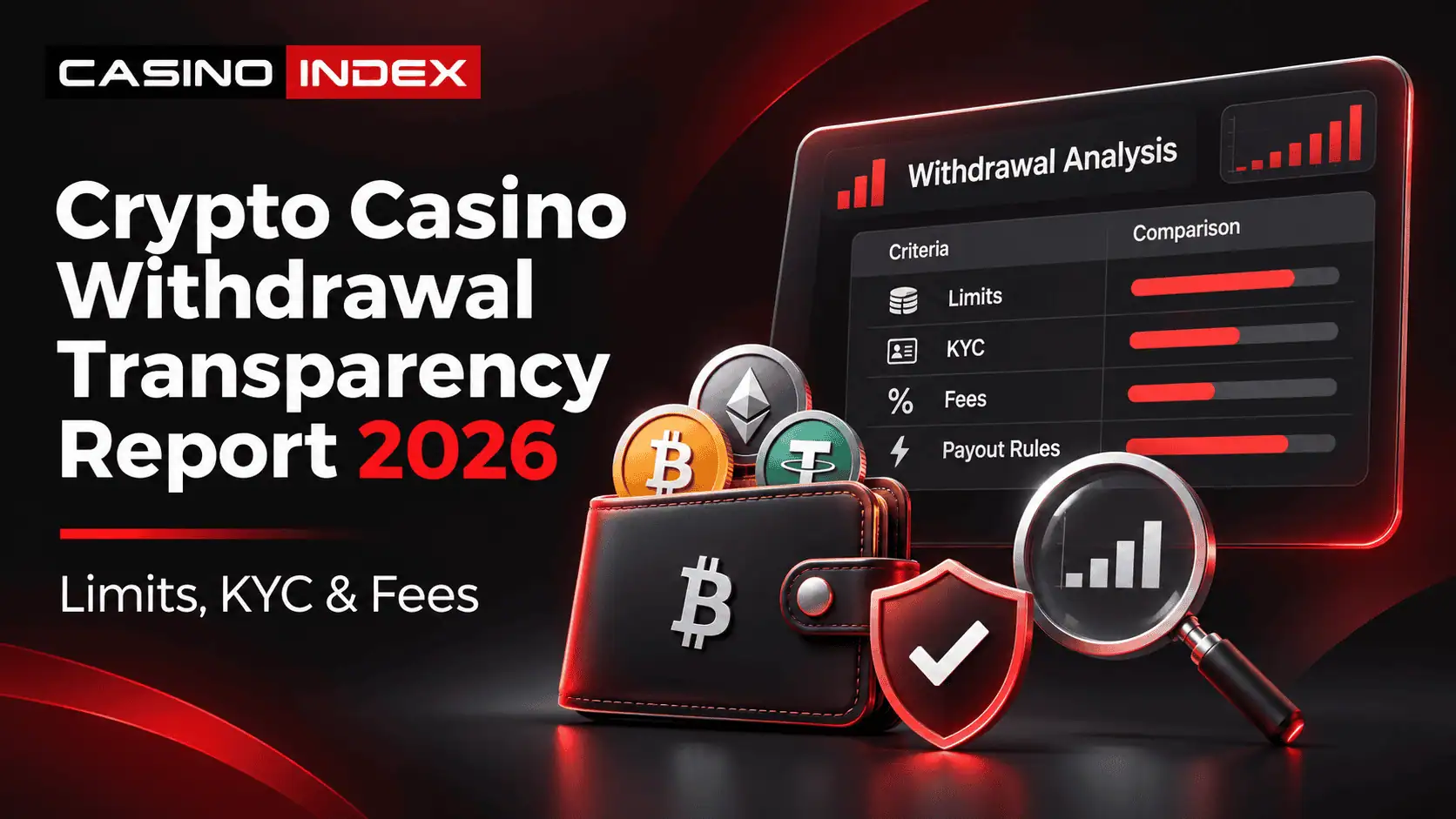
Crypto Casino Withdrawal Transparency Report 2026: Limits, KYC & Fees
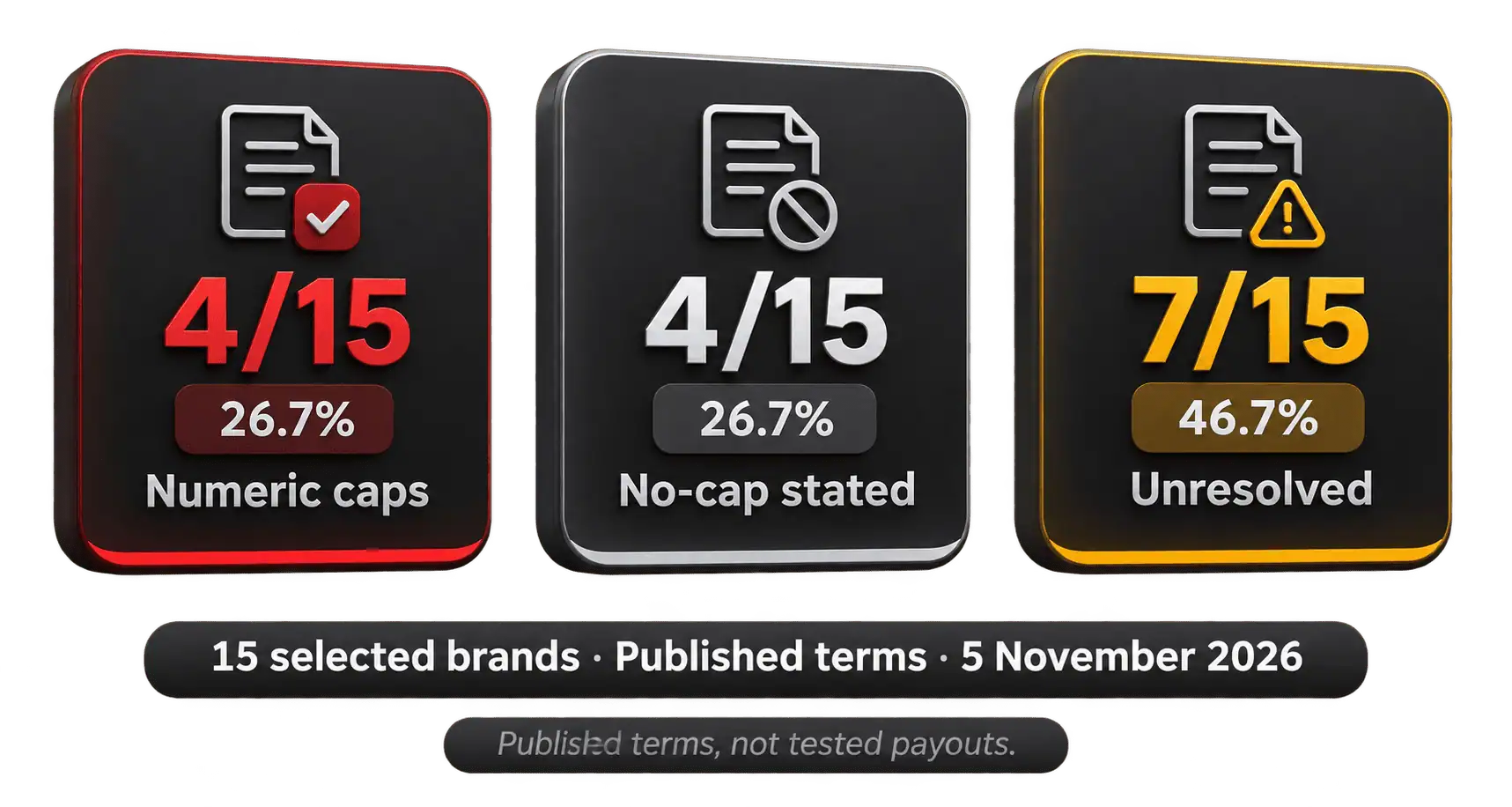
Article OverviewCasinoIndex reviewed published withdrawal rules for 15 crypto casino brands on 5 November 2026. Four had documented numeric periodic limits, four published explicit no-cap statements, and seven had no comparable general limit established from the sources reviewed. The research compares operator terms, not tested payouts.
Crypto casino withdrawal transparency is uneven. In our review of 15 casino brands’ publicly available withdrawal terms and help pages on 5 November 2026, four had a documented numeric periodic cap tied to a defined account or token situation, four explicitly stated that a general maximum or periodic cap did not apply, and seven had no universal limit that we could resolve from the sources checked. These findings describe published rules, not real-money payout tests.
The practical issue is rarely just how quickly a blockchain confirms a transaction. A player may face a minimum cashout, a weekly ceiling, identity or source-of-funds checks, a deposit-turnover condition, or a large-win instalment clause before the transaction ever reaches the chain. Therefore, we compare the policies against linked operator evidence and leave unresolved questions open instead of filling them with estimates.
What the 2026 dataset actually shows
- 15 brands reviewed, drawn from existing CasinoIndex casino-review coverage; the selection is not a random industry sample.
- 4/15 (26.7%) give a numeric daily, weekly or monthly ceiling in the public materials reviewed, including tier- or token-specific rules.
- 4/15 (26.7%) explicitly describe no general maximum or no daily/monthly cap for the relevant crypto service; other conditions may still apply.
- 7/15 (46.7%) fall into an unresolved ceiling group. That means our reviewed sources did not establish a comparable universal figure, not that the casino has no limit.
Scope: Public English-language operator materials, primarily crypto payment rules. Country, payment rail, account status and VIP treatment can change the applicable outcome. Updated check: 5 November 2026.
Crypto casino withdrawal transparency: 15 operator policies compared
The report groups all 15 brands by the kind of limit evidence we found, rather than ranking casinos by headline payout amounts. Each row keeps the published policy and official sources visible. For more context on the operator itself, use the red Read Review link.
How to read this withdrawal comparison
4/15 — Numeric periodic cap: A source specifies a daily, weekly or monthly ceiling. It may apply only to one account tier, token or withdrawal method.
4/15 — Explicit no-cap statement: An operator expressly says no general maximum or no periodic ceiling applies to a defined service. KYC, deposit turnover, per-transaction caps, instalments and fees may still apply.
7/15 — Unresolved: The reviewed public sources did not establish a comparable ceiling. Unresolved never means unlimited.
Sample: 15 selected brands; source-check date 5 November 2026. Read each row in the stated market and payment context, not as a guaranteed account-specific limit.
Numeric periodic limits: 4 casinos
| Casino & review | Published limit / minimum | Fees, checks & source |
|---|---|---|
| €10,000 rolling week; €40,000 calendar month; fiat minimum €20 | Fee: No general crypto fee schedule verified; extra processing fee possible if wager rules unmet Verification: Identity documents may be required before payout Evidence: Official source · 5 Nov 2026 | |
| $2,200/day without Level 2; limits removed with Level 2 per help page; tier-specific | Fee: Not verified from cited account-verification page Verification: Level 2 ID, address and face; may be requested anytime Evidence: Official source · 5 Nov 2026 | |
| $10,000/day equivalent per core/community token by published token guide | Fee: Web3 wallet: no platform fee, gas; non-Web3: flat fee Verification: CDD/KYC; additional payment-team checks possible Evidence: Official source · Additional terms · 5 Nov 2026 | |
| $100,000 per 7 days; $200,000 per 30 days; 5 USDT min | Fee: 1 USDT; 0.00001571 BTC (published table) Verification: Account verification may hold withdrawals Evidence: Official source · Additional terms · 5 Nov 2026 |
Explicit no-cap statements: 4 casinos
| Casino & review | Published limit / minimum | Fees, checks & source |
|---|---|---|
| No daily or monthly limits stated; per-transaction limits apply | Fee: Operator says no platform fee; network fees apply Verification: Verification may be requested at discretion Evidence: Official source · 5 Nov 2026 | |
| Operator says no maximum deposit or withdrawal cap; 10 USDT (TRC-20) min | Fee: No platform charge; network fee applies Verification: AML checks may request ID, address, wallet ownership, SoF Evidence: Official source · Additional terms · 5 Nov 2026 | |
| No crypto maximum stated; large withdrawals may split into separate transactions | Fee: Not resolved in checked general T&C Verification: T&C: extra checks above $10,000; another official page says €2,500 Evidence: Official source · Additional terms · 5 Nov 2026 | |
| Operator states no maximum withdrawal restriction; 2.5 USDT min | Fee: 1 USDT; 0.00001571 BTC (published examples) Verification: May require verification and enhanced checks before payout Evidence: Official source · Additional terms · 5 Nov 2026 |
Unresolved periodic limits: 7 casinos
| Casino & review | Published limit / minimum | Fees, checks & source |
|---|---|---|
| No universal cap in the referenced operator guide; cashier method cap; operator guide cites ~20 USDT min | Fee: Not established in checked primary material Verification: Operator sportsbook guide says KYC before first withdrawal Evidence: Official source · Additional terms · 5 Nov 2026 | |
| May limit very large requests to 1,000,000 USDT per week (discretionary) | Fee: May deduct transaction costs Verification: May request extra KYC above €2,500 or for smaller amounts Evidence: Official source · 5 Nov 2026 | |
| Not resolved in reviewed sources | Fee: Network-dependent fee deducted; Standard/Fast/Turbo options Verification: May request verification for withdrawals and regulatory checks Evidence: Official source · Additional terms · 5 Nov 2026 | |
| No numeric periodic maximum verified in checked payment help; 5 USDT min | Fee: No platform fee; standard on-chain gas Verification: Account verification available; trigger not established here Evidence: Official source · Additional terms · 5 Nov 2026 |
More unresolved cases: 3 additional casinos
| Casino & review | Published limit / minimum | Fees, checks & source |
|---|---|---|
| Not resolved in checked help | Fee: No platform fee per operator; blockchain fees apply Verification: KYC may be required in specific situations Evidence: Official source · Additional terms · 5 Nov 2026 | |
| No universal periodic amount established from reviewed T&C | Fee: May charge disclosed fee; blockchain network fee may be deducted Verification: Govt ID required before first withdrawal under T&C §5.2 Evidence: Official source · 5 Nov 2026 | |
| No numeric periodic maximum verified in checked help | Fee: Not established in checked help Verification: Email confirmation; full KYC trigger not verified in this source Evidence: Official source · 5 Nov 2026 |
Table note: Limit figures are not interchangeable across currencies, KYC tiers, networks or countries. A blank public fee disclosure is not a confirmed zero fee. Each listed primary source was checked on 5 November 2026.
Methodology: how CasinoIndex assembled this withdrawal dataset
Selection, scope and source hierarchy
We began with CasinoIndex’s existing crypto-casino review inventory and selected 15 identifiable real-money casino brands for which direct operator material could be read. The unit of analysis is the brand and its applicable public policy, not necessarily a unique corporate group. For example, separately branded sites can share an operator. Do not count them as independent corporate owners or extrapolate these proportions to the entire gambling industry.
We prioritized the operator’s terms of service, payment policies and current help-center articles. We used product marketing and operator-authored guides only where we could describe their evidentiary limits. Likewise, we did not import third-party comparison estimates. We checked sources on 5 November 2026, with links and claim summaries recorded separately in the downloadable editable dataset. However, public pages can change after that date without a version history.
What counts as disclosed, undisclosed or not verified?
We treated a number as verified in a public source only when the source names the rule and its scope: for example, “$100,000 in any seven days,” or “$2,200 daily until Level 2 verification.” Similarly, we labeled a fee as zero only when the operator explicitly says its own platform does not charge one; we did not confuse that with a blockchain network fee.
For the summary’s cap classification, numeric periodic means a stated daily, weekly or monthly amount, even if it applies only to a verification tier or token. Explicit no-cap means the operator publishes a clear no-maximum or no-periodic-limit statement for the relevant service. Unresolved means the reviewed evidence could not establish either. An unresolved value is a research gap, not evidence of concealment.
Our source log also distinguishes the legal company from the casino brand, and “published limit” from the limit a specific account will actually see. Importantly, we did not open private cashiers, complete KYC or request any real-money cashouts. This is an audit of published-offer terms, not withdrawal performance. For the broader editorial framework, read how CasinoIndex evaluates trust and payment risk.
What counts as a withdrawal limit?
Four different figures are often mislabeled as a single “casino payout limit.” The minimum withdrawal is the lowest request the cashier accepts. A per-transaction maximum limits one payment but may allow multiple payments. A daily, seven-day or monthly cap limits the total over a period. Finally, a win or bonus cashout cap may restrict a particular promotion, not normal account funds.
Confusing these creates bad comparisons. A casino could say “no daily limit” while enforcing a minimum in USDT and a maximum for one bank or token transfer. It could also reserve the right to split large payouts for compliance. The distinction is explained in more detail in our guide to casino withdrawal limits and payout ceilings.
Which crypto casinos publish clear numeric withdrawal limits?
7Bit Casino currently states €10,000 for a rolling seven-day period and €40,000 per calendar month in its English terms, alongside a fiat minimum of €20. Wild.io publishes $100,000 within seven days and $200,000 within 30 days. Cloudbet describes a $2,200 daily limit until Level 2 verification, with the documented account-level limit removed after that verification. Solcasino.io publishes a default $10,000 daily token limit in its token documentation, which needs a live cashier recheck because the token listing includes older dates.
Those four are not equivalent policies. Two are periodic operator ceilings, one is conditional on KYC tier, and one is token-specific. Therefore, a single “maximum payout” league table would hide information a player actually needs.
Which crypto casinos say “no maximum withdrawal”?
In this 15-brand sample, Stake.com, Duelbits, Sportsbet.io and BitStarz publish explicit no-cap statements within the scope of particular crypto withdrawal services. Stake.com’s crypto help states no maximum withdrawal restriction; Duelbits’ payment help says no cap; Sportsbet.io states no cryptocurrency maximum while reserving the ability to split large transactions; and BitStarz says no daily or monthly caps while retaining per-transaction limits.
Why “no maximum” does not mean no restrictions: None of those statements waives KYC, deposit-turnover rules, anti-fraud checks, possible payment splitting, per-transaction restrictions or network costs. Likewise, a missing maximum in an unexamined policy is not the same as an explicit no-cap statement.
KYC and source-of-funds checks can change the payout decision
Likewise, a cashier displaying an amount does not mean the account has completed every withdrawal condition. Moreover, some operators reserve the right to ask for identity documents at any time. Others explicitly identify a first-withdrawal step or a verification-tier ceiling. Even so, the public terms tell us what an operator may require, not what any individual player will experience.
Shuffle’s English terms state that a government-issued identity document may be checked at the operator’s chosen threshold and, in any event, before the first withdrawal. Cloudbet makes its published daily cap depend on verification level. Duelbits describes possible identification, wallet ownership and source-of-funds evidence during AML reviews. In other words, these are materially different types of disclosure.
For players, the practical questions are when the operator requests documents, whether it holds funds during review, and whether it identifies the additional evidence it wants. See what happens before a casino approves a withdrawal and our focused explanation of source-of-funds checks at online casinos.
Deposit turnover is not a bonus wagering requirement
Several operators publish a minimum amount of ordinary wagering before deposited funds become withdrawable. For example, Stake publishes a 100% deposit turnover condition for crypto withdrawals; Duelbits describes 10%; TrustDice’s withdrawal help describes 5×; and Shuffle sets 100% with an explicit exception for certain same-wallet, same-network returns. These numbers are not interchangeable with welcome-bonus wagering or a permitted maximum bet.
Consequently, even without a bonus, an immediate withdrawal after a deposit may trigger further checks. Instead, the operator’s AML and account-ownership rules, not just its bonus page, determine what happens next.
Casino approval time is not blockchain settlement time
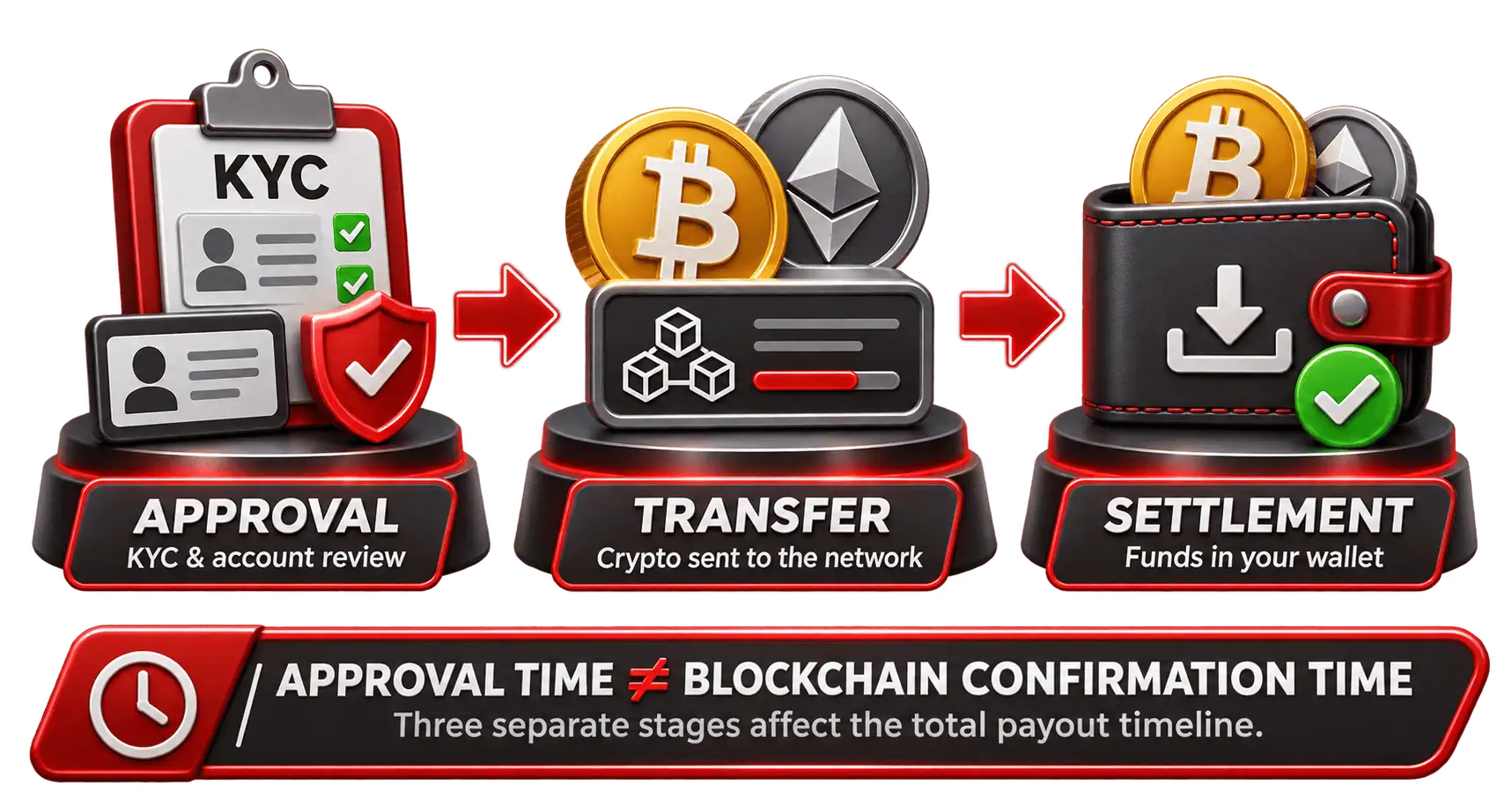
Three separate stages
1. Eligibility and approval: wagering checks, KYC, fraud review and approval of the requested amount.
2. Transfer submitted: the operator sends funds to the stated blockchain address or payment provider.
3. Settlement and receipt: network confirmations, wallet requirements and possible conversion or intermediary costs.
By comparison, a “ten-minute withdrawal” may refer to internal processing, blockchain confirmation, or the entire request-to-wallet interval. Wild.io’s help center says withdrawals are typically processed automatically within ten minutes, then adds blockchain confirmation time. Gamdom states a typical window of five minutes to an hour, with network-dependent fees and speed options. However, these are operator claims, not CasinoIndex measurements.
BitStarz publishes its own claimed cashout timing dataset for late 2026. We did not treat that promotional operator study as independent payout proof. Therefore, we do not award any casino a “fastest” label based on transfers we did not observe.
Fee transparency: casino charges, networks and exchange rates
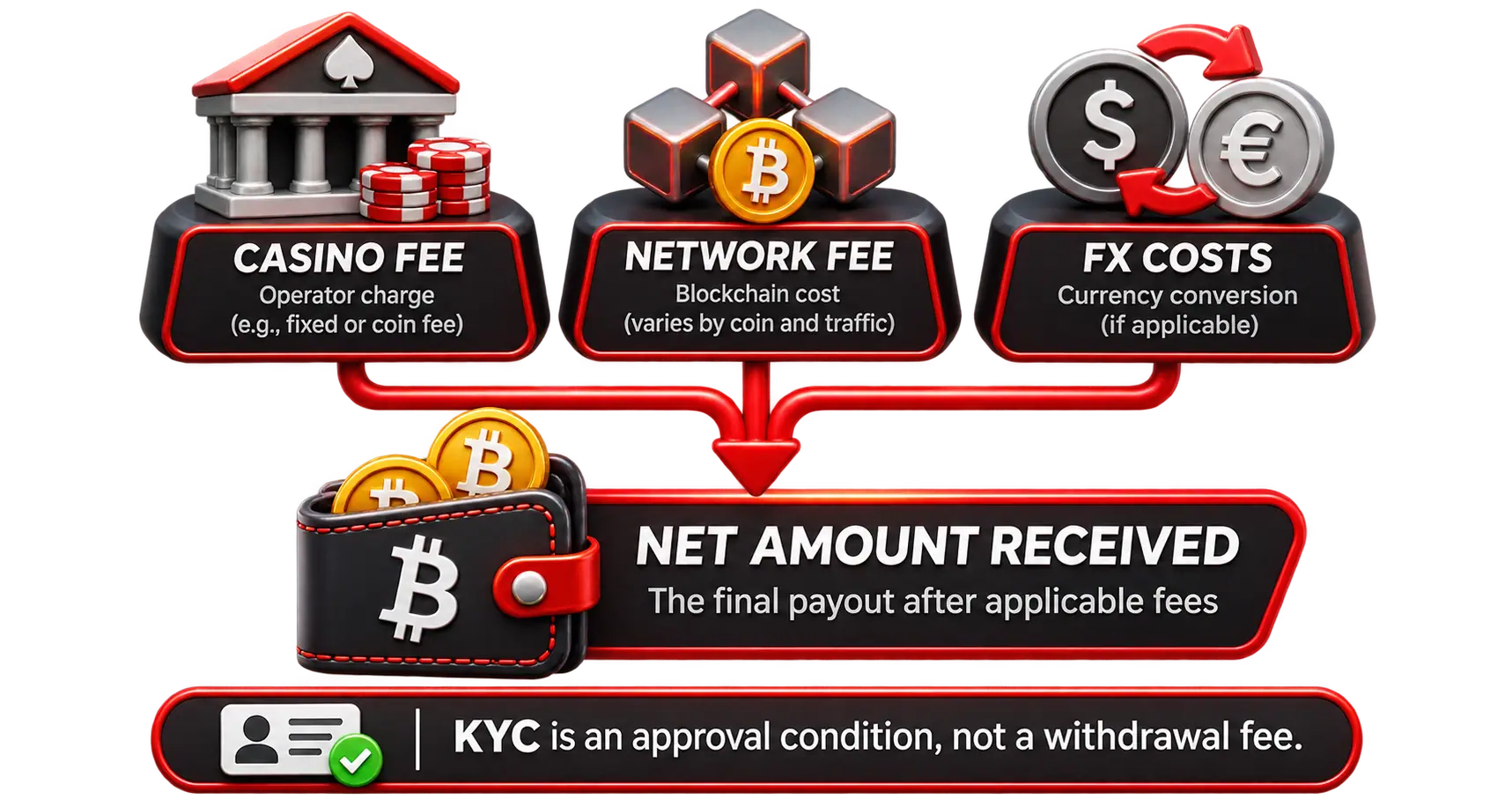
Published withdrawal fees do not all mean the same thing. A casino may state that it charges zero platform fees but deduct a changing blockchain cost; another may display a specific coin fee; a third may apply a fiat conversion or intermediary charge. As a result, the amount arriving in a player’s wallet or bank account can differ.
Stake’s public crypto table lists a 2.5 USDT minimum and a 1 USDT withdrawal fee, alongside separate figures for BTC and other coins. Wild.io publishes a 5 USDT minimum and 1 USDT fee in its help center. Rollbit and Duelbits say the operator adds no fee beyond the relevant on-chain cost. Solcasino distinguishes Web3-wallet gas fees from its stated flat-rate fee for non-Web3 withdrawals.
Still, these examples are not a universal fee schedule. The chain, token, speed setting, network congestion and cashier quote may change the result. Our separate guide explains how casino fees, network charges and FX costs affect the net payout.
Large-win instalments: the detail a headline maximum misses
For larger balances, a published weekly or monthly cap can change the payout schedule. Meanwhile, some operators may stagger a large payment even without an ordinary published cap. The table below separates the cashout prerequisite from the right to split a payout. However, none of these clauses proves that an instalment actually occurred.
| Casino | Before withdrawal | Instalments / exceptions | Source |
|---|---|---|---|
| 7Bit Casino | 3× deposit; 10× for table/live games | Yes: payment-method excess may be split | Operator document |
| Bitcasino.io | May require 1× deposits; exceptional 5× in suspected mixer case | Yes: discretionary €1m-equivalent weekly processing for large request | Operator document |
| Cloudbet | Not established in checked source | No installment clause established in checked source | Operator document |
| Shuffle | 1× deposit, exception for same-wallet/same-network digital-asset return | May split across original payment methods for AML | Operator document |
| Solcasino.io | 1× deposited amount before withdrawal | Yes: reserves monthly instalments for substantial wins | Operator document Additional terms |
| Sportsbet.io | T&C may require 1× deposit wager | May divide large crypto withdrawal into several transactions | Operator document Additional terms |
| Stake.com | 100% of deposit for crypto withdrawal | No fixed periodic payout plan shown; can consolidate pending requests | Operator document Additional terms |
| Wild.io | Bonus/playthrough rules and first-deposit conditions may block request | Exceptions for VIP/jackpots possible; no universal schedule promised | Operator document Additional terms |
For example, a hypothetical €50,000 withdrawal under a €10,000 weekly cap might require five weekly allowance periods, even if the casino promptly approves every eligible request. However, this is arithmetic, not an observed case. VIP exceptions are discretionary unless the terms grant a specific enforceable right. This matters particularly when assessing large-balance withdrawal considerations.
Conflicting and incomplete public terms: two examples
7Bit: current English terms versus other public copies
7Bit’s English terms reviewed on 5 November 2026 state a €20 fiat minimum and €10,000/€40,000 weekly/monthly limits. A publicly accessible French page shows BTC-denominated figures instead. The operator says its English terms prevail in a translation conflict. We therefore report the English-page terms with an explicit note, not a blended invented conversion.
Sportsbet.io: inconsistent KYC thresholds across official pages
Sportsbet.io’s general terms page describes enhanced verification above $10,000, whereas a separate official Solana payment page refers to €2,500. Clearly, those are different currencies and thresholds. They may reflect different product scopes or update schedules; the public pages alone do not resolve the discrepancy. A player should obtain an account-specific written clarification rather than rely on either number as a universal trigger.
When sources disagree, record the exact URL, date, language and affected payment product. Still, they flag a gap in the available evidence, not automatic proof of an unpaid withdrawal or wrongdoing.
What the 2026 dataset cannot prove
This sample does not establish a casino’s actual payout rate, median approval time, solvency, reserves, complaint outcome or probability that a withdrawal will succeed. It does not compare identical real accounts in one country, using one coin and one VIP tier. No live KYC request, real deposit or real-money withdrawal formed part of this research.
Furthermore, it cannot establish that an unstated field is absent everywhere: a value may exist behind login, in the cashier, in a promotional policy, or in a market-specific set of terms. Therefore, we record not resolved from reviewed public sources instead of calling the operator secretive. Equally, a generous published limit does not earn an operator a safety endorsement.
How this report will be updated
The accompanying editable CasinoIndex source dataset records the 15 brands, observed fields, supporting URLs, exact clause summaries, policy scope, uncertainty and the 5 November 2026 check date. That structure lets us correct individual observations without rewriting unrelated findings. If an operator changes its terms significantly, we should recheck the affected profile and update its individual verification date. A page-wide date must not be changed unless the full sample has actually been re-reviewed.
Before a major withdrawal, readers should therefore check the operator’s live terms, current cashier fees and limits, account eligibility, local gambling rules and payment ownership requirements. This report is a guide to the documents worth checking, not financial or legal advice.
Frequently asked questions
Which crypto casino has the highest withdrawal limit in this report?
This report does not rank casinos by the size of a single advertised maximum. Some state no general maximum, while others specify account-level, token-level, per-transaction or periodic caps. Compare the rule for your coin, account level and market before drawing a conclusion.
Does “no maximum withdrawal” mean no KYC?
No. A maximum governs an amount; KYC and source-of-funds rules govern whether a request can proceed. A no-cap statement does not override verification, account ownership or AML requirements.
Why are some table cells “not resolved”?
Because the reviewed public materials did not establish a comparable figure. That differs from a confirmed zero fee or a policy that explicitly says no maximum. We have not invented the missing value or treated a third-party comparison as the operator’s own rule.
Can a crypto casino pay a large win in instalments?
Some published terms reserve the right to split larger withdrawals or impose rolling caps. Whether those conditions apply depends on the operator, payment method, current rules and individual account. A theoretical payment schedule is not an observed payout.
Are published processing times reliable?
They tell you what the operator claims or targets. They do not prove how long your own payout will take, particularly when identity review, payment approval and network confirmations are separate steps.
Do crypto casino withdrawal fees include blockchain costs?
Sometimes. An operator may charge no platform fee but still pass on a network cost. Others publish a fixed coin deduction or a fee that changes with the selected network. Check the final amount in the cashier and the receiving wallet’s requirements.
CasinoIndex original research disclosure — checked 5 November 2026: This is a source-checked comparison of published terms for 15 selected casino brands, not a representative industry survey or real-money withdrawal test. Figures are operator-published, subject to market, currency, KYC and subsequent policy changes. No payout reliability, fee-free transfer, legal access or successful verification is guaranteed. Operators were selected for relevance to the CasinoIndex review inventory and accessible first-party policy documents, not commission order. For adults of legal gambling age only.

Talha Aydin has been active in cryptocurrency since 2017 and is a co-founder of Freecoins24 and CryptoMutant. Over the years, he has worked with crypto projects on community growth, giveaways, user acquisition and digital strategy while gaining hands-on experience across blockchain platforms and crypto markets. At CasinoIndex, Talha focuses on crypto casinos, withdrawals, payment systems, platform trust and the risks players face when moving funds between wallets and gambling platforms.