Casino Verification Documents Rejected? Reasons and Safe Fixes
Article OverviewCasino verification documents are often rejected because they are unreadable, expired, unsupported or inconsistent with account details. Learn how to fix the exact problem, resubmit securely and handle repeated KYC rejections.
Casino verification documents rejected? Most rejections involve unreadable images, expired identification, unsupported files, missing information or details that do not match the casino account. A rejection does not automatically mean the casino considers your identity fraudulent or intends to block your withdrawal permanently.
The safest fix is to identify the exact rejection reason, correct that specific problem and submit genuine evidence through the casino’s official verification channel. Never alter document details, borrow another person’s identification or submit random files hoping that one will pass.
This guide explains how to resolve rejected ID, proof-of-address, selfie and payment documents. It also covers repeated KYC failures, withdrawal-related verification problems and the point at which you should request a manual review.
For the complete process, see how casino verification normally works.
What to do when casino verification documents are rejected
Start with the individual document status rather than the account’s overall verification message. A general “verification failed” warning may hide a specific problem with identification, address evidence, payment ownership or an additional compliance review.
Identify the actual rejection reason
Look for messages such as “document expired,” “image unclear,” “unsupported format” or “information does not match.” If the casino gives only a generic error, ask support to identify the failed requirement.
A clearer photograph can resolve an image-quality problem. However, another passport photo will not fix an address mismatch or a separate source-of-funds review.
Follow the safe resubmission process
Verification rejected? Follow these six steps.
- Read the error: Identify which document or verification category failed.
- Request clarification: Ask support for the exact reason if the message lacks detail.
- Correct the problem: Obtain a suitable original document or provide a genuine explanation.
- Resubmit securely: Use the casino’s confirmed verification channel.
- Keep records: Save submission dates, case references and support correspondence.
- Seek review if needed: Request manual review when repeated rejections lack a useful explanation.
Safety warning: Never pay an unexpected verification fee or deposit additional money simply because someone claims it will unlock your account or payout.
Each casino sets its own accepted-document requirements within the laws and regulations that apply to it. Age limits for statements, accepted file formats and screenshot restrictions can differ between operators.
Casino KYC document rejected: diagnosis and safe fixes
Use the following diagnostic tables to identify the likely cause. The first covers document quality and eligibility. The second addresses account details, payment ownership and additional compliance reviews.
Document quality, format and validity problems
| Rejection reason | Safe correction | What to avoid | When to request review |
|---|---|---|---|
| Poor image qualityBlur, glare or unreadable text. | Retake a clear original photograph with the required details visible. | Do not digitally reconstruct text or alter document images. | A clear replacement receives the same unexplained error. |
| Unsupported file or documentWrong format, screenshot or document category. | Check accepted formats and obtain an original file where permitted. | Do not disguise a screenshot as an original document. | Support cannot identify an acceptable alternative. |
| Expired identificationExpired ID or insufficient remaining validity. | Provide another accepted current ID or ask about renewal procedures. | Never change expiry dates or use someone else’s ID. | The casino rejects an eligible valid replacement without explanation. |
| Incomplete evidenceMissing edges, pages, sides or required details. | Submit the complete original and any specifically requested pages. | Do not erase information or independently conceal required fields. | Instructions conflict or request unnecessary sensitive information. |
Account mismatches and additional compliance checks
| Rejection reason | Safe correction | What to avoid | When to request review |
|---|---|---|---|
| Name or address mismatchOld address, spelling difference or legal name change. | Explain the discrepancy and request accepted supporting evidence. | Do not modify statements or create replacement accounts. | Support offers no way to resolve a legitimate difference. |
| Payment ownership mismatchCard, bank account or wallet ownership remains unclear. | Explain the actual payment route and request method-specific instructions. | Never impersonate an owner or reveal payment security secrets. | The operator cannot explain the outstanding ownership requirement. |
| Duplicate account or household reviewShared address, device or suspected linked accounts. | Explain the genuine household arrangement and request the relevant rule. | Do not conceal connections or open accounts to bypass restrictions. | Restrictions continue without a clear decision or complaint route. |
| Enhanced due diligenceThe casino needs financial evidence rather than another ID. | Ask which transactions, dates and supporting records matter. | Never invent income evidence or misrepresent a funding source. | Requests expand repeatedly without identifying outstanding evidence. |
The tables describe common diagnostic patterns, not universal casino policies. Always compare the suggested correction with your operator’s current requirements.
Why casinos reject ID verification documents
Identity verification helps an operator establish who controls an account. The review may involve document authenticity, personal details and a comparison between the document and the person submitting it.
The NIST Digital Identity Guidelines explain technical principles for evidence validation and identity matching. These guidelines provide useful context but do not establish mandatory document policies for every casino.
Blurry photographs and missing document sides
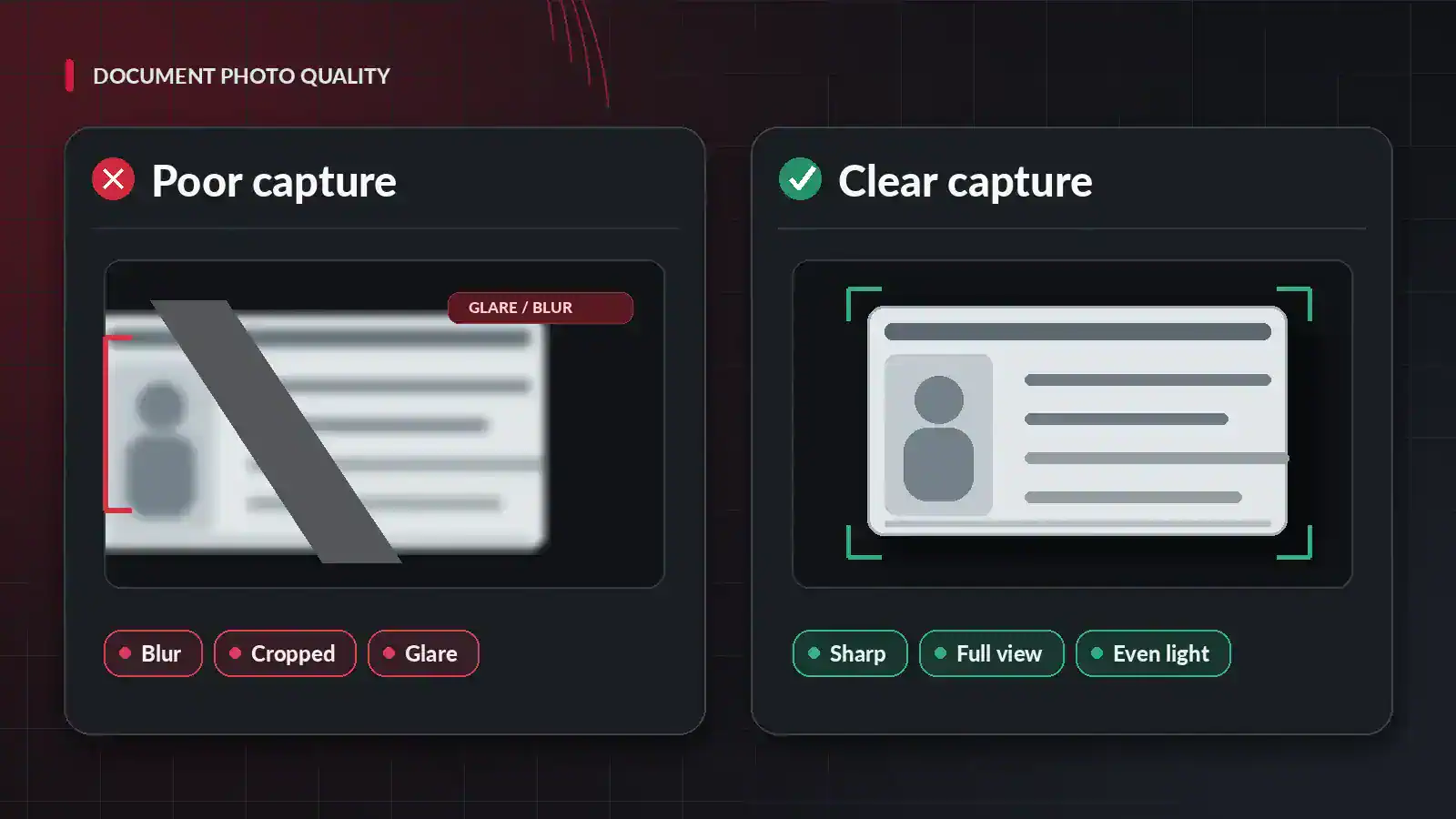
Place your ID on a flat surface and use steady, even lighting. Capture all required edges and inspect the photograph before uploading it. Check that the image clearly displays the relevant names, dates and document details.
If the operator requests both sides of an identity card, submit both. For a passport, follow the instructions for the relevant information page.
Take another photograph when the image lacks clarity. Do not use AI image tools, filters or digital editing to reconstruct unclear information.
Expired ID and unsupported document types
Some verification systems reject expired identification automatically. Others require a particular document category or sufficient remaining validity.
Check the accepted-ID list before trying another upload. If your passport has expired, ask whether the casino accepts another current government-issued document.
If you cannot provide a qualifying document immediately, explain the circumstances and request the operator’s procedure for customers awaiting replacement identification.
Casino ID verification problems after a name change
A legal name change, missing middle name or spelling difference can interrupt automated identity matching. Transliteration differences may also create discrepancies between account details and identification.
Ask support how to update the relevant account information. Where the operator accepts it, a marriage certificate or legal change-of-name document may explain a genuine discrepancy.
Do not repeatedly change account information until the automated check passes. Multiple inconsistent edits may create additional questions.
Proof of address rejected by a casino: what to check
A casino may reject a genuine address document because it lacks required information or falls outside the operator’s accepted-document rules.
Check four details first: your full name, current residential address, issuing organisation and document date. Then confirm the accepted format and maximum document age.
Original bank PDF versus banking-app screenshot
Consider a customer who downloads a monthly bank statement directly from their bank. The original PDF shows their name, residential address, bank identity and statement date.
If the casino accepts bank statements and original PDFs, that document may provide suitable address evidence.
Now consider a screenshot from the same banking app. It displays a balance and partial account details but omits the address and issue date.
The screenshot may fail even though the customer has done nothing dishonest.
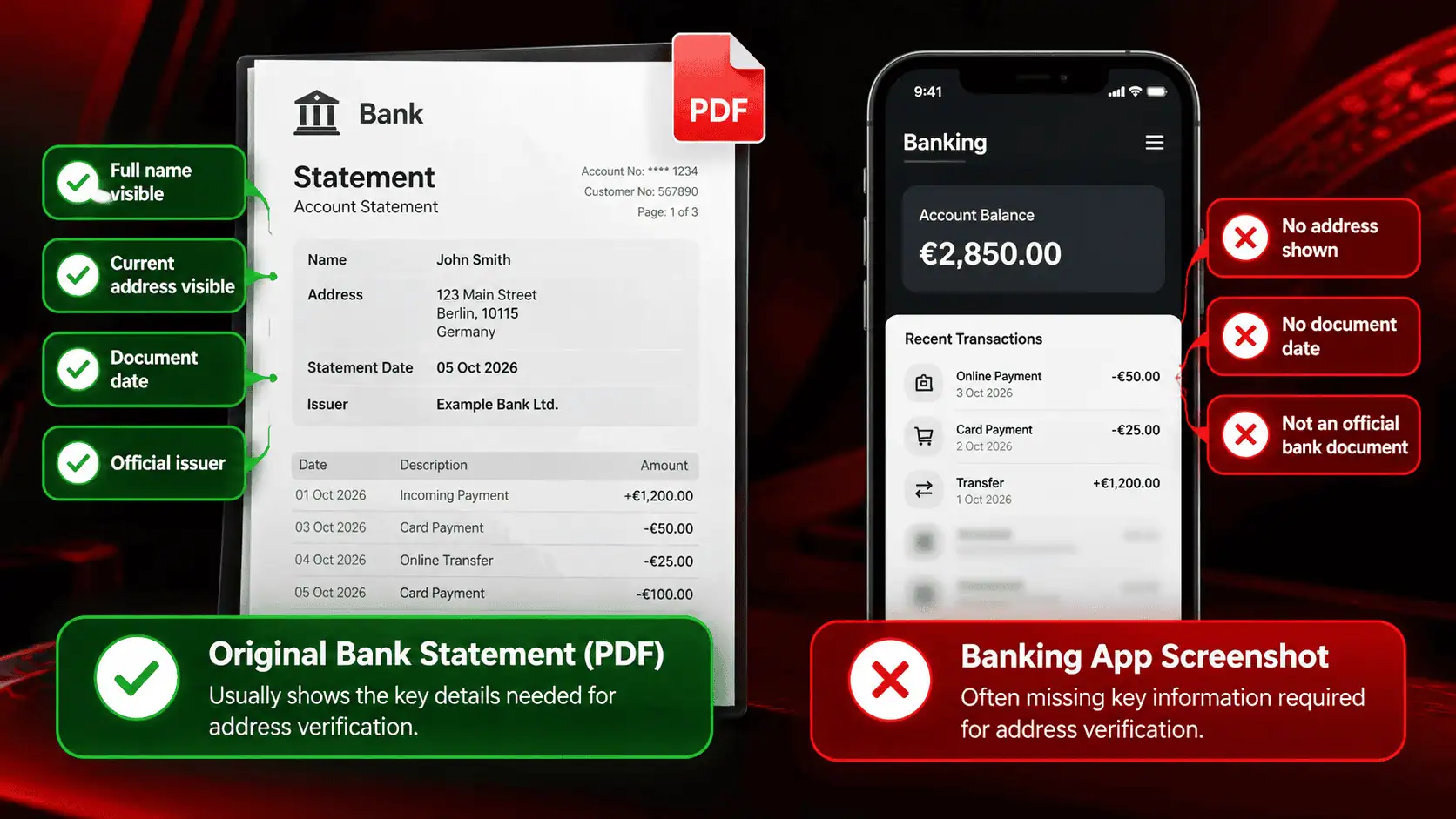
Safe fix: Check the operator’s requirements and download an original statement from the bank when the casino accepts that format. Never edit a screenshot to make it resemble an official bank document.
Old address after moving house
If you recently moved, your casino profile may still show your previous address. Ask support how to update the account before submitting further documents.
Provide genuine evidence of the address change where the operator requests and accepts it. Do not modify an old utility bill or claim an outdated address remains current.
No utility bill in your own name
Students, tenants and people living with relatives may not have household bills in their names. A bill addressed to a partner, parent or landlord does not automatically establish your own residential address.
Ask whether the operator accepts a bank statement, tenancy agreement, government letter or another official document instead.
If the standard list does not fit your circumstances, request a manual or alternative-document review. The operator may still need evidence of your address, but you can ask for a practical way to provide it.
For wider context, read what a fair casino KYC process should look like. A demanding verification request does not automatically indicate misconduct; the explanation, purpose and resolution process matter.
Casino selfie verification failed: safe troubleshooting
A failed selfie or liveness check does not automatically mean the casino suspects a fake ID. Poor lighting, camera permissions, technical errors and face-positioning problems can interrupt a legitimate verification attempt.
Camera, lighting and liveness problems
Open the verification session through your official casino account. Check camera permissions, clean the lens and follow the on-screen instructions.
Avoid strong backlighting and keep your face visible as the system requires. Some providers request a live camera session rather than an uploaded photograph.
If the session expires, start a fresh verification attempt through the confirmed account process.
What if selfie verification keeps failing?
Contact support after repeated genuine attempts. Explain the error and ask whether the operator offers a manual or accessible alternative.
Do not ask someone else to complete the selfie check. Never use manipulated photographs, deepfake software or recorded video to imitate a live verification session.
If the casino redirects you to an external identity provider, confirm that provider through the official account or verified support channel before sharing your image.
Payment-name mismatches and ownership verification
Identity approval does not necessarily settle payment ownership. A casino may still need to establish whether the customer controls the relevant bank account, payment card, e-wallet or withdrawal destination.
What if your partner owns the payment card?
Imagine a customer who registers under their own legal name but deposits with a card belonging to a spouse or partner.
The resulting mismatch raises a payment-ownership question, not necessarily an ID-photograph problem. Some operators prohibit third-party funding even when the cardholder gives permission.
Safe fix: Explain who owns the payment method and request the operator’s applicable policy and permitted resolution.
Do not present another person’s bank statement as your own or attempt to disguise the original payment route.
For more detail, see why payment-account names must match.
Bank statements that do not establish ownership
A statement may show a transaction without identifying the account holder. An e-wallet screenshot may display a payment reference without confirming who owns the wallet account.
Ask support which account details must appear and which evidence types it accepts.
If the operator requests a card image, follow its verified masking instructions. Never provide your CVV or CVC security code.
Crypto casino wallet verification problems
A blockchain transaction hash can help identify a transfer, but the transaction record alone does not establish the legal identity of a wallet controller.
If you deposited from an exchange, the casino may request an exchange withdrawal record or other account-specific evidence. For a self-custody wallet, ask what non-secret evidence the operator accepts.
Never share a seed phrase or private key. Do not approve unfamiliar wallet permissions, signatures or transactions merely because someone calls them a verification requirement.
Duplicate account and shared-household reviews
Casinos may investigate accounts that share an address, device, network connection or other identifying information. Such connections may trigger account-rule or bonus-abuse reviews.
However, a shared IP address does not, by itself, prove that two accounts belong to one person.
How to explain a legitimate shared household
If several adults use the same household connection, explain the arrangement truthfully. Ask which account restriction or verification requirement the operator is investigating.
Support may request additional evidence to distinguish customers. Follow the legitimate procedure without inventing information or concealing relationships.
Do not create another casino account to avoid verification or an existing restriction.
When the problem becomes enhanced due diligence
Not every outstanding request belongs to ordinary identity verification. A casino may approve your ID but continue reviewing payment ownership, transaction history or the origin of funds.
Identity versus payment versus source of funds
Three separate compliance questions
Identity verification: Who are you?
Typical evidence includes identification, address information and identity-matching checks.
Payment ownership: Do you control the payment method?
The operator may request bank-account ownership information or payment-specific records.
Source of funds: Where did the money originate?
Evidence may include payslips, financial statements, income records or explanations of relevant transactions.
Source of funds concerns the origin of money used for gambling. Source of wealth concerns how someone accumulated their broader assets.
If the casino requests income evidence after approving your passport, another passport photograph will not resolve the financial question.
What to ask during an enhanced review
Ask support which review remains open, which transactions or periods matter and what evidence the operator accepts.
The UK Gambling Commission’s customer due diligence guidance explains risk-based checks, identity verification and enhanced monitoring in its regulatory framework.
These requirements do not apply identically to every jurisdiction. An operator may also withhold certain internal fraud or anti-money-laundering details where disclosure would create legal or security concerns.
For a deeper explanation, see when a request becomes a source-of-funds review.
How to resubmit casino documents securely
Before sharing more personal information, confirm exactly what the casino needs. Sending the same records through multiple channels may expose sensitive data without solving the problem.
Prepare and upload the correct evidence
- Confirm the outstanding category. Identify whether the problem concerns identity, address, selfie, payment ownership or financial compliance.
- Review the document rules. Check accepted file formats, document age, required pages and other relevant details.
- Prepare genuine evidence. Retake a poor photograph or obtain a fresh original document from its issuer.
- Open the official verification channel. Navigate independently to the casino website and sign in.
- Protect sensitive details. Follow verified masking instructions and ask whether the operator accepts a less intrusive alternative.
- Record the submission. Keep the date, case number, document category and relevant status messages privately.
- Follow the review process. Use the operator’s stated timeframe before requesting another update.
Protect yourself from fake KYC agents
Do not automatically trust someone who contacts you through Telegram, WhatsApp or an unfamiliar email address claiming to represent casino compliance.
Verify unusual requests through the operator’s official support channel. Never send passports or complete financial records to an unsolicited contact.
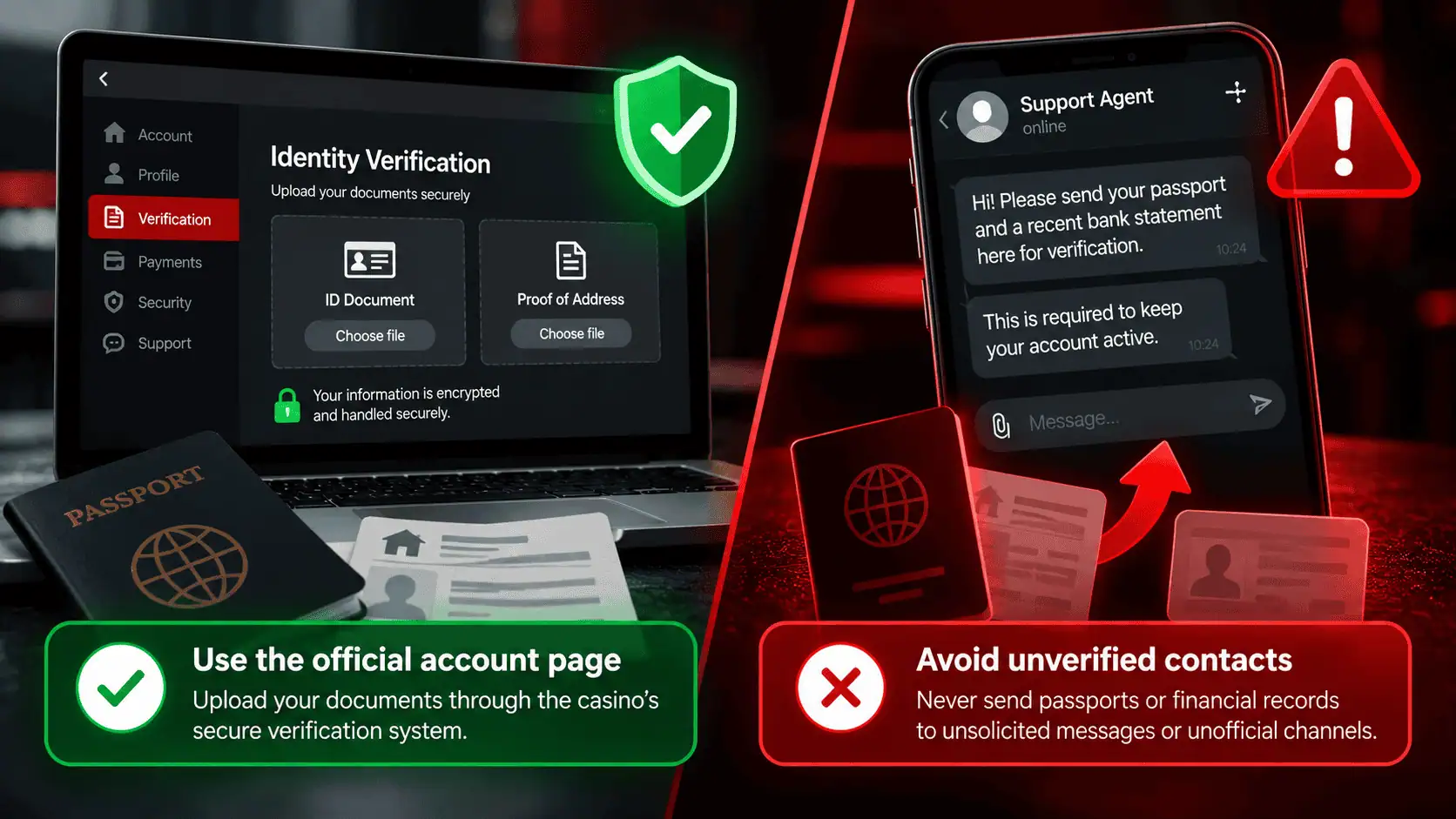
Be especially cautious if someone demands remote-access software, wallet secrets or additional deposits to release your balance.
Repeated casino verification rejection: when to escalate
Two failed submissions do not automatically prove unfair treatment. The original defect may still remain. However, repeated unexplained rejection deserves closer attention.
Warning signs of an unresolved verification dispute
Watch for contradictory instructions, changing requirements without explanation or repeated requests for evidence that support previously confirmed as satisfactory.
Also check whether the operator continues to restrict a withdrawal without explaining which verification category remains outstanding.
These patterns justify a request for a documented manual review. They do not, by themselves, prove deliberate wrongdoing.
Ask for a written manual review
Keep your message short and specific. Include the document category, submission dates, correction attempted and case reference.
Hello Verification Team,
My proof-of-address document failed verification on [date]. I submitted a replacement [document type] on [date], showing my full name, current address, issuer and issue date.
Please confirm which requirement remains unmet, whether you accept another document type and whether any separate account, payment or financial review is still open.
My case reference is [reference]. Thank you for reviewing this issue.
When to use the formal complaint process
If support cannot provide an actionable response, request the operator’s official complaint procedure, licensing details and applicable dispute-resolution route.
Preserve relevant correspondence and submission records. Avoid publishing passports, full bank statements or wallet secrets in public complaint forums.
Read how to escalate an unresolved verification dispute before taking the next step.
UK identity verification and complaint rules
For operators subject to the relevant UK remote licence requirements, UK Gambling Commission Licence Condition 17.1.1 requires operators to verify customer identity before permitting gambling.
The condition also restricts additional withdrawal-stage information requests when the operator could reasonably have requested that information earlier. Other legal obligations can still justify further checks.
For eligible disputes, customers may access an approved alternative dispute resolution provider after the applicable complaints period or through an earlier deadlock referral. The UK Gambling Commission explains the ADR procedure.
The eight-week UK complaints framework is not a universal casino verification deadline. Different jurisdictions follow different rules, and not every customer-service issue qualifies for ADR.
Casino verification pending after resubmission: next steps
A successful upload does not necessarily mean the casino has approved the document. Account dashboards may show “received,” “pending,” “under review” or another status while staff or automated systems continue checking the evidence.
Confirm which verification stage remains open
Ask whether the casino received your replacement, whether it resolved the original error and whether another document category still requires attention.
Do not assume that a fresh pending status means your previous document failed again.
How long should you wait?
No single review period applies across every casino. Automated identity matching, manual checks and enhanced financial reviews may follow different timelines.
Use the operator’s published or communicated timeframe. If that period passes, request a written status update with your case reference.
Remember that identity approved and withdrawal approved describe different outcomes. An outstanding payment or financial review may still affect your payout.
Casino verification rejected: common questions
Can I resubmit the same document after KYC rejection?
Yes, if you correct the problem that caused the rejection. For example, you can retake a blurry photograph or submit a missing document side. An expired or unsupported document usually requires a different accepted document.
Why did the casino reject my proof of address?
The document may lack your full name, current address, issuing organisation or issue date. It may also exceed the operator’s age limit or use an unsupported format. Ask which requirement failed.
Does failed selfie verification mean my ID is fake?
No. Camera errors, lighting, positioning and technical matching problems can interrupt genuine attempts. Follow the official retry procedure and ask for an alternative review if repeated attempts fail.
Can I redact a bank statement for casino verification?
Only follow the operator’s verified masking rules. Removing required information independently can cause another rejection. Ask what details must remain visible and whether a different accepted document offers better privacy.
What if my casino account name differs from my bank account?
Ask support which ownership rule applies. A documented legal name change may have a valid resolution. A bank account belonging to another person raises a separate payment-ownership issue.
Can a casino request documents after approving my ID?
Yes. Identity approval does not necessarily complete address, payment or financial checks. Operators may also need updated evidence under applicable rules. Ask which specific requirement remains outstanding.
Should I send documents to a casino agent on social media?
Avoid unsolicited social-media contacts. Confirm any unusual request through the official casino account or verified support channel before sharing sensitive documents.
What if my address documents are in my partner’s name?
Ask whether the casino accepts alternative evidence in your own name. Do not alter your partner’s statement or present it as your personal document.
Does document rejection mean my winnings are lost?
Not automatically. A rejection may reflect a correctable evidence problem, an outstanding compliance review or an account dispute. Ask for the relevant rule, current withdrawal status and next review step.
Final advice: fix the defect, not the document
When casino verification fails, identify the precise problem before submitting more evidence. Use genuine documents, follow official instructions and keep sensitive information inside verified channels.
If repeated submissions fail without a useful explanation, request a written manual review. Where the operator cannot resolve a legitimate dispute, consider the applicable formal complaint process.
Never alter document facts, impersonate another account holder or deposit more money simply because someone claims it will unlock verification or a pending withdrawal.
Verification requirements and dispute procedures depend on the operator, licence and jurisdiction. This guide provides general information, not legal advice. Gambling carries financial risks and should take place only where lawful and age-appropriate.

Maria Hoffmann has worked in cryptocurrency content and digital publishing since 2017. She is a co-founder of Freecoins24 and CryptoMutant and has covered blockchain projects, crypto platforms and emerging industry trends for several years. She has also been active as a cryptocurrency investor since 2019. At CasinoIndex, Maria combines content research and SEO experience with a focus on casino trust, platform security, withdrawal processes, payment risks and user protection. Her work looks beyond bonuses and product features to examine how gambling platforms handle player funds, verification and account-related risks.