Provably Fair Dice Casinos 2026: Five Sites Compared

The strongest provably fair Dice casinos in 2026 are Stake, TrustDice, Shuffle, Crypto.Games and Duelbits.
Stake ranks first overall because it combines transparent Dice mathematics with the strongest full-platform profile in this group. TrustDice is the better specialist choice when Dice is the main reason for opening an account. Shuffle provides the clearest technical documentation, Crypto.Games offers deeper automation controls, and Duelbits keeps the game simple.
Each shortlisted game publishes a standard house edge of 1%. Crypto.Games also documents a reduced 0.8% rate for qualifying VIP members. However, that lower rate is not automatically available to a new account.
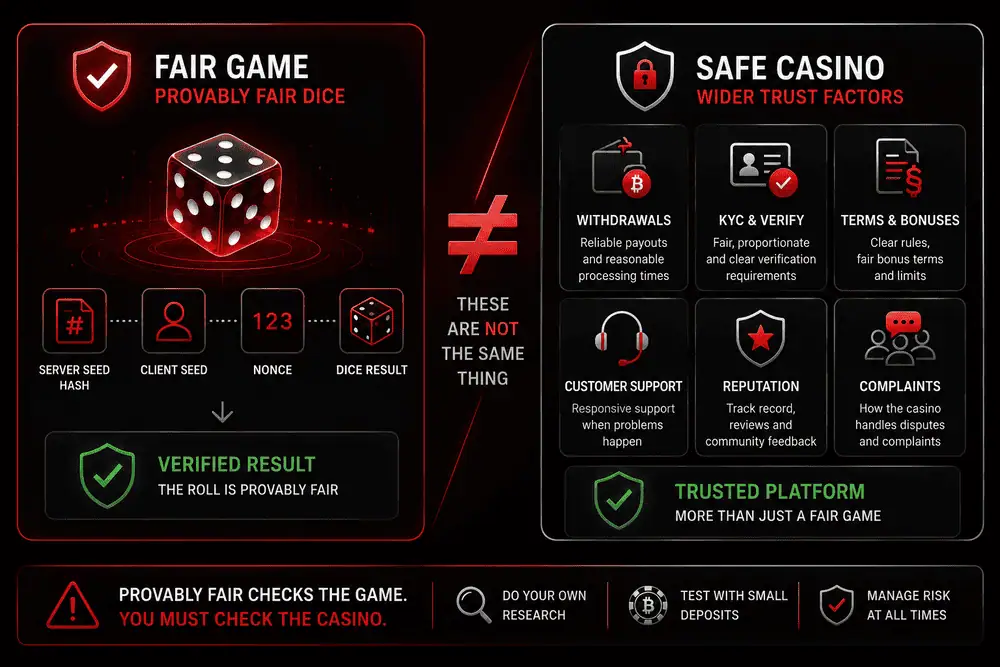
More importantly, “provably fair” is not a complete casino safety certificate.
The technology can help a player reproduce a Dice result from committed seeds. It cannot prove that withdrawals will be fast, KYC will be proportionate, bonus terms will be reasonable or account disputes will be handled fairly.
Players unfamiliar with the system should first understand how provably fair casino games can be independently checked rather than relying on a badge beside the game.
Quick Picks
- Stake — best overall: Strong Dice transparency combined with a more established full-platform profile.
- TrustDice — best Dice specialist: A dedicated product with visible odds and direct result verification.
- Shuffle — best verifier experience: Clear seed rotation, detailed technical documentation and an on-site checker.
- Crypto.Games — best advanced controls: Fast betting, API access and a lower VIP edge, but mandatory verification matters.
- Duelbits — best simple interface: Easy over-or-under controls with a published 1% house edge.
Provably Fair Dice Casinos Compared
| Rank | Casino | Best For | Standard Dice Edge | Main Limitation |
|---|---|---|---|---|
| 1 | Stake | Best overall | 1% | Crypto withdrawals can trigger wallet screening and KYC |
| 2 | TrustDice | Dedicated Dice play | 1% | Rapid auto-betting can increase total wagering quickly |
| 3 | Shuffle | Verifier clarity | 1% | Less long-term operating history than Stake |
| 4 | Crypto.Games | Advanced controls | 1%; 0.8% for qualifying VIPs | Level 3 verification is required in 2026 |
| 5 | Duelbits | Simple customizable Dice | 1% | Fast automation can hide how much has been wagered |
This is a Dice-specific ranking. It does not simply copy the overall CasinoIndex casino scores.
Why Rollbit Was Not Selected
Rollbit was part of the original shortlist. However, its current in-house Originals catalogue does not show a classic seed-verifiable over-or-under Dice game.
Its Originals focus on games such as Mines, Plinko, X-Flip, X-Crash and X-Roulette. Dice-labelled games elsewhere in the lobby may come from third-party providers, but they do not offer the same specific in-house Dice format required for this ranking.
Stake is therefore the cleaner match for the search intent. It publishes the Dice house edge, explains its provably fair system and allows users to verify historical results.
How We Ranked These Dice Casinos
A game did not qualify simply because the casino displayed the words “provably fair.” We focused on six practical questions.
Can Players Find and Use the Verifier?
A useful system should make the server seed commitment, client seed, nonce and revealed server seed accessible.
A built-in verifier is preferable. It turns provably fair from a marketing claim into a process the player can test. If a casino makes verification difficult to find or understand, most users will never complete it.
Is the House Edge Visible?
The casino should publish the Dice edge clearly. Showing only the win probability and multiplier is not enough.
All five selected platforms advertise a standard 1% Dice edge. Crypto.Games documents a lower 0.8% rate for eligible VIP users, but that rate is not the normal setting for every player.
Can Players Control Variance?
Classic crypto Dice lets the player adjust the target, win chance and potential multiplier.
These settings change the pattern of wins and losses. They do not remove the casino’s mathematical edge. A higher chance produces more frequent small wins, while a lower chance creates longer losing runs with occasional larger payouts.
Are the Auto-Bet Controls Practical?
Useful controls include:
- a fixed number of rolls
- a stop-loss value
- a stop-on-profit value
- a maximum stake
- clear increase and reset conditions
- an obvious stop button
Open-ended automation or aggressive loss-based increases create more risk, even when every underlying roll is fair.
How Fast Can the Game Consume a Bankroll?
Fast settlement makes manual testing convenient. It also allows hundreds or thousands of bets to pass before the player reacts to a falling balance.
Speed should therefore be treated as both a product feature and a bankroll risk.
Is the Wider Casino Trustworthy?
A technically fair game does not approve withdrawals.
The operator still controls KYC, wallet screening, bonus reviews, payment limits and account restrictions. This distinction is explained further in what provably fair actually proves and what it leaves unanswered.
1. Stake — Best Overall Provably Fair Dice Casino
Stake Dice uses a virtual 100-sided result. Its official game information publishes a 1% house edge, 99% theoretical RTP and adjustable over-or-under targets.
The multiplier changes with the selected win probability. A 49.5% chance produces a total payout close to 2.00x, while lower win probabilities offer larger multipliers. The long-term house edge remains fixed across those settings.
The interface works well for small manual tests. It also supports automated conditions, although those settings need firm limits.
Stake ranks first because the wider platform matters. It has a longer operating history, a large casino and sportsbook, detailed fairness documentation and an established crypto payment system.
However, this does not make every withdrawal automatic.
Crypto deposits and withdrawals may pass through blockchain-risk screening. Stake can also request KYC after an account reaches an internal, risk-based threshold. A verified Dice result cannot bypass those checks.
Best for: Players who want provably fair Dice inside a larger casino and sportsbook platform.
Main strength: Transparent game mathematics combined with stronger all-round platform relevance.
Main risk: Game verification does not remove wallet screening, deposit-wagering rules or withdrawal-stage KYC.
2. TrustDice — Best Dedicated Dice Casino
TrustDice places Dice near the centre of its product rather than treating it as a minor Original.
Its Dice page shows a fixed 1% house edge and 99% theoretical RTP. Players can adjust the win chance between lower- and higher-probability settings, while the payout changes to preserve the same expected return.
Reducing the win chance increases the multiplier. Increasing the chance produces more frequent wins but smaller payouts. Neither approach removes the house edge.
TrustDice also allows players to inspect individual bets through the game history. The available information includes the server seed, server-seed hash and client seed. These values can be used to reproduce the result.
That direct access makes TrustDice the strongest specialist option.
Still, visible mathematics can create false confidence. A low edge does not protect a bankroll when auto-bet runs for thousands of rounds.
Best for: Players who mainly want Dice and intend to verify individual rolls.
Main strength: Dice-specific transparency and accessible verification information.
Main risk: Fast, repeatable betting can turn a small stake into a large cumulative wager.
3. Shuffle — Best Dice Verifier Experience
Shuffle Dice uses a virtual 100-sided roll and publishes a 1% house edge. Players can adjust the target, payout and risk level through a simple interface.
Its main advantage is documentation.
Shuffle explains how server seeds, client seeds, nonces and cryptographic hashing are used to generate game data. It also explains how the resulting random value is converted into a Dice outcome.
Players can rotate the seed pair, reveal the previous server seed and enter the relevant values into Shuffle’s verifier. The reproduced number should match the original bet record.
This is more useful than a generic fairness badge. The player can follow the process and verify a real historical result.
Shuffle has less long-term operating history than Stake. Its technical transparency is a positive signal, but it should not be treated as proof of future payout performance.
Best for: Players who want clear verification steps without relying on external tools.
Main strength: Detailed documentation and an accessible on-site verification workflow.
Main risk: A polished verifier says little about future KYC, bonus disputes or larger withdrawal reviews.
4. Crypto.Games — Best for Advanced Dice Controls
Crypto.Games offers classic Dice and Dice V2.
The standard product uses a 1% house edge. The casino also documents a reduced 0.8% edge for qualifying VIP members.
This lower rate is an official benefit rather than an unsupported marketing claim. However, it is conditional. A normal new player should expect the standard 1% edge unless the required VIP status has already been reached.
Dice V2 supports faster play and more detailed automation. Crypto.Games also publishes API guidance for users who connect Dice bots or custom betting tools.
Those features suit technically experienced users. They also add risk.
A badly configured script can place a huge number of bets before the player notices the cumulative loss. An exposed API key may compromise the account or give third-party software more access than intended.
Crypto.Games also introduced mandatory Level 3 identity verification in 2026. The platform should therefore no longer be treated as a low-KYC Dice casino.
Best for: Technically experienced users who understand APIs, permissions and hard bankroll limits.
Main strength: Deep control over speed, probability and automated betting.
Main risk: Advanced automation increases both wagering risk and account-security risk.
5. Duelbits — Best Simple Modern Dice Interface
Duelbits Dice uses a familiar over-or-under format with a published 1% house edge and 99% theoretical RTP.
Players choose a target and win chance, then receive a matching multiplier. A lower probability increases the potential payout but creates longer losing sequences.
Duelbits documents its provably fair process through the server seed, client seed and nonce. The platform publishes the hashed server seed before play and reveals the original value after seed rotation.
The interface is easier to understand than an external Dice bot or API setup. This makes Duelbits practical for manual sessions and limited automation.
Simplicity does not make auto-bet harmless. Loss-based stake increases can grow much faster than expected, particularly when rolls settle almost instantly.
Best for: Players who want a clean Dice interface without third-party betting software.
Main strength: Clear controls and an openly published 1% edge.
Main risk: Easy automation can accelerate losses before the player notices the total amount wagered.
How Provably Fair Dice Works
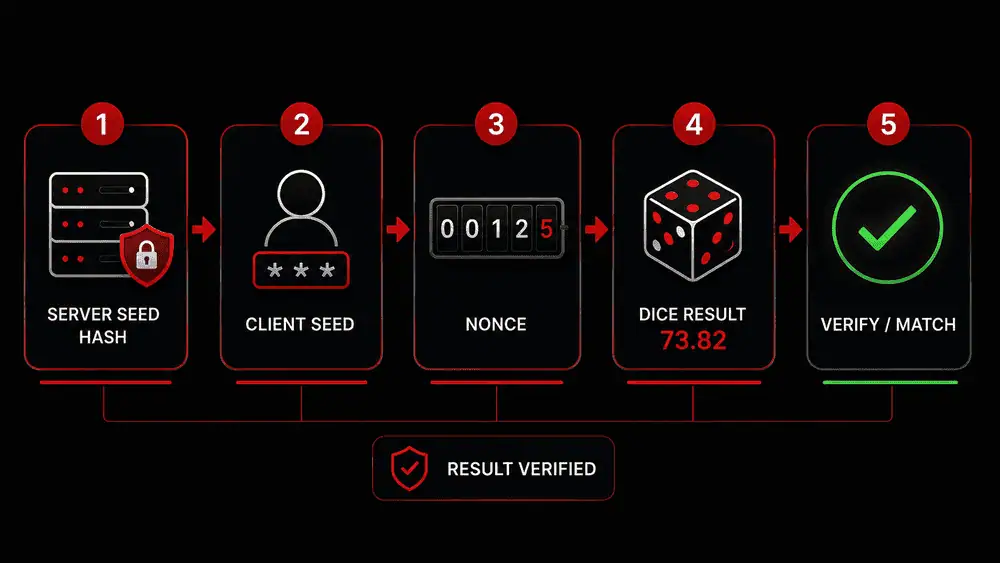
Most seed-based Dice systems use four main components.
Server Seed
The casino generates a secret server seed.
Before the player bets, it publishes a cryptographic hash of that value. The hash acts as a commitment.
When the original seed is later revealed, it should produce the same hash. A different seed would normally create a different commitment.
Client Seed
The client seed supplies player-side input.
The platform may generate it automatically, but many casinos allow the player to change or randomize it before placing bets.
Nonce
The nonce counts the rounds completed with the same seed pair.
It normally increases after each bet. This allows the same server and client seeds to generate a different result for every roll.
Game Formula
The casino combines the inputs through a published algorithm and converts the output into the displayed Dice number.
Once the server seed is revealed, the player can repeat the calculation. When the result and previous hash both match, the recorded roll followed the committed inputs.
Some blockchain-focused casinos use similar verification systems across several Originals. However, provably fair does not necessarily mean that every Dice roll is stored directly on a public blockchain.
What Verification Confirms
A successful check can confirm that:
- the revealed server seed matches the earlier commitment
- the stated client seed and nonce were used
- the published formula reproduces the recorded roll
- the operator did not simply replace that result after the wager
It does not confirm that:
- the house edge is favourable
- the casino is solvent
- a bonus is fair
- a withdrawal will be approved
- KYC will be proportionate
- support will resolve a dispute
- future rolls can be predicted
The verifier answers one narrow but important question:
Did the recorded inputs produce this result?
House Edge: Why 99% RTP Still Costs Money
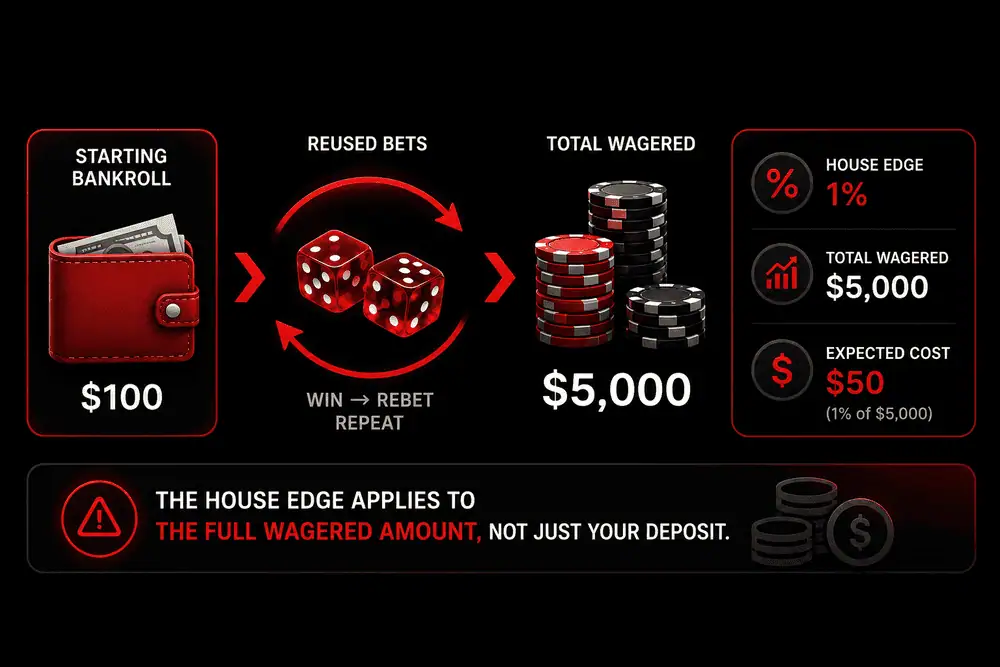
A 1% house edge means that the theoretical expected loss equals 1% of total wagering over a very large sample.
It does not mean the player loses only 1% of the original deposit.
| Bet Size | Number of Rolls | Total Wagered | Theoretical Cost at 1% |
|---|---|---|---|
| $0.10 | 1,000 | $100 | $1 |
| $1 | 1,000 | $1,000 | $10 |
| $1 | 10,000 | $10,000 | $100 |
| $5 | 10,000 | $50,000 | $500 |
A $100 balance can create several thousand dollars in turnover when winnings are reused for later bets. The edge applies to the full turnover.
Changing the win chance affects variance:
- A high win chance creates frequent small wins and occasional larger losses.
- A low win chance creates longer losing runs with rare high multipliers.
- Neither setting changes the expected return when the edge remains fixed.
This is why a visibly low house edge can still become expensive during a fast session.
Why Auto-Bet Is the Main Dice Risk
Auto-bet often feels controlled because the player enters the rules before the session starts.
The danger is how quickly those rules repeat.
A common setup doubles the next wager after every loss:
$1 → $2 → $4 → $8 → $16 → $32 → $64 → $128
Eight losing bets consume $255 in total stakes. The ninth bet alone would require another $256.
The next roll is not more likely to win because earlier rolls lost. Each result follows the same selected probability.
Safer automation uses:
- a fixed base stake
- a fixed number of rolls
- a hard stop-loss
- a maximum single bet
- no automatic increase after a loss
- a stop-on-profit value chosen before play
Do not leave a Dice bot running unattended.
Do not share API keys or connect unknown betting software to a funded casino account. Even legitimate software can cause damage when the limits are configured incorrectly.
Speed of Play and Bankroll Control
Dice has almost no natural pause.
There is no dealer, card sequence or slot bonus round. A result can appear immediately, and the next bet may start at once.
That makes the game easy to test. It also removes the moments in which a player might reconsider the next wager.
A practical test session could use:
- a $100 maximum session bankroll
- a fixed $0.10 stake
- no more than 200 rolls
- a $5 stop-loss
- no loss-based stake increases
- a manual balance check every 50 rolls
This setup does not improve the odds. It limits how much one session can cost.
Players unfamiliar with instant games can first review how Dice differs from other casino game types.
Why a Fair Game Can Still Sit Inside an Unsafe Casino
Provably fair technology evaluates a game result.
Casino safety depends on a much larger system:
- ownership and licensing
- withdrawal approval
- KYC timing
- wallet and payment checks
- bonus restrictions
- account-block procedures
- complaint patterns
- support behaviour under pressure
The casino still holds the player’s balance before withdrawal.
Even when every Dice roll verifies correctly, the operator may review the payment for identity, AML, bonus or wallet reasons.
Some checks are legitimate. The risk becomes more serious when the casino gives no clear reason, repeatedly adds new document requests or relies on terms that were not obvious before the deposit.
Game fairness is one useful trust signal. It cannot replace a complete platform review.
How to Verify a Dice Roll
Start with one small manual bet.
- Open the game’s fairness or seed panel.
- Record the current hashed server seed.
- Confirm or change the client seed.
- Place the bet and record its ID or nonce.
- Rotate the seed pair so the old server seed becomes available.
- Open the casino’s verifier.
- Enter the server seed, client seed and nonce.
- Reproduce the roll.
- Compare it with the result in the bet history.
A mismatch needs investigation.
First confirm that the correct seed pair, nonce and Dice formula were used. Different Originals on the same platform may convert the cryptographic output in different ways.
Seeing a “provably fair” label is not the same as completing this test.
Which Dice Casino Fits You?
Stake is the strongest fit for players who value a broader casino, a longer platform history and an account they may use beyond Dice.
TrustDice makes more sense when Dice is the main priority and direct access to game verification matters more than having a large sportsbook or slot library.
Shuffle suits users who want clear technical explanations, easy seed rotation and a straightforward way to verify previous bets.
Crypto.Games is aimed at more experienced players who understand API permissions, external betting tools and the risks of high-speed automation.
Duelbits offers the simplest route for players who prefer a clean Dice interface without connecting bots or third-party software.
Players who place greater weight on withdrawals, reputation and long-term platform safety than on one casino Original should compare stronger all-round crypto casino options before depositing.
A Safer First-Session Test
Do not begin with a bonus or an automated strategy.
Make a small deposit, place a few manual Dice bets and verify at least one result. Then request a modest withdrawal through the payment route you expect to use later.
Record:
- the displayed house edge
- the selected probability and multiplier
- seed and nonce details
- whether the result verifies
- the total amount wagered
- casino approval time
- blockchain confirmation time
- any KYC or wallet request
This tests both sides of the platform: the game and the cashier.
One successful small cashout does not guarantee that a larger withdrawal will follow the same path. It still provides more useful evidence than a fast deposit and a fairness badge alone.
Frequently Asked Questions
What is the best provably fair Dice casino in 2026?
Stake is the strongest overall choice because it combines documented 1% Dice with the stronger full-platform profile. TrustDice is the better specialist option when Dice is the main priority.
What is a provably fair Dice game?
It uses cryptographic inputs such as a server seed, client seed and nonce. After the server seed is revealed, the player can reproduce a past roll and compare it with the recorded result.
Does provably fair mean there is no house edge?
No. Fairness verification and house edge are separate. A roll can be generated honestly while the payout still gives the casino a mathematical advantage.
Is a Dice game with 99% RTP profitable?
No. A 99% theoretical RTP still leaves a 1% long-term edge for the casino. Short sessions can end in profit, but more wagering increases the expected cost.
Does changing the win chance improve the RTP?
Usually not. The multiplier adjusts when the probability changes. A higher win chance pays less, while a lower chance offers a larger multiplier.
Is auto-bet safe?
It is safer when it uses fixed stakes, a short roll limit and a hard stop-loss. Loss-based increases and unattended scripts can drain a balance quickly.
Are provably fair Dice rolls stored on the blockchain?
Not always. Many systems use cryptographic commitments and seed verification without recording each roll on a public blockchain.
Can a provably fair casino require KYC?
Yes. Provably fair technology concerns game outcomes. Casinos can still request identity, wallet or source-of-funds information.
Can a provably fair casino delay a withdrawal?
Yes. A verified roll does not bypass casino approval, KYC, AML screening, bonus checks or payment limits.
Does Martingale work on crypto Dice?
No. Martingale does not remove the house edge. The required stake rises exponentially during a losing run, while real accounts have limited balances and maximum bet rules.
Final Assessment
Stake is the strongest overall provably fair Dice casino in 2026. TrustDice is the better dedicated Dice platform, while Shuffle provides the clearest verification workflow.
Crypto.Games offers the deepest automation options, but its 0.8% VIP edge is conditional and Level 3 verification is now required. Duelbits provides the simplest modern interface.
The strongest choice is not the casino with the fastest roll or largest multiplier. It is the platform that combines visible game mathematics, usable verification, sensible controls and a withdrawal process the player understands before depositing.
Provably fair Dice remains a house-edge game. Set fixed limits, avoid loss-chasing systems and never let automated betting continue without supervision.

Nina Kanu has worked in cryptocurrency content and blockchain research since 2016. She is also known within parts of the crypto community through CryptoMutant, where her work has covered emerging projects, market trends and developments across the blockchain ecosystem. At CasinoIndex, Nina focuses on crypto casino reviews, platform comparisons, player experience, game ecosystems and bonus fairness. Her research examines how casino products perform beyond their marketing, including usability, payment options, promotional terms and the overall experience players receive after signing up.