Can the Same Slot Have Different RTP? How to Check the Active Version
Article OverviewThe same slot can use different RTP configurations depending on the provider, casino setup and market. This guide explains why that happens, how to check the active RTP inside the game, and how to distinguish a legitimate lower-RTP version from a misleading or unverified claim.
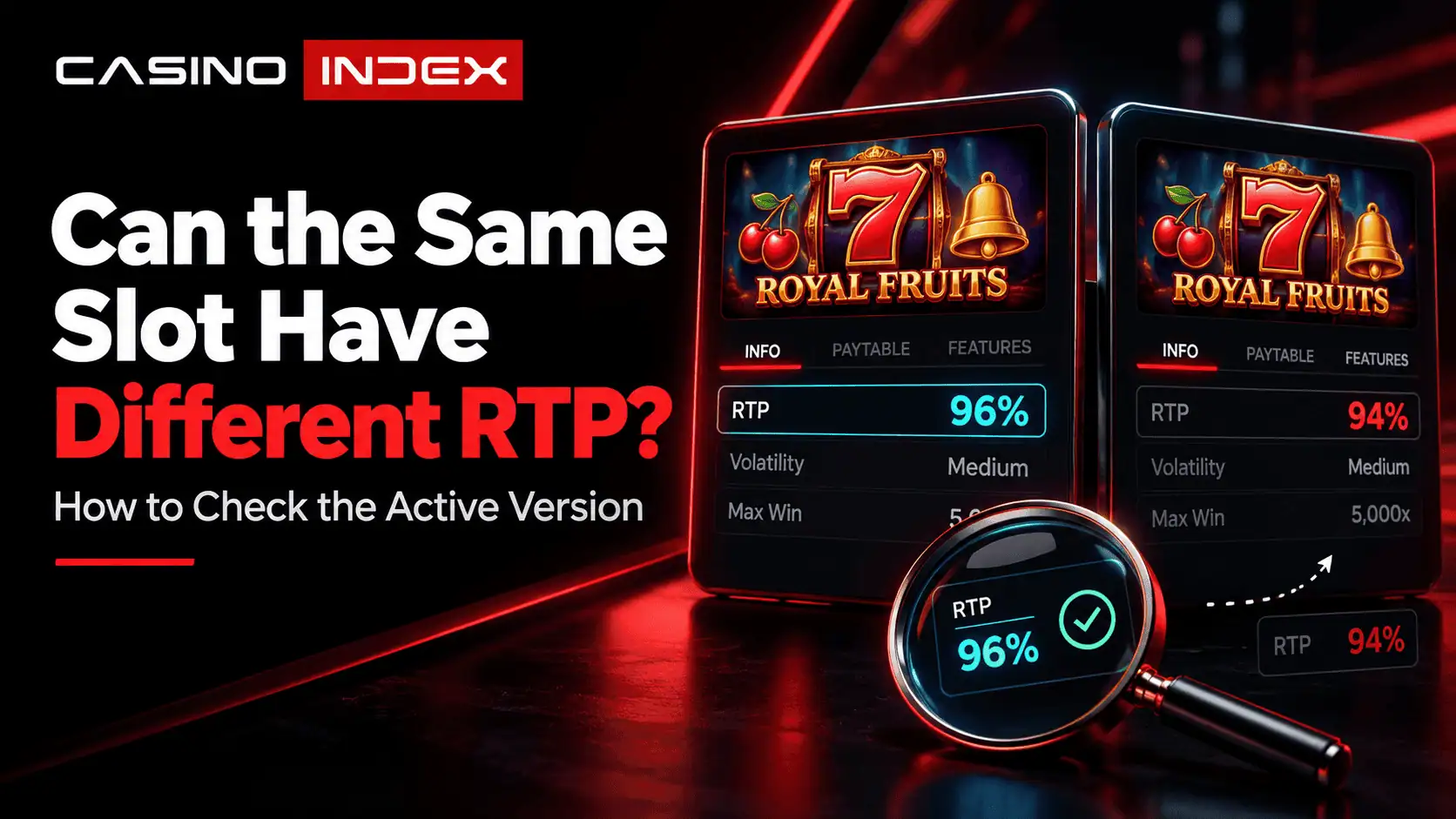
Yes. The same online slot can be available with different RTP configurations. The title, graphics, bonus features and provider can look identical while the mathematical return behind the game is different.
One casino might offer a version around 96% RTP while another makes a lower certified version available. That does not automatically mean either game is fake or manipulated. Some game providers create and certify several RTP configurations of the same title.
The important question is not only “What is this slot’s RTP?” It is “Which RTP version am I actually playing?”
A percentage copied from a casino review, game database or search result may describe another configuration. The stronger check is the RTP shown for the active game, supported where possible by official provider information.
If you first need the broader concept explained, see what RTP means in practice. This guide deals specifically with different versions of the same slot and how to identify the one currently being offered.
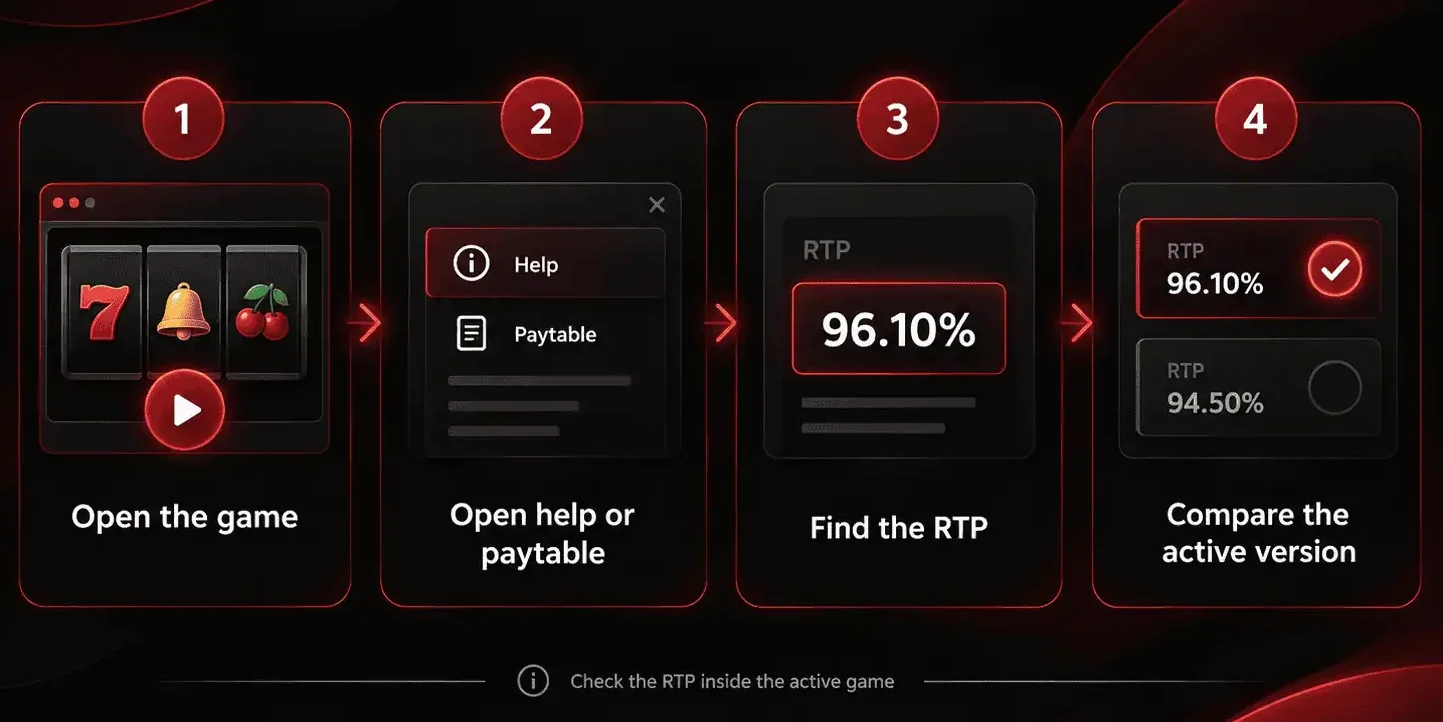
How to Check the Active RTP Version
You do not need to calculate RTP from your own spins. In most cases, the first place to look is inside the game itself.
- Open the actual slot you intend to play.
- Open the help, information, rules or paytable menu.
- Look for RTP, Return to Player or game information showing a percentage.
- Compare the displayed figure with official information from the game provider where available.
Do this before relying on an RTP figure shown somewhere else on the casino website.
The casino lobby may use generic game information. A review site may quote the provider’s default version. An old database entry may describe a configuration that is no longer the one available in your market.
The version loaded in front of you is the version that matters.
Why Can the Same Slot Have Different RTP?
An online slot is more than its artwork, reels and bonus rounds. Behind the interface is a mathematical model that determines how prizes are distributed over a very large number of rounds.
A provider can create more than one approved mathematical configuration for the same game.
Play’n GO provides a particularly clear first-party example. The provider states that its slot catalogue is certified around five RTP levels:
| Provider target RTP | Approx. house edge |
|---|---|
| 96% | 4% |
| 94% | 6% |
| 91% | 9% |
| 87% | 13% |
| 84% | 16% |
Play’n GO notes that exact values can vary slightly between jurisdictions. The important point is the principle: one provider can legitimately distribute several RTP configurations rather than one universal percentage for every installation of a game.
That means the slot name alone does not always tell you its exact mathematical version.
Who Decides Which RTP Version Is Available?
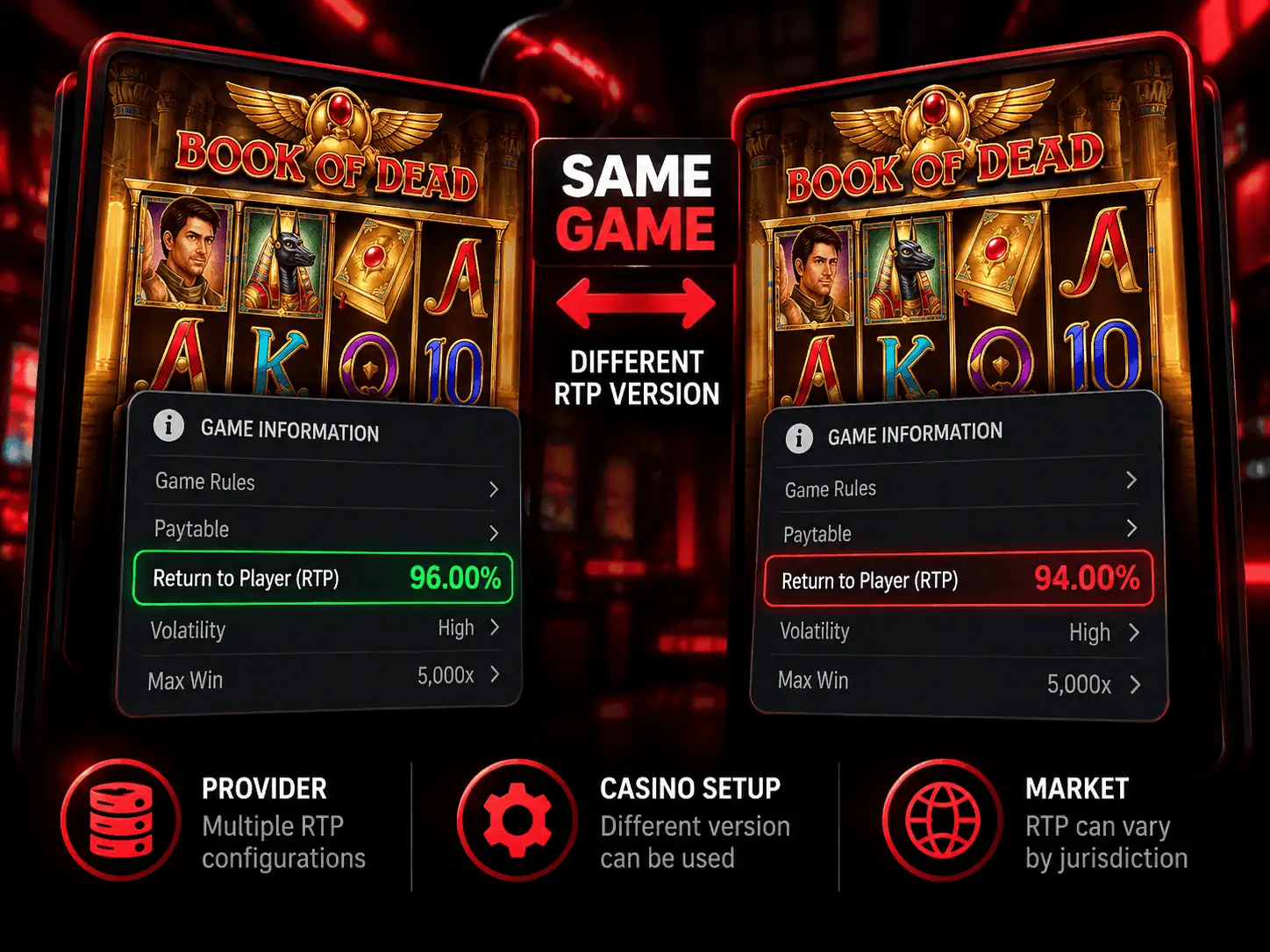
It is tempting to reduce this to “the casino chooses the RTP”, but the real setup can involve several parties.
The game provider creates the title and determines which mathematical configurations exist.
A platform or aggregator may sit between the provider and casino and control which game packages are available through that integration.
The casino operator may have certain configuration choices within the options available to it.
The market and regulator can also affect which versions are permitted and how information must be disclosed.
So it would be wrong to assume that every operator can select every RTP ever certified for a game.
For more context on these relationships, see how game providers distribute casino titles.
How to Find RTP on an Online Slot
Ahrefs shows real search demand around questions such as “how to find RTP on a slot machine”, “how to check RTP on slots” and “where to find RTP on slot machines”. For online games, the process is usually fairly simple once you know where to look.
Open the slot and look for an information control such as:
- an i icon;
- a ? icon;
- Help;
- Rules;
- Paytable;
- Game Information;
- or an About section.
Some providers display RTP close to the main paytable. Others place it several pages into the help file.
Do not stop just because the first rules screen does not show a percentage.
In regulated markets, disclosure rules may also apply. Great Britain’s remote gambling standards, for example, require information that allows players to make an informed decision about their chances of winning to be easily available before gambling. Depending on the game, that information can include RTP, house edge or relevant probabilities.
That is a specific regulatory example, not a rule that should automatically be applied to every gambling market worldwide.
What if the casino page and the active game show different RTP?
Imagine a casino game page says:
RTP: 96.20%
But after opening the slot, its game information says:
RTP: 94.20%
The difference deserves investigation.
It does not automatically prove that the game is manipulated. The casino page could contain generic or outdated information while the live integration uses another legitimate configuration.
But the operator should not present one RTP as if it describes the active game when it does not.
CasinoIndex covers that distinction separately in when an RTP claim becomes misleading.
Is There a Slot RTP Checker?
There is no universal slot RTP checker that can reliably tell you the active configuration at every online casino.
That distinction matters because “slot RTP checker” currently has its own search demand, but many players using that phrase are really looking for a way to verify the game they are about to play.
A database can tell you that a slot has been documented at 96.2%. It cannot automatically prove that the casino in front of you is using that exact version.
A useful RTP check therefore combines several pieces of evidence:
| Evidence | What it tells you | Main limitation |
|---|---|---|
| Active game help or paytable | RTP displayed by the version currently loaded | The information still depends on the game’s own disclosure |
| Official provider material | Supported RTP configurations or game specifications | May list several versions rather than the casino’s active one |
| Regulatory or testing documentation | Information about approved or tested game mathematics | Public availability varies by jurisdiction |
| Casino game page | What the operator says it offers | Can be generic, incomplete or outdated |
| Third-party RTP database | A useful research lead | Does not prove the active casino configuration |
For CasinoIndex, a third-party database should be treated as supporting research rather than final proof when stronger evidence is available.
Theoretical RTP Is Not the Same as Actual RTP
This is another common source of confusion.
The RTP listed in a game’s rules is normally its theoretical RTP: the mathematical return built into that version of the game over a very large number of rounds.
Some casinos or community discussions also refer to actual RTP, meaning what players have really received over a particular sample of bets.
Those are not interchangeable.
A 96% theoretical RTP slot can show an actual return far above or below 96% over a limited sample. A large win can push observed results upward. A long losing period can pull them downward.
That does not mean the configured theoretical RTP changed.
For the purpose of checking which version of a slot you are playing, the figure you want is the theoretical RTP attached to that game configuration, not a short-term statistic generated from recent player results.
How Much Difference Does a Lower RTP Make?
A difference of one or two percentage points can look small until you translate it into house edge.
| RTP | House edge | Theoretical loss per $1,000 wagered | Theoretical loss per $10,000 wagered |
|---|---|---|---|
| 96% | 4% | $40 | $400 |
| 94% | 6% | $60 | $600 |
| 91% | 9% | $90 | $900 |
| 87% | 13% | $130 | $1,300 |
Moving from 96% RTP to 94% RTP is only a two-point reduction in the headline percentage.
But the house edge rises from 4% to 6%. Relative to the original 4% edge, that is a 50% increase in the casino’s theoretical advantage.
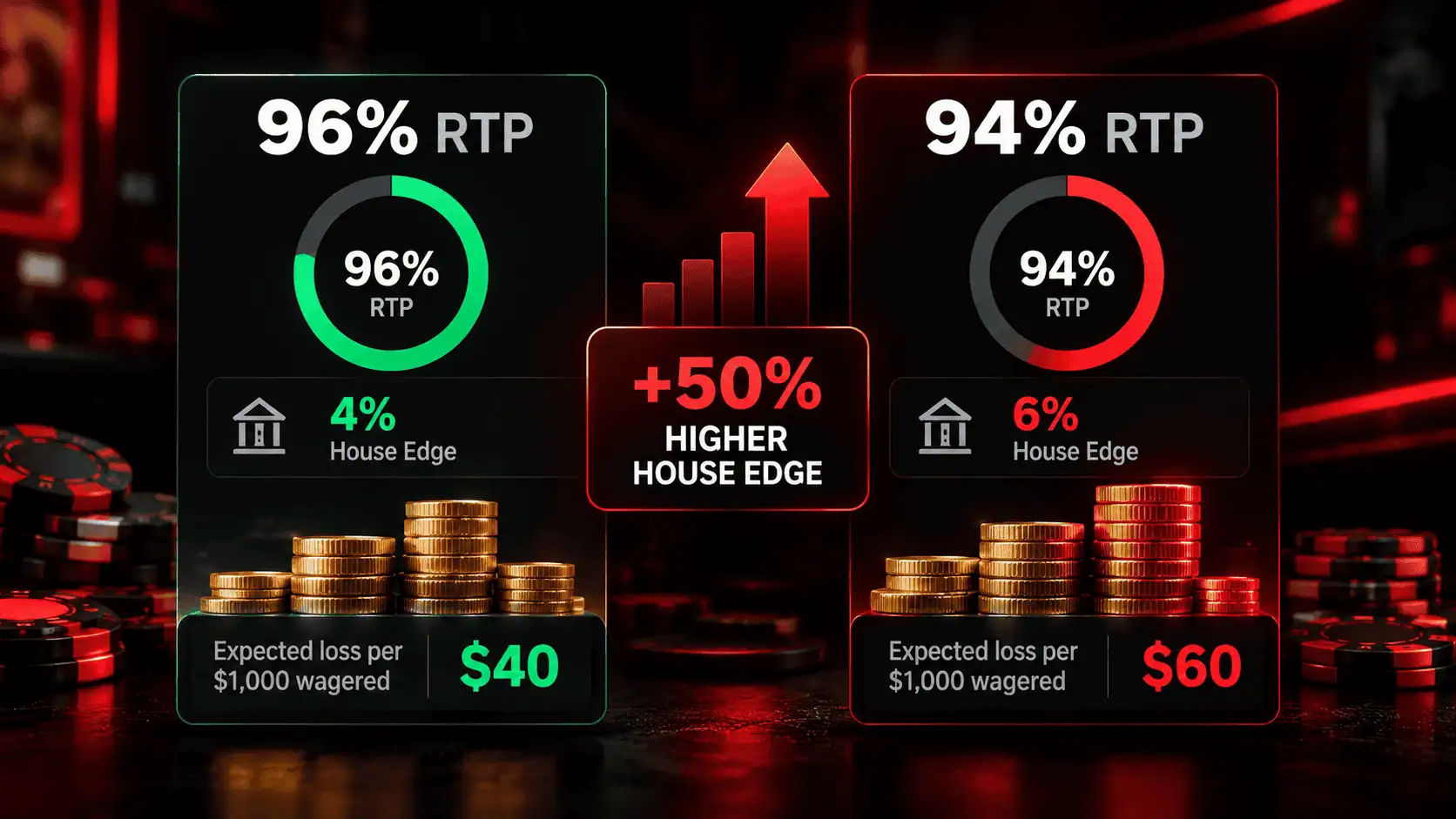
That does not mean a player depositing $100 will lose exactly $4 at 96% RTP or $6 at 94% RTP.
RTP applies over very large amounts of wagering. Short sessions can finish far above or below the theoretical expectation.
Total wagering can also be much larger than the original deposit because money can be recycled through repeated wins and bets.
For the mathematical relationship, see how a lower RTP increases the house edge.
Does a Lower RTP Mean the Slot Is Rigged?
No. A lower RTP configuration is not automatically a fake or rigged game.
There are several different situations that should not be confused.
1. A legitimate lower-RTP configuration
The original provider created the version and distributes it as one of its supported configurations.
You may prefer the higher-return version, but worse mathematical value is not the same thing as fraud.
2. A misleading RTP claim
The casino publicly describes a slot as having one RTP while the version available to players displays another.
The game itself may still be genuine. The problem is the accuracy of the information shown to the player.
3. A technical or configuration problem
A legitimate game can also be implemented incorrectly or encounter a software issue.
That is different from intentionally deploying one of the provider’s approved lower-return configurations.
4. A fake or unauthorised copy
A cloned or altered game that cannot reliably be connected to the claimed provider presents a much more serious integrity problem.
Warning signs can include missing provider identification, unusual loading domains, inconsistent game information or mathematical claims that cannot be reconciled with legitimate documentation.
Does Provably Fair Verify the RTP?
Not necessarily.
Provably fair systems are usually designed to let players verify that a particular outcome was generated according to a defined cryptographic process.
That is not automatically the same as independently verifying the complete payout model or long-term RTP of a slot.
A game can have verifiable outcome generation and still have a particular house edge built into its paytable.
So “provably fair” and “verified RTP version” should not be treated as interchangeable claims.
Can Demo and Real-Money Versions Be Different?
You should not assume that a demo hosted on one site proves the RTP of a real-money version offered somewhere else.
They may be different integrations, markets or configurations.
However, some regulated markets impose rules on how demo games must represent the corresponding real-money game.
In Great Britain, for example, a play-for-free game offered on the same facility must use the same game rules as the corresponding play-for-money game and must accurately represent the likelihood of winning and prize distribution.
The practical rule is still simple:
Use the version offered where you intend to play as your primary reference.
What if the Slot Does Not Show Its RTP?
First, check the help and paytable carefully. RTP information can be several screens deep.
If you still cannot find it, search the official provider information for the exact game title.
If the provider documents several RTP configurations but you cannot determine which one the casino is using, ask support a precise question:
What is the theoretical RTP of the real-money version of [game name] currently available on my account?
An answer such as “our games use standard RTP” does not identify the actual version.
If neither the game nor the operator provides enough information to establish the configuration, the correct conclusion is unconfirmed.
That is not proof of wrongdoing. It simply means there is not enough evidence to state an exact active RTP with confidence.
For broader information about paytables, reels and slot mechanics, see how online slot mechanics work.
Three RTP Mistakes to Avoid
- Do not treat RTP as a prediction for your next session. It is a long-term mathematical expectation.
- Do not assume the first RTP number you find online is the active version. The same title can have several configurations.
- Do not use RTP as proof that a casino itself is trustworthy. RTP says nothing about withdrawal handling, KYC disputes, account restrictions or the fairness of casino terms.
Frequently Asked Questions
Can two casinos offer the same slot with different RTP?
Yes. Some providers create and certify multiple RTP configurations of the same game. Which version is available can depend on the provider, integration, operator and market.
Can the same slot really look identical at two different RTPs?
Yes. The title, graphics and core gameplay can appear the same even when the underlying mathematical configuration is different. That is why checking the RTP information inside the active game matters.
Can a casino change my RTP because I am winning?
Multiple RTP configurations should not be confused with a personalised RTP that changes because one account is winning or losing. The issue discussed in this guide is which game configuration has been deployed, not a player-specific return that reacts to an individual session.
How do I check RTP on slots?
Open the game, enter its help, rules, information or paytable section and look for the Return to Player percentage. If several official versions of the game exist, compare the number shown in the active game with provider documentation.
Is a slot RTP checker accurate?
A database or RTP checker can be useful for discovering documented values, but it cannot automatically prove which configuration is active at every casino. Use it as a research aid rather than the only evidence.
Does higher RTP guarantee that I will lose less tonight?
No. Higher RTP improves long-term mathematical expectation, but short-term outcomes can vary dramatically. A player can lose quickly on a high-RTP slot or win on a lower-RTP version.
Is a lower RTP version fake?
Not if it is a genuine configuration created and distributed by the provider. A lower certified version and an unauthorised or manipulated copy are different issues.
Does mobile play change the RTP?
Simply changing screen size should not by itself change the mathematics of the same game configuration. However, separate integrations, markets or game builds should not automatically be assumed to be identical without checking.
Final Takeaway
The same slot name does not always mean the same RTP.
Game providers can create several mathematical configurations of one title, and the version available to a player can depend on how that game is distributed and where it is being offered.
Before relying on a percentage from a review or database:
- open the actual game;
- check its help, rules or paytable;
- find the displayed RTP;
- compare it with official provider information where possible.
A lower certified RTP is not automatically evidence of a rigged game. At the same time, a casino advertising a high RTP does not prove that the version in front of you uses that figure.
The number that matters is the one you can connect to the active game version you are actually being offered.
And RTP remains only one part of casino evaluation. It does not tell you whether withdrawals are reliable, account checks are reasonable or the operator’s terms are fair.
Research note: CasinoIndex separates provider-documented RTP configurations from RTP values observed in a specific casino client. We do not label an active casino RTP as verified unless the available evidence supports that exact game version and context.
Primary sources reviewed: Play’n GO provider documentation on multiple RTP certification levels; UK Gambling Commission Remote Gambling and Software Technical Standards covering likelihood-of-winning information and play-for-free game representation.

Nina Kanu has worked in cryptocurrency content and blockchain research since 2016. She is also known within parts of the crypto community through CryptoMutant, where her work has covered emerging projects, market trends and developments across the blockchain ecosystem. At CasinoIndex, Nina focuses on crypto casino reviews, platform comparisons, player experience, game ecosystems and bonus fairness. Her research examines how casino products perform beyond their marketing, including usability, payment options, promotional terms and the overall experience players receive after signing up.