Casino Card Deposit Charged but Not Credited? What to Do
Article OverviewA casino card deposit can appear in your bank account without reaching your casino balance. This guide explains pending holds, posted charges, 3D Secure, payment references, refunds, and safe escalation.
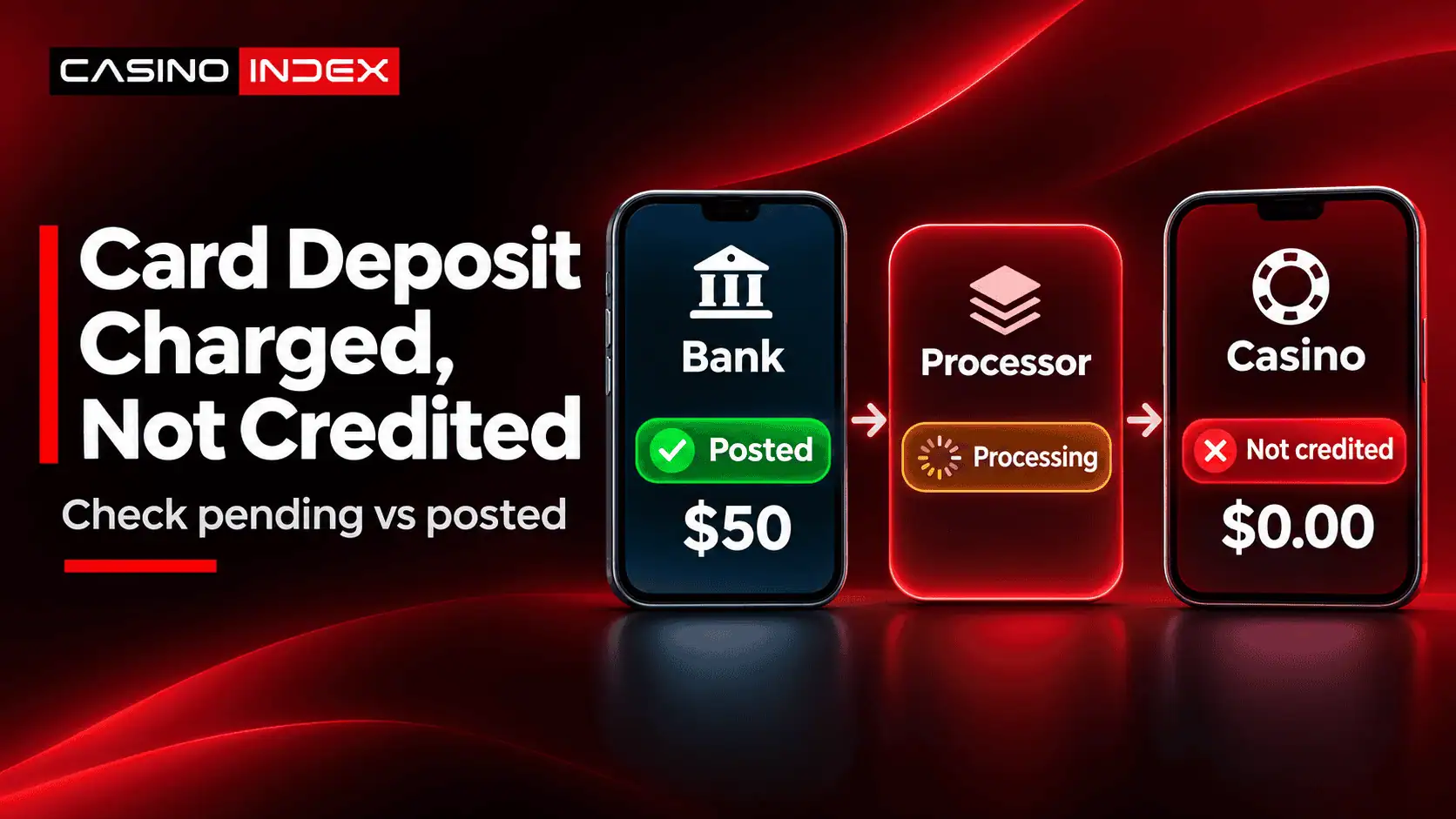
Quick answer: If your casino deposit was charged but not credited after a card payment, check the bank transaction and casino cashier separately. A pending charge may only reserve funds, while a posted charge requires closer investigation. Compare the amount, date, currency, and payment references before contacting support. Do not make another deposit just to test whether the first payment worked.
CasinoIndex Expert Take
A missing card deposit is not automatically a lost payment. Three systems can show different information: your card issuer, the payment processor, and the casino cashier. The most useful evidence comes from matching their transaction records, not from relying on a single banking notification.
Our approach: Identify whether the card transaction is pending, posted, cancelled, or genuinely unknown before discussing refunds or payment disputes. Never repeat a deposit solely to diagnose an unresolved transaction.
Three checkpoints: Bank authorisation, payment-processor handling, and casino cashier credit are separate events. Completion of one does not confirm the next.
Casino Card Deposit Charged but Not Credited? Start Here
A casino deposit can appear to fail even when your banking app shows a deduction. However, the word “charged” does not always describe the transaction’s actual status.
First, separate three parts of the payment process:
Three Stages of a Casino Card Deposit
1. Card Issuer or Bank
Checks the payment request and displays a pending authorisation, posted transaction, reversal, or decline.
2. Payment Processor or Acquirer
Processes the merchant’s payment request and records authorisation, capture, cancellation, failure, or settlement events.
3. Casino Cashier
Associates the payment with the player account and records whether the deposit was received, credited, rejected, or remains unresolved.
This is a simplified model. Real card payments may involve additional institutions, and each system may use different status labels.
Important: A reduced available bank balance does not prove that the payment processor completed the charge. Likewise, a successful card authorisation does not prove that the casino credited your player account.
Four card deposit situations to identify first
Use the following table to decide which transaction you need to investigate. The four cases form a CasinoIndex troubleshooting framework rather than a universal set of payment-provider status codes.
| Payment situation | Bank status | Casino status | Next step |
|---|---|---|---|
| Pending authorisation | The bank shows a pending card transaction or hold. | No deposit credit appears. | Check whether the casino received or cancelled the payment request. Ask about the hold if its status remains unclear. |
| Posted charge, no credit | The transaction appears as posted or completed. | The cashier shows no matching deposit credit. | Ask casino support to trace the payment using its deposit or processor reference. |
| Failed deposit, pending hold | The banking app still displays a reservation. | The deposit attempt shows failed or declined. | Confirm whether the processor cancelled the authorisation and ask the issuer about releasing the hold. |
| Unknown or unauthorised charge | A transaction appears that you did not recognise or authorise. | No corresponding deposit attempt is identifiable. | Contact the card issuer immediately through an official channel and report suspected unauthorised activity. |
Evidence limitation: These situations describe common diagnostic possibilities. Bank records, processor data, and the operator’s payment history must establish the actual outcome. A pending transaction is not necessarily fraudulent, and an unfamiliar merchant name alone does not prove wrongdoing.
For the broader differences between cards, bank transfers, e-wallets, and other payment routes, see our guide to casino payment methods.
Pending Card Hold vs Posted Charge: What Is the Difference?
The most important distinction is whether your bank has only reserved money or has recorded a completed card transaction.
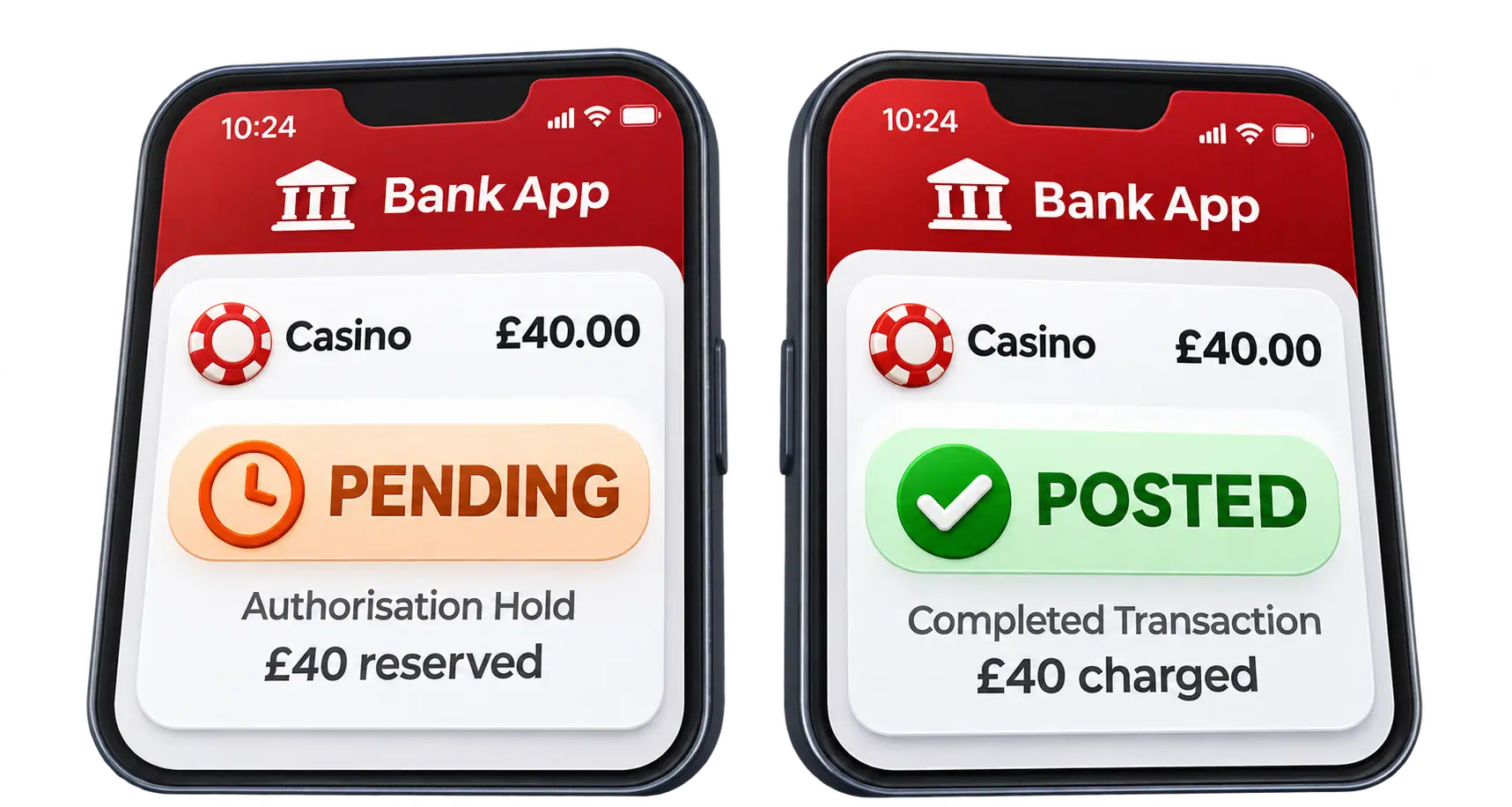
Pending authorisation: money may only be reserved
When you attempt a card payment, the merchant can request authorisation from the card issuer.
If the issuer approves the request, it may temporarily reserve the amount. This reservation can reduce your available bank balance or available credit before the merchant completes the transaction.
Your banking app might display the amount under labels such as Pending, Authorised, Reserved, or Processing.
Capital One explains that pending debit and credit card transactions can affect available funds without immediately becoming final posted charges.
Stripe also describes authorisation holds as temporary reservations that may disappear when the merchant does not complete the payment.
What this means: Seeing £40 leave your available balance does not independently prove that the casino received £40.
Posted charge: the transaction has progressed further
When a transaction moves to Posted or Completed, your card issuer has recorded a completed purchase rather than only an open authorisation.
At that point, the missing casino credit needs closer investigation.
However, a posted card transaction does not reveal every step inside the casino’s payment system. The operator may still need to reconcile the card payment with the player’s deposit attempt.
Ask whether the processor captured the payment and whether the casino’s ledger contains a matching credit, rejection, or adjustment.
Adyen’s payment lifecycle documentation separates authorisation, capture, settlement, cancellation, and refund events. These differences explain why an apparent successful payment can still require transaction-level investigation.
How long can a pending card authorisation last?
There is no single waiting period that applies to every card, issuer, casino, or country.
Capital One provides examples of pending card transactions that can remain open for several days. Other issuers, card networks, and merchant arrangements may use different timeframes.
A casino’s advertised instant-deposit processing time also does not necessarily describe how long a bank will retain a cancelled authorisation.
Instead of assuming a universal deadline, ask:
- Has the merchant completed or cancelled the authorisation?
- Does the card issuer still show an active hold?
- When does the issuer expect to release that particular authorisation?
- Has the pending transaction already changed into a posted charge?
For general explanations, consult Capital One’s debit card pending-transaction guidance and Stripe’s explanation of authorisation holds.
Why 3D Secure Approval Does Not Guarantee a Casino Deposit
Some card payments require an extra security step through 3D Secure.
For example, you might approve the payment in your banking app, complete a verification challenge, or confirm the transaction through your card issuer.
That approval helps authenticate the payment attempt. It does not necessarily establish that the merchant completed every subsequent payment step.
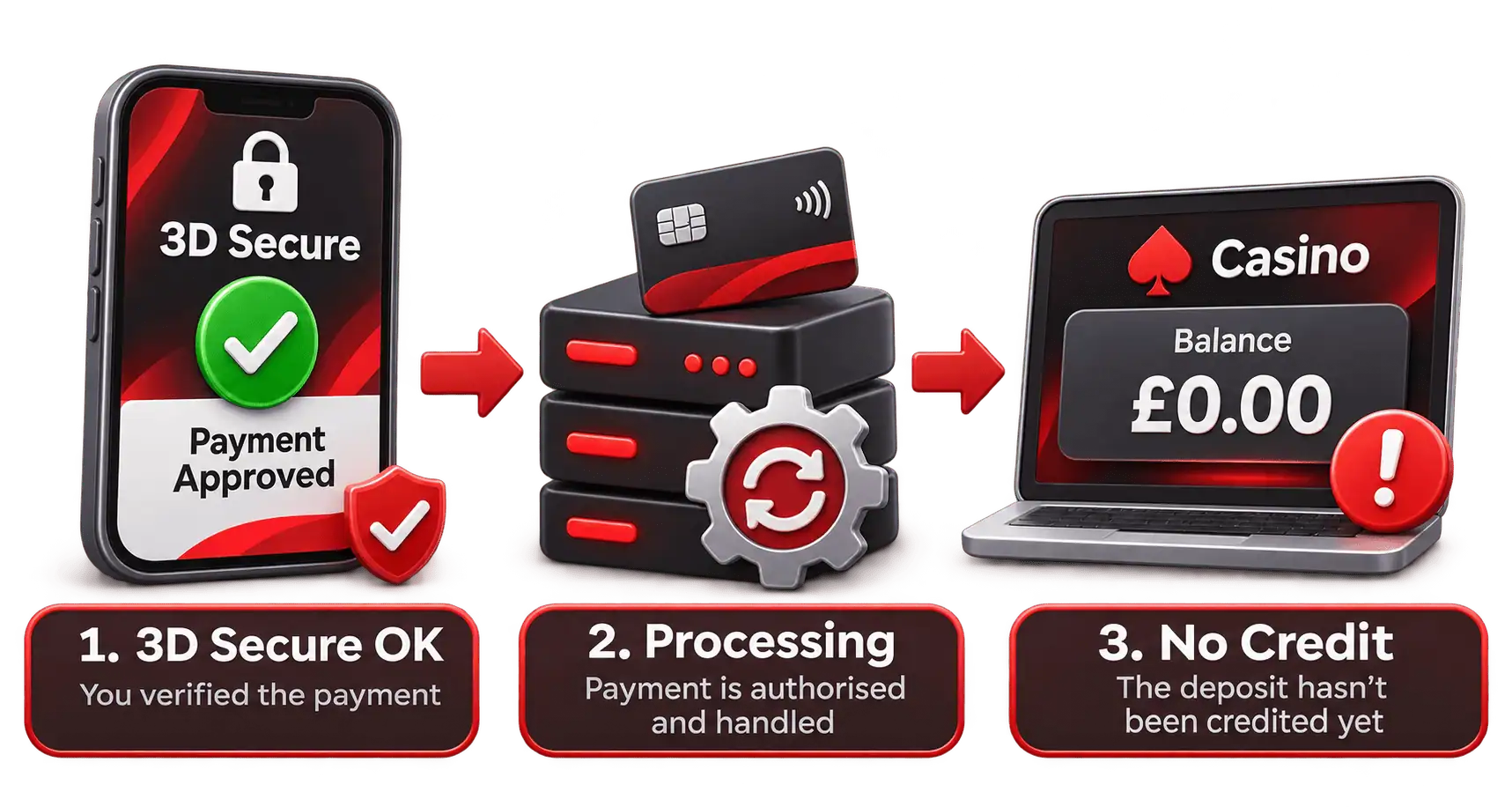
Authentication, authorisation, and capture are different
Payment systems can distinguish between:
- Authentication: The issuer checks whether the payment attempt meets its cardholder-verification requirements.
- Authorisation: The issuer approves or declines the transaction request.
- Capture: The merchant or payment processor initiates collection of the authorised payment.
- Casino credit: The casino associates the successful payment with the correct player account.
Not every payment integration requires separate manual capture. Some systems capture payments automatically. Nevertheless, the technical stages remain important when investigating a missing credit.
Adyen’s 3D Secure documentation distinguishes successful authentication from later payment results and associated processing events.
Therefore, “I approved the payment in my banking app” is useful evidence, but it does not prove that the casino credited the deposit.
What if the casino displayed an error after bank approval?
A failed redirect, connection interruption, technical timeout, or processing problem can create uncertainty about the final payment result.
For example, Holland Casino Online documents an operator-specific case where the checkout reports a declined deposit even though the card payment may have succeeded.
Separately, 888’s published support guidance describes failed card deposits that can leave a temporary hold visible to the cardholder.
These examples demonstrate two different possibilities. They do not establish which event occurred in your transaction, and their published procedures should not be treated as universal casino rules.
Rather than repeating the payment, check the casino cashier and ask support to verify the original transaction.
Check the Banking App and Casino Cashier Separately
Before contacting support, compare both sides of the same payment attempt.
Step 1: Review your bank transaction
Open the official banking app or card account and locate the relevant transaction.
Record the following information:
- Transaction date and approximate time.
- Exact amount and currency.
- Pending or posted status.
- Merchant name shown on the transaction.
- Last four card digits, if needed for identification.
- Any accessible bank transaction reference.
If your issuer displays only a pending notification, do not describe it to support as a confirmed final charge.
Also check whether the pending entry later disappears or changes into a posted transaction.
Step 2: Review your casino deposit history
Next, open the casino’s official cashier and transaction-history section.
Look for an attempted deposit matching the amount, date, and payment method.
The casino may display the transaction as Successful, Pending, Processing, Failed, Rejected, or another operator-specific status.
Record any deposit ID, payment reference, or error message. Some systems expose these references directly, while others require support to retrieve them.
Importantly, a failed casino deposit status and a pending bank authorisation can coexist. That combination does not necessarily mean the merchant collected the funds.
Step 3: Match the payment details
Compare the following items across the two accounts:
- Amount: Is the card transaction consistent with the attempted deposit?
- Currency: Did the payment involve a currency conversion?
- Timestamp: Could timezone differences explain a different transaction date?
- Merchant descriptor: Does the displayed merchant name correspond to the payment processor or operator?
- Deposit reference: Can support identify a matching transaction?
Visa’s merchant-name guidance explains why statement descriptors matter for identifying card transactions. However, a different descriptor should trigger verification rather than an automatic assumption of fraud.
Do not share complete card credentials to prove ownership. If support requests documentation, ask why it needs the information and use its secure, authenticated submission channel.
What if the card belongs to someone else?
A casino may apply payment-ownership rules that restrict third-party cards or require additional verification.
However, a payment-matching issue does not automatically explain a missing deposit. The operator still needs to identify whether the payment succeeded, failed, or requires reversal.
For a separate explanation of cardholder ownership and payment-method restrictions, read our guide to casino payment matching rules.
Two Examples: £40 Pending vs £40 Posted
The following examples illustrate how the same missing casino credit can require different investigations.
Both examples are fictional. CasinoIndex did not conduct a real-money card deposit or contact a payment provider for these scenarios.
Example A: £40 pending, no casino credit
On 10 November 2026, a hypothetical player attempts to deposit £40 using a debit card.
The banking app shows a pending £40 transaction. However, the casino cashier displays no matching deposit credit.
Illustrative Transaction A
Attempted deposit: £40
Bank status: Pending authorisation
Casino credit: £0
Deposit reference: Not visible
Next action: Confirm whether the operator received, captured, or cancelled the original payment request.
The pending amount may represent a temporary reservation rather than a completed charge.
If the payment fails and the merchant does not capture it, the issuer may release the hold. The available balance should then reflect that release, subject to the issuer’s processing.
The player should not expect a separate refund transaction when the system simply removes an uncaptured authorisation.
Example B: £40 posted, no casino credit
In a second hypothetical case, the bank shows a completed £40 card transaction from 10 November 2026.
The casino account still displays no corresponding deposit credit.
Illustrative Transaction B
Attempted deposit: £40
Bank status: Posted charge
Casino credit: £0
Casino reference: DEPOSIT-EXAMPLE-001
Next action: Ask the casino to trace the payment through its processor and reconcile the payment result with the player ledger.
Here, the player has stronger evidence of a completed card transaction, but the records still do not explain why the casino failed to credit the account.
The casino should investigate the payment and establish whether it credited, rejected, reversed, or refunded the amount.
If support cannot resolve the discrepancy, the player can ask the issuer about the appropriate dispute process without assuming that every missing deposit qualifies for an immediate chargeback.
Why the distinction matters
Both players see £40 associated with the card and no casino credit. Nevertheless, they may face different payment situations.
In Example A, the key issue is whether an active authorisation will become a charge or expire.
In Example B, the central question is how the operator accounted for a posted transaction.
That is why CasinoIndex recommends checking the bank status before choosing the escalation route.
What Payment Evidence Should You Collect?
Gather enough information to identify the original payment without exposing unnecessary personal or financial data.
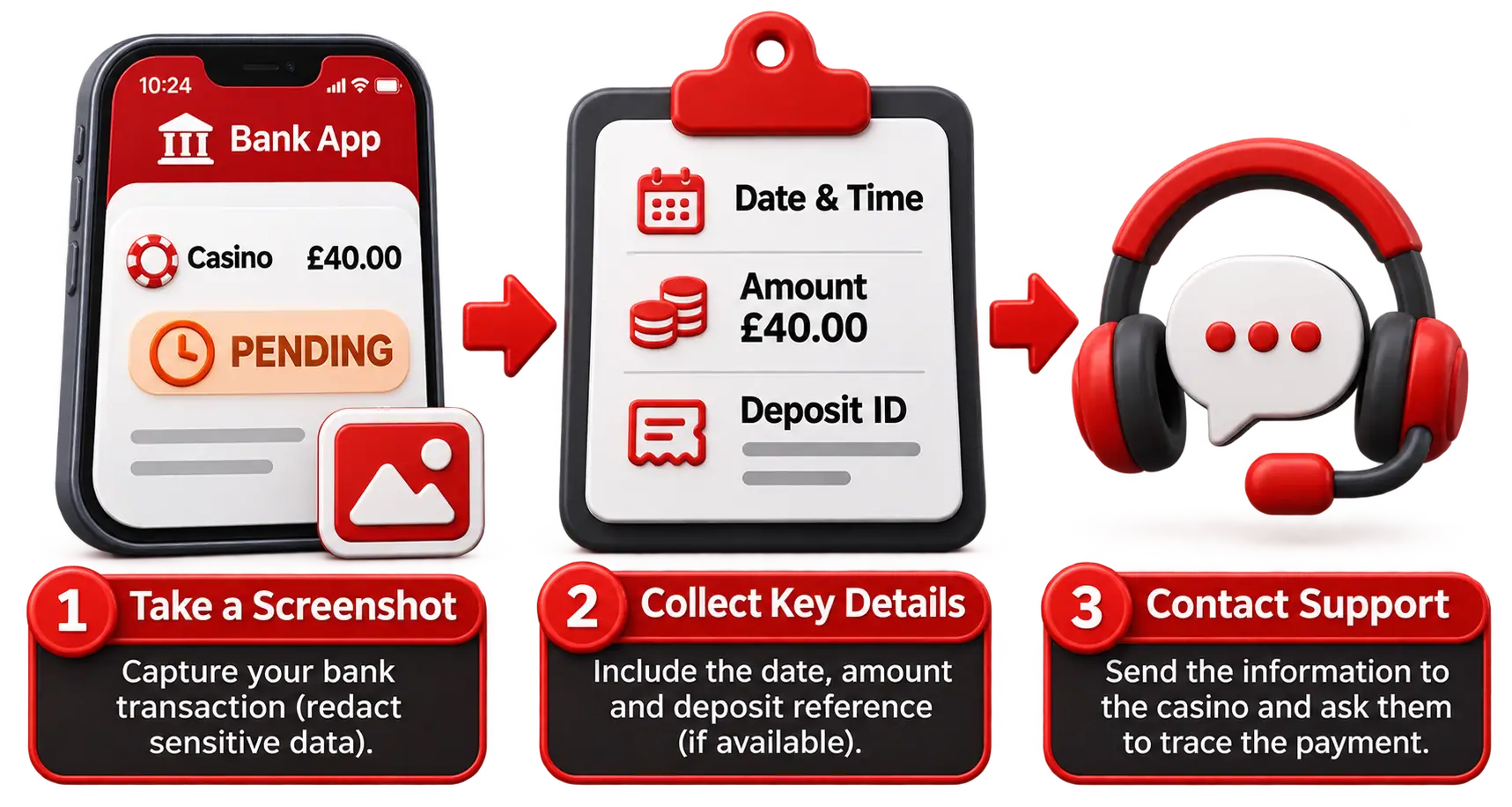
CasinoIndex Missing Card Deposit Checklist
- Date and time of the attempted deposit, including timezone.
- Exact amount and currency.
- Card type and last four digits only, if needed.
- Current bank status: Pending, Posted, Reversed, or another displayed label.
- Merchant name shown in the banking app.
- Casino deposit ID, if available.
- Relevant payment-processor reference, if support provides one.
- Screenshot of the cashier transaction history.
- Screenshot of the card transaction with unrelated details hidden.
- Any error message and existing support ticket number.
Never share: Full card number, PIN, CVV/CVC, banking password, or one-time authentication code. Submit sensitive evidence only through an authenticated support channel and disclose the minimum necessary information.
Which payment reference should you request?
Different payment systems use different identifiers. The most useful reference depends on the payment stage.
| Reference | Purpose | Who may provide it | Important limitation |
|---|---|---|---|
| Casino Deposit ID | Identifies the attempted deposit in the operator’s cashier. | Casino account or support. | May not exist in the visible history after certain failed attempts. |
| Processor / PSP Reference | Helps the operator identify the payment in its processing system. | Casino or payment processor. | The casino may need to retrieve it internally. |
| Bank Transaction Reference | Helps the issuer identify a pending or posted card entry. | Bank or card issuer. | May not match the casino’s internal deposit ID. |
| ARN, if available | Can help trace certain card refunds. | Merchant, acquirer, or payment processor. | Not a universal identifier for pending authorisations or failed deposits. |
Adyen documents separate payment and refund references in its payment-management system. Its documentation also explains how an Acquirer Reference Number can help track a refund where the relevant transaction provides one.
Do not automatically request an ARN for a pending authorisation. First establish whether the casino captured the original payment and whether a refund actually exists.
Who Should You Contact First: Casino or Bank?
The correct contact depends on whether you recognise the transaction and what your bank currently shows.
For an authorised payment missing from the casino balance
Start with the casino’s official payment-support channel.
Provide the original deposit details and ask support to identify the transaction in its cashier and payment-processor records.
Request confirmation of the payment status and whether the casino intends to credit, reverse, or refund the amount.
If the casino claims the transaction failed but your issuer shows a posted charge, ask for a trace or reconciliation rather than accepting an unsupported explanation.
For a pending authorisation
Ask the casino whether it captured or cancelled the payment attempt. You can also contact the card issuer to establish how it currently classifies the transaction.
The issuer may explain whether the amount remains reserved and what information it needs to investigate the authorisation.
Do not assume that either organisation can instantly remove every pending transaction. Card-network and issuer procedures can affect the release process.
For an unknown or unauthorised card transaction
Contact the card issuer immediately.
Do not wait for ordinary casino support to finish a deposit investigation if you suspect someone used your card without permission.
Use the official banking app or the contact number provided by your issuer. Ask about securing the card, checking recent activity, and reporting an unauthorised transaction.
Some unfamiliar merchant descriptors can have legitimate explanations. However, uncertainty about a merchant name should never delay an urgent fraud report when you do not recognise or authorise the payment.
For broader advice about protecting casino accounts, payment details, and authentication methods, consult our casino security guide.
Copyable Support Message for a Missing Casino Card Deposit
Use the following message when you authorised the original card transaction but cannot find the deposit in your casino account.
Already contacted support? Reply in the existing ticket using the same transaction details. Open a new case only if support instructs you to do so or the original channel is unavailable.
Subject: Card Deposit Charged but Not Credited – Payment Status Request
Hello Support Team,
I attempted a card deposit, but the amount has not appeared in my casino account. My bank currently shows the transaction as described below.
Date and time: [Date, time, timezone]
Amount and currency: [Amount]
Card type: [Debit or credit card]
Bank transaction status: [Pending or Posted]
Casino deposit ID: [Reference, if available]
Last four card digits: [Only if required]
Displayed error: [Error message, if any]
Please confirm whether your payment processor authorised, captured, cancelled, or refunded this transaction and whether your cashier recorded a matching deposit.
If the payment was captured, please investigate why my account has not received the credit.
If you cancelled or refunded the payment, please provide the relevant transaction reference and current status.
I can provide appropriately redacted screenshots through your secure support channel.
Thank you.
A clear reference-based request gives support a specific transaction to investigate.
Record each support response and keep the ticket reference with your bank and casino evidence.
Hold Released, Payment Refunded or Casino Deposit Credited?
When the operator reports that it has resolved the issue, verify what actually happened.
Three outcomes deserve separate treatment.
1. The issuer released a pending hold
If the merchant never captured the payment, the pending authorisation may expire or disappear after the issuer releases it.
In that situation, your available balance or credit should reflect the released reservation.
You may not see a separate refund entry because the card issuer never recorded a completed purchase.
2. The merchant refunded a posted transaction
If the payment was already captured, the operator may need to process a refund rather than simply release an authorisation.
The refund can appear as a separate credit or another issuer-specific adjustment.
Ask for the refund status and reference. Where the relevant processor supports it, an ARN may help the issuer locate the returning funds.
Do not treat a merchant’s statement that it requested a refund as proof that the issuer has already credited your account.
3. The casino credited the player account
If the operator resolves the discrepancy by crediting the deposit, check the cashier transaction history and current player balance.
Confirm the amount, currency, and corresponding deposit reference.
Do not assume that a support ticket marked Resolved proves the financial reconciliation is complete.
Keep the ticket open or request clarification if the announced outcome does not match your bank and casino records.
When Should You Dispute a Card Transaction?
A card dispute can help in certain circumstances, but it is not the first step for every missing casino deposit.
The distinction between an authorised payment problem and suspected unauthorised activity is essential.
Authorised deposit, but the casino never credited it
If you made the payment yourself and the issuer shows a posted transaction, first ask the casino to investigate and reconcile it.
Document the original deposit, transaction status, support responses, and any promised refund.
If the operator cannot resolve the problem, contact your card issuer and ask whether the circumstances qualify for a card dispute under the applicable card-scheme rules.
The Financial Ombudsman Service explains that chargeback can provide a way to challenge eligible debit or credit card transactions. However, the issuer must consider the evidence and applicable scheme requirements.
A chargeback is not guaranteed, and the relevant time limits vary. Contact your issuer promptly rather than relying on a universal deadline.
See the Financial Ombudsman Service’s chargeback guidance for the general UK framework.
Unauthorised card transaction
If you did not authorise the payment, treat it as a potential card-security incident rather than an ordinary missing-deposit case.
Contact the issuer immediately and follow its fraud-reporting instructions.
The issuer may need to secure the card, investigate the transaction, and explain any applicable protections or dispute procedures.
Chargeback is not a way to reverse gambling losses
A missing card deposit differs from a completed deposit that the player later used for gambling.
Do not describe a legitimate, authorised gaming transaction as unauthorised merely because the outcome of gameplay was unfavourable.
Likewise, do not assume that a payment dispute automatically cancels casino terms, account reviews, or other applicable processes.
When the operator and card issuer disagree about a genuinely unresolved deposit, retain both sets of records and seek the appropriate dispute-resolution route.
For broader casino-side complaints, see our guide explaining how online casino dispute resolution works.
Card Deposit Restrictions in Great Britain and Other Markets
Card payment rules differ by jurisdiction, card type, and licensed operator.
A card that works for an ordinary online purchase may not be eligible for gambling transactions.
Great Britain: credit cards are prohibited for gambling payments
The UK Gambling Commission introduced its gambling credit-card ban on 14 April 2020.
Under the relevant British licensing rules, operators cannot accept credit-card payments for online casino gambling. The restriction also addresses credit-card-funded payments through certain intermediary services.
The prohibition does not generally extend to debit cards, although banks and operators can apply additional restrictions.
The UKGC’s licence condition 6.1.2 and its official guidance explain the regulatory framework. The Commission’s published information also identifies a limited exception for certain non-remote lottery payments.
Practical consequence: If you are investigating a purported credit-card deposit at a UKGC-licensed online casino serving Great Britain, verify the payment method and merchant identity carefully. Do not assume that the transaction followed a permitted direct credit-card deposit route.
United States and other jurisdictions
Card eligibility can vary by US state, licensed gambling operator, card issuer, and payment method.
For example, Hollywood Casino’s US support documentation distinguishes debit-card deposits from credit-card deposits and notes state-dependent limits on credit-card use.
Other jurisdictions may impose additional rules on gambling transactions, account verification, deposit limits, and payment ownership.
Check the operator’s published terms for the player’s market. Our casino terms guide explains how payment conditions fit into the wider set of rules players should understand.
Primary Sources and Evidence Limitations
CasinoIndex based this guide on official card-issuer guidance, payment-processor documentation, regulatory material, and published casino support procedures.
The following evidence summary separates general payment mechanics from operator-specific examples.
| Market | Source | Checked on | Scope | Limitations |
|---|---|---|---|---|
| US issuer guidance | Capital One – Pending Credit Card Transactions | 10 Nov 2026 | Pending authorisations, posted transactions, and reporting problems. | Issuer-specific procedures and timing; not a universal casino deposit policy. |
| US issuer guidance | Capital One – Pending Debit Card Transactions | 10 Nov 2026 | Available balance, pending card transactions, and final posting. | Does not independently establish the casino’s payment-processor status. |
| General card processing | Stripe – Authorisation Holds Explained | 10 Nov 2026 | Card authorisation, temporary reservations, capture, and release. | General industry explanation; actual hold timing depends on the relevant systems. |
| Processor documentation | Adyen – Payments Lifecycle | 10 Nov 2026 | Payment states, settlement, cancellation, and refund processing. | Adyen terminology does not establish which processor a particular casino uses. |
| Great Britain | UK Gambling Commission – Licence Condition 6.1.2 and Preventing Credit Card Use | 10 Nov 2026 | Credit-card restrictions for relevant British gambling licensees. | Not a universal restriction applying to every gambling market. |
| Great Britain | Financial Ombudsman Service – Chargeback and Section 75 Guidance | 10 Nov 2026 | Card disputes, evidence requirements, and general consumer complaint handling. | Eligibility, remedies, and time limits depend on the applicable circumstances. |
Official casino support examples
Several published operator procedures support the distinction between a failed deposit, a pending authorisation, and a completed payment without a corresponding casino credit.
Holland Casino Online (Netherlands): Its support article, “Why have I been charged for a declined debit or credit card deposit?”, updated 30 May 2025, describes a situation where the card payment may succeed despite an error message. The operator also describes a specific refund process when the payment does not reach the player account.
Hollywood Casino (United States): Its published Debit Card Deposits guidance explains that a failed card deposit can leave a temporary pending authorisation. It gives a two-to-three-business-day example for its described payment arrangement.
888: Its support article, “Why has my failed card deposit still been charged?”, describes how a failed deposit may temporarily appear as a card hold rather than a final charge.
These examples come from publicly available operator help content. They do not prove how unrelated casinos handle failed transactions, and their specific timelines are not universal guarantees.
CasinoIndex names these sources for transparency without providing outbound promotional links to casino operators.
Research methodology and what this guide cannot prove
CasinoIndex compared official banking and payment-processing explanations with published operator support procedures to identify recurring transaction states.
The four-case diagnostic model and both £40 scenarios are illustrative editorial tools. They do not represent real customer transactions or independent CasinoIndex payment tests.
We did not conduct a real-money deposit, contact a bank or casino support team, or verify an individual player’s payment history for this article.
Payment-status names, hold durations, card eligibility, refund procedures, and complaint routes can change by provider, bank, operator, and jurisdiction.
Research checked: 10 November 2026. Readers should verify current policies and individual transaction statuses directly with the relevant financial institution or licensed operator.
Frequently Asked Questions
Why does my bank show a casino charge but the casino balance is zero?
The bank may show a pending authorisation rather than a completed payment. Alternatively, the issuer may have posted the charge while the casino has not matched or credited the transaction. Check both histories and ask support to identify the payment-processor status.
Can a pending casino card hold disappear by itself?
Yes. If the merchant does not complete the payment, the issuer may release an uncaptured authorisation. The entry can disappear without a separate refund because the original reservation never became a final charge. The timing depends on the relevant bank and payment arrangements.
What if the casino deposit failed but my bank still shows the money as taken?
First, confirm whether the bank labels the transaction Pending or Posted. A pending hold may later expire. A posted charge requires closer reconciliation with the casino and payment processor. Avoid repeating the deposit until you understand the original attempt.
Does successful 3D Secure verification mean the casino received my payment?
No. The verification step authenticates the payment attempt. The merchant’s payment system may still need to authorise, capture, and correctly associate the transaction with your casino account.
Should I try the casino deposit again?
Not merely to diagnose the problem. A second attempt can create another authorisation or separate charge. First establish whether the original payment succeeded, failed, or remains unresolved.
How long does a missing casino card deposit take to resolve?
There is no universal timeframe. A pending authorisation, a posted charge, and an initiated refund can each follow different processes. Ask the operator and card issuer for the status and timeframe relevant to your specific transaction.
What information should I send casino support?
Provide the deposit date, time, amount, currency, bank status, casino deposit ID if available, and appropriately redacted screenshots. Never send your full card number, PIN, CVV/CVC, banking password, or one-time security code.
What is an ARN for a casino deposit refund?
An Acquirer Reference Number can help trace certain card transactions, including applicable refunds. It is not always available and should not be treated as the standard reference for every failed deposit or pending authorisation.
Who should I contact if the casino card charge was unauthorised?
Contact your card issuer immediately through its official channel. Report the unfamiliar or unauthorised transaction and follow the issuer’s security instructions. Do not wait for a routine casino deposit investigation if you suspect fraud.
Can I request a chargeback if a casino never credited my deposit?
Possibly, depending on the transaction, evidence, jurisdiction, and card-scheme rules. First try to reconcile an authorised payment with the operator. If the issue remains unresolved, ask the issuer about the relevant dispute procedure and deadlines. A chargeback is not guaranteed.
Are credit-card casino deposits allowed in Great Britain?
UKGC-licensed gambling operators cannot accept credit-card payments for online casino gambling in Great Britain under the relevant ban introduced on 14 April 2020. Debit cards are different, although banks and operators may impose additional restrictions.
Final Checklist: Confirm the Payment Before Taking Further Action
If your casino card deposit was charged but not credited, do not assume that the money has permanently disappeared.
Start with the bank status. Establish whether the transaction is pending or posted, then compare it with the casino’s payment history.
When the records do not match, ask the operator to identify the processor reference and explain whether it captured, cancelled, refunded, or credited the payment.
Keep the evidence, follow the correct escalation route, and report genuinely unauthorised activity to your card issuer immediately.
The essential distinction is simple: a card authorisation, a completed payment, and a casino account credit are not the same event.
Editorial note: CasinoIndex is an independent information and research website, not a casino operator, bank, or payment processor. We cannot access private card records, release authorisation holds, issue refunds, or determine the final status of an individual payment. Research checked: 10 November 2026.

Talha Aydin has been active in cryptocurrency since 2017 and is a co-founder of Freecoins24 and CryptoMutant. Over the years, he has worked with crypto projects on community growth, giveaways, user acquisition and digital strategy while gaining hands-on experience across blockchain platforms and crypto markets. At CasinoIndex, Talha focuses on crypto casinos, withdrawals, payment systems, platform trust and the risks players face when moving funds between wallets and gambling platforms.