Crypto Casino Deposit From an Exchange Wallet: Rules & Risks
Article OverviewYou may be able to send crypto directly from an exchange to a casino, but both platforms must permit the transfer. Check exchange policies, account ownership, jurisdiction and the exact blockchain before sending.
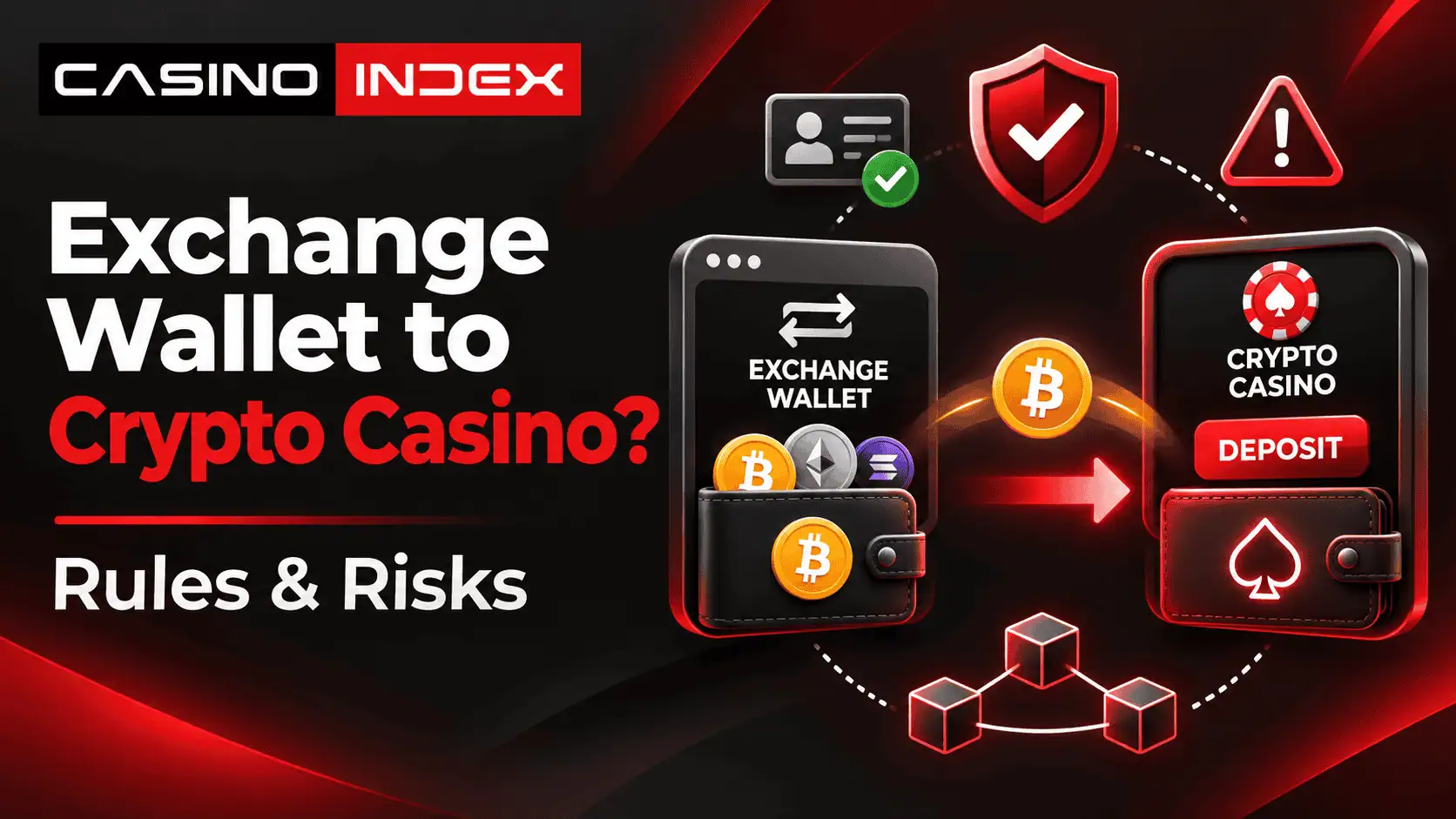
Quick answer: You may be able to deposit crypto directly from a centralized exchange to an online casino, but technical compatibility does not mean the transfer is permitted. Before sending, check the exchange’s gambling and withdrawal policies, your account’s jurisdiction, the casino’s payment-ownership requirements, and the exact cryptocurrency network. If either platform cannot confirm the route, do not guess or send funds.
CasinoIndex Expert Take
A direct exchange-to-casino transfer must pass four separate checks: Exchange Policy → Account & Jurisdiction → Casino Cashier & Ownership → Exact Asset & Network. Passing the blockchain check does not establish that the exchange permits the destination or that the casino accepts the source of funds.
Centralized exchanges may also request beneficiary information, review destination addresses or delay withdrawals for compliance checks. Meanwhile, casinos can require deposits to originate from funds and payment methods belonging to the registered player.
Do not: Mislabel a casino address as your personal wallet, provide false beneficiary details, use another person’s account or move funds through an intermediate wallet to evade restrictions. If the transfer is not permitted, do not attempt it.
Scope: This guide examines transfers sent directly from a custodial cryptocurrency exchange to a casino’s deposit address. It does not teach general crypto purchasing, recommend gambling platforms or provide methods for bypassing exchange controls. For ordinary wallet-to-casino transaction mechanics, see our guide to depositing cryptocurrency at online casinos.
Can You Deposit to a Crypto Casino Directly From an Exchange?
Sometimes. A centralized exchange can technically broadcast a blockchain withdrawal to an external address. However, the exchange may prohibit the intended use, require information about the recipient or restrict transfers to certain destination types.
Separately, the casino must accept the source of funds and support the exact cryptocurrency and network. Even when both platforms support USDT, they may impose different rules on payment ownership, beneficiary identity and transfer processing.
The four checks before sending
| Control point | What to verify | If unclear or restricted | Who can confirm? |
|---|---|---|---|
| 1. Exchange policy | Whether the intended gambling-related destination is allowed under your exchange’s applicable terms | Do not initiate the transfer | Exchange support |
| 2. Account & jurisdiction | Your applicable exchange entity, location, gambling eligibility and beneficiary-information requirements | Resolve the restriction before proceeding; never misclassify the destination | Exchange; casino for its own market eligibility |
| 3. Casino cashier & ownership | Whether the casino accepts deposits initiated from a custodial exchange account registered to you | Ask the casino to interpret its payment-ownership clause | Casino support |
| 4. Asset & network | Exact coin, blockchain, receiving address, memo/tag, deposit minimum and withdrawal fee | Do not broadcast the transaction | Exchange for sending options; casino for receiving requirements |
Important: This is a pre-transfer decision framework, not proof that any particular exchange-casino combination works. CasinoIndex has not performed real-money transfers between the providers discussed in this guide.
Technical support does not equal permission
Imagine an exchange offers USDT withdrawals on TRON and a casino accepts USDT on TRON. Their blockchain options appear compatible.
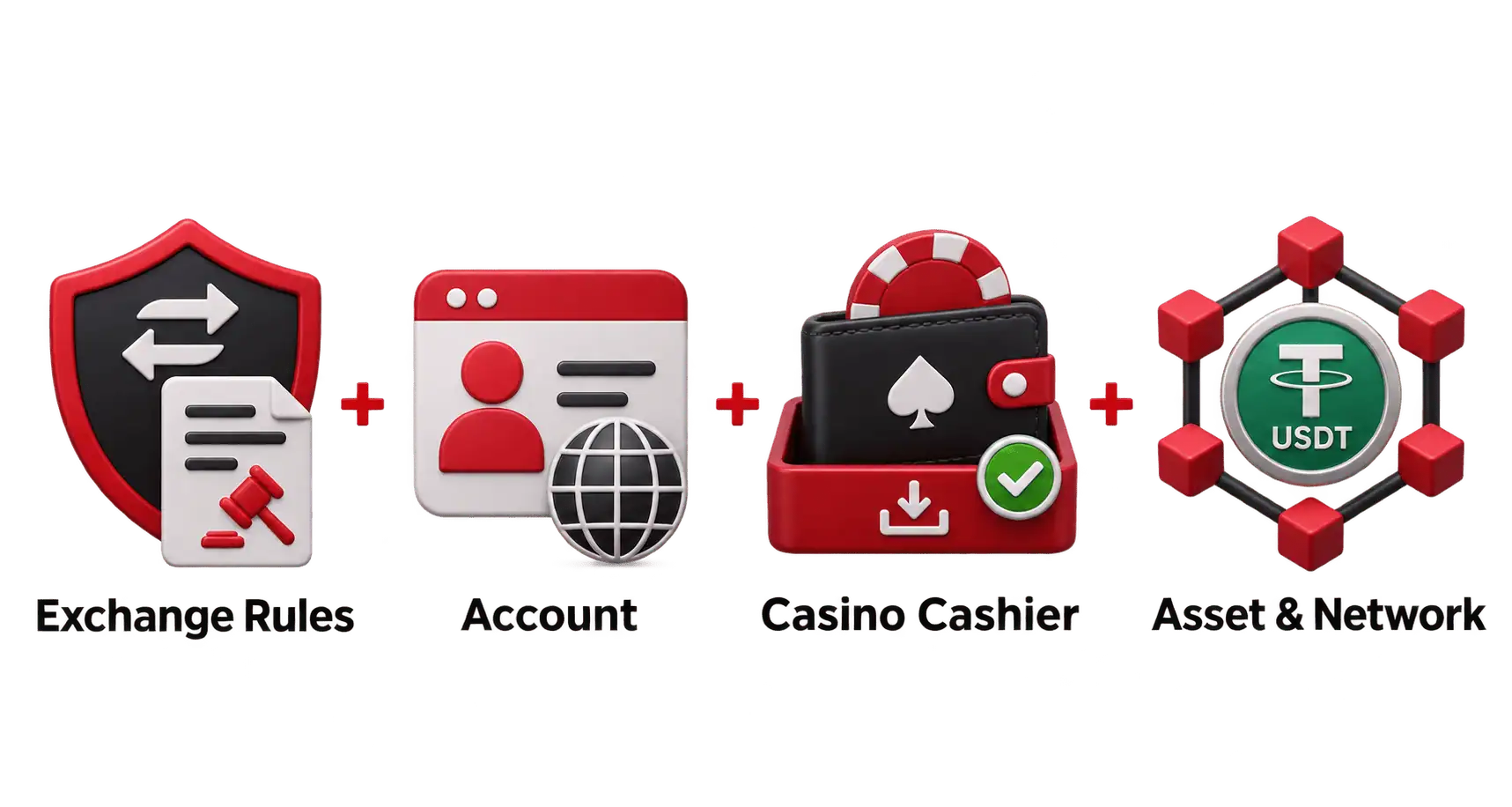
Nevertheless, the exchange could restrict the destination under its acceptable-use rules. Alternatively, the casino might require the player to control the source wallet or provide evidence that the deposited funds belong to the account holder.
Therefore, matching the coin and network answers only the technical part of the question. It does not settle the contractual or regulatory checks.
Exchange Wallet vs Self-Custody: Who Controls the Funds?
A centralized exchange account and a personal cryptocurrency wallet are not the same type of payment source.
Custodial exchange accounts
With a custodial exchange, the provider controls the private keys and the infrastructure used to send cryptocurrency. You typically request a withdrawal through your authenticated exchange account.
The exchange may process the withdrawal from a shared hot wallet or as part of a larger transaction batch. Consequently, the blockchain sender address may belong to the exchange rather than to an address individually assigned to you.
This distinction matters when a casino investigates where a deposit originated. The visible blockchain sender alone does not necessarily identify the customer who instructed the exchange to make the payment.
Self-custody wallets
In a self-custody wallet, the user controls the private keys or recovery credentials. This usually provides more direct control over transaction signing and supported networks, although it also places greater responsibility on the wallet holder.
However, self-custody does not make a prohibited gambling transaction lawful or exempt it from exchange and casino terms. Moving crypto to another wallet solely to conceal a restricted destination can itself violate applicable rules.
Our crypto wallet guide explains custodial and personal-wallet security, ownership and transaction risks in greater detail.
Is an exchange hot-wallet address a third-party payment?
Not automatically. A blockchain explorer may show an exchange-controlled address because the exchange broadcasts the payment on the customer’s behalf.
However, the casino still needs to determine whether the customer owns the funds and whether its rules permit that funding arrangement. Some casino terms refer to wallets under the player’s control, while others also require payment instruments to belong to the registered account holder.
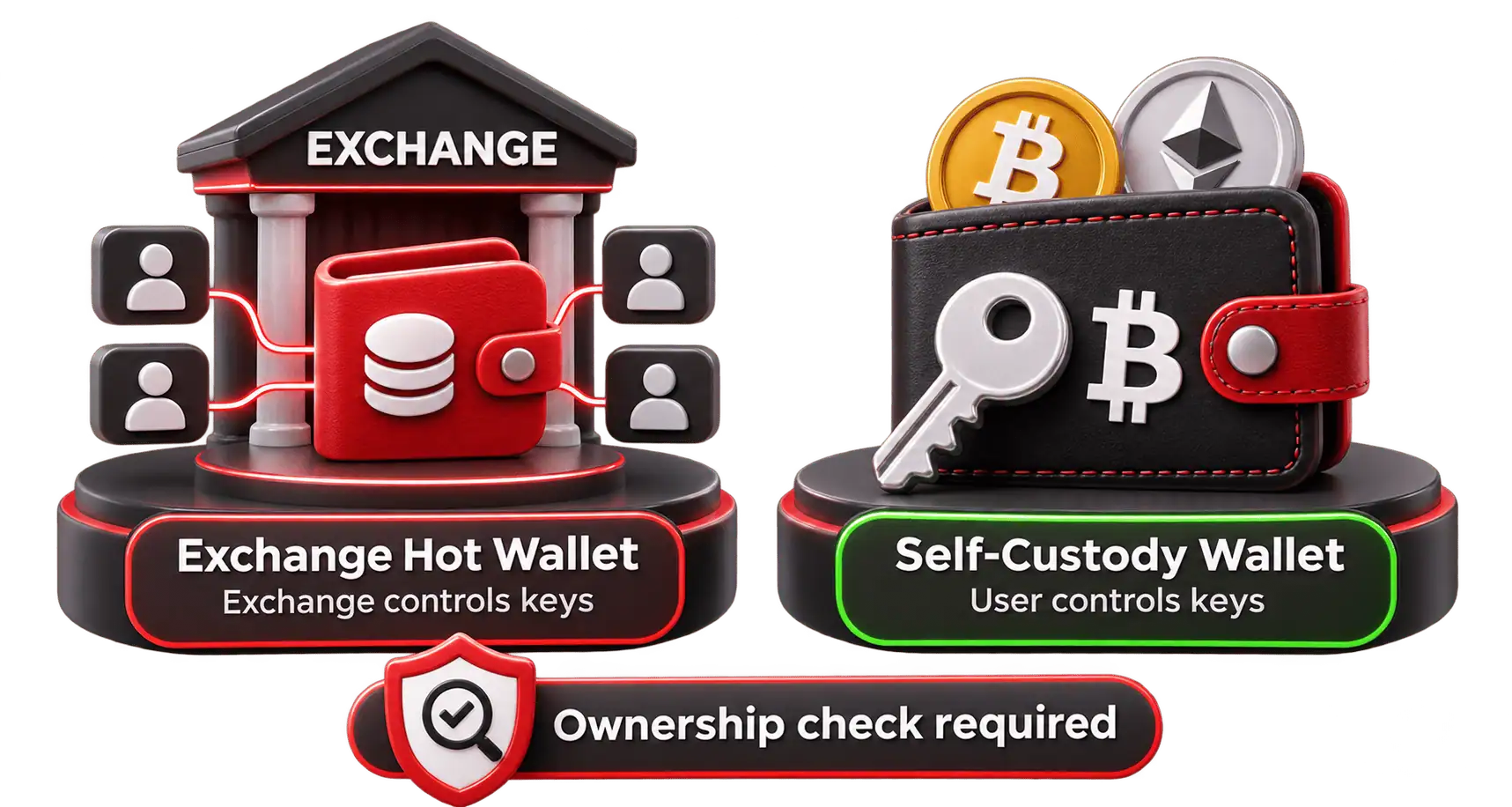
Therefore, neither conclusion is safe without evidence: an exchange sender address does not automatically prove a forbidden third-party deposit, and an exchange account registered in your name does not automatically prove that the casino accepts the transfer.
Check the Exchange’s Gambling and Withdrawal Policies First
Cryptocurrency exchanges do not apply one universal gambling policy. Their restrictions depend on the provider, applicable legal entity, account jurisdiction and sometimes the particular service involved.
Coinbase: unlawful gambling is prohibited
Coinbase’s published Prohibited & Conditional Use Policy includes a category called Unlawful Gambling. It covers specified gambling-related activities that lack the required governmental or regulatory authorization.
That wording should not be rewritten as a universal statement that Coinbase prohibits every transaction connected to every legally authorized gambling operator.
However, an authorized casino licence does not automatically establish Coinbase approval. The activity, customer location, applicable Coinbase agreement and destination restrictions still matter.
Coinbase’s published prohibited-use page carries an effective date of 31 January 2022. CasinoIndex checked the accessible policy on 12 November 2026. The original effective date must not be presented as a new 2026 policy announcement.
Kraken: account-specific and regional transfer controls
Kraken publishes regional terms and compliance procedures. Its global terms were updated on 6 November 2026 and distinguish their scope from separate agreements for customers in the European Economic Area, Canada and Brazil.
More importantly for direct transfers, Kraken’s EU/UK guidance explains that crypto withdrawals may require identification of the receiving virtual asset service provider or verification of ownership for certain wallet transfers.
Kraken also describes its EU/UK transfer procedures as supporting first-party transactions. That creates an important question when the intended destination is a casino-controlled deposit address rather than another wallet owned by the exchange customer.
See Kraken’s official EU/UK crypto transfer guidance. The guidance was updated on 3 November 2026. It does not establish that Kraken accepts a particular casino as a destination.
What about Binance and other exchanges?
Other exchanges also apply entity-specific terms, transaction screening and Travel Rule requirements. A restriction documented for one Binance jurisdiction, for example, should not be attributed to every Binance customer worldwide.
Likewise, the ability to add an external address to an exchange’s withdrawal form does not mean the provider has approved its use for gambling.
The correct question for exchange support is whether the specific destination and intended use are permitted under the terms applying to your account. A generic statement that external crypto withdrawals are available is not enough.
Does Bitunix permit direct casino deposits?
Bitunix publishes instructions for withdrawing cryptocurrency to external blockchain addresses and emphasizes matching the sending and receiving networks.
However, its general withdrawal documentation does not establish that transfers directly to gambling platforms are permitted for every account or jurisdiction. Bitunix also publishes account-eligibility and compliance restrictions.
Therefore, CasinoIndex does not classify Bitunix as a casino-approved exchange or recommend it as a way around restrictions imposed by another provider.
Travel Rule Checks: Why an Exchange May Block the Destination
A transfer can fail before reaching the blockchain even when the exchange supports the selected asset and network.
What information can an exchange request?
The Travel Rule is an anti-money-laundering framework that requires regulated crypto service providers to collect and, in relevant circumstances, share information about transaction counterparties.
Depending on the jurisdiction and transfer, an exchange may ask for the recipient’s identity, destination platform, account ownership or wallet classification. Some transfers also require additional verification.
Coinbase explains these requirements in its official Travel Rule guidance.
VASP or self-hosted wallet: why the distinction matters
A VASP is a virtual asset service provider, such as a regulated cryptocurrency exchange or certain custodial crypto businesses. A self-hosted wallet is a wallet controlled directly by its user.
Coinbase’s specific European documentation for Coinbase Exchange customers of Coinbase Europe and Coinbase Germany requires destination addresses to be classified as exchange/VASP addresses or self-hosted wallets.
Under that documented workflow, VASP withdrawals must use approved providers, while self-hosted-wallet withdrawals require ownership verification. An address that does not meet the applicable requirements may be unavailable for withdrawal.
These Coinbase Exchange rules must not automatically be generalized to every retail Coinbase product. The relevant source is Coinbase’s Europe Travel Rule Regulations for Coinbase Exchange.
Never mislabel a casino’s receiving address
A casino deposit address is not automatically your self-hosted wallet just because you can copy it from the cashier.
If an exchange asks whether you own and control the destination wallet, answer accurately. Do not declare that you control a casino-operated address, invent a beneficiary or select an unrelated VASP to pass the transfer form.
If the exchange does not offer a truthful classification for the intended destination, stop and contact support. A rejected classification is not an invitation to try another label.
Does the Casino Accept Deposits From Your Exchange Account?
Even after the exchange approves a withdrawal, the receiving casino may apply separate payment-ownership and account-verification requirements.
Stake.com: own funds and wallets under your control
Stake.com’s published Terms of Service state that deposits may come from crypto wallets under the player’s control or other available payment methods. They also require deposits to use the player’s own funds and payment methods.
Its deposit instructions require account and email verification before depositing and direct players to select the cryptocurrency in the Stake wallet.
However, those public rules do not conclusively establish whether every transfer initiated from a verified personal exchange account, but broadcast from a shared exchange hot wallet, satisfies Stake’s interpretation of wallet control.
That is a question for Stake support before the transaction. The relevant account must also be legally eligible to use Stake.com in its own jurisdiction.
Shuffle: account ownership and supported payment sources
Shuffle’s published Terms of Service state that deposited funds must belong to the player and that payment methods must be held in the player’s own name.
Clause 9.3 discusses cryptocurrency deposits from wallets under the player’s control. Clause 9.5 addresses deposits using third-party payment methods and the potential consequences of violating those requirements.
These provisions support a strict ownership check. Nevertheless, they do not independently prove that every customer-owned exchange account qualifies as an accepted source.
Shuffle also states that supported payment methods, currencies and minimum deposit amounts appear in its cashier and may vary by country.
Why payment ownership can affect later withdrawals
A casino may identify a mismatch during a deposit review or only after the player requests a withdrawal. In that case, the source of funds and account ownership can become relevant even if the blockchain transaction originally cleared.
For a closer explanation, read how casinos match payment sources, account holders and withdrawals.
Also, a casino may require withdrawals to return through particular payment methods or apply separate verification. An exchange-to-casino deposit should never be interpreted as a guarantee that winnings can later return to the same exchange account.
Match the Exact Asset, Blockchain and Deposit Address
Once both providers permit the transfer, the technical details still need to match. Cryptocurrency symbols alone do not identify the correct blockchain route.
USDT on Ethereum is not USDT on TRON
For example, USDT can exist on several blockchain networks. An exchange withdrawal labeled USDT ERC-20 does not use the same route as a USDT TRC-20 withdrawal.
Stake’s published network guide lists USDT support on Ethereum ERC-20, BSC BEP-20, Polygon, TRON TRC-20 and Solana. Shuffle’s published asset guide also lists several USDT networks, including ERC-20, BEP-20, TRC-20, Polygon and Solana.
However, those lists represent the casino side only. They do not establish that a particular exchange permits withdrawals to either casino on the same network.
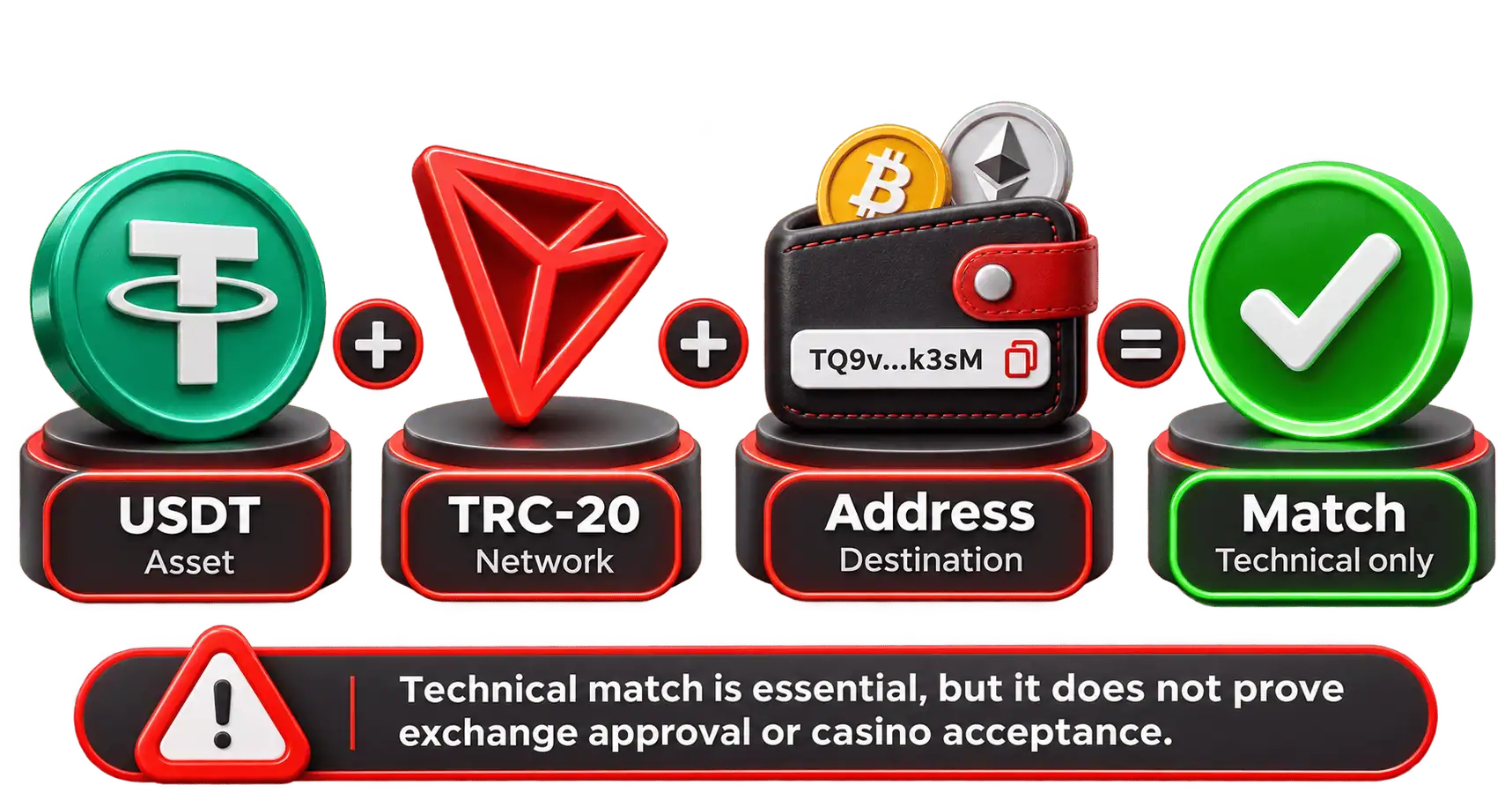
Furthermore, supported-asset lists may change. The exact deposit instructions shown in the player’s current cashier take precedence over an old screenshot or an unrelated account’s instructions.
Deposit address, memo and destination tag
Some cryptocurrency transfers require more than a receiving address. Assets such as XRP may also use a destination tag, while other networks or receiving services may require a memo.
If the casino cashier provides a memo or tag, confirm that the exchange’s withdrawal form supports the required field. Missing or incorrect information may prevent the casino from identifying the deposit.
Do not invent a memo, reuse an old address or assume that an address for one blockchain will work on another. If the cashier instructions and exchange form do not match, stop.
Withdrawal fees, deposit minimums and credited amounts
An exchange may charge an outgoing withdrawal fee. Meanwhile, the casino may require a minimum amount to arrive at its receiving address.
Therefore, compare the amount that will actually reach the destination with the casino’s applicable minimum, rather than relying only on the amount shown in the exchange balance.
For an illustrative calculation, suppose an exchange quotes a withdrawal of 25 USDT with a 1 USDT fee deducted from that amount. The destination would receive 24 USDT before any other applicable adjustment. This is hypothetical, not a verified fee or minimum at Stake, Shuffle or any exchange.
A successful network transfer also does not prove that the casino has credited the account. The receiving platform may still require confirmations, address matching or an account review.
Two Exchange-to-Casino Policy Scenarios
The following comparisons use documented provider rules to show where uncertainty arises. They are illustrative policy scenarios, not tested transfers, approved payment routes or recommendations to use either casino.
Scenario A: Coinbase Europe Exchange and Stake.com
Illustrative policy comparison: Coinbase Europe Exchange → Stake.com
Exchange-side evidence: Coinbase Exchange’s European Travel Rule workflow requires an accurate destination classification. VASP destinations must meet its approved-provider requirements, and self-hosted destinations require ownership verification.
Casino-side evidence: Stake.com requires deposits from the player’s own funds and acceptable payment sources. It publishes supported cryptocurrency networks.
Unresolved question: The reviewed sources do not establish that Coinbase recognizes Stake as an approved destination in this workflow or that Stake accepts a direct withdrawal from a Coinbase-controlled hot wallet.
Conclusion: Compatibility is not independently verified. The route should not be attempted unless the applicable jurisdiction and both providers’ requirements are satisfied.
This example is particularly useful because a technically valid BTC or USDT transaction can still fail the destination-classification or ownership test.
It also illustrates why a casino’s offshore licence does not establish that the casino is legally available to every Coinbase customer in Europe.
Scenario B: Kraken EU/UK and Shuffle
Illustrative policy comparison: Kraken EU/UK → Shuffle
Exchange-side evidence: Kraken describes EU/UK Travel Rule procedures involving counterparty information, VASP identification and first-party wallet transfers.
Casino-side evidence: Shuffle requires the player’s own funds and payment methods, and its published documentation identifies supported networks for assets such as USDT.
Unresolved question: The evidence does not establish that Kraken approves the casino as a destination or that Shuffle accepts a transfer initiated from a customer-owned Kraken account but broadcast from Kraken-controlled infrastructure.
Conclusion: A matching USDT network would not resolve the outstanding compliance and ownership questions. Pairwise compatibility is not verified.
In both examples, the correct approach is to verify the transfer with the responsible platforms rather than infer permission from the availability of a withdrawal button.
Exchange Withdrawal Held, Completed or Missing: Who Handles It?
If a transfer has already started, identify its current stage before contacting support. An exchange-side hold, an unconfirmed blockchain transaction and a missing casino credit are different problems.
Exchange withdrawal is pending or under review
If the exchange has not broadcast the transfer, it may still be processing the withdrawal or reviewing the recipient information. A Travel Rule request, account-security check or withdrawal restriction can prevent a TXID from appearing.
In this situation, contact the exchange. Ask whether the withdrawal has been broadcast, whether additional information is required and whether the request can still be cancelled.
Do not submit a replacement withdrawal merely because the first request remains pending.
Exchange shows a TXID but the blockchain is unconfirmed
A TXID identifies a blockchain transaction. However, an unconfirmed transaction is not equivalent to a completed casino credit.
Check the hash using an explorer for the exact network. Compare the destination address, asset, transaction status and any relevant token-transfer record.
The exchange can explain its withdrawal record and broadcast status. The blockchain’s confirmation process is separate from the casino’s internal crediting system.
Blockchain confirmed but casino balance is missing
First, verify that the destination address and network match the casino cashier instructions. For token transfers, check the actual token movement rather than relying only on a successful outer transaction.
If the blockchain shows a confirmed transfer to the assigned casino address, contact casino support with the TXID, asset, network, amount, address and relevant memo or tag.
Our dedicated guide explains what to check when a crypto casino deposit has not appeared, including confirmations, transaction references and cashier requirements.
Wrong network, address or memo
Incorrect blockchain transfers may be irreversible. The exchange generally cannot undo a transaction after the network has confirmed it.
Stake warns that unsupported coins or networks may not receive credit. Shuffle likewise warns that incorrect or unsupported deposits may be irrecoverable and does not guarantee recovery.
Contact the platform that controls the destination address and provide the relevant transaction details. However, do not assume that recovery is technically possible, required or free.
What If You Later Withdraw Casino Winnings to an Exchange?
A casino-to-exchange withdrawal reverses the direction of the transfer, but it does not simply reverse all the rules.
The receiving exchange may ask for the source of the funds, beneficiary information or proof that the originating account belongs to you. It may also reject deposits involving unsupported assets, networks or counterparties.
Meanwhile, the casino may require withdrawals to follow the original deposit route or pass additional KYC and payment-ownership checks.
Therefore, a successful exchange-to-casino deposit does not guarantee that a later casino-to-exchange transaction will receive approval. The rules for the receiving exchange must be checked separately.
Do not: Reuse an exchange deposit address without checking its current asset, network, memo/tag and source-of-funds requirements. Some exchange deposit addresses or supported routes can change.
Evidence Checklist Before Contacting Either Platform
Save the information needed to identify the original transaction without exposing sensitive account credentials. A blockchain screenshot alone usually cannot establish exchange-account ownership or prove that a casino approved the source.
CasinoIndex Exchange-to-Casino Evidence Pack
- Exchange: Provider name, applicable account entity and account jurisdiction.
- Withdrawal: Exchange withdrawal reference and current processing status.
- Blockchain: TXID, asset, exact network, amount and confirmation status, if broadcast.
- Destination: Receiving address copied from the casino cashier and memo/tag where required.
- Ownership: Confirmation that the exchange account belongs to the same person as the casino account, where relevant.
- Timing: Withdrawal request, broadcast and casino credit times with timezone.
- Fees: Amount requested, exchange fee and amount actually transferred.
- Compliance: Relevant Travel Rule or beneficiary-information request.
- Casino: Account reference, deposit-history entry and payment-source instructions.
- Support: Existing ticket numbers and written responses from each platform.
Privacy reminder: Use official secure support channels. Never send passwords, 2FA codes, private keys, wallet recovery phrases or complete card details. Redact unrelated personal information from screenshots.
Copyable Exchange Support Request
Use this message before sending a transfer if the destination classification or exchange policy is unclear. If a withdrawal already exists, include its reference and current status instead.
Subject: Clarification of External Crypto Withdrawal Destination and Applicable Restrictions
Hello Support Team,
I would like to confirm whether a cryptocurrency withdrawal to an online casino’s deposit address is permitted under the terms applying to my exchange account and jurisdiction.
Exchange account jurisdiction: [Country / applicable entity]
Asset: [BTC / ETH / USDT / Other]
Network: [Exact blockchain]
Destination type: Casino-operated deposit address
Destination platform: [Operator name]
Withdrawal ID, if already requested: [Reference]
Current status: [Not submitted / Pending / Under review / Broadcast]
Please confirm whether this destination and intended use are permitted for my account, which beneficiary or VASP information is required, and whether any additional ownership or Travel Rule verification applies.
I do not want to misclassify the destination or bypass any restriction. If the transfer is not supported, please confirm that before processing.
Thank you.
Kind regards
Important: If the exchange has already opened a review, continue within the existing case. Do not submit different destination descriptions in separate tickets to obtain a more favourable answer.
Copyable Casino Support Request
Use this message to clarify the casino’s payment-ownership rule before sending funds from a custodial exchange. For a completed transfer, add the TXID and credited-deposit status.
Subject: Verification of Direct Deposit From My Centralized Exchange Account
Hello Support Team,
Before initiating a cryptocurrency deposit, I would like to confirm whether your cashier and payment-ownership rules permit a transfer directly from a centralized exchange account registered in my own name.
The exchange may broadcast the transfer using its own custodial hot wallet rather than an on-chain address personally controlled by me.
Casino account reference: [Account ID]
Casino account market: [Country / jurisdiction]
Exchange: [Provider]
Exchange account ownership: [Registered to me]
Asset: [Coin or token]
Network: [Exact blockchain]
Casino deposit address: [Address, if already provided]
Memo/tag: [If applicable]
Transaction ID, if already sent: [TXID]
Please confirm whether this funding source satisfies your rules requiring deposits from the player’s own funds and permitted payment methods.
Also, please confirm the supported asset and network, any memo/tag requirement, the minimum deposit and whether additional source-of-funds documentation is necessary.
If direct exchange transfers are not permitted, please identify the applicable clause so I can avoid an unsupported transaction.
Thank you.
Kind regards
A support response should clarify the actual ownership and transfer requirements. However, a generic statement that a casino supports cryptocurrency deposits does not establish acceptance of withdrawals from every centralized exchange.
Official Sources, Markets and Evidence Limits
CasinoIndex reviewed the following primary documentation on 12 November 2026. Where a source provides its own publication or update date, that date is identified separately from the research check.
| Provider / scope | Official source | Checked on | What it establishes | What it cannot prove |
|---|---|---|---|---|
| Coinbase – account policy | Prohibited & Conditional Use Policy Effective 31 Jan 2022 | 12 Nov 2026 | Restrictions involving unlawful gambling and other prohibited activity | That all lawful gambling transfers are approved or all casino transfers are banned |
| Coinbase Exchange – Europe/Germany | Coinbase Europe Travel Rule Regulations | 12 Nov 2026 | Destination classification, approved-VASP and self-hosted-wallet requirements in the stated Exchange workflow | The eligibility of a named casino or the rules for all retail Coinbase customers |
| Kraken – EU/UK | EU/UK Crypto Transfer Procedures Updated 3 Nov 2026 | 12 Nov 2026 | Counterparty information, VASP identification and first-party wallet verification requirements | That a casino deposit address qualifies as an approved receiving account |
| Stake.com – operator terms | Stake Terms of Service, Section 7 | 12 Nov 2026 | Own-funds, payment ownership and wallet-control requirements | Acceptance of every centralized exchange hot-wallet transfer or eligibility in every country |
| Stake.com – networks | Acceptable Blockchain Networks | 12 Nov 2026 | Operator-published support for specific assets and blockchains, including several USDT networks | Exchange-side approval, live cashier availability or an individual account’s eligibility |
| Shuffle – operator terms | Shuffle Terms of Service, Section 9 | 12 Nov 2026 | Own-funds, payment ownership, supported-asset and network requirements | That all exchange-controlled sending addresses are accepted or that recovery is guaranteed |
| Shuffle – asset support | Supported Deposit and Withdrawal Assets Published 24 Jul 2026 | 12 Nov 2026 | Published cryptocurrency and network combinations, including USDT ERC-20 and TRC-20 | That a particular exchange supports the same network for an approved casino transfer |
Evidence methodology: These are operator-published rules, not CasinoIndex transaction tests. The cited pages establish individual platform requirements, but they do not provide confirmed end-to-end compatibility for Coinbase → Stake or Kraken → Shuffle. Asset support, customer eligibility and cashier instructions can change. Market-specific terms take precedence over general explanations.
What CasinoIndex has not tested
CasinoIndex did not initiate real-money deposits from Coinbase, Kraken, Binance or Bitunix to Stake, Shuffle or another casino for this article.
We also did not submit Travel Rule declarations, verify private exchange or casino accounts, inspect individual cashier sessions, test account holds or confirm recovery outcomes.
Therefore, no exchange-casino pair in this article should be interpreted as independently approved, tested, reliably credited or guaranteed to support withdrawals.
Frequently Asked Questions
Can I deposit to a crypto casino directly from Coinbase?
It depends on the Coinbase service, account jurisdiction, destination and applicable rules. Coinbase prohibits unlawful gambling-related activity and applies separate transfer-verification requirements. A technically valid blockchain destination does not establish that the specific casino transfer is permitted.
Can I send crypto from Binance directly to a casino?
Do not assume that an external withdrawal option permits every gambling destination. Binance products and legal entities can apply different rules by jurisdiction. Check the terms for your actual account and confirm whether the receiving casino accepts that source.
Is depositing from Kraken to a crypto casino allowed?
There is no universal approval. Kraken’s EU/UK procedures include Travel Rule and first-party ownership checks. The receiving casino must also accept the payment source, and both platforms must support the intended transaction.
Does a casino count an exchange wallet as a third-party wallet?
Not necessarily. A centralized exchange may send funds from an address it controls on behalf of the customer. However, whether this satisfies the casino’s ownership requirements depends on the specific terms and supporting account records.
Why does an exchange ask who owns the destination address?
Travel Rule and anti-money-laundering requirements can require an exchange to identify counterparties or verify wallet control. The information requested varies by account, region and transfer type. Always classify the destination accurately.
Can I use a personal wallet if the exchange does not allow casino transfers?
Self-custody is a legitimate wallet model, but it is not a lawful workaround for prohibited use. Moving funds through another wallet to hide a gambling destination or evade platform controls may breach applicable terms and rules.
Will a casino deposit work if both platforms support USDT TRC-20?
Not automatically. Matching USDT and TRC-20 establishes only potential network compatibility. The exchange must permit the transfer, the casino must accept the funding source, and the address, amount and any additional requirements must be correct.
Why does my exchange withdrawal say completed but the casino has no funds?
The blockchain transaction may still require confirmations, or the casino may not have matched the deposit to the account. An unsupported network, incorrect address, missing memo or compliance review can also affect processing. Use the TXID to establish what occurred before contacting the responsible platform.
Can an exchange reverse a crypto transfer sent to the wrong casino address?
A confirmed blockchain transaction is generally irreversible. The sending exchange cannot normally recall it simply because the destination was wrong. The receiving platform may be able to investigate certain mistakes, but recovery is not guaranteed.
Can I withdraw casino winnings back to the same exchange account?
Possibly, but the casino’s payout rules and the exchange’s incoming-deposit requirements must both permit the transfer. Source-of-funds checks, account ownership, network support and beneficiary information may apply even if the original deposit succeeded.
Final Checklist: Confirm Both Platforms Before Sending
Start with the exchange’s acceptable-use policy and your applicable account jurisdiction. Then check whether the intended destination can be classified accurately under its beneficiary and Travel Rule requirements.
Next, verify that the casino accepts funds originating from your custodial exchange account. Confirm the exact asset, blockchain, current cashier address, required memo or tag, withdrawal fee and deposit minimum.
If either provider cannot confirm the route, do not send funds or mislabel the destination to force the transfer through. Technical compatibility is only one part of a valid exchange-to-casino payment.
CasinoIndex conclusion: A direct exchange-wallet deposit can be possible, but it is never automatically permitted merely because the blockchain transfer is available. The exchange, customer jurisdiction, receiving casino and exact cryptocurrency network must all satisfy their separate requirements.
Editorial note: Written for CasinoIndex by Talha Aydin. Official sources researched and checked on 12 November 2026. This guide is independent educational content, not legal advice, a casino endorsement or a claim of real-money transaction testing. CasinoIndex does not recommend using personal wallets, alternative exchanges or account changes to bypass gambling restrictions, ownership checks or anti-money-laundering controls.

Talha Aydin has been active in cryptocurrency since 2017 and is a co-founder of Freecoins24 and CryptoMutant. Over the years, he has worked with crypto projects on community growth, giveaways, user acquisition and digital strategy while gaining hands-on experience across blockchain platforms and crypto markets. At CasinoIndex, Talha focuses on crypto casinos, withdrawals, payment systems, platform trust and the risks players face when moving funds between wallets and gambling platforms.