How to Get Casino Bet History and Transaction Records
Article OverviewCasino bet history shows individual game rounds, while transaction records show balance changes and payments. Learn where to find both, match round IDs to ledger entries, and request missing records safely.
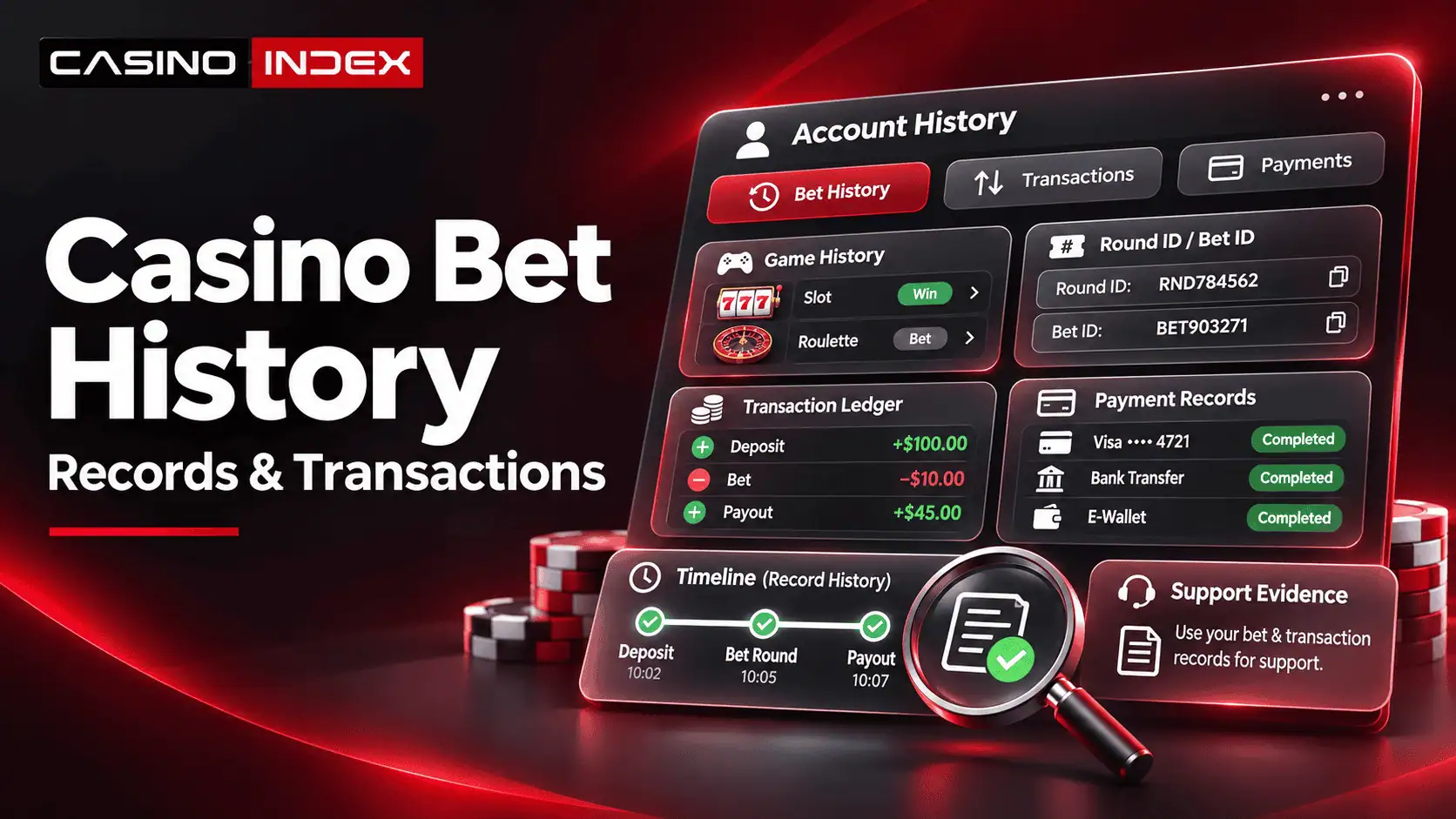
Quick answer: To get your casino bet history, open the game’s history or account statement and select the correct date range. Save the round reference, stake, result and payout. Then check the transaction ledger for matching balance changes. If entries are missing, request both records from support using a precise time window. Preserve the originals and share redacted copies only when necessary.
CasinoIndex Expert Take
A casino bet history and an account transaction history answer different questions. The game record helps identify what happened during a round. The account ledger shows how the operator recorded its financial effect. Payment records document deposits and withdrawals. A reliable evidence pack connects all three rather than relying on one screenshot.
Also, do not confuse a Round ID, Bet ID, Session ID, Casino Transaction ID or Payment Reference. These identifiers may refer to different systems, even when they relate to the same incident.
Scope: This guide covers finding, requesting and preserving casino account records. It does not determine whether a casino acted incorrectly or explain the full complaints process. Those steps require a separate review of the evidence.
Casino Bet History vs Transaction History: What Is the Difference?
Online casinos may display several different histories inside the same account. The names vary by operator, but they usually serve different purposes. Knowing which record to request prevents confusion when a game result, payment or account balance appears incorrect.
Game history and individual bet records
A casino game history may identify the game title, provider, date, stake and outcome. Some interfaces also show a Round ID, Bet ID, transaction reference or replay option. By contrast, other systems display summaries until the player opens a specific round.
For example, a slot round might show a $10 stake and a $25 payout. In other words, that record describes the gameplay. It does not necessarily prove that the casino credited the $25 to the correct account balance.
Account transaction history and balance ledger
The account ledger records financial movements inside the casino. These can include stakes, game payouts, bonus credits, adjustments, transfers between wallets and reversals.
Ideally, a ledger entry shows when the casino debited or credited the amount and the resulting balance. However, a visible transaction list may not provide every internal accounting field.
Payment and cashier records
Payment history usually covers deposits, withdrawals and related processing statuses. A cashier reference can help identify a deposit or payout without identifying the individual casino round that preceded it.
Bank references, payment-provider identifiers and blockchain transaction hashes may also exist outside the casino’s internal records. Therefore, keep those systems separate.
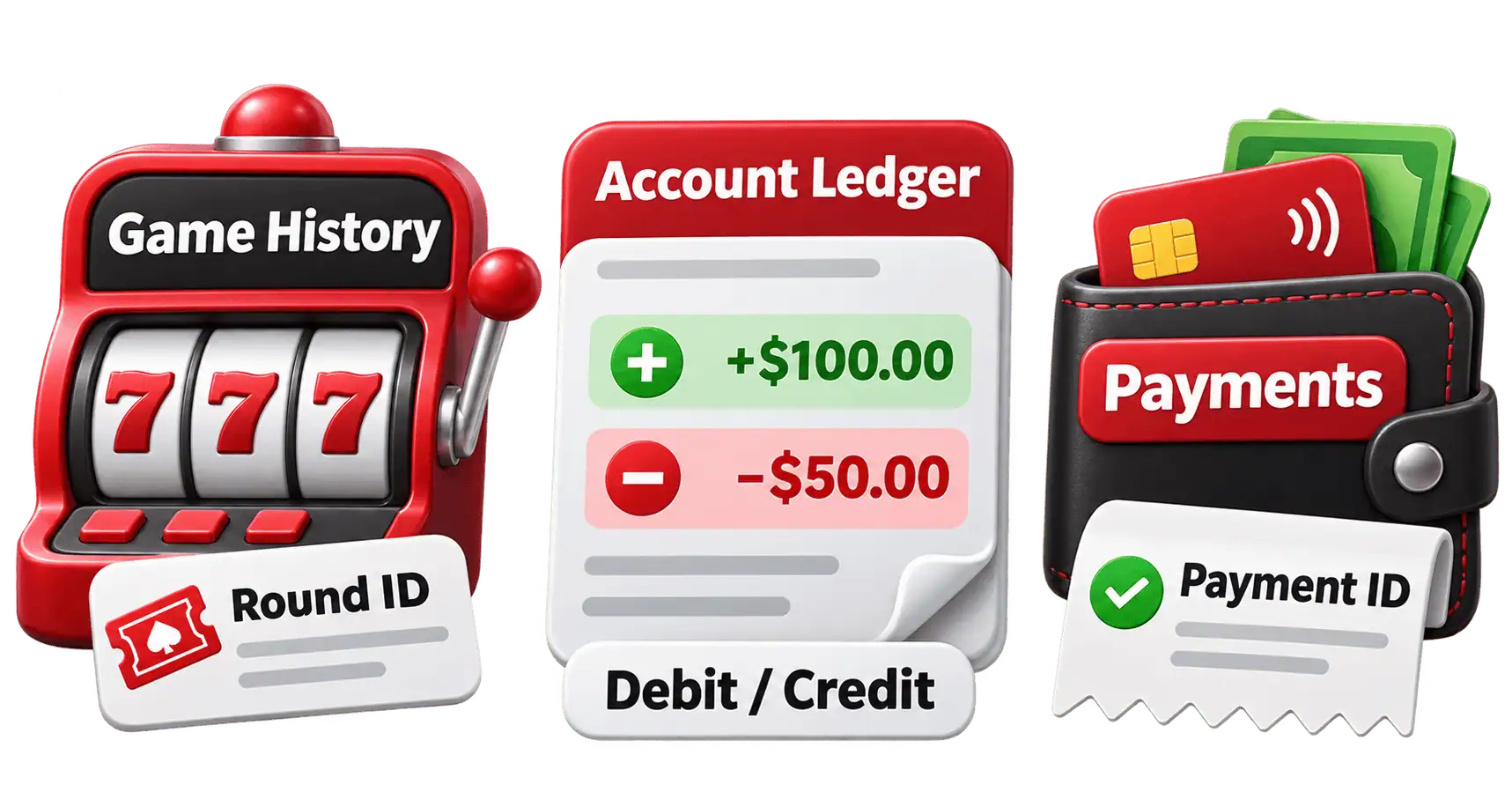
Which casino record should you request?
| Record | Useful fields | Where to look | Main purpose |
|---|---|---|---|
| Game / Bet History | Game, provider, Round ID, time, stake, outcome, payout | Game History / My Bets | Identify a round and outcome |
| Account Ledger | Time, debit/credit, balance, ID | Account / transaction statement | Reconcile a game with balance changes |
| Payment History | Payment ID, amount, method, status | Cashier, deposits, withdrawals | Match deposits and withdrawals |
| Bonus History | Bonus ID, credit, progress, adjustments | Bonus wallet / promotions | Separate cash and bonus movements |
| Support History | Ticket ID, dates, replies, decision | Support inbox / email | Keep the support audit trail |
Evidence limitation: These are CasinoIndex-recommended fields, not a guarantee that every casino exposes them. Some interfaces provide only a limited or summarised view.
Where to Find Your Casino Bet and Game History
Start with the casino’s own account menus. Common locations include My Bets, Game History, Transactions, Account Statement and the history panel inside a particular game.
Three official operator help articles illustrate how different these paths can be. They are examples of documented interfaces, not recommendations to join those casinos. Menu names and availability may change by country, product or software version.
Example 1: DraftKings Casino – United States
DraftKings documents access to individual casino hand and spin results through its account transaction information.
In the app, its published instructions describe this path:
- Open the account icon.
- Choose View Balance Details.
- Open Statements & Transactions.
- Locate the relevant game transaction.
- Open the transaction details and record its ID.
Its desktop instructions use Account Information → Account Statement – Transactions. Selecting a game transaction can reveal the corresponding hand or spin details.
What this proves: DraftKings documents a method to retrieve individual round information. It does not establish that every casino provides the same interface or a downloadable complete game log.
Example 2: PokerStars – Casino Game History
PokerStars documents different routes for desktop software and mobile or web accounts.
Desktop: Tools → History & Stats → Get Casino Game History.
Mobile and website: Select your user ID → My Gameplay → Casino → choose the date range.
The published help material also describes filters by the number of games, timeframe or Game ID. For Live Casino, players may find additional history within the game’s own interface.
Important limitation: PokerStars states that its documented casino history system stores records for real-money games. However, that does not promise access to every play-money event or internal provider log.
Example 3: Gamba – Finding a Casino Bet ID
Gamba’s help centre describes a bet-specific process. From the profile menu, open Transactions → Casino Bets to locate the history. Then:
- Open Casino Bet History from the transaction area.
- Select the bet you want to investigate.
- Find the Bet ID at the top of the detail window.
- Use the copy function to preserve the exact identifier.
Its guidance also describes accessing bet information through the My Bets tab on a casino game page.
The identifier displayed there is a Gamba-specific bet reference. As a result, do not equate it automatically with a payment-provider reference or universal game-provider Round ID.
What if your casino uses different menus?
Check the account area and the history panel inside the specific game. For example, some casinos separate slots from Live Casino, sportsbook bets and cashier transactions.
If an entry remains missing, avoid opening repeated game sessions just to search for it. Record the approximate time and ask support which history contains the relevant game and transaction.
For an interrupted round where the game froze or closed, our guide to investigating a casino game that crashed mid-spin explains the separate question of whether the casino recorded or settled the round, or left it unfinished.
Round ID vs Bet ID vs Transaction ID: What Do These Numbers Mean?
Importantly, casino identifiers do not always refer to the same event. A player may have several references for one incident, and their exact definitions depend on the operator and its software provider.
Round ID and Game ID
A Round ID usually identifies a specific game round. In slots, it may correspond to a spin or a broader round structure, depending on the game. For Live Casino, the identifier may refer to a hand or other defined game event.
A Game ID may identify the game title, a game instance or a particular event, depending on the system. Therefore, never assume that a Game ID and Round ID are equivalent without confirming the operator’s terminology.
Bet ID and Session ID
A Bet ID identifies a wager within a system. Some operators use it as the main support reference for casino rounds. Others maintain a distinct Round ID and Bet ID.
A Session ID may cover multiple bets or rounds within a period of play. It may help the operator locate a group of events, but it is not necessarily the identifier for a single disputed result.
Casino Transaction ID
A casino transaction ID typically identifies an entry within the operator’s account or transaction system. An accepted stake and its later payout may have separate accounting entries even when they belong to one game round.
Sometimes the transaction record links directly to the round. Elsewhere, the operator must establish that relationship internally.
Payment Reference and Blockchain TXID
A Payment Reference identifies a cashier, banking or payment-processing event. A blockchain TXID identifies an on-chain transaction where one exists.
Neither reference automatically proves that a specific casino round was settled correctly. Keep payment records separate from gameplay records until the casino establishes the connection.
If the case involves a withdrawal, our Casino Withdrawal Guide explains the different approval, processing and settlement stages that may appear in the cashier.
Choose the Exact Date Range and Timezone
Time differences are a common reason why players and support teams cannot locate the same event. For example, the account screen may display local time while internal systems use UTC or another timezone.
Use a bounded search window
Instead of asking for an entire account history immediately, start with the period surrounding the incident. Include time before and after the disputed round to capture related stakes, payouts and adjustments.
Illustrative request window: 2026-11-12 18:00–19:00 UTC.
That is a sample window, not an actual player transaction. Replace it with the relevant date and time. If you know only local time, write the location or UTC offset and ask support to identify the corresponding server time.
Include the event’s identifying details
Record the game title, provider, approximate stake, displayed result and any existing reference numbers. Two reliable references are better than a guess at an identifier: for example, one Round ID plus one casino transaction reference.
Alternatively, if you have no Round ID, provide the game, approximate time and amount. Mark estimated information as estimated rather than inventing precise timestamps.
Check filter boundaries
Review whether the selected date range includes the start and end times, whether the history is sorted by placement or settlement, and whether the interface is showing the correct product or currency wallet.
For instance, a transaction shortly after midnight UTC can appear on a different local calendar day. Likewise, when a game settles after the original bet, its result may appear under a later timestamp.
How to Match a Casino Game Round to Account Transactions
To investigate an account discrepancy, compare the game-history entry with the corresponding balance change. The following example illustrates how a basic reconciliation works using fictional references and amounts.
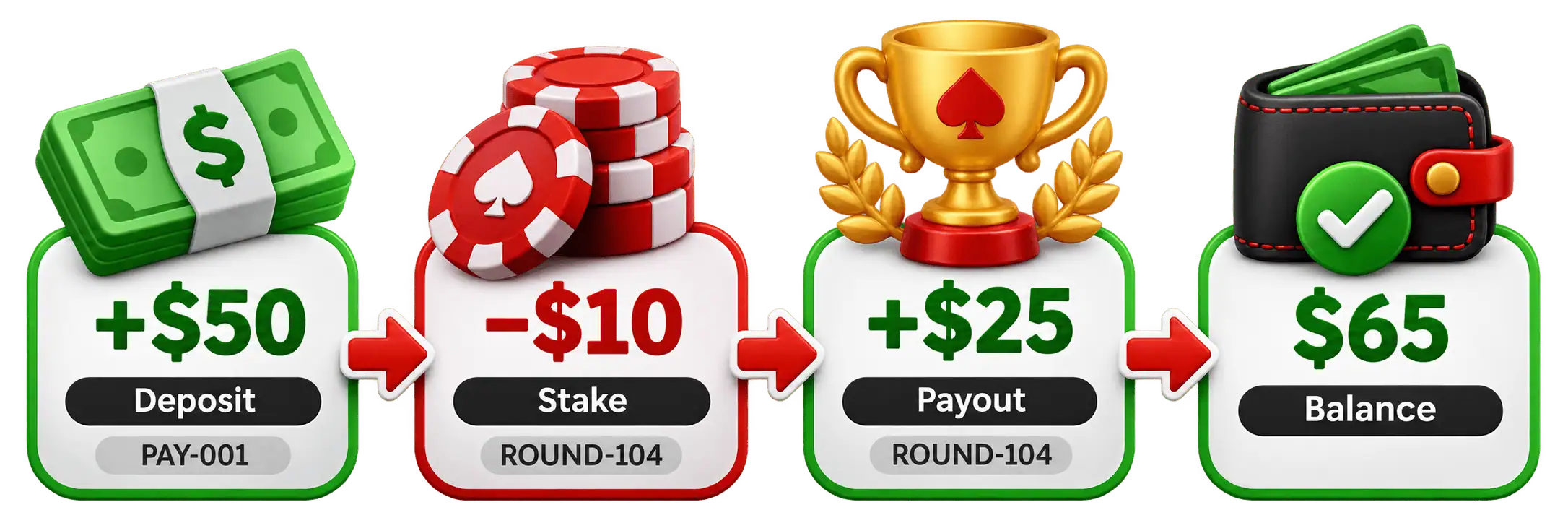
Example: A $10 bet, a $25 payout and a $65 final balance
Illustrative casino account journal – not a real-money test
18:40 UTC · Deposit PAY-001: +$50.00 → balance $50.00
18:42 UTC · Stake ROUND-104: −$10.00 → balance $40.00
18:43 UTC · Payout ROUND-104: +$25.00 → balance $65.00
Reconciliation: $50.00 − $10.00 + $25.00 = $65.00. This fictional journal starts at $0 and assumes no other bets, fees, bonus-wallet movements or adjustments.
Here, the Round ID links the stake and payout to the same fictional game event. The payment reference identifies the separate deposit. If no other adjustments exist, the calculated cash balance is $65.
What if the actual balance shows $40 instead?
Do not immediately conclude that the casino stole $25. First check whether the payout entry is absent, delayed, reversed, assigned to another balance or offset by a separate recorded transaction.
Ask support for the exact ledger movements related to the round. If the game history shows a $25 payout but the ledger contains no matching credit or explanation, ask the operator to reconcile that specific discrepancy.
What if the account includes bonus funds?
In practice, a combined account balance can conceal separate cash and bonus ledgers. For example, the casino may have credited the displayed payout to a restricted bonus wallet rather than cash.
In that situation, ask which balance category received each movement. A mathematical reconciliation of the overall balance alone may not explain whether the funds are withdrawable.
UK Gambling Commission RTS 1B: Three Months and Twelve Months
The UK Gambling Commission’s Remote Gambling and Software Technical Standards, RTS 1 – Customer Account Information, establish record-access requirements for relevant licensees.
Under RTS requirement 1B, customers must have easy access to at least three months of account and gambling history without contacting the licensee. At least 12 months of gambling and account history must be available on request, with the request option made clear and the information provided as soon as practicable.
What types of information does RTS 1B cover?
The requirement includes appropriate credit and debit information, deposits, withdrawals, transfers between products, bonuses, bets placed, bet results and winnings paid.
In addition, the guidance covers customer-selected time periods and summary totals. When funds move between different gambling products, account statements should show those movements clearly.
Does RTS 1B guarantee every individual casino round?
No. Crucially, the implementation guidance allows full or summarised gaming information for casino gaming and bingo. Where customers cannot directly access detailed historic game information, the guidance requires easy access to the last game played and summaries of earlier activity.
Therefore, the 12-month provision should not be described as a universal right to download 12 months of detailed spin-by-spin provider logs, a CSV export or internal server records.
Which casinos must follow this rule?
RTS 1B applies within the relevant UKGC licensing framework, rather than automatically to every casino accessible from the United Kingdom or every offshore gambling site.
For casinos operating under another licensing regime, check the local requirements and the operator’s actual record-access policy. Do not assume that the British three-month and twelve-month standards apply globally.
Official source: UK Gambling Commission, Remote Gambling and Software Technical Standards – RTS 1: Customer Account Information, Requirement 1B. Reviewed 12 November 2026. The regulator’s document is named without a direct link.
Visible Casino History vs Internal Game-Provider Logs
One of the biggest misunderstandings in casino disputes is the assumption that the account’s visible history contains every technical event recorded by the operator or software provider.
What the player usually sees
A self-service history may show timestamps, stakes, results, transaction numbers and summary balances. Some games provide a replay, bonus-round details or downloadable records. Others offer much less information.
Therefore, a visible interface may omit fields from the operator’s accounting or game-event database.
What may exist behind the interface
Depending on the architecture, the casino or game provider may retain additional records such as transaction states, game events, internal identifiers, retries, reversals or settlement messages.
However, the existence, retention period and accessibility of those records vary. CasinoIndex cannot assume that a particular operator possesses every possible log or that a player can obtain the raw files directly.
Who should investigate missing technical records?
For an individual casino round, start with the casino’s official support team. The operator controls the player’s account relationship and is normally best placed to identify the game provider and investigate related account movements.
If the issue concerns a bank or payment-provider transaction, the relevant payment service may hold separate processing records. However, those records cannot independently establish a casino game’s result.
Ask what information the operator reviewed, which round and ledger references its team used, and whether it requested a provider-level investigation. Avoid demanding proprietary server files as though their disclosure were automatically guaranteed.
How to Request Missing Casino Bet History Through Support
First, use the normal support channel when you cannot find a known game round or account entry. Keep the request narrow and include enough details for the team to find the relevant activity.
What to include in your request
Specify the account’s registered username or reference, relevant game, date range with timezone, stake, expected result and any known identifiers. Describe precisely which record is missing and which balance movement you cannot reconcile.
Where possible, attach a privacy-safe copy of the visible history or the relevant account statement.
Copyable casino support request
Subject: Request for Casino Bet History and Matching Account Transactions
Hello Support Team,
I am requesting the available game-history and account-transaction records for a specific casino event that I cannot fully reconcile.
Account reference: [Username or account ID]
Game and provider: [Game / provider, if known]
Requested period: [YYYY-MM-DD HH:MM–HH:MM UTC, or local time with timezone]
Round ID / Bet ID: [If available]
Casino transaction reference: [If available]
Stake: [Amount and currency]
Recorded or expected result: [Describe what you observed and identify anything uncertain]
Relevant payment reference: [If applicable]
Please provide the available game-history details, the corresponding account debit and credit entries, and any balance adjustments for this period.
If the player interface does not show detailed round information, please explain which records you can provide and whether your team can investigate the event with the game provider.
I would also appreciate confirmation of the timestamps and timezone used in your records.
Thank you.
Keep one consistent support record. If a ticket is already open, continue there instead of repeatedly opening cases with inconsistent times or amounts. Preserve the original reply and any later correction.
Can You Request Casino Records Under Data Protection Law?
In some jurisdictions, a player may have a separate legal right to access personal information held by an organisation. This can be useful if the ordinary account interface or support request does not provide enough information.
A Subject Access Request (SAR), sometimes called a DSAR, is an additional option – not a replacement for asking support to investigate a particular casino round.
United Kingdom: UK GDPR subject access rights
The UK’s Information Commissioner’s Office explains that individuals can request access to their personal information. Organisations normally must respond without undue delay and within one month, subject to applicable identification, clarification and extension rules.
Where a request is complex or multiple requests have been made, an extension of up to two further months may be possible, with an explanation within the required period. However, restrictions and exemptions may also apply.
For authoritative guidance, consult the Information Commissioner’s Office guide to subject access.
European Union: GDPR access rights
Under applicable EU GDPR rules, individuals can request access to personal data about themselves. The normal response period is one month, with a possible extension of up to two additional months where justified.
Importantly, these rights depend on whether the relevant law covers the organisation and processing activity. For guidance, see the European Data Protection Board’s explanation of individual rights.
What can a subject access request provide?
For example, depending on the available information and applicable exemptions, a response might include personal account activity, recorded transactions and relevant communications for the period.
However, a right to access personal data is not an unconditional right to every business document, internal investigation note, proprietary game algorithm or complete provider raw log.
Copyable subject access request
Subject: Subject Access Request – Casino Account Activity
Hello Privacy / Data Protection Team,
I would like to exercise my right of access to personal data, where applicable under the relevant data protection legislation.
Please provide the personal data relating to my casino account activity during the following period:
Account reference: [Username or account ID]
Date range: [YYYY-MM-DD HH:MM–HH:MM UTC or specified timezone]
Relevant references: [Round ID, transaction ID or ticket ID, if known]
I am particularly interested in personal data relating to game activity, account balance movements, deposits, withdrawals and associated account records for this period, insofar as those data are held and subject to the right of access.
If you cannot provide any requested personal data, please identify the relevant reason or restriction.
Please let me know the appropriate secure process for verifying my identity if necessary.
Thank you.
Send this through the operator’s official privacy or data-protection channel where available. However, a privacy request cannot determine whether a result was correct or guarantee restoration of a missing payout.
Build a Casino Records Evidence Pack
Above all, an evidence pack should preserve enough reliable information to reconstruct the event without exposing unnecessary personal details.
CasinoIndex Records Evidence Pack – Minimum Checklist
- Game: Title, provider and type of casino game.
- Reference: Round ID or Bet ID, plus any separate transaction ID.
- Time: Date, precise time and timezone, or a clearly marked estimate.
- Gameplay: Stake, recorded result and payout.
- Ledger: Matching debit, credit, reversal or bonus adjustment.
- Payments: Cashier or payment reference if a deposit or withdrawal is relevant.
- Evidence: Original screenshots, statements or exported files.
- Correspondence: Support ticket number and written explanations.
Evidence limit: This checklist identifies useful records. It does not guarantee every casino can provide all fields or internal provider logs.
Keep a clean evidence timeline
Organise the events chronologically: what happened before the game, what the round recorded, how the balance changed and what the operator subsequently explained.
For instance, an account deposit might precede a game stake by two minutes. A payout entry may follow settlement, while a later manual adjustment could explain another balance change. Each event needs its own timestamp and reference where available.
Therefore, write factual observations separately from assumptions. “The history shows a $25 win, but I cannot locate a matching credit” is more precise than “The casino deleted my winnings” when the account ledger has not yet been examined.
Preserve original files and screenshots
Keep the original downloaded documents and unaltered screenshots in a private location. Record when you obtained them and, where useful, the source account page or transaction range.
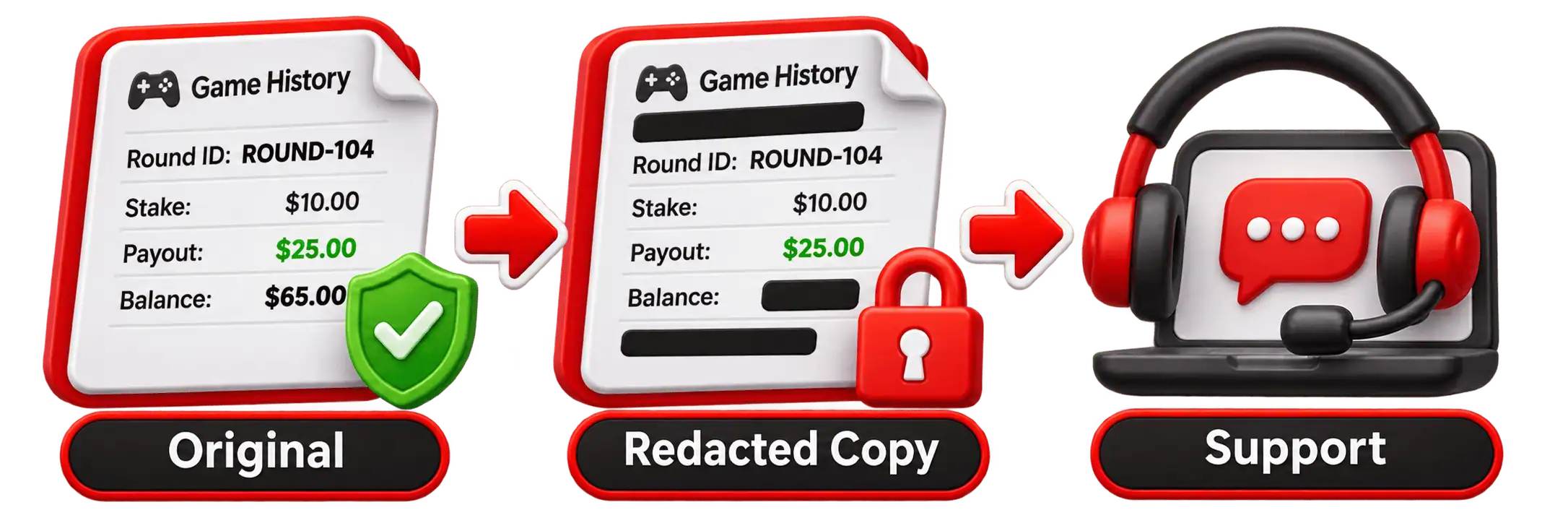
For sharing, make a separate redacted copy for support or third parties. Do not crop or edit the original evidence file. If you annotate a screenshot, identify it as an annotated copy rather than presenting it as the original.
Privacy and Account Security
Never include passwords, recovery phrases, two-factor authentication codes, full card details or unnecessary identity documents in a normal support message. Redact unrelated balances and personal information from copies you share. If identity verification is legitimately required, use the operator’s official secure verification process rather than public chat links or unsolicited email attachments.
What If Your Casino History Is Missing or Incomplete?
Missing records can have several explanations. The correct next step depends on whether the event is outside the visible range, stored under another menu or genuinely absent from the account information provided.
Wrong date, timezone or product filter
Check the chosen date range, account currency and product type. For instance, some casinos list casino rounds under account transactions rather than sports betting history. Likewise, a settlement may appear later than the original stake.
The event is older than the self-service history window
For example, some interfaces expose only recent activity. Ask the operator whether an older account statement or game summary can be supplied.
If UKGC RTS 1B applies to the casino, check the three-month self-service and twelve-month request requirements. For another market, do not assume the same retention or access period.
The account is restricted or no longer accessible
An account suspension, closure or security review may prevent access to normal history menus. Contact official support or the appropriate privacy channel and explain that the interface is unavailable.
Do not attempt to bypass access restrictions or create a second account to retrieve records. Preserve any records you already hold.
A game result appears but no matching credit exists
Request the corresponding accounting entry, balance type and settlement status. Check for delayed settlement, bonus-wallet allocation, reversals or other documented movements before describing the funds as missing.
Where the underlying issue is an unresolved withdrawal or withheld account balance, see our guide to what to check when an online casino will not pay out.
The casino supplies only a summary
Ask whether it can identify the individual event from your known references and provide a more specific explanation. Nevertheless, a summary may satisfy published access requirements while leaving your specific question unanswered.
If the casino cannot provide technical records, note precisely what you requested, what it supplied and what remains unverified. Avoid interpreting an absent export as automatic proof of misconduct.
Who Can Explain Each Missing Record?
Different organisations may control different parts of an incident. Start with the party responsible for the specific record rather than sending the same request indiscriminately.
Casino support: game and account records
The casino should be the first contact for a missing round, unclear game result, disputed balance change or unmatched internal transaction. Ask the team to identify the relevant game and ledger references.
Payment provider or bank: payment-processing evidence
A bank or payment provider may be able to clarify whether a deposit or withdrawal transaction was processed, rejected or reversed. However, it cannot normally confirm the result of an individual slot spin or Live Casino hand.
Privacy team: personal-data access
A data-protection contact may handle applicable SAR or DSAR requests. The privacy process addresses access to personal data, while a casino support investigation addresses the meaning and correctness of a specific game result.
If support has not resolved a documented discrepancy after your records request, our casino dispute resolution guide explains the separate complaint and escalation process.
Primary Sources, Markets and Evidence Limitations
CasinoIndex reviewed official operator instructions, published regulatory standards and data-protection guidance on 12 November 2026. These sources show documented access routes and requirements, not real-money account tests.
Official evidence by market and source
| Market / scope | Official source | Checked on | What it supports | What it cannot prove |
|---|---|---|---|---|
| Great Britain | UKGC – RTS 1B | 12 Nov 2026 | 3 months self-service; 12 months on request | No guaranteed raw logs; not global |
| US – DraftKings Casino | DraftKings – Casino Hand / Spin History | 12 Nov 2026 | Statements and round-detail access | No universal menus or full export |
| PokerStars – platform-specific | PokerStars – Casino Game History | 12 Nov 2026 | Desktop/mobile paths; real-money records | No guarantee of all rounds or raw logs |
| Gamba – casino help | Gamba – Locating a Bet ID (16 Mar 2026) | 12 Nov 2026 | Find and copy an individual Bet ID | Bet ID need not equal Round/Payment ID |
| UK – data protection | ICO – A Guide to Subject Access | 12 Nov 2026 | Personal data access and response timing | No automatic raw-log access or remedy |
| EU – GDPR | EDPB – Respect Individuals’ Rights | 12 Nov 2026 | GDPR access rights and response deadlines | Not global; no unrestricted document access |
Table note: Each row describes the source’s market, scope and limits as checked on 12 November 2026. CasinoIndex has not confirmed these menu paths by logging into the named operators.
Editorial method and what we did not test
Editorial method: CasinoIndex compared official help documentation and regulatory guidance with the practical records needed to investigate a casino account event. The recommended field schema, evidence workflow, support templates and illustrative $50-to-$65 journal are original explanatory material.
CasinoIndex did not log into the named casino accounts, test record exports, request private files, perform real-money bets or verify a game-provider settlement in preparing this article. Menu locations, retention practices, privacy rights and available record detail can differ by operator, jurisdiction and account status.
Frequently Asked Questions
How do I get my casino bet history?
Open the casino’s Game History, My Bets or Account Statement area and select the relevant date range. Record the game, stake, result and any available Round ID or Bet ID. If the event is missing, request it through official casino support.
Can I download my complete casino game history?
Some operators provide downloads or history requests. Others offer only an on-screen record or summary. There is no universal guarantee of a CSV export, full spin-by-spin history or access to all technical logs.
Is a Round ID the same as a Transaction ID?
Not necessarily. A Round ID usually identifies a game event, while a transaction ID may identify an internal debit or credit. An operator may link them. Nevertheless, treat the references separately unless the system confirms the relationship.
What if I cannot find my casino Round ID?
Provide support with the game title, provider, stake, approximate date and time with timezone, and any visible transaction reference. Ask which identifier the operator uses for the event.
How far back can I request casino records?
It depends on the operator and applicable rules. Under relevant UKGC RTS 1B requirements, at least three months must be readily accessible without contacting the licensee and at least twelve months must be available on request. These rules do not automatically apply to offshore casinos.
Does a casino have to give me its game-provider raw logs?
Not automatically. Published gambling-history standards can permit summarised gaming information, and data-protection rights do not create an unconditional entitlement to every proprietary technical document. Ask what records are available and whether the operator can investigate the specific event.
Can my bank statement prove a slot win?
No. A bank statement can help establish deposits or withdrawals, but it normally does not show a slot round’s outcome. Use game history and casino account movements to investigate the result and its recorded financial effect.
What if my game history shows a win but my account balance did not increase?
Check the relevant ledger entry, bonus wallet, any pending settlement and later adjustments. Then ask the casino to reconcile the game result against the account’s debit and credit records. The difference may require investigation, but it is not automatically proof of deliberate non-payment.
Can I request casino history after my account is closed?
You can ask the operator whether historic records remain available. Applicable gambling and data-protection requirements may provide access rights, but the exact scope depends on the jurisdiction, retention practices and legal limitations.
Should I submit a support request and a SAR at the same time?
For a missing game event, start with a focused support request. A SAR or DSAR may be useful as an additional route if the relevant privacy law applies and you need personal data not otherwise available. They serve different purposes; neither guarantees that the operator will change a disputed game result.
Final Checklist: Get the Records Before Drawing Conclusions
Begin with the casino’s own game history and account statement. Identify the specific event, save its references and set a precise time window. Match the recorded stake and outcome against the corresponding balance movements, then check any relevant cashier or bonus records.
If the entries do not reconcile, first request the missing information through official support. Keep original files private, use redacted copies for communication and distinguish documented facts from assumptions.
A complete casino evidence pack should explain which round occurred, what the account recorded and which information remains missing. Therefore, the pack can establish a question worth investigating without presuming misconduct.
CasinoIndex editorial note: This guide concerns account records and evidence preservation, not a determination of individual legal rights or casino liability. Written for CasinoIndex by Talha Aydin. Sources researched and checked on 12 November 2026.

Maria Hoffmann has worked in cryptocurrency content and digital publishing since 2017. She is a co-founder of Freecoins24 and CryptoMutant and has covered blockchain projects, crypto platforms and emerging industry trends for several years. She has also been active as a cryptocurrency investor since 2019. At CasinoIndex, Maria combines content research and SEO experience with a focus on casino trust, platform security, withdrawal processes, payment risks and user protection. Her work looks beyond bonuses and product features to examine how gambling platforms handle player funds, verification and account-related risks.