Online Casino Won’t Pay Out? What to Do When Winnings Are Withheld
If an online casino won’t pay out, stop playing with the disputed balance, save your evidence and find out exactly what is blocking the withdrawal before you escalate. A slow payout does not automatically mean the casino refuses to pay. However, repeated delays, changing explanations and an undefined review process can become serious warning signs.
Start by diagnosing the situation. Your withdrawal may still be going through normal processing, an extended review, a genuine KYC or terms dispute, or a case that increasingly points to unresolved non-payment.
Each situation requires a different response. Treating a routine review like theft can make a solvable case harder. At the same time, accepting repeated excuses as a normal delay can leave you without important evidence when you finally need to escalate.
Is the Casino Actually Refusing to Pay?
“Casino not paying” can describe several different situations. The status shown inside the cashier gives you only part of the picture.
| Situation | What It Usually Looks Like | What to Do |
|---|---|---|
| Normal processing | The withdrawal remains within the stated processing period and the casino gives a consistent status. | Wait within the stated timeframe and keep records. |
| Extended review | The casino identifies a KYC, payment, security, source-of-funds or account check that still needs attention. | Complete reasonable requests and ask what remains outstanding. |
| Active dispute | The casino rejects, cancels or freezes the withdrawal because it cites a rule, account issue or verification problem. | Request the exact decision, evidence and applicable rule in writing. |
| Likely unresolved non-payment | Normal timeframes have passed, explanations keep changing, support stops helping or no realistic path to a decision exists. | Preserve the full case file and move to formal escalation. |
The boundary between an active dispute and unresolved non-payment is not always sharp. Focus on the overall pattern: how long the issue has lasted, whether the operator identifies a specific problem, whether its explanation stays consistent and whether a realistic route to resolution still exists.
Before treating a slow withdrawal as deliberate non-payment, check when a casino delay may still be normal and what a pending withdrawal status means.
Quick Action Checklist
If the casino has already exceeded its expected timeframe, start with these actions:
- Stop playing with the disputed balance.
- Screenshot the withdrawal, account balance and transaction history.
- Ask what exact check, transaction or rule is blocking payment.
- Save KYC requests, emails and live-chat transcripts.
- Request the casino’s final written position if it refuses payment.
- Verify the legal operator and licence before choosing an escalation route.
After that, work through the case according to whether you face a delay, review, dispute or unresolved refusal.
What to Do When an Online Casino Won’t Pay Out
1. Stop Gambling With the Disputed Money
Do not keep playing while you try to resolve a withdrawal.
If a casino lets you reverse a pending cashout, returning the money to your balance and continuing to gamble can turn a clear payment dispute into a much more complicated account-history dispute. You also risk losing the disputed winnings before anyone resolves the complaint.
Avoid repeatedly cancelling and recreating withdrawals unless the casino gives you a specific technical reason.
2. Record the Withdrawal Details
Save the amount, currency, date, payment method, withdrawal reference and current status. Take screenshots of your balance and transaction history as well.
Do this early. Account restrictions can remove access to cashier screens, chat history or transaction records that could later support your case.
3. Ask What Exactly Is Blocking Payment
Repeatedly asking “Where is my money?” often produces another generic answer.
A more useful question is:
What exact check, document, transaction or account rule is currently preventing this withdrawal from receiving approval?
Casinos can perform legitimate checks before releasing money. These may involve identity, payment ownership, account security, bonus compliance or financial-risk controls.
CasinoIndex explains these stages in more detail in its guide to what casinos check before approving a withdrawal.
You can judge the situation more accurately once the casino identifies the actual issue instead of describing everything as “under review.”
4. Ask for the Exact Rule if the Casino Disputes Your Winnings
If the casino says you breached its terms, ask which clause applies and what activity triggered the decision.
Common disputed areas include bonus wagering, maximum bets, restricted games, duplicate accounts, third-party payments, VPN use, prohibited jurisdictions and account ownership.
A reference to “our terms and conditions” gives you far less information than a specific allegation linked to a specific rule.
If the operator cancels or removes winnings rather than simply delaying them, it may also help to understand when casinos can reverse or confiscate winnings and where that decision becomes questionable.
Save the version of the terms available during the dispute. Casino terms can change, so screenshots or archived copies may become important later.
5. Complete Reasonable Verification and Track Every Request
A legitimate KYC request does not automatically mean the casino is trying to avoid payment.
If the operator reasonably needs proof of identity, address, payment ownership or another relevant document, submit it through the casino’s official secure process.
Keep a record of every request. Note what the casino asked for, when you uploaded it, whether staff accepted it and why they rejected anything.
KYC becomes more concerning when the process turns into an undefined moving target. One requirement may lead to another unrelated request, staff may ask for documents they already accepted, or nobody may explain what would complete the review.
For operators licensed in Great Britain, UK Gambling Commission Licence Condition 17.1.1 states that a withdrawal request must not create a new information requirement when the operator could reasonably have requested that information earlier.
The rule still allows checks that another legal obligation requires at the withdrawal stage. The Commission also expects remote operators to carry out identity verification as early as practicable rather than creating unnecessary cashout friction. UK Gambling Commission: Customer identity verification.
This provides a useful benchmark for player-friendly verification. However, it does not automatically govern offshore casinos licensed in other jurisdictions.
6. Separate Source-of-Funds Checks From Generic KYC
Identity verification and source-of-funds checks are related, but they serve different purposes.
A higher-value account, unusual transaction pattern or another risk indicator can sometimes trigger additional financial checks. If this happens, ask what category of evidence the casino requires and record what you have already provided.
CasinoIndex explains how source-of-funds checks work at online casinos, including why a legitimate review should have a clear purpose instead of becoming an endless payout barrier.
7. Move the Case From Live Chat to a Formal Complaint
Live chat works well for basic troubleshooting. It becomes much less useful once the conversation starts repeating the same scripted answers.
If frontline support cannot resolve the withdrawal, ask for the operator’s formal complaints procedure and submit your case in writing.
Include your account identifier, disputed amount, withdrawal date, payment method, current status, the reason the casino has given, the evidence you already supplied and the outcome you want.
If support no longer provides meaningful answers, follow CasinoIndex’s process for how to escalate after casino support stops helping.
8. Identify the Legal Operator and Licence
Do not choose an escalation route based only on the casino’s brand name or a logo in the footer.
Find the legal company behind the site and verify which licence covers the domain you actually used. Check the terms, regulator register and official licence details where available.
Different licensing systems give players very different complaint routes. Some depend heavily on independent ADR. Others accept regulatory reports without deciding the individual payment dispute themselves.
Unlicensed operators may leave players with far less practical leverage.
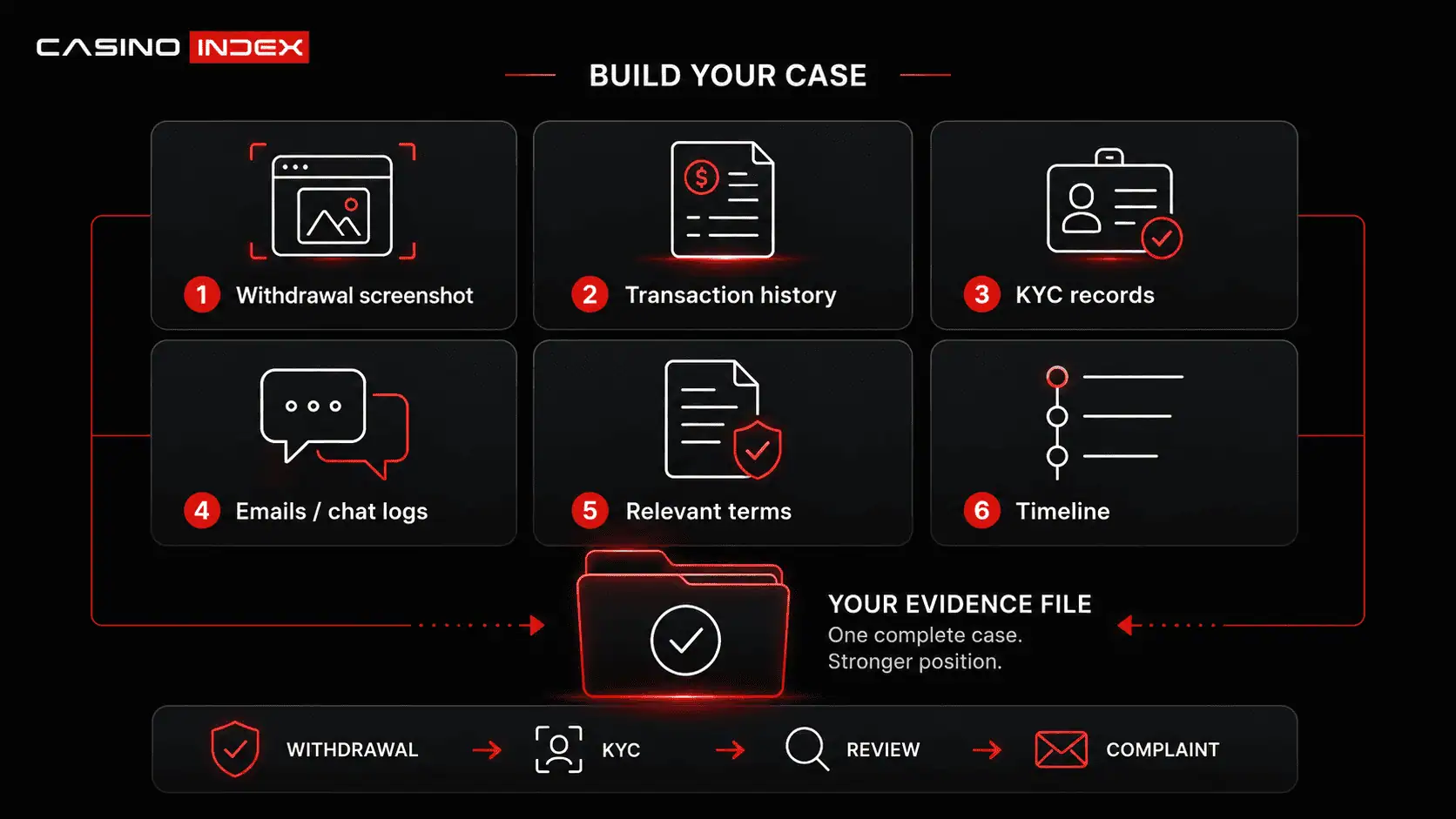
Build an Evidence File Before You Escalate
A strong casino withdrawal dispute relies on evidence rather than accusation.
| Evidence | What It Helps Establish |
|---|---|
| Withdrawal screenshot | Amount, date and original status |
| Transaction history | Whether the casino cancelled, rejected or reversed the withdrawal |
| Balance screenshot | What funds appeared before any account restriction |
| Emails and chat logs | What the casino said and whether its explanations changed |
| KYC records | What the casino requested, what you submitted and what staff accepted |
| Payment evidence | Ownership of the deposit or withdrawal method |
| Bonus records | Which promotion and rules applied |
| Relevant terms | The wording the casino relies on |
| Crypto transaction data | Network, address and TXID where available |
| Timeline | How the dispute developed from start to finish |
A short chronological timeline can make the case much easier to understand:
June 4: $2,400 withdrawal requested.
June 5: Casino requests proof of address; player uploads it.
June 7: Casino marks verification complete.
June 9: Support says the account is undergoing a security review.
June 12: Support cannot identify another outstanding requirement.
This type of timeline gives an ADR reviewer or complaint investigator far more useful information than simply saying the casino “has not paid for eight days.”
Never post identity documents, bank statements, full card details or other sensitive personal information publicly on forums or review sites.
Why Casinos Withhold Winnings
Casinos can delay or dispute withdrawals for legitimate and illegitimate reasons. Focus on whether the operator provides a specific explanation, applies its terms consistently and gives you a realistic path to resolution.
KYC and Account Ownership
The operator may need to establish that the account belongs to the person using it. Problems often become more complicated when names, dates of birth, addresses or submitted documents do not match.
Ask what information is missing and whether the request directly relates to the identified problem.
Payment Ownership
A deposit from another person’s card, bank account, e-wallet or crypto account can create ownership and fraud concerns.
When payment ownership causes the dispute, ask which transaction or payment method requires verification instead of accepting a broad reference to “payment checks.”
Bonus or Terms Disputes
A casino may allege a wagering violation, maximum-bet breach, restricted-game play or bonus abuse.
Request the promotion name, the relevant clause and the bet or transaction that allegedly caused the breach. A specific allegation gives you something to review. A vague allegation does not.
VPN, Location or Multiple Accounts
Casino terms may restrict certain countries, VPN use, duplicate accounts or connected accounts within the same household.
Technical signals do not always prove intentional abuse. Separate the evidence the casino has collected from its interpretation of that evidence and the rule it ultimately applies.
AML, Security or Financial Checks
Some reviews involve anti-money-laundering or financial-risk controls. Operators may not always disclose every detail, particularly when disclosure could conflict with legal obligations.
Even so, players should normally expect a coherent process and a path toward a decision. A genuine restriction on what support can disclose does not automatically justify an undefined delay.
Crypto Casino Won’t Pay? Check Whether Anything Was Sent On-Chain
Crypto withdrawals add an important distinction that traditional casino payment disputes do not have.
Casino approval and blockchain settlement are separate events.
If a casino says it already sent Bitcoin, USDT, ETH or another cryptocurrency, ask for the coin, network, destination address, amount and transaction hash.
No TXID usually means there is nothing on-chain to wait for yet.
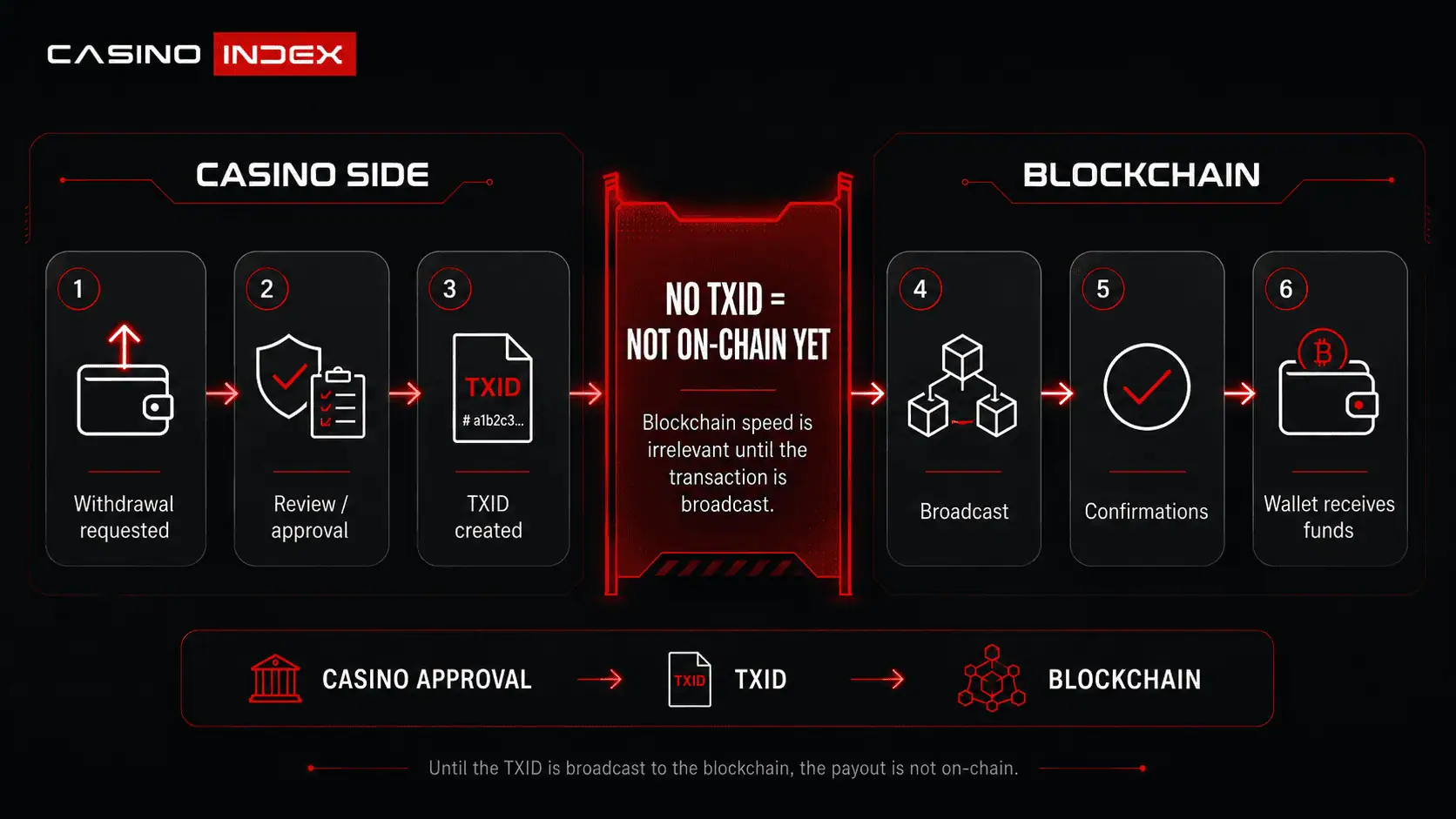
If the casino has not broadcast the transaction, Bitcoin, Ethereum, TRON or another blockchain cannot be responsible for the delay. The withdrawal may still sit inside the casino’s approval system or with its payment processor.
Once you have a valid transaction hash, use the relevant blockchain explorer to check whether the casino broadcast the payment, whether the network confirmed it and where the funds went.
Be especially cautious if an operator asks you to make another deposit, pay an unexpected “release fee,” send tax money directly to the casino or transfer more crypto to unlock existing winnings.
Do not send additional money merely because an operator claims another payment is required to release a withdrawal that already belongs to you.
When Does a Delay Start to Look Like Non-Payment?
No single red flag proves that a casino will never pay. Several signals appearing together matter far more.
Risk increases when:
- the casino’s stated processing period has clearly passed;
- support cannot identify the unresolved check;
- different departments give different explanations;
- new KYC demands appear whenever you complete the previous requirement;
- staff request previously accepted documents again without explanation;
- the casino alleges a terms breach but will not identify the relevant clause;
- the operator repeatedly cancels withdrawals without a clear reason;
- the casino restricts account access without explaining what will happen to the balance;
- support stops responding after you request a formal decision;
- the operator demands an extra payment or deposit before releasing winnings;
- you cannot verify the claimed operator or licence.
A wider complaint pattern also matters. One unresolved complaint does not prove misconduct. Repeated reports involving the same payout problem, changing verification demands or similar confiscation disputes carry more weight.
CasinoIndex explains how to interpret broader warning signs associated with rogue casinos without automatically treating every negative report as proof.
Your Escalation Route Depends on the Casino’s Licence
No universal regulator resolves every casino withdrawal dispute. Verify the operator and current licence before filing a complaint.
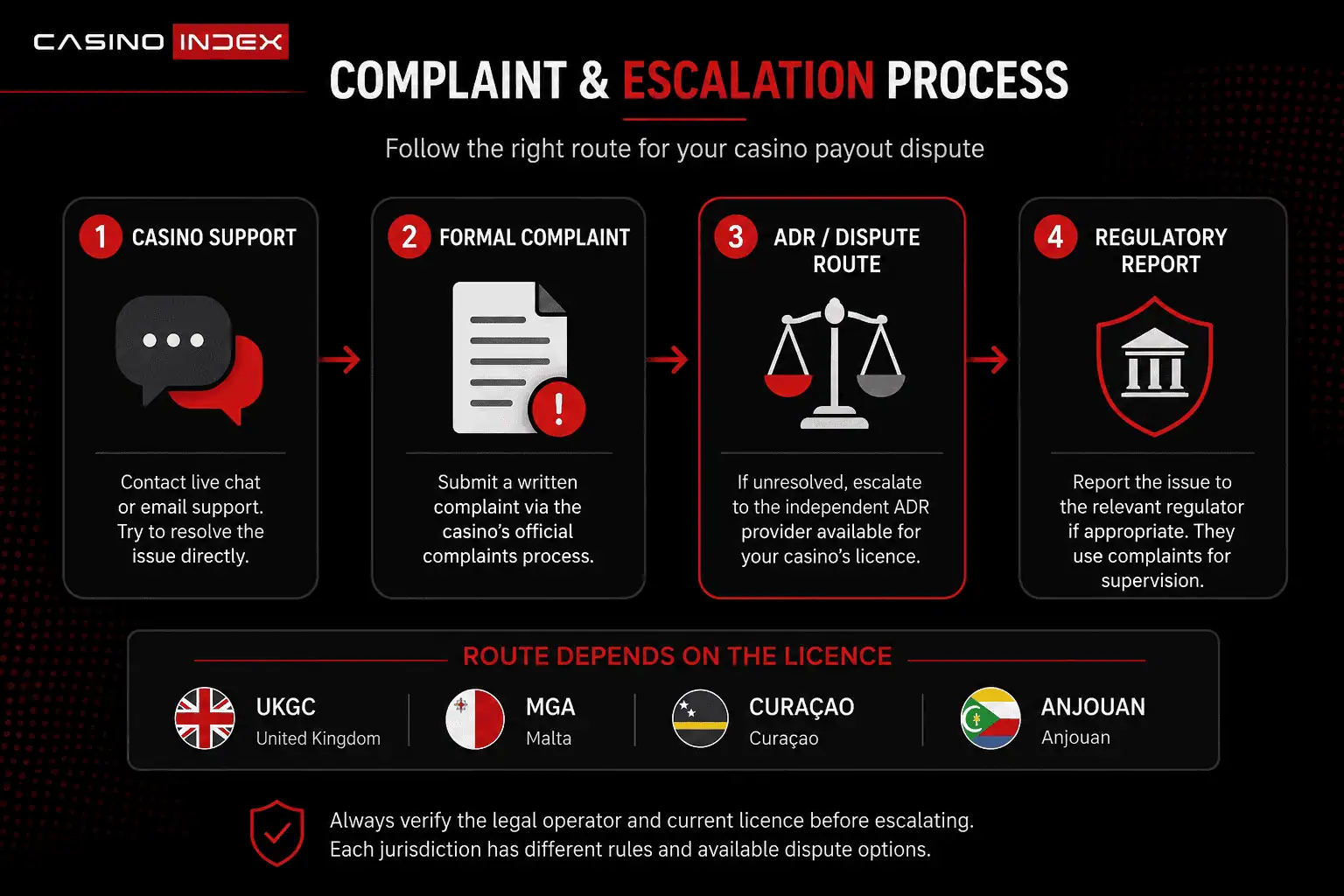
Great Britain — UK Gambling Commission
Players using a business licensed by the UK Gambling Commission should first follow the operator’s formal complaints process.
Current UKGC guidance gives the gambling business up to eight weeks to resolve a complaint after receiving it. If the internal process does not resolve the dispute, the player may then take the case to an approved Alternative Dispute Resolution provider. UK Gambling Commission: How to complain.
The Commission acts as the regulator rather than the normal tribunal for an individual payout dispute. Player complaints can still provide useful regulatory information when they point to wider operator failures.
Malta — Malta Gaming Authority
The Malta Gaming Authority offers a formal complaint channel for disputes involving MGA-licensed operators and recommends trying to resolve the issue directly with the casino first. Malta Gaming Authority: Lodge a complaint.
MGA-licensed operators must also maintain a documented complaints process and provide access to a registered ADR entity after the player exhausts the internal dispute route.
The MGA states that ADR conclusions bind the parties, while players still retain the right to pursue proceedings in a competent court.
Curaçao — Curaçao Gaming Authority
Curaçao changed its regulatory framework substantially under the National Ordinance on Games of Chance, commonly known as the LOK.
Current Curaçao Gaming Authority licence conditions require licensed operators to provide a complaints procedure and access to ADR. Operators must also publish information about their complaints and dispute process. Curaçao Gaming Authority: Online gaming licence conditions.
That does not mean the CGA itself decides whether an individual player must receive payment.
The CGA states that resolving individual disputes between players and operators falls outside its mandate. It does not mediate, arbitrate or issue compensation orders.
However, the authority can use complaints and repeated complaint patterns as regulatory information when they suggest possible breaches of the LOK. Curaçao Gaming Authority: Online gaming complaints.
For players, the practical route is therefore to use the operator’s complaint and ADR procedure where available. A separate report to the CGA serves a regulatory purpose rather than directly deciding the payment dispute.
Anjouan
Under Anjouan Gaming’s current complaint process, players must first submit an individual dispute to the licensed operator through its prescribed complaint channel.
The operator has 30 calendar days to investigate and respond. If the dispute remains unresolved, the player can move the case to an approved independent ADR provider.
Licensed operators must participate in ADR and cover the cost of the proceeding. The Authority itself states that it does not mediate or adjudicate individual player disputes. Anjouan Gaming: Player complaint process.
Unlicensed or Unclear Operators
This category creates the greatest practical risk.
If you cannot verify the legal operator, licence or dispute route, enforcing a claim can become much harder. Public complaint platforms may sometimes encourage a casino to respond, but they are not courts and cannot guarantee payment.
When a substantial amount is involved, professional legal advice may make sense once you identify the legal entity and relevant jurisdiction.
This guide provides general information and is not legal advice. Rights and complaint procedures depend on the operator, licence, player location and facts of the dispute.
How to Write a Strong Casino Non-Payment Complaint
A useful complaint should allow someone with no prior knowledge of the case to understand the problem quickly.
Include:
- Account: username or registered email;
- Disputed withdrawal: amount, currency and date;
- Payment method: bank, card, e-wallet, BTC, USDT or another method;
- Current status: pending, rejected, cancelled, frozen or balance removed;
- Casino explanation: the exact reason given;
- Evidence supplied: KYC documents, transaction records or payment proof;
- Relevant rule: the clause cited by the operator, if any;
- Requested outcome: payment, restoration of funds or a final written decision.
Add a short timeline beneath the summary.
“Casino stole my money” tells a reviewer very little.
A statement such as “Withdrawal requested July 8; KYC completed July 10; verification confirmed July 11; withdrawal still pending July 18; support cannot identify another outstanding requirement” gives the reviewer something concrete to assess.
If the operator refuses payment, request its final written position. An ADR provider, regulator or other reviewer may later need that document to identify the exact dispute.
For the complete process beyond the operator’s own complaint stage, see how online casino dispute resolution works.
What Not to Do During a Withdrawal Dispute
Do not weaken your own case while trying to pressure the casino.
Avoid threats, duplicate accounts, altered documents and misleading statements. Be open about relevant facts involving payment ownership, bonuses, VPN use or linked accounts when those issues genuinely apply.
Keep KYC documents private. Also avoid gambling with money you are actively trying to withdraw.
A payment chargeback should not become the automatic response just because casino winnings have not arrived. An authorized deposit and a later dispute over unpaid winnings are not necessarily the same issue.
If you contact a card issuer or bank, describe what happened accurately and review the available dispute reasons. Never select a chargeback reason that does not match the actual transaction simply because the casino delayed or refused a withdrawal.
Most importantly, never send extra money to a questionable operator because it claims you must “unlock,” “verify,” “insure” or “release” an existing withdrawal.
How CasinoIndex Assesses an Unpaid Winnings Complaint
CasinoIndex does not treat every delayed withdrawal as proof that a casino acts dishonestly.
Instead, we examine the process and the available evidence.
Has the Expected Processing Period Passed?
A withdrawal that remains inside a clearly disclosed timeframe differs from one that has exceeded that period without a useful explanation.
Has the Casino Identified the Actual Reason?
A specific payment-ownership or verification issue gives the player something concrete to address. A generic “security review” with no meaningful detail is harder to evaluate.
Has the Player Completed Reasonable Requests?
If the player has not supplied required information, the operator may have a legitimate reason to pause the withdrawal. Once the player completes reasonable requirements, the casino should identify any remaining issue clearly.
Does the Explanation Remain Consistent?
A case that moves from KYC to security to a bonus investigation without a clear explanation deserves more scrutiny than a documented review with one stable reason.
Is There a Wider Complaint Pattern?
One complaint may lack important context. Repeated complaints describing the same withdrawal behavior carry more weight.
CasinoIndex treats complaint patterns as risk signals, not automatic proof of misconduct. Our broader trust methodology explains how withdrawal behavior, verification, licensing and complaint evidence are evaluated without allowing one isolated report to determine the verdict.
Bottom Line: Evidence First, Escalation Second
If an online casino won’t pay out, the strongest response is not the loudest one. A well-documented case gives you far more leverage.
First determine whether the withdrawal remains in normal processing, sits in an identifiable review, forms part of a genuine dispute or shows signs of unresolved non-payment.
Next, stop playing with the disputed balance. Preserve your evidence, ask why the casino has blocked payment, complete reasonable verification and request the specific rule when the operator challenges your winnings.
If support cannot resolve the issue, move to the formal complaints process. Verify the legal operator and licence before choosing an ADR provider, regulator or another escalation route.
A legitimate casino may sometimes need more time. The important question is whether the process stays specific, consistent and capable of reaching an outcome.
Repeated delays without a defined reason, constantly changing verification demands, unexplained confiscation, contradictory explanations or complete support silence create a much stronger risk signal.
At that stage, treat the issue as a documented casino withdrawal dispute rather than simply another slow payment.
FAQ
What should I do if an online casino will not pay my winnings?
Stop gambling with the disputed balance, save the withdrawal and account evidence, and ask the casino to state exactly why it has not approved payment. Complete reasonable verification, then use the operator’s formal complaints process if support cannot resolve the issue. After that, follow the ADR or regulatory route that applies to the casino’s verified licence.
How long should I wait before saying a casino is not paying?
No universal deadline applies to every casino or payment method. Compare the delay with the operator’s published processing timeframe and any legitimate review taking place. A missed deadline combined with vague, changing or contradictory explanations creates more concern than time alone.
Can an online casino refuse to pay winnings?
A casino may dispute or temporarily withhold winnings in some circumstances, including documented terms breaches, identity problems, payment-ownership issues or legitimate compliance checks. Whether the refusal is valid depends on the facts, applicable rules and jurisdiction. Ask for the exact reason and contractual basis for the decision.
Why is my withdrawal still pending after I passed KYC?
Identity verification is only one part of some withdrawal reviews. Payment ownership, account security, source-of-funds checks, bonus compliance or another issue may still require attention. Ask which specific check remains unresolved rather than assuming completed KYC means the casino has fully approved the withdrawal.
What if a crypto casino says it paid me but gives no TXID?
Ask for the cryptocurrency, network, destination address and transaction hash. Without a valid TXID or equivalent on-chain record, you cannot independently confirm that the casino broadcast the payment. Blockchain speed does not matter while the transaction still exists only inside the casino’s withdrawal system.
Can a gambling regulator force a casino to pay me?
That depends on the licensing system. Some jurisdictions use independent ADR providers to decide player disputes, while other regulators mainly supervise operator compliance and do not decide individual payment claims themselves. Verify the current procedure attached to the casino’s actual licence before escalating.
Should I charge back my casino deposit if the casino does not pay?
Not automatically. An authorized deposit and a later dispute over winnings are different issues. Any chargeback or payment dispute should accurately describe what happened. For a substantial amount or complex legal dispute, consider appropriate professional advice before taking action.

Maria Hoffmann has worked in cryptocurrency content and digital publishing since 2017. She is a co-founder of Freecoins24 and CryptoMutant and has covered blockchain projects, crypto platforms and emerging industry trends for several years. She has also been active as a cryptocurrency investor since 2019. At CasinoIndex, Maria combines content research and SEO experience with a focus on casino trust, platform security, withdrawal processes, payment risks and user protection. Her work looks beyond bonuses and product features to examine how gambling platforms handle player funds, verification and account-related risks.