How to Verify Casino RNG Certificates: GLI, eCOGRA & Test Labs
Article OverviewAn RNG certificate can verify that a named software component passed defined laboratory checks, but it does not confirm every live game version or casino payout. This guide shows how to check the issuer, product owner, report scope, date and jurisdiction using real GLI and iTech Labs records, while explaining eCOGRA verification limits.
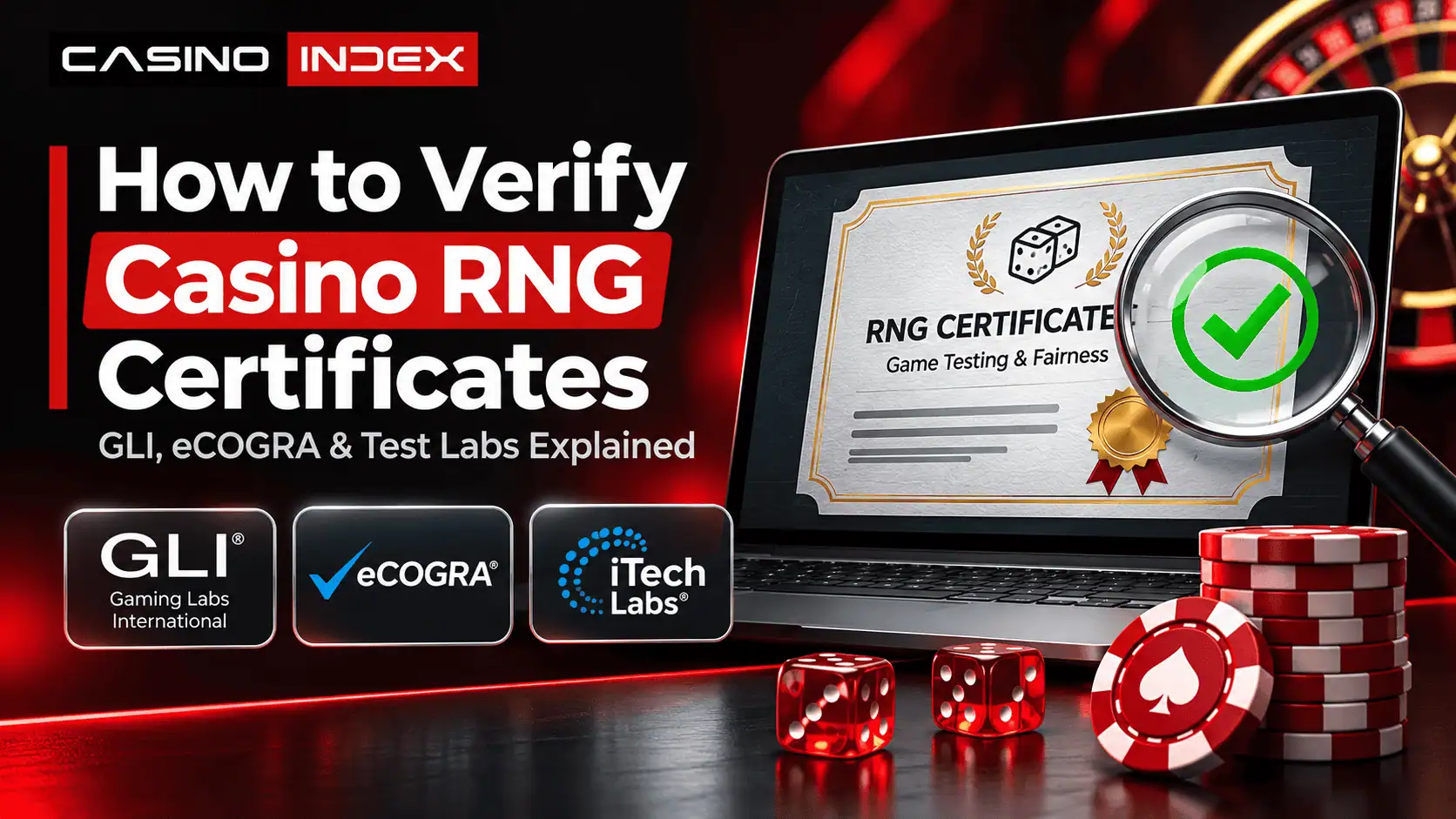
To verify a casino RNG certificate, follow the claim to the testing laboratory’s original record, then compare the certificate holder, tested software, date, standard and any version identifiers with the game you intend to play. However, a genuine certificate may cover only a random number generator, not the complete game. If you cannot match the tested component to the live version, that version remains unverified.
The key distinction
Two questions matter: Is the laboratory record genuine? And does it actually cover this game or software version? Therefore, a convincing badge cannot answer either question by itself.
What an RNG certificate actually proves
A random number generator (RNG) supplies values used to determine outcomes in many digital casino games. For example, laboratories may examine the algorithm, its source-code implementation, raw output and the process that converts numbers into cards, symbols or other results. However, the precise test scope depends on the component the supplier submits and the applicable standard. The UK Gambling Commission’s testing strategy explicitly separates RNG testing from checks of a game’s rules, mathematics and theoretical return to player (RTP).
This distinction also matters when you read a casino’s claims. For instance, on its official website, iTech Labs describes three different services: RNG certification, RNG-and-game certification, and an RTP/RNG audit based on server logs. They assess different things. Therefore, do not call an RNG component certificate an audit of every slot that uses the generator.
- RNG component certificate: evidence about the generator and any stated scaling or shuffling tests.
- Game certificate: evidence about the named game and whichever rules, mathematics or implementation the assessment covers.
- RTP/RNG audit: an assessment of defined data or operation over a specified scope or period; not the same as a component test.
- Casino licence: regulatory authorisation for the named business and activities; check it separately through official casino-licence records.
In addition, even a genuine game certificate does not establish how quickly an operator processes withdrawals or whether its account restrictions are fair.
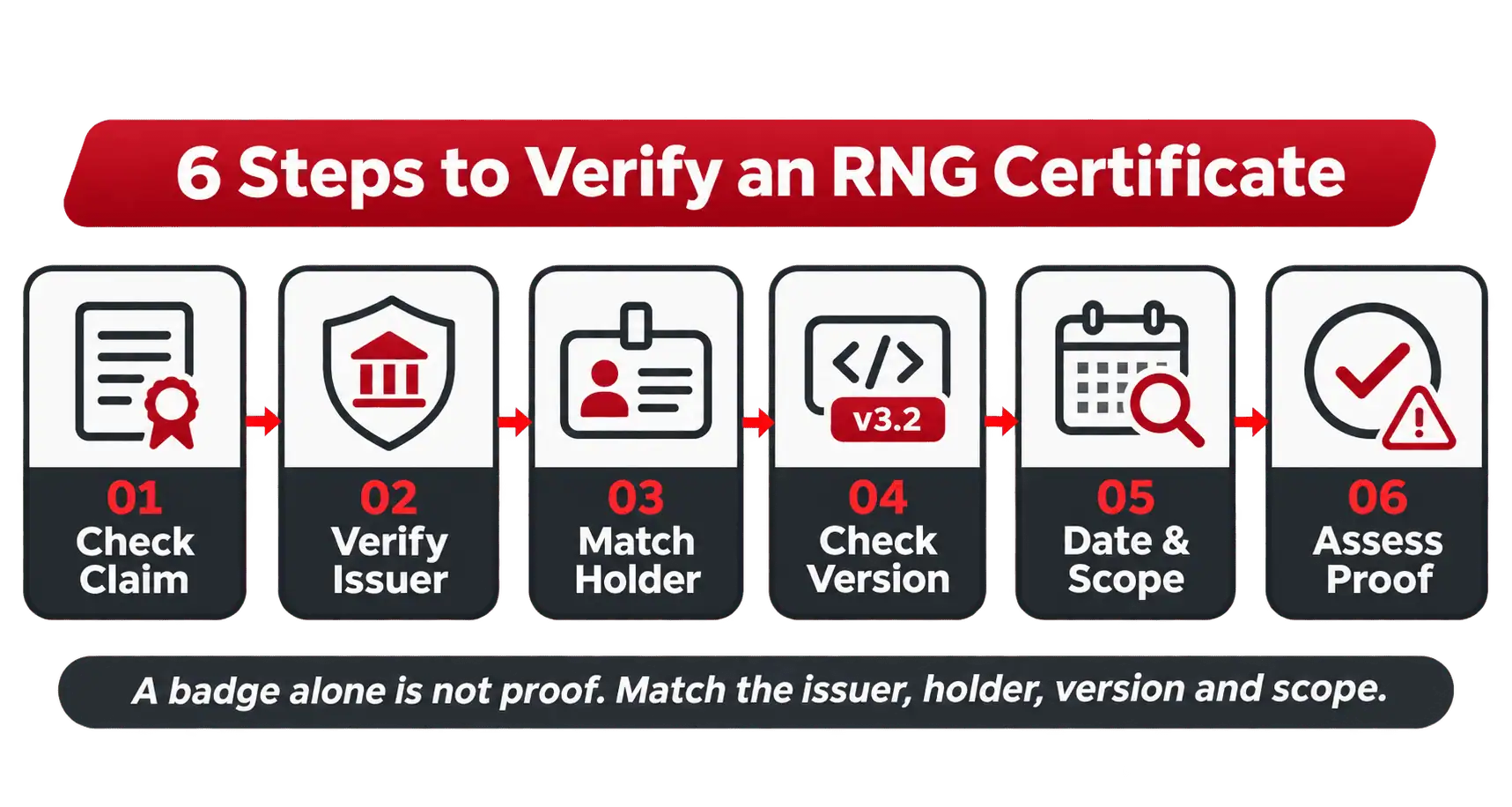
How to verify a casino RNG certificate in six steps
1. Record the exact claim
Start with the casino or provider page that displays the seal. First, note the laboratory name, certificate or report number, company name, game title and any accompanying wording. Then save the page address and the date you checked it. Without a traceable source, a standalone logo remains an advertising claim rather than independent evidence.
2. Trace the record to the actual issuer
Open the badge link and inspect the full destination domain, not just its logo or page design. Whenever possible, look for a certificate on the testing laboratory’s own website or an identifiable official regulator record. By contrast, a casino-hosted screenshot offers weaker evidence because you cannot independently establish its origin, scope or current status. Do not enter account details or upload documents merely to check a public badge.
3. Match the certificate holder and tested supplier
Read the legal entity names carefully. The certificate may name a software studio, platform provider or operator. However, these may be different businesses. If a casino claims that a supplier’s certificate covers its own game catalogue, ask which products the record covers and what relationship the supplier has to those games. Therefore, do not treat a supplier-level document as certification of every casino using that supplier.
4. Identify the precise software and version
Look for the RNG module, game title, version number, build identifier, code fingerprint or report reference. The absence of a public version identifier does not make the certificate fake; it means the player cannot complete the live-version match with that document alone. Likewise, a test of the RNG alone cannot reveal which of several available slot RTP configurations is active. Use the game information screen and check the active slot RTP version separately.
5. Check dates, standards and the relevant jurisdiction
Distinguish the original test date from a badge renewal date. Next, note the technical standard and any jurisdiction the report cites. Then check whether that market’s regulator approves the laboratory for the relevant testing category. A document referring to UK standards, for example, does not on its own prove current UK test-house approval or an operator’s UK licence. Also, do not assume age alone makes a report invalid; instead, look for changes to the tested build and the applicable recertification rules.
6. State only the result you can support
- Issuer verified: you retrieved the document from an attributable official source.
- Scope established: the named component, product and testing area are identifiable.
- Live version matched: independent evidence connects the deployed game or module to the tested version. A laboratory PDF alone often cannot complete this step.
- Not publicly verifiable: an essential record, version match or access route is missing.
- Conflicting claim: the marketing claim contradicts the documented holder, product or scope. Investigate the mismatch before alleging forgery.
Worked example: reading a real Apparat Gaming RNG certificate
For a concrete example, open the Apparat Gaming RNG certificate hosted by iTech Labs (one-page PDF). The document carries a signature date of 3 February 2025. The fields below come from the laboratory’s document, not from a CasinoIndex software test.
- Issuer: iTech Labs. iTech Labs hosts the PDF on
www.itechlabs.com, which provides a stronger source trail than a casino-hosted image. - Named entity: The document names Apparat Gaming Services Ltd as both operator and software provider. It does not name an unrelated player-facing casino.
- Tested component: the RNG. The statement also mentions statistical tests of random output and scaling tests for slot games.
- Code control: the certificate reports fingerprinting of the tested RNG code. However, it does not publish the fingerprint value a reader would need to compare against a live build.
- Standard and date: the document cites Maltese regulatory requirements and bears the signatures and date of 3 February 2025. That is not a fresh 2026 retest.
- Limitation: the disclaimer describes testing appropriate to a component assessment, rather than every possible scenario in a live casino environment.
CasinoIndex evidence assessment
Confirmed: an original-source RNG component certificate names Apparat Gaming Services Ltd, the testing laboratory, a date and the stated technical checks.
Not confirmed: certification of a named live slot, its active RTP configuration, a specific casino integration or any operator’s payment performance. The PDF does not provide those facts.
As a result, an authentic document may still fall short of sufficient proof of a live game claim. A reader can verify the former without being able to verify the latter.
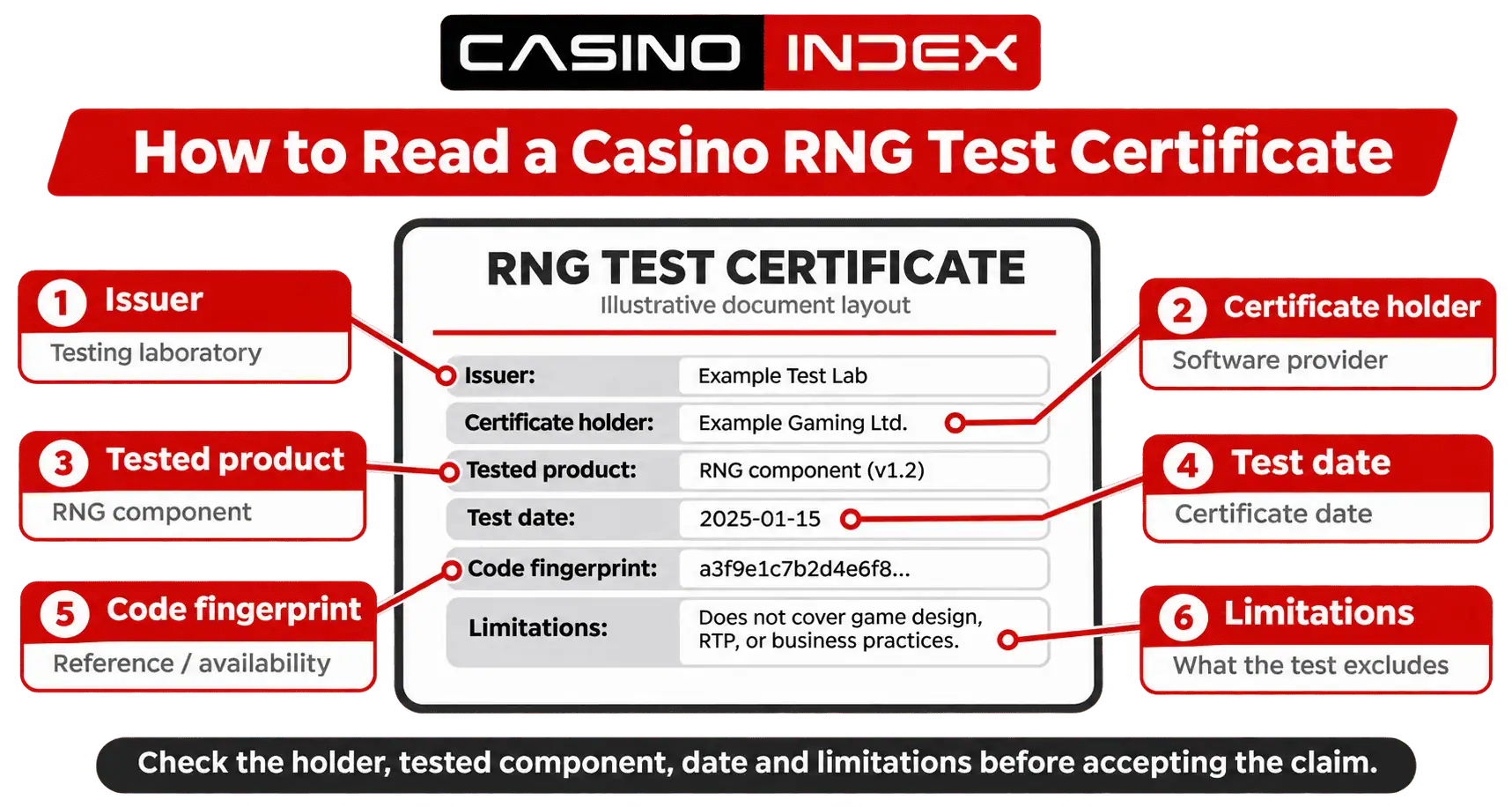
Where to verify GLI, eCOGRA and iTech Labs claims
GLI: check the Certificate of Integrity and the mark rules
Gaming Laboratories International explains that its approved digital Gaming Labs Certified mark should link to a GLI-maintained Certificate of Integrity (COI). That record can name the permitted mark user, associated brands or websites, certified products and certification dates. See GLI’s official Certified Mark FAQs.
Crucially, a COI’s “valid until” date concerns the permission to use the mark. However, GLI says the underlying product certification report remains valid when operators continue using the product in its tested form, subject to the relevant requirements. Therefore, do not equate annual mark renewal with annual RNG retesting.
A publicly indexed GLI Certificate of Integrity for Arrise Solutions Limited, trading as Pragmatic Play identifies an RNG as having passed on 31 March 2026, with mark-use validity through June 2027. Access limitation: we could review its indexed text on 18 November 2026, but our research environment could not open the dynamic certificate page. Do not treat this example as a confirmed live-page or exact slot-version match without checking the page directly.
eCOGRA: request the actual product certificate, not just the seal
eCOGRA’s official certification procedure describes a product directory containing the certified product’s identity, the applicable standards and the client. According to eCOGRA, relevant parties can request access to the applicable documents. However, that procedure does not establish a universal public search database for every RNG or slot certificate.
Do not confuse certification types. For example, eCOGRA labels the search field on its contact page as a check for ISO 27001 certified clients. It is not a public RNG-certificate lookup. If a casino invokes eCOGRA, ask for the product name, certificate or report reference, covered version and testing scope. Still, the absence of a public lookup does not, by itself, mean someone fabricated the certificate.
iTech Labs: use the original linked PDF and read the disclaimer
iTech Labs publishes some certificates directly on its own domain. Read the issuer, software provider, test methods, dated signature, jurisdictional standard and any exclusions. For example, this guide links to publicly accessible iTech PDFs. However, their availability does not mean all iTech reports are public or that every certificate covers full game mathematics.
Which laboratories does each market approve?
The UK Gambling Commission’s approved-test-house list identifies laboratories by testing category. Its published list of approvals as of 2 March 2026 includes eCOGRA and several GLI entities for Remote Technical Standards. However, it does not list iTech Labs under that name. This observation neither invalidates a historical iTech certificate nor establishes what a different regulator accepts. It only prevents readers from assuming that a report and a market-specific approval are interchangeable.
Two more original RNG records that show why scope matters
ACR Poker / SJH Studio: a certificate with an explicit exclusion
In an iTech Labs certificate dated 11 December 2025 (PDF), the named operator is ACR Poker and the software provider is SJH Studio. According to the document, the lab assessed the RNG and single-deck card shuffling.
However, the document expressly excludes game rules and game payouts from its component assessment and says that games need a separate certification. Here, “game payouts” refers to the game’s rules and mathematical returns; do not confuse that term with an assessment of cash withdrawals to a player’s bank account or wallet. The certificate also places responsibility for production use and appropriate monitoring on operators and regulators.
Nameless Limited / CSBattle: named game categories are not a deployment match
A second iTech Labs PDF dated 4 July 2025 names Nameless Limited as the software provider and describes RNG scaling tests for categories including Coinflip, Mines, Plinko and Tower. Those category labels describe the test scope. However, they neither identify the complete live game build nor establish certification for every implementation with the same labels.
Does an old RNG certificate expire automatically?
No universal expiration rule applies to every laboratory and jurisdiction. Instead, changes to the tested software and market-specific rules matter more than the age of the PDF alone. For example, the Danish Gambling Authority’s updated certification programme, updated on 19 March 2026, removed routine annual recertification for specified RNG and game requirements and ties recertification to relevant changes. However, other parts of that programme still follow fixed schedules.
For an older certificate, the practical question is therefore: Does the live software still match the build the lab tested, and did any change trigger additional testing? Without that evidence, you cannot confirm the current version from the historic certificate alone.
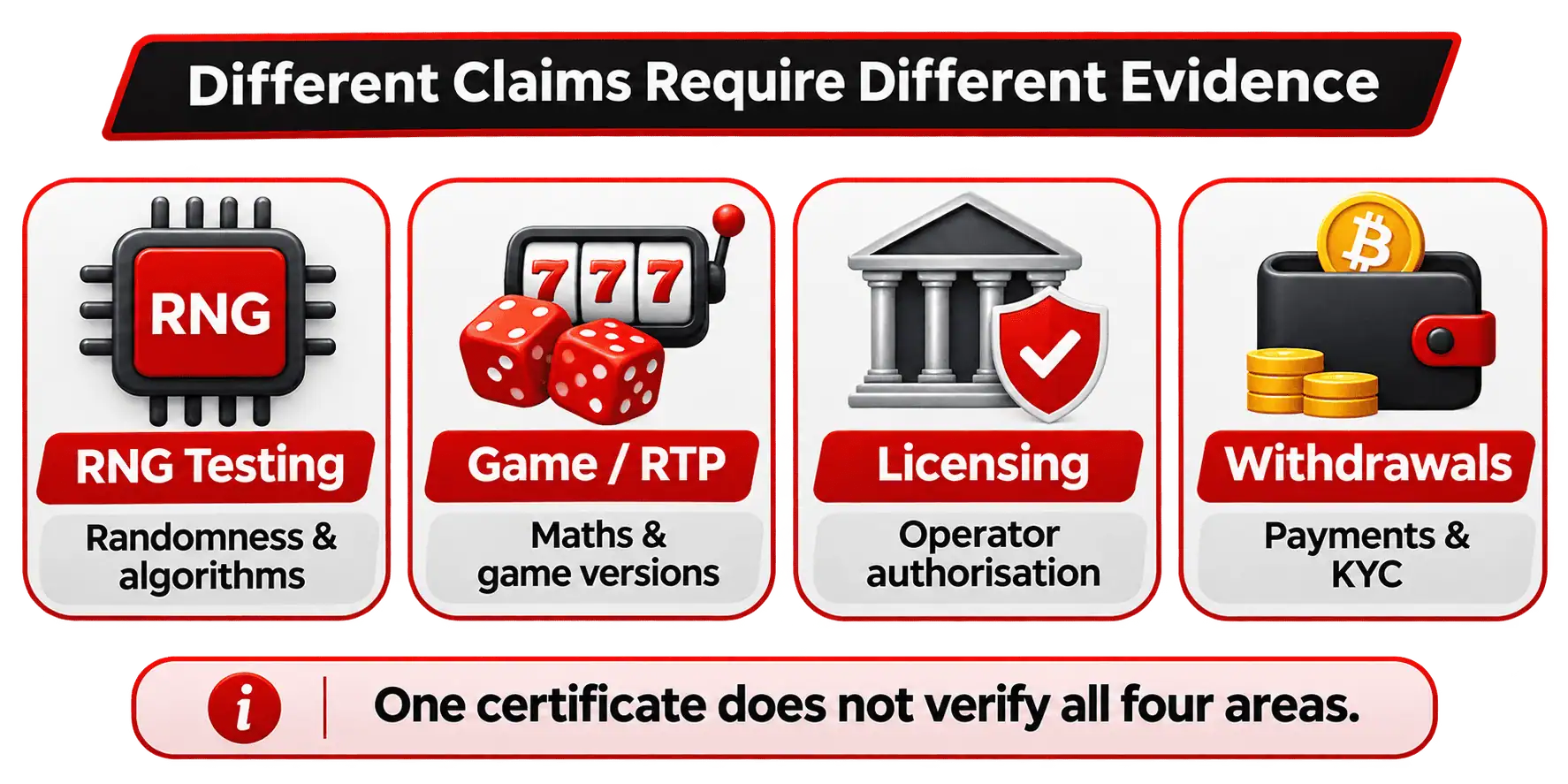
What the certificate does not establish
Therefore, assess these claims separately, even when the casino promotes them together:
- Live-game identity: a PDF may not reveal whether the casino is running the exact tested build or a modified integration.
- Active RTP: component RNG testing does not determine which theoretical-return configuration the player has opened.
- Individual round verification: a provably fair game check uses seeds, commitments and a game-specific calculation to test an individual result; it is different from laboratory component certification.
- Regulatory authorisation: a game supplier’s test report is not a player-facing casino licence.
- Account and withdrawal behaviour: certification of game software does not verify KYC practices, payment approval, bonus disputes or solvency. Instead, assess these trust questions separately, as the casino security guide.
Evidence log: original records checked on 18 November 2026
The table records what the issuer published, not a CasinoIndex live-game test. We could directly open all three iTech PDFs for document review. By contrast, we could only review indexed text for the GLI record; our research environment could not open its live page.
| Issuer and subject | Market and documented scope | Original source and date | Not established |
|---|---|---|---|
| iTech Labs — Apparat Gaming Services Ltd | Maltese requirements cited; RNG statistical and slot-scaling tests | Lab PDF Issued 03 Feb 2025; checked 18 Nov 2026 | Named live slot, build match or active RTP |
| iTech Labs — ACR Poker / SJH Studio | UK technical standards cited; RNG and single-deck shuffling | Lab PDF Issued 11 Dec 2025; checked 18 Nov 2026 | Game-rule certification or production-code match |
| iTech Labs — Nameless Limited | UK technical standards cited; RNG scaling for named instant-game categories | Lab PDF Issued 04 Jul 2025; checked 18 Nov 2026 | Specific deployed versions or other casinos’ games |
| GLI — Arrise Solutions / Pragmatic Play | Market not individually identified in indexed COI; RNG listed as PASS | Indexed GLI COI Test date shown 31 Mar 2026; indexed text checked 18 Nov 2026; live page unconfirmed | Full technical report, game build, live access or operator payout reliability |
Scope note: “UK standards cited” or “Maltese requirements cited” describes the laboratory document’s stated testing basis, not proof of a current operating licence in that jurisdiction. The checked date is an editorial source-review date, not a new laboratory examination.
What to ask when you cannot match a certificate
Ask the casino or game provider for four precise details: (1) the issuing laboratory and report reference, (2) the tested legal entity and product, (3) the applicable game or RNG version and jurisdiction, and (4) an official issuer link or confirmation route. If the lab keeps the detailed report confidential, ask which non-confidential details could substantiate the claim.
Keep a dated record of the reply. However, if the operator supplies only the same badge or an untraceable screenshot, the result remains not independently verifiable. That disclosure gap matters, but it does not, by itself, prove that anyone manipulated the game.
Frequently asked questions
Can I check every eCOGRA RNG certificate online?
Our review of the available eCOGRA materials found no universal public game-certificate lookup. The ISO 27001 client search on its contact page is a different service. Request the relevant product record or verification route.
Does a GLI “valid until” date mean the RNG test expires then?
Not necessarily. GLI distinguishes the annual licence to display its Certified Mark from the validity of the product test, which depends on continued use as tested and applicable requirements.
Is a genuine RNG certificate proof that a casino is safe?
No. It concerns a specified technical testing scope. Operator licensing, game versions, account treatment and withdrawals require separate evidence.
Does an RNG certificate verify the RTP of a particular slot?
Only if the actual report expressly covers the relevant game mathematics and configuration. An RNG-only component certificate does not establish which RTP setting a live casino offers.
What if the casino’s badge links nowhere?
Request the original issuer record and the exact product details. Until you can trace that evidence, mark the claim unverified rather than calling it fraudulent.
Research note (18 November 2026): CasinoIndex reviewed publicly available laboratory certificates and regulatory guidance. We did not independently inspect source code, test live game versions or access casino accounts. Each certificate supports only its documented scope, while public records and applicable requirements may change over time.

Nina Kanu has worked in cryptocurrency content and blockchain research since 2016. She is also known within parts of the crypto community through CryptoMutant, where her work has covered emerging projects, market trends and developments across the blockchain ecosystem. At CasinoIndex, Nina focuses on crypto casino reviews, platform comparisons, player experience, game ecosystems and bonus fairness. Her research examines how casino products perform beyond their marketing, including usability, payment options, promotional terms and the overall experience players receive after signing up.